A problem statement in quantitative research clearly defines the issue that the study aims to investigate using measurable data. It explains what the problem is, why it is important, and what gap exists in existing research. This article provides examples of problem statements in quantitative research proposals to help students and researchers develop strong academic research topics.
Practical Examples of Research Problem Statements
Example 1: Systematic Literature Review (SLR)
- Sample Research Title: A Comprehensive Literature Review on the Impact of Artificial Intelligence in Entrepreneurial Activities.
- Problem Statement
Entrepreneurship is a popular topic (Indrianti et al., 2020), and researchers such as Audretsch and Moog (2022) argue that it warrants special attention given its connection to current economic and social challenges. The emergence of Artificial Intelligence (AI) tools has become particularly important in the digital transformation of businesses, as entrepreneurs must constantly adapt and stay informed on emerging trends (Kraus et al., 2018). Therefore, AI has been propelled by ongoing market transformations and the rising needs of an expanding population. The surge in the Internet of Things (IoT) has played a crucial role in advancing AI and has sparked interest among both business and government leaders (Zhang & Lu, 2021).
Nonetheless, there remains a scarcity of literature specifically addressing the relationship between entrepreneurship and AI (Popkova & Sergi, 2020), despite findings by Obschonka & Audretsch (2019) indicating that the integration of AI into entrepreneurship marks the beginning of a new era.
Among various systematic literature reviews, Giuggioli & Pellegrini (2022) notably emphasize the advantages of AI in fostering entrepreneurial growth.
However, our research not only addresses the previously overlooked semantic analysis but also extends and builds upon analyses conducted over the past two years, which is particularly pertinent in light of the digital acceleration following the COVID-19 pandemic.
Additionally, Di Vaio et al. (2020) review the literature on AI and business models. In recent years, various literature reviews have examined connections between topics such as education (Tahiru, 2021), health (Shah & Chircu, 2018), public administration (Reis et al., 2019), and consumer behavior (Mariani et al., 2022). The absence of comprehensive, systematic literature reviews on the role of AI in entrepreneurship underscores the significance of the current study.

Example 2: AI Adoption in HRM (Quantitative Framework)
- Sample Research Title: The Antecedents of Artificial Intelligence Adoption among HR Professionals in the Tourism & Hospitality Industry in Malaysia.
- Problem Statement
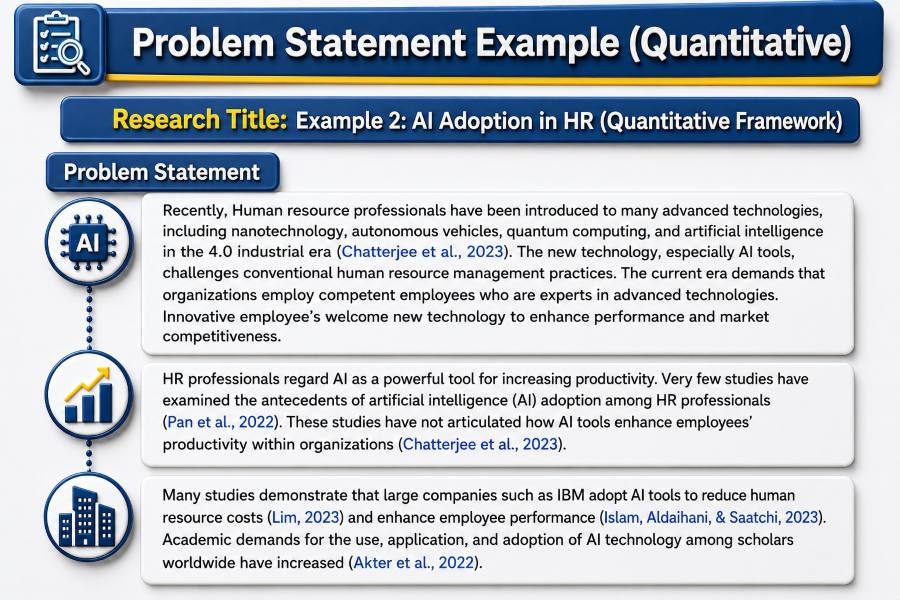
Recently, Human resource professionals have been introduced to many advanced technologies, including nanotechnology, autonomous vehicles, quantum computing, and artificial intelligence in the 4.0 industrial era (Chatterjee et al., 2023). The new technology, especially AI tools, challenges conventional human resource management practices. The current era demands that organizations employ competent employees who are experts in advanced technologies. Innovative employees welcome new technology to enhance performance and market competitiveness.
HR professionals regard AI as a powerful tool for increasing productivity. Very few studies have examined the antecedents of artificial intelligence (AI) adoption among HR professionals (Pan et al., 2022). These studies have not articulated how AI tools enhance employees’ productivity within organizations (Chatterjee et al., 2023).
Many studies demonstrate that large companies such as IBM adopt AI tools to reduce human resource costs (Lim, 2023) and enhance employee performance (Islam, Aldaihani, & Saatchi, 2023). Academic demands for the use, application, and adoption of AI technology among scholars worldwide have increased (Akter et al., 2022).
Example 3: Organizational Psychology (Variables & Mediators)
- Sample Research Title: Effects of High‐Performance Work Systems (HPWS) on Hospitality Employees’ Outcomes Through Their Organizational Commitment, Motivation, and Job Satisfaction
- Problem Statement
Limited research has investigated the influence of High-Performance Work Systems (HPWS) on employee outcomes, including health and job satisfaction, which are particularly important during the COVID-19 pandemic (Kloutsiniotis and Mihail, 2020a; Adikaram et al., 2021). Stressful and uncertain environments have exacerbated burnout, which was already a significant issue among hotel staff before the COVID-19 crisis (Ayachit & Chitta, 2022; Tsui, 2021; Wong et al., 2019). Earlier studies have confirmed that HPWS directly affects employees’ social identity and also mediates the relationship between HPWS and “psychological empowerment” (Mihail and Kloutsiniotis, 2016).
What is a Problem Statement in Research?
A problem statement in research is a concise, precise description of an issue that needs to be studied. It also identifies the knowledge gap that motivates the research and contributes to the body of knowledge. Quantitative research focuses on measurable variables and identifies gaps between the current situation and the desired outcome.
The problem statement section analyzes what is known and what remains unknown regarding the research problems and issues. The ‘known’ vs ‘unknown’ needs to be analyzed, synthesized, and defended rather than written descriptively. Arguments for the existence of the problem may be supported by highlighting inconsistencies, controversies, conflicts, or contradictions in prior studies.
It also proposes variables that identify the research gaps contributing to the resolution of the research problem. Additionally, the research problem statement highlights the weaknesses of prior findings. Moreover, it emphasizes the expected knowledge or what is required (still unknown) to enable you to contribute to the body of knowledge.
A high-quality problem statement answers two fundamental questions:
What specific empirical or theoretical issue needs to be addressed?
Why is it critical to resolve this issue right now?
The 4 Key Elements of a Research Problem Statement
The problem statement contains these four elements:
- Context or Background
- Problem or Literature Gap
- Relevance or Significance
- Objective or Purpose
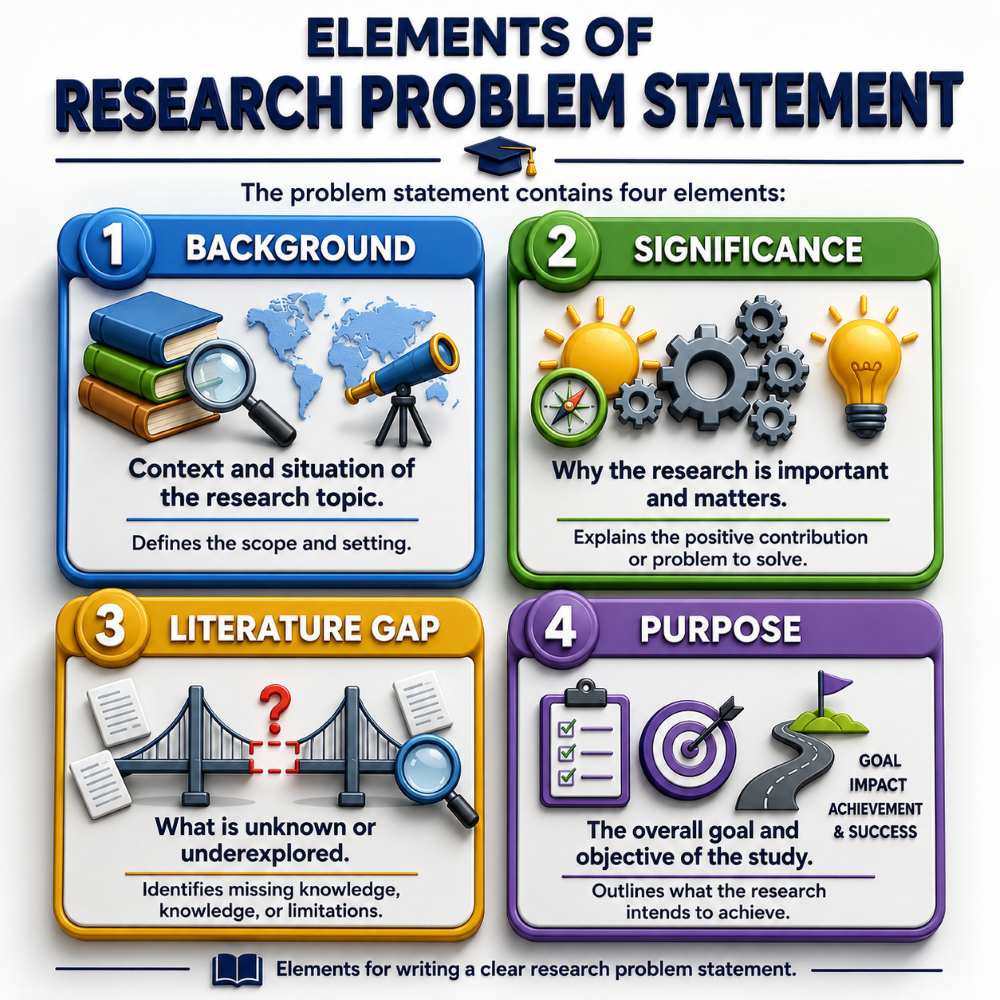
The context is the background of what is currently known and unknown about the research issue. The problem statement establishes context for the audience and defines the problem within that context.
The problem concerns what we need to know. It clearly states the specific problem the research aims to address. It highlights a gap in the current knowledge or literature that your study intends to address.
Relevance refers to the significance of the study. It justifies why it is an essential issue to research and the value of research.
Finally, the objective is the study’s aim: what you want to discover, clarify, or confirm. It proposes a solution to the problem.
Table: Four Components of Problem Statement at a Glance
| Element | Focus | Purpose |
| 1. Context / Background | Current Literature Status | Establishes what we know from past empirical findings and real-world data. |
| 2. Problem / Literature Gap | The “Unknown” Issues | Identifies inconsistencies, conflicts, population gaps, or methodological flaws in previous studies. |
| 3. Relevance / Significance | The Impact | Justifies why this issue matters and the consequences of not resolving it |
| 4. Objective / Purpose | The Resolution | Explicitly articulate what and how your study will discover, test, measure, or confirm to resolve the gap. |
Steps to Write a Quantitative Problem Statement
The author divides the process into three stages to define four elements.
The Three Stages of Writing a Problem Statement are:
- Review the Literature From Previous Findings
- Identifying the Problem With Research Gaps
- Contribute to the Body of Knowledge
Step 1: Review the Literature From Previous Findings
First, the researchers must read industry reports, government statistical reports, and newspaper articles to better understand the broader context. They also read relevant research papers, review papers, and dissertations previously published to deepen their knowledge.
Many scholars suggest that researchers systematically review journal articles to advance knowledge. According to Mark Petticrew and Helen Roberts, the systematic literature review is closely aligned with knowledge acquisition in a particular area. The PRISMA systematic literature review is the most widely used and well-accepted strategy for synthesizing prior studies.
The literature review from past findings has to answer the following question:
- What research has already been conducted on this topic?
It summarizes and organizes existing knowledge to provide a background for the current work.
- What are the main themes, trends, or patterns that have emerged from prior research?
It classifies previous research and identifies dominant views or areas of controversy.
- What has been established, and what remains unknown or unresolved?
The primary goal is to identify knowledge gaps, inconsistencies, or under-explored areas that the current study will address.
- How does the past research lead to the author’s current study?
It situates the new research within the broader academic field and clarifies how it builds upon or departs from previous work.
- What do we know about the problem from the real world and academic literature?
Knowledge from the real world, often gained through practical or personal experience, defines the problem in a tangible, immediate context
Step 2: Identifying the Problem With Research Gaps
Researchers must identify research gaps, including inconsistencies, controversies, conflicts, or contradictions in prior studies. Among approaches to identifying research gaps, the most common involve concepts, perspectives, theories, methodologies, methods, and analyses. Research gaps must be systematically identified as the basis for an investigation. Therefore, researchers need to state the research gaps clearly and specify the type of research they intend to conduct.
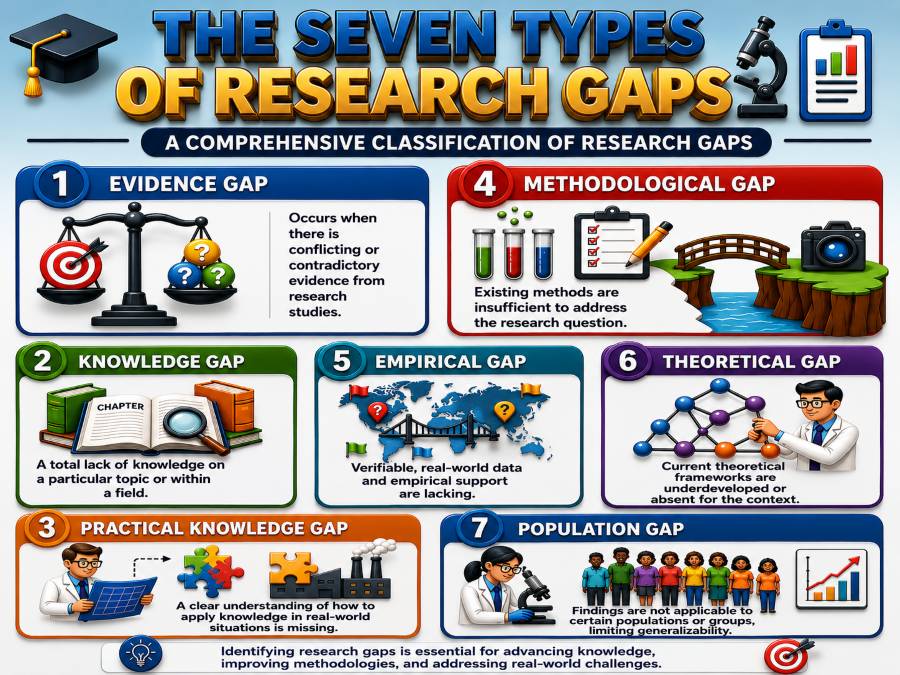
The seven types of research gaps are:
- Evidence gap
- Knowledge gap
- Practical knowledge gap
- Methodological gap
- Empirical gap
- Theoretical gap
- Population gap.
Researchers must identify key gaps, inconsistencies, and controversies in the literature to establish the need for additional research. Researchers can conduct research based on one, two, or more than two research gaps. This section also defines the study process and methods to achieve the goals.
The Problem with research gaps must answer the following questions:
- What do we not know about the problem from the real world and academic literature?
- What does your research want to achieve by this study?
- How do we want to resolve the problems?
Step 3: Contribute to the Body of Knowledge
Finally, the research problem addresses the study’s importance and significance. It explains why and how it contributes to the body of knowledge. The empirical evidence contributes to the literature. It also highlights the study’s theoretical and practical significance in resolving the issues.
The section answers the following questions:
- Why do we need to know what we do not know about the problem?
- What might happen if the problem is not resolved?
- What are the future benefits of solving the issues, including the impact on society, community, and people’s lives?
Importance of a Strong Problem Statement
The statement of the problem is the most crucial component of securing acceptance for the research proposal or project. The candidates must systematically identify research problems and knowledge gaps to write a problem statement for a research proposal, project, dissertation, or thesis. A strong problem statement impresses examiners and reviewers and helps secure the proposal’s acceptance. Moreover, it is the foremost step in conducting any academic research.
The researcher sets the research objective, research question, and hypothesis based on the problem statement. Hence, candidates or students cannot continue their research without a strong problem statement. The research problem is an inevitable part of quantitative, qualitative, and other research. No research can be conducted without identifying the research problem.
A good research proposal must include a research problem statement that identifies weaknesses in prior studies. Accordingly, it provides empirical evidence that enriches the literature. A strong problem statement must explain how to fill the research gaps.
Ph.D. and Master of Science (by research) students undergo a proposal defense. In this presentation, examiners may ask candidates which research problem they aim to address. Thus, a concise and strong problem statement is essential for overcoming proposal defense (PD).
Weaknesses of a Poorly Written Problem Statement
A research proposal may be rejected due to a poorly written problem statement.
The authority might deny the research proposal for the following reasons: A research proposal can be rejected if this section is poorly defined and discussed. Additionally, the research proposal may also be declined if the candidate merely states the Research Proposal without critically discussing why it is a problem. Moreover, the candidate did not successfully highlight the connections between constructs with the theory used to explain the framework.
FAQ (Frequently Asked Questions): Problem Statement
Q: Does the research problem statement differ between quantitative and qualitative research?
A: The answer is no, and there is no difference. The writing style of the research problem statement is similar across research strategies. Consequently, the research candidates use the same style when writing research problems across quantitative, qualitative, and other research approaches.
Q: How does a problem statement articulate the necessity of conducting and publishing a study?
A: Problem statements articulate the study’s importance, explaining why we should conduct the research and publish the findings. Thus, no research is conducted without necessity.
Q: What are the components of a concise problem statement?
A: A strong problem statement has four elements: background, literature gap, significance, and objective.
Q: What are the three stages of writing a problem statement in research?
A: The three inevitable steps to write a problem statement are as follows:
Review the Literature From Previous Findings
Identifying the Problem With Research Gaps
Contribute to the Body of Knowledge
Reference List (APA 7th Edition)
Adikaram ASNaotunna NPriyankara H (2021), “Battling COVID-19 with human resource management bundling”. Employee Relations: The International Journal, Vol. 43 No. 6, pp. 1269–1289, doi: https://doi.org/10.1108/ER-08-2020-0390
Akter, S., Dwivedi, Y. K., Sajib, S., Biswas, K., Bandara, R. J., & Michael, K. (2022). Algorithmic bias in machine learning-based marketing models. Journal of Business Research, 144, 201-216.
Audretsch, D. B., & Moog, P. (2022). Democracy and entrepreneurship. Entrepreneurship Theory and Practice, 46(2), 368-392.
Ayachit, M., & Chitta, S. (2022). A systematic review of burnout studies from the hospitality literature. Journal of Hospitality Marketing & Management, 31(2), 125-144.
Chatterjee, S., Chaudhuri, R., Kamble, S., Gupta, S., & Sivarajah, U. (2023). Adoption of artificial intelligence and cutting-edge technologies for the sustainability of production systems: a moderator-mediation analysis. Information Systems Frontiers, 25(5), 1779-1794.
Di Vaio, A., Boccia, F., Landriani, L., & Palladino, R. (2020). Artificial intelligence and digital business models: A systematic literature review. Technological Forecasting and Social Change, 163, 120-123. https://doi.org/10.1016/j.techfore.2020.120123
Giuggioli, G., & Pellegrini, M. M. (2022). Fostering entrepreneurial growth via artificial intelligence and automated networks. Technological Forecasting and Social Change, 182, 121818. https://doi.org/10.1016/j.techfore.2022.121818
Indrianti, R., Wibowo, A., & Nugroho, A. (2020). The modern landscape of global entrepreneurship trends. Journal of Entrepreneurship and Innovation in Emerging Economies, 6(2), 145–160. https://doi.org/10.1177/2393957520938921
Islam, M. N., Aldaihani, F. M., & Saatchi, V. (2023). The impact of automation systems on human resource operational costs in multinational organizations. International Journal of Information Management, 69, 102558. https://doi.org/10.1016/j.ijinfomgt.2023.102558
Kloutsiniotis, P. V., & Mihail, D. M. (2020). High-performance work systems in the healthcare sector during economic crises: A systematic review. Personnel Review, 49(5), 1165–1186. https://doi.org/10.1108/PR-04-2019-0170
Kraus, S., Palmer, C., Kailer, N., Kallinger, F. L., & Spitzer, J. (2018). Digital transformation in small and medium enterprises: A review and research agenda. Journal of Business Research, 90, 324–334. https://doi.org/10.1016/j.jbusres.2018.05.002
Lim, J. (2023). Workforce analytics and organizational cost reduction through artificial intelligence. International Journal of Human Resource Management, 34(7), 1452–1473. https://doi.org/10.1080/09585192.2022.2156789
Mariani, M. M., Perez-Vega, R., & Wirtz, J. (2022). Artificial intelligence in consumer behavior research: A systematic review and future agenda. Journal of Business Research, 149, 889–903. https://doi.org/10.1016/j.jbusres.2022.05.013
Mihail, D. M., & Kloutsiniotis, P. V. (2016). The impact of high-performance work systems on employee empowerment and job satisfaction. International Journal of Human Resource Management, 27(12), 1280–1300. https://doi.org/10.1080/09585192.2015.1072108
Obschonka, M., & Audretsch, D. B. (2019). Artificial intelligence and the entrepreneurial future: A psychological perspective. Journal of Business Venturing Insights, 11, e00120. https://doi.org/10.1016/j.jbvi.2019.e00120
Pan, Y., Zhang, J., & Li, X. (2022). Antecedents of artificial intelligence adoption in high-turnover service industries. International Journal of Hospitality Management, 104, 103254. https://doi.org/10.1016/j.ijhm.2022.103254
Petticrew, M., & Roberts, H. (2006). Systematic reviews in the social sciences: A practical guide. Blackwell Publishing.
Popkova, E. G., & Sergi, B. S. (2020). Artificial intelligence and business model innovation: A literature synthesis. Journal of Knowledge Economy, 11, 1201–1215. https://doi.org/10.1007/s13132-019-00607-9
Reis, J., Amorim, M., & Santos, C. (2019). Artificial intelligence applications in public administration systems. Government Information Quarterly, 36(4), 101390. https://doi.org/10.1016/j.giq.2019.101390
Shah, R., & Chircu, A. M. (2018). Internet of Things and AI integration in healthcare systems. Health Policy and Technology, 7(3), 284–293. https://doi.org/10.1016/j.hlpt.2018.05.004
Tahiru, F. (2021). A review of digital transformation frameworks in higher education. Journal of Computing in Higher Education, 33(3), 1–22. https://doi.org/10.1007/s12528-021-09272-x
Tsui, E. (2021). Artificial intelligence in the hospitality workforce and mental health management. International Journal of Contemporary Hospitality Management, 33(10), 3650–3668. https://doi.org/10.1108/IJCHM-01-2021-0123
Wong, A. K., Cheung, R., & Huang, Y. (2019). Employee burnout and turnover in the hospitality industry: A structural analysis. International Journal of Hospitality Management, 77, 376–388. https://doi.org/10.1016/j.ijhm.2018.08.010
Zhang, J., & Lu, Y. (2021). The rise of artificial intelligence and IoT in government digital transformation. Government Information Quarterly, 38(4), 101579. https://doi.org/10.1016/j.giq.2021.101579

M M Kobiruzzaman is a researcher, academic content writer, traveler, and the founding editor of Newsmoor.com. Specializing in communication, management, technology adoption models, and frameworks analysis, and journalism, his work bridges the gap between theory explanation and cultural communication. With a strong background in communication and management, he is dedicated to providing authoritative guides that elevate business and media literacy and academic writing standards.