Netflix Organizational Change. Netflix Organizational Structure 2026. Case Study: Netflix Change Management Organizational Structure of Netflix.
List of Contents
Netflix
Netflix is an online video streaming platform that allows users to watch movies, dramas, TV shows, and cartoons. The user can watch all these videos through a subscription service. Netflix regularly adds new films, series, and TV shows to the chart so users can watch them instantly.
It ranks in the top 50 sites, following Google, YouTube, Yahoo, Facebook, and Twitter. Thus, Netflix has become the most popular video streaming site or web portal in the world.
What is Organizational Change?
Organizational change is a business transformation in which a company changes its business tools, such as policies, strategies, operations, structures, and culture. The key drivers of organizational change are technology, globalization, new market conditions, poor performance, and customer demand.
The management changes enable the company to cope with the digital era. Therefore, many organizations have accepted technological changes to adjust to the digital age. It assists the company in changing old systems with new tools to achieve the business goal.
Organizational Change Examples
Netflix is one of the best examples of management change. It accepts the changes to cope with the new context. Netflix’s organizational change is a real-life example of Lewin’s change management model. The management needs to pass a few stages to complete the full process. Technology, culture, and environment are the most significant factors that foster an organization’s acceptance of change.
Netflix’s Organizational Change has replaced the old procedures with new techniques to adjust to the current situation. So, Netflix is the most general example of management change. Additionally, Wipro, Infosys, Samsung, and Amazon accepted the change to achieve business success.
Netflix Change Management Case Study
The Netflix change management case study includes the organizational change at Netflix. Additionally, it describes the history of the Netflix business change model. The author presents a change management case study of Netflix for students.
Netflix Organizational Change
Technology has changed the world in many ways, including education, business, sports, and entertainment. Many renowned companies have been closed due to new technology such as computers, smartphones, and social media. Some have managed to cope with the force of change by applying sophisticated strategies and accepting organizational change.
Netflix is one of the best examples of a company that has changed its business model and strategy to survive. It has handled the force of organizational change to achieve a competitive advantage. Hence, it has become the most popular video streaming site among netizens.
Netflix was founded in 1997 in California, USA. However, in 1998, Netflix began operating as a DVD-by-mail rental service. The product was a rent-by-mail DVD, and the payment system was the pay-per-rental model.
The following year, in 1999, Netflix launched a new subscription service allowing customers to rent DVDs at a monthly rate. This service allowed subscribers to enjoy unlimited DVD rentals for a monthly fee. So, the change was from the pay-for-use model to a monthly subscription model. Subscribers choose movie and video titles from Netflix’s official website. After that, the distributors send the shows on DVDs to the subscribers.
Netflix Change Management Case Study
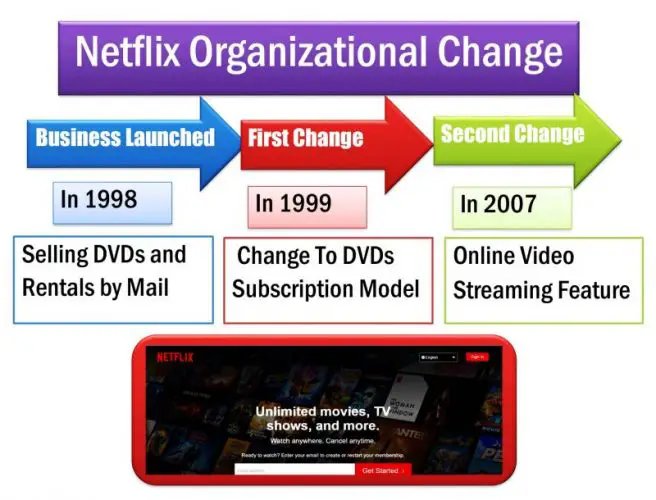
In 2007, Netflix introduced a new video streaming feature for films and television series. The proper utilization of the force of change has helped to achieve success. However, it is believed that Netflix is one of the most popular platforms for watching new movies, drama series, TV shows, and so more. They have achieved a competitive advantage by adopting new features in response to audience demand.
The three main divisions of Netflix management are functional, geographical, and product teams. The operational division includes the CEO, content, communications, talent, finance, legal, and related functions. Additionally, the geographical team consists of local and international services. Finally, the product team controls and ensures quality content.
Additional Change Management at Netflix
In 2011, Netflix introduced its mobile apps and iOS service for smartphone users. Smartphone users can download the apps for free from the Play Store.
Recently, Netflix switched from HTTP to HTTPS encryption to better protect viewers’ privacy.
In 2016, Netflix launched its offline playback system to cache content. Therefore, Netflix mobile app users can watch high-quality cached content without an internet connection.
In 2018, Netflix added the “the Skip Intro” option for customers to skip show intros. So, the users can skip the video if they want.
In 2022, Netflix began alerting customers when they shared their account IDs and passwords with others.
In 2022, Netflix intended to extend its business into the video gaming industry. The 200 million Netflix subscribers can be reached through a bundle of games like Apple Arcade. Video games play a significant role in attracting potential customers.
In 2023, Netflix launched a new advertising tier for subscribers. The new AVOD tier increases revenue. Users can buy a subscription at a lower cost, but they must see ads while watching videos.
Netflix History Timeline
Netflix has become one of the most famous American production companies worldwide. It was established in 1997 by Reed Hastings and Marc Randolph in California. However, Marc Randolph left Netflix in 2002. In 1998, Netflix introduced its official website with 925 items. These items were available to rent for a pay-per-month approach. It began with only 35 employees.
Netflix launched its operation with the first and largest online DVD rental store. Since 2012, Netflix has produced and distributed its original content, including film and television series, entertaining many viewers. This variety of content has been stored in the online library for subscribers to view. Since 2016, it has been providing services in around 190 countries. This company has established offices worldwide, including in Brazil, the Netherlands, France, the United Kingdom, Japan, India, and South Korea. In 2023, Netflix had more than 231 million subscribers globally, with a pay-per-month subscription model.
However, Netflix is available worldwide except in China, Syria, and North Korea. According to a 2020 report, Netflix earned $1.2 billion in operating income due to its excellent performance with updated tools.
Netflix Organizational Structure
Netflix has a flat organizational structure that provides ample freedom for employees. It is also known as a decentralized organizational structure that allows individuals to make quick decisions. Netflix maintains a unitary organizational structure, also known as the U-form. It reduces organizational communication noise and encourages employees to be more responsive to their duties. Netflix’s organizational structure avoids top-down decision-making strategies to create a conducive working environment for employees. It also focuses on creating a favorable environment to promote employee performance. Netflix has a labor division that works to improve performance. The authority reviews the performance regularly. They opt for a multi-rater feedback system, also known as a 360-degree review method.
Netflix’s management team consistently focuses on applying and maintaining the principles of total quality management. TQM helped make the company the most popular worldwide.
According to McGraw-Hill, Netflix wanted someone as HR director who prioritizes business first, clients second, and talent third. It also did not require Competencies for HR Professionals in the SHRM certificate, change agent, or organization development practitioner. The authority considers three core issues: who is suitable for the company, how we communicate with that employee, and how to ensure high performance.
Netflix Organizational Structure
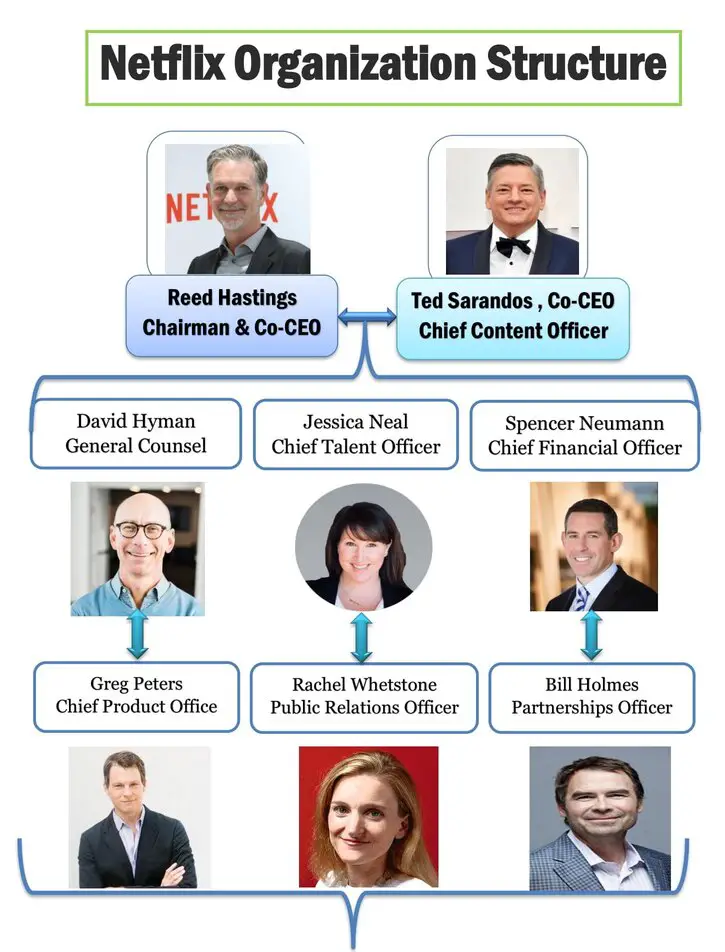
The three main divisions of Netflix management are functional, geographical, and product teams. The operational division includes the CEO, content, communications, talent, finance, legal, and related functions. Additionally, the geographical team consists of local and international services. Finally, the product team controls and ensures quality content.
Netflix CEO in 2023
Netflix Founder Reed Hastings stepped down from his CEO role and was appointed as the company’s chairman in 2023. Ted Sarandos is the current CEO of Netflix. In 2020, Ted Sarandos joined Netflix as co-CEO. Initially, Reed Hastings and Marc Randolph were the co-chief executive officers of Netflix. Marc Randolph left Netflix in 2002.
Netflix Organizational Transformation
1. DVD Rental Business Model (1997–2006)
Transformation:
Netflix started as an online DVD-by-mail rental company founded by Reed Hastings and Marc Randolph. Netflix has made two significant changes since its launch. First, it introduced a subscription option for DVD rentals in 1999. This change allows clients to rent unlimited DVDs without late fees. It was the first change to Netflix’s business model in its history.
Key Changes:
- Replaced traditional video rental stores
- Introduced a subscription-based rental model
- Eliminated late fees
Organizational Impact:
- Built a customer-centric culture
- Used data analytics for customer recommendations
- Created operational efficiency through logistics and technology
2. Shift from DVDs to Streaming (2007)
Transformation:
Netflix launched its streaming service “Watch Now” in 2007, transforming digital entertainment consumption. Later, in 2007, Netflix made its second change by launching an online video streaming service. Consumers have accepted this change. It is believed to have become the primary source of income.
Key Changes:
- Transition from physical distribution to online streaming
- Heavy investment in cloud infrastructure and digital technology
- Adoption of scalable digital operations
Organizational Impact:
- Shifted workforce skills toward software engineering and digital media
- Created a technology-driven organizational structure
- Expanded globally through internet-based delivery
3. Becoming a Content Producer (2013)
Transformation:
Netflix moved from content distributor to original content creator with shows like House of Cards.
Key Changes:
- Developed Netflix Originals
- Reduced dependence on Hollywood studios
- Invested billions in content production
Organizational Impact:
- Built creative production divisions
- Expanded partnerships with filmmakers and creators
- Strengthened data-driven content decisions
4. Global Expansion Strategy (2016 onward)
Transformation:
Netflix expanded to over 190 countries.
Key Changes:
- Localization of subtitles and dubbing
- Production of regional content such as Money Heist and Squid Game
- Multicultural organizational management
Organizational Impact:
- International talent recruitment
- Regional production hubs
- Cross-cultural leadership and communication systems
Results:
Non-English content grew from less than 10% of viewing to more than one-third of total viewing by 2026.
5. Data-Driven & AI-Powered Organization (2015–2026)
Transformation:
Netflix increasingly adopted AI and machine learning to improve personalization, operations, and advertising.
Key Changes:
- Personalized recommendation algorithms
- AI-based viewer behavior analysis
- AI-supported advertising systems
Organizational Impact:
- Greater reliance on data scientists and AI engineers
- Faster decision-making processes
- Increased automation in marketing and content planning
6. Transition to Ad-Supported Business Model (2022–2026)
Transformation:
Netflix introduced a lower-cost advertising-supported subscription tier after subscriber growth challenges in 2022.
Key Changes:
- Launch of “Standard with Ads”
- Creation of Netflix Ads Suite
- Expansion into AI-driven advertising technologies
Organizational Impact:
- Built advertising and media-sales divisions
- Integrated ad-tech infrastructure
- Shifted from a pure subscription model to a hybrid revenue model
By 2026:
- Netflix’s ad tier reached over 250 million monthly viewers globally.
7. Diversification into Gaming & Interactive Entertainment (2021–2026)
Transformation:
Netflix expanded beyond streaming into gaming and interactive experiences.
Key Changes:
- Mobile gaming launch
- Cloud gaming experiments
- Interactive storytelling
Organizational Impact:
- New gaming development teams
- Integration of entertainment ecosystems
- Increased focus on user engagement
8. Live Events, Sports & Fan Ecosystem (2024–2026)
Transformation:
Netflix expanded into live content and fan engagement.
Key Changes:
- Live sports partnerships
- Video podcasts
- Vertical video feeds
- Expansion of the Tudum fan platform
Organizational Impact:
- Broader entertainment business model
- More real-time content operations
- Social-media-style engagement strategies
9. Mobile App & User Experience Transformation (2025–2026)
Transformation:
Netflix redesigned its mobile platform to compete with platforms like TikTok and YouTube.
Key Changes:
- Vertical scrolling video features
- Enhanced content discovery
- Interactive mobile-first interface
Organizational Impact:
- UX/UI redesign teams
- Greater focus on daily engagement metrics
- Social-media-inspired platform strategies
10. AI-Integrated Advertising & Automation (2026)
Transformation:
Netflix integrated AI into advertising creation, planning, and optimization.
Key Changes:
- AI-generated ads
- Personalized ad loads
- AI-powered media buying agents
Organizational Impact:
- Automation of advertising workflows
- Advanced audience analytics
- Transformation into an entertainment-tech-advertising ecosystem
Purpose of Netflix Organizational Change
Netflix is becoming famous daily for its ease of access, quality, and updated tools. After all, adopting new technology is necessary to meet customer demand. The technology adoption models and theories, including TAM, ETAM, UTAUT, and DOI, have explained why and how people adopt new technologies. In the 21st century, people do not want to spend extra time in the cinema hall.
People used to go to the cinema hall to watch new movies before watching movies at home on Netflix. New technologies, including computers, laptops, and smartphones, easily entertain people through internet services. In addition, the social media revolution changed the way we communicate with each other. It has become an excellent site for sharing user-generated content, including photos and videos.
Most people globally use social media in many ways, such as in education, entertainment, and marketing. Netflix’s authority had perceived the upcoming market demand. Therefore, they have changed their business model to focus on watching movies and television series on computers and smartphones. Netflix’s management realized that consumers do not like storing video, so they changed their business model.
Additionally, Netflix is always aware of competitors’ approaches. Blockbuster is a crucial Netflix competitor; hence, they added a new feature to distinguish themselves. The reason for changing Netflix’s business model was appropriate and effective in achieving success.
How Netflix Handles the Organizational Change Forces
Organizational change refers to the adjustment and transformation of a company’s operations. The company introduces a minor or significant change to improve productivity and adapt to the new context. There are two types of forces of change in a company: external and internal. External forces include technological, social, and political change, as well as the management of ethical behavior.
For example, technological change is the primary external force that compelled Netflix to change the feature.
New technology changes people’s expectations and behaviors, altering the features, tools, and patterns of a company’s products or services. Netflix effectively navigated the forces of change to drive success and prosperity for the company. Internal forces influence the organization to change its management, such as changes in managerial personnel, the work climate, effectiveness, employee expectations, and crises.
For example, Netflix realized that watching movies at home would reduce the entertainment budget and transportation costs. Therefore, Netflix accepted the organizational change.
Conclusion
Netflix began as an ordinary company. Now it has achieved a competitive advantage by changing its business model to fulfill customer demand. The company’s authority changed its features to adapt to new technology. It made two changes in 1999 and 2007. However, the video streaming service brought the company immense fame and income in 2007.
The author highlights some critical points for companies that want to change their businesses. Firstly, changing the business tools is significant to exceed customers’ demands. Additionally, digital technology must be accepted by employees and customers. Finally, the company must add updated tools to improve functionality, such as Netflix launching online video streaming in 2007. “The measure of intelligence is the ability to change” -Albert Einstein.
Netflix has followed the blue ocean strategy to achieve its business goals. The Blue Ocean strategy involves creating a new market. The red ocean strategy refers to competing with other companies in the same market. Blue Ocean’s approach creates a unique market context. It also designs a new feature to attract new customers.
Hence, Netflix accepted the blue ocean strategy and has become one of the most successful companies worldwide.

M M Kobiruzzaman is a researcher, academic content writer, traveler, and the founding editor of Newsmoor.com. Specializing in communication, management, technology adoption models, and frameworks analysis, and journalism, his work bridges the gap between theory explanation and cultural communication. With a strong background in communication and management, he is dedicated to providing authoritative guides that elevate business and media literacy and academic writing standards.
"." Newsmoor,

Comments are closed.