Eid al-Fitr is the most prestigious festival for the Muslim community. It is also spelled Eid al-Fitr based on the geographic region. Eid al-Fitr is celebrated on the first day of Shawwal on the Islamic Calendar. Therefore, the Muslim community observes this auspicious festival on the 1st day of Shawwal (Islamic Calendar), following Ramadan. Shawwal follows Ramadan. Ramadan is the month of fasting for the Muslim community. Eid al-Fitr 2027 is expected to be celebrated globally on Wednesday, March 10, 2027.
Eid al-Fitr Celebration Dates 2027
The expected dates for the Eid al-Fitr 2027 celebration are Tuesday, March 10, 2027, worldwide. The global Muslim community celebrates Eid al-Fitr on different days depending on whether the moon is sighted. For example, People in Saudi Arabia, the Middle East, the UAE, and other Gulf countries began fasting on March 08; therefore, they likely celebrate Eid al-Fitr on March 09, 2027. However, people in South Asian countries, including Pakistan, India, Indonesia, Malaysia, and Bangladesh, began fasting on February 08, 2027, and are expected to celebrate Eid on March 09 or March 10, 2027.
Eid al-Fitr Celebration Date in 2027 & 2028 Globally
Year
Gregorian calendar Date
Islamic (Hijri) Calendar
Countries
2027
March 9, 2027 (Tuesday)
01 Shawwal 1448 AH
Middle East countries, including Saudi Arabia
March 10, 2027 (Wednesday)
01 Shawwal 1448 AH
South Asian Countries, including Indonesia, Malaysia, Pakistan, India, Bangladesh, and others
2028
February 27, 2028 (Sunday)
01 Shawwal 1449 AH
Middle East countries, including Saudi Arabia
February 26, 2028 (Saturday)
01 Shawwal 1449 AH
South Asian Countries, including Indonesia, Malaysia, Pakistan, India, Bangladesh, and others
Ramadan 2027 Date
Ramadan 2027 is estimated to begin on the evening of Monday, Feb 08, 2027, and end on Monday, Mar 08, 2027. Eid al-Fitr 2027 will be observed on 09 March in Saudi Arabia, the United Arab Emirates, Yemen, Dubai, and Malaysia. However, Eid al-Fitr will be celebrated on March 09, 2027, in South Asian countries such as Pakistan, India, Bangladesh, the Maldives, Bhutan, and Sri Lanka. Likewise, Eid Mubarak: Muslim people share Ramadan Mubarak wishes with others.
Eid Mubarak Wishes
Eid Mubarak is a greeting message that includes SMS, images, and videos. Muslims share Eid Mubarak wishes to celebrate Eid. They also post Eid Mubarak wishes and greetings on social media platforms such as Facebook, Instagram, Twitter, LinkedIn, and WhatsApp. They convey Eid greetings via written messages, images, videos, and illustrations. The Muslim community exchanges Eid Mubarak greetings to commemorate Eid al-Fitr and Eid al-Adha. Facebook users post a variety of captions to wish their friends and followers well. Sharing Eid Mubarak wishes is a key part of celebrating Eid with family, friends, relatives, mentors, and followers.
How To Wish Someone Eid Mubarak
This article will help people wish a Happy Eid al-Fitr. The author has provided Eid Mubarak greetings for the audience to use on their social media timelines.
Eid Mubarak Wishes 2027
Wishing you a blessed Eid! May Allah accept your good deeds, forgive your missteps, and shower you with endless blessings.
Eid Mubarak. Wishing you and your family a joyful Eid filled with happiness, peace, and prosperity. May this special occasion bring continued success and good health to you.
May the blessings of Allah bring peace, joy, and prosperity to you and your family this Eid al-Fitr.
Happy Eid Mubarak 2027! I wish you to celebrate a Happy Eid With Your Family, Friends, Relatives, coworkers, and well-wishers.
Eid ul Fitr Moon Sighting in the Sky and The Feasting Time Welcomes Us- Advance Eid al Fitr Mubarak Wishes To All.
The Crescent Shawwal Moon Has Been Seen in the Sky; So, Tomorrow Is Eid al-Fitr. Advance Happy Eid Mubarak 2027.
Eid Mubarak! May this special day bring peace, happiness, and prosperity to your life and fill your home with love and joy.
May this Eid bring in your life endless joy, sweet moments, and unforgettable memories to your life with your beloved family and friends.
Eid Mubarak! I pray this Eid celebration lights up your journey and brings clarity to every step you take.
Happy Eid al-Fitr! May the spirit of Eid illuminate your heart and guide you toward a life full of hope, harmony, and success.
Happy Eid Mubarak- 2027! May this blessed Eid bring peace and countless best wishes.
Eid is not only a festival to celebrate, but it is a reward from Allah. Have a blessed Eid.
Happy Eid Mubarak to my family, friends, and well-wishers
May Allah Accept Your Devotions and bless you- Eid Mubarak.
I Wish Allah Bless Us With Good Health, Enough Wealth, and Countless Happiness.
May Allah forgive us, and I wish everyone a happy Eid Mubarak- 2027.
I wish you a joyous Eid filled with blessings, joy, and happiness. Happy Eid Mubarak.
May this Holy occasion bring peace, happiness, and prosperity to you and your family. Wishing everyone a joyful and blessed Eid.
Putra Mosque in Putrajaya, Kuala Lumpur, Malaysia
May the crescent moon of Eid bring endless blessings, illuminate your path with joy, and fill your home with harmony and prosperity. Eid Mubarak to you and your loved ones!
May this Eid bring new hopes, new opportunities, and countless reasons to smile. Eid Mubarak!
May the spirit of Eid al-Fitr bring you closer to your loved ones and fill your life with kindness, prosperity, and peace. Eid Mubarak!
Eid Mubarak! May this beautiful day bring peace to your heart, joy to your home, and endless blessings to your life.
May the light of Eid fill your life with happiness, your heart with faith, and your days with countless blessings. Eid Mubarak!
Eid Mubarak to you and your family. Wishing this Eid brings new hopes, new opportunities, and countless reasons to smile.
Eid Mubarak! May every moment of this special day bring you closer to happiness and faith.
Eid ul Fitr 2026 Wishes
Eid al Fitr 2027 Knocked on Our Door. We Are Going To Celebrate Our Cherished Eid Festival Globally. Do Not Get Frustrated If You Are Far Away From Your Loving Family Members. Hopefully, We Will Surely Celebrate Our Next Eid together- Happy Eid ul Fitr 2027 Mubarak To All.
May Allah Fulfill Your All Anticipated Dreams in Marking The Eid al-Fitr 2027.
I wish you a Happy Eid al-Fitr, Mubarak To All Muslim Brothers and Sisters.
I Pray That You Will Be Blessed With a Beautiful Life On The Occasion Of Eid. Happy Eid al-Fitr, Mubarak To All.
Happy Eid al-Fitr Mubarak 2027. May Allah Bless You To Achieve Your Goals and Hopes. Wishing Allah Will Allocate Unlimited Happiness For You On This Auspicious Occasion.
Happy Eid al-Fitr Mubarak 2027. Praying Allah (SWT) Bless Us With His Unlimited Mercy On This Auspicious Festival And Accept Our Good Deeds.
On this Eid al-Fitr, may Allah fill our hearts with kindness, our homes with happiness, and our lives with success.
Eid Mubarak to All! I hope you have a very Special day with your Family and loved ones. Wishing you all peace and happiness.
As the doors of Ramadan close and the gates of Eid open, may your heart be adorned with gratitude, your days with laughter, and your future with countless opportunities. Wishing you a radiant Eid ul-Fitr!
May the magic of Eid al-Fitr bring happiness and fill your heart with joy.
Eid Brings Happiness and Prosperity For Us; So, Welcome It Properly and Celebrate Together.
May this Eid al-Fitr bring happiness, peace, and success all year round! Happy Eid al-Fitr Mubarak.
Happiness Doubles When Shared With Others; however, Eid al-Fitr’s Happiness Increases When Shared with People Around You.
Eid al-Fitr brings countless blessings to the Muslim Community. So, Share Your Happiness With Others- Happy Eid al Fitr Mubarak Wishes.
Do Not Forget To Pay Zakat al-Fitr Before Eid al-Fitr Salat- Happy Eid Mubarak.
I hope Eid al-Fitr will wipe all problems out of your Life. Allah will reward you immensely beyond your imagination.
I wish the Almighty Allah The Fulfillment of your dream wishes on the Eid Al Fitr.
May Allah Answer The Ramadan Month’s Prayers In Eid al-Fitr.
Eid ul Fitr Greetings
Happy Eid al-Fitr Mubarak. Greetings to everybody. Remember, Eid is not only a Festival to enjoy yourself but also to share your happiness with the people around you.
I Am Expressing Eid Mubarak Greetings From Abroad. May Allah shower His countless blessings upon us on this auspicious occasion.
Eid al-Fitr Mubarak! Greetings to All. Stay Safe Wherever You Are!! This One Is For All My Well-Wishers!!!
Happy Eid al Fitr Mubarak Greetings. As You Make Dua To Allah SWT and Offer Your Sacrifices In the Holy Month of Ramadan. Here’s Hoping All Your Wishes Get Fulfilled, And Your Du’a Be Granted. Maaf Zahir & Batin.
O Allah, Bless Us With Forgiving All of Our Previous Mistakes. I Hope You Make Us Sinless.
Eid ul Fitr Greetings to Everyone. I believe Allah Will Bless Us With Enough Strengths To Overcome the Obstacles in our lives.
Eid al-Fitr Greetings
I am sending my best wishes for Eid al-Fitr to everyone. Have an Excellent Day With Your Family.
I am wishing you a truly blessed Eid al-Fitr, filled not only with peace and success but also with moments of love, laughter, and heartfelt joy.
May this beautiful day of Eid al-Fitr bring peace and warmth to your heart, and deepen the bonds of love and friendship.
I am delighted to greet you on the occasion of Happy Eid al-Fitr, Mubarak. Wish To All After Passing Difficult Times.
Let’s Exchange Eid al Fitr Greetings As Great As Possible To Enhance the Beauty of Eid.
The Shawwal Moon Has Marked The End of Ramadan and Confirmed Eid al-Fitr Date. Happy Eid al-Fitr, Greetings to Everyone.
May Eid al-Fitr bring you prosperity and satisfaction.
Eid ul Fitr 2027 Messages
Eid al-Fitr Welcomes Feasting Time After Taking Over A Month-Long Fasting Period. Happy Eid al-Fitr Mubarak To My Family Members, Friends, Relatives, and followers, and Best Wishes.
Wishing you a blessed Eid al-Fitr. May this special occasion inspire unity and goodwill in your life.
Eid Mubarak! May the blessings of this holy Eid al-Fitr bring you continued success, happiness, and fulfillment in all that you do.
The Word “EID” Has Been Mentioned In the Quran Three Times, And This Year We Are Expected To Celebrate Eid al-Fitr on 09 March 2027.
Happy Eid ul Fitr Mubarak Wishes
Eid al-Fitr is the Most Enchanted Festival for Muslims. Happy Eid al-Fitr, Mubarak Wishes to All.
Eid al-Fitr brings a Great Opportunity to Eat After Fasting.
The Holy Month of Ramadan Magnifies the Significance of Eid al-Fitr. Happy Eid al-Fitr. Mubarak Wishes To All.
Eid ul Fitr Eid Mubarak Wishes 2027
Eid Mubarak! May the blessings of this sacred day turn your hopes into reality and your worries into gentle whispers of the past.
Wishing you and your family a very Eid Mubarak! May this Eid bring happiness, peace, and prosperity into your life.
Eid Mubarak! May Allah shower His mercy and blessings upon you and your family.
Happy Eid Mubarak! May this day fill your life with stories worth remembering, smiles worth sharing, and moments that touch the deepest corners of your heart.
Eid Mubarak! May Allah give us Hidayah and Blessings on this blessed Day.
Eid Mubarak! May the beautiful Eid moon bring joy, peace, and prosperity to your life.
Happy Eid al-Fitr Mubarak 2027
May this majestic event of Eid al-Fitr give us all the Opportunities To Make Our Life More Beautiful. In addition, Almighty Allah grants us prosperity and Peace. Happy Eid To All My Friends and Family.
ﻭﻛﻞ ﻋﺎﻡ ﻭﺍﻧﺘﻢ ﺑﺨﻴﺮ ﻭﺗﻘﺒﻞ ﺍﻟﻠﻪ ﻣﻨﺎ ﻭﻣﻨﻜﻢ ﺻﺎﻟﺢ ﺍﻻﻋﻤﺎﻝ
It Was Narrated That Sahaabah (May Allaah Be Pleased With Them) used to Congratulate One Another On The Occasion of Eid by saying, “Taqabbal Allaahu Minna Wa Minkum.” (May Allaah Accept (This Worship) From You and Us)
Happy Eid al-Fitr Mubarak 2027, From Our Family To Your Family. May Allah Keep You and Your Family Safe and Sound.
Eid ul Fitr Quotes
Eid al-Fitr teaches us that there is no difference between the rich and the needy.
Happy Eid al-Fitr Mubarak To All! Greeting of Peace and Joy- Ayatollah Khamenei
Ramadan was the raining of blessings; Eid is the soul blossoming. May the faith we planted sustain our spirits all year long. Eid Mubarak.
May Allah accept our silent prayers and bless our hearts with peace. Eid Mubarak.
May Allah Bless You To Accomplish Your Cherished Goals in Eid al-Fitr.
Eid al-Fitr is not a festival to celebrate alone; we celebrate it together.
May the True Spirit of Eid al-Fitr glow in Your Soul and Shine on Your Path.
Shawwal Moon Reminds Fasting Is Over and Feasting Time Has Started.
Eid-ul-Fitr Quotes From the Quran
In Chapter 2, Verse 185 of the Holy Quran, the Almighty Lord States, “You Shall Complete the Number [of Days], And You May Glorify God For His Guiding You, And That You May Be Thankful.”
Eid al-Fitr is the most solemn festival for Muslims. The Word “EID” Appears in Surah Al-Ma’ida of The Holy Quran.
Eid al-Fitr Mubarak Wishes From Celebrities.
We have collected a few notable Facebook Eid Mubarak greetings from famous politicians, actors, actresses, athletes, and social workers. Our team has posted these Eid Facebook captions here for our viewers. You are welcome to copy these captions and post them on your social media timeline.
The following Eid Mubarak Facebook captions have been collected from celebrities worldwide.
I’m sending my warmest wishes to all Muslims celebrating Eid al-Fitr and marking the end of Ramadan. After a month of prayer, fasting, and giving back, I hope you can enjoy this time of celebration and community.-#Justin Trudeau
As Ramadan comes to an end, Muslims worldwide celebrate the breaking of the fast with family and friends. Eid Mubarak to all who are celebrating!- Kamala Harris -Vice President of the United States.
Eid Mubarak to everyone around the world. May Allah shower each of us with health & give us strength & means to be compassionate to all those who need our help in our country, India. As always, together, we will conquer all! Love U- Shahrukh Khan-2021 Eid ul Fitr.
Eid Mubarak to all. May God grant good health and peace and ease the suffering of everyone across the world- Akshay Kumar– 2021
May we witness a healthy world in the days to come. I am wishing you all a very Happy #EidMubarak. Stay safe.- Srabanti Chatterjee, Indian actress.
Top QS-Ranked Private University in Malaysia 2027. Top 20 Best Private Universities in Malaysia.
Best Private University in Malaysia
The best private universities are the top non-government educational institutions in Malaysia that offer foundation, diploma, bachelor’s, master’s, and Ph.D. programs. The five types of academic institutions in Malaysia are public universities, private universities, university colleges, training centers, and language centers. Malaysia holds more than 100 educational institutions, including public and private universities. Malaysia also hosts many reputable foreign university campuses from the USA, UK, Australia, Ireland, and China, among others. According to the Ministry of Higher Education Malaysia, there are currently 20 public universities, 50 private universities, 34 university colleges, 10 foreign university campuses, and more than 50 language institutes.
Top QS-Ranked Private University in Malaysia 2027
According to the QS World University Rankings, Taylor’s University is the top-ranked private university in Malaysia, ranking 272nd in 2026. Additionally, UCSI University ranked 282nd, Sunway University 354th, and INTI International University ranked 406th.
The list of the top QS world-ranked private universities in Malaysia is as follows:
Taylor’s University
Kuala Lumpur
272
UCSI University
Kuala Lumpur
282
Sunway University
Kuala Lumpur
354
INTI International University
Nilai
406
Universiti Tenaga Nasional (UNITEN)
Kuala Lumpur
518
Asia Pacific University of Technology and Innovation (APU) Malaysia
Kuala Lumpur
528
Management and Science University (MSU)
Shah Alam
597
Lincoln University College
Kuala Lumpur
701-710
SEGi UNIVERSITY
Kota Damansara, Kuala Lumpur
701-710
Multimedia University (MMU)
Cyberjaya
771-780
Universiti Tunku Abdul Rahman (UTAR)
Kampar, Perak
801-850
University of Cyberjaya
Cyberjaya
951-1000
Universiti Kuala Lumpur (UniKL)
Kuala Lumpur
1401+
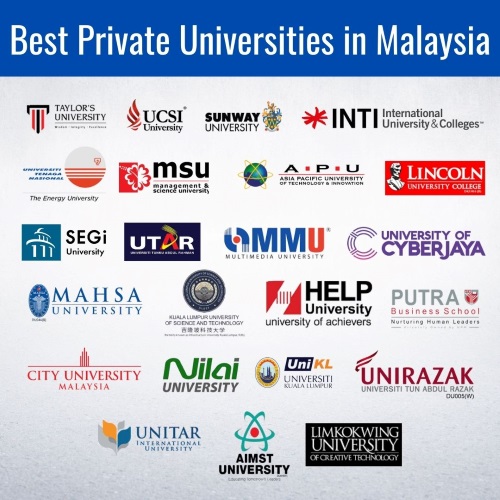
The Best Private Universities in Malaysia
The list of the Top Private Universities in Malaysia is:
Taylor’s University
UCSI University
Sunway University
INTI International University
Universiti Tenaga Nasional (UNITEN)
Asia Pacific University of Technology & Innovation (APU)
Management and Science University (MSU)
Lincoln University College
SEGi UNIVERSITY
Multimedia University (MMU)
Universiti Tunku Abdul Rahman (UTAR)
University of Cyberjaya
University Kuala Lumpur (UniKL)
Mahsa University
Infrastructure University Kuala Lumpur (IUKL)
HELP University
Putra Business School (UPM)
City University
Nilai University
UNIRAZAK University
UNITAR International University (UNITAR)
AIMST University
Limkokwing University
Best Private University in Malaysia
1. Taylor’s University
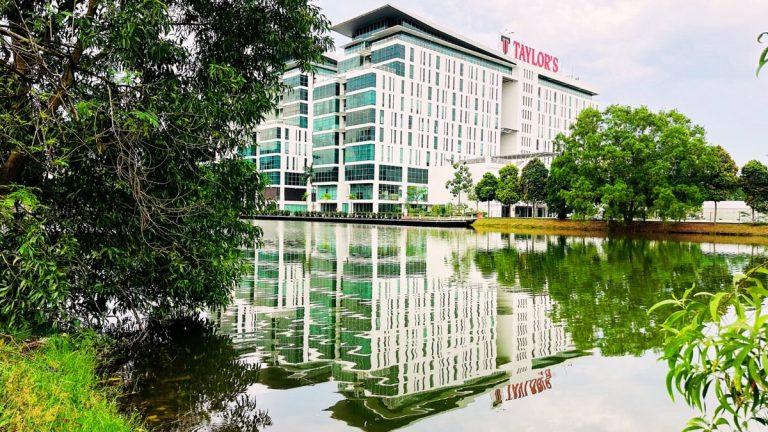
Taylor is the best private university in Malaysia, according to the QS World University Rankings, and has a lakeside campus. The lakeside campus is located in Subang Jaya, Selangor, Malaysia. Taylor’s University ranks 251st in the QS World Rankings 2026. Therefore, it is the best-ranked university for its ranking, campus location, infrastructure, and American degree programs. It offers courses in engineering, business studies, tourism and hospitality, and law. Taylor is the best private university in Malaysia for law. Taylor’s University’s tuition fees appear reasonable compared to those of other top-ranked universities globally.
This university offers credit-transfer degrees to students in America, the UK, Canada, and Australia. Students can transfer credit to America after completing 65 credits. The American credit transfer program applies to Bachelor’s degrees in Business, Computer Science, Engineering, and Liberal Arts. The postgraduate student can transfer credits to an American university and be admitted to the Master of Communication program.
Taylor’s University Fees From the Official Website
Location: Subang Jaya, Selangor, Malaysia. Rankings: QS World University Rankings: 253 Globally. QS Asia Rankings: 27 in Asia. Status: Number 1 Private University in Southeast Asia. Distance From KLCC Tower: Taylor’s University (Lakeside Campus) is located roughly 18 to 20 kilometers (about 11 to 12 miles) from the KLCC Tower (Petronas Twin Towers) in Kuala Lumpur. Best Program: Business and MBA programs. Special Program: American Degree Transfer Program (ADTP)
2. UCSI University
UCSI is one of the best private universities in Malaysia, offering programs in engineering, IT, management, multimedia, creative arts, pharmacy, music, and applied science. It provides all types of courses, including foundation, diploma, bachelor’s, and postgraduate programs, including master’s and Ph.D. Programs.
The address of UCSI University is UCSI Heights, 1, Jalan Puncak Menara Gading, Taman Connaught, 56000 Cheras, Wilayah Persekutuan Kuala Lumpur, Malaysia. Additionally, it has three additional campuses in Malaysia: the KL Campus, the Sarawak Campus, and the Terengganu Campus. It holds more than 10,000 international students.
Location: Kuala Lumpur, Malaysia. Rankings: QS World University Rankings: 269 Globally. QS Asia Rankings: 30 in Asia. Status: One of the top private universities in Malaysia and Southeast Asia. Distance From KLCC Tower: Approximately 7–9 km from Petronas Twin Towers (KLCC). Best Program: Performing Arts (Music) — Top 32 globally. Special Program: Industry-integrated education with paid internships,
Twinning & global mobility programmes
3. Sunway University
Sunway University is a prominent private university in Bandar Sunway, Petaling Jaya, Malaysia, recognized for its academic quality and high graduate employability rates. The university operates as a non-profit entity under the Jeffrey Cheah Foundation and is affiliated with the broader Sunway Education Group. It is well-respected for its campus amenities and its diverse, multicultural student population.
Campus: Located within Sunway City, the campus is known for its modern facilities and connectivity to amenities via the “canopy walk,” which links it to the Sunway Pyramid Mall, Sunway Medical Centre,
Location: Bandar Sunway. Rankings: QS World University Rankings: 410 Globally. QS Asia Rankings: 55 in Asia. Status: One of Malaysia’s leading private non-government linked universities and ranked among the top private universities in ASEAN. Distance From KLCC Tower: Approximately 18–22 km from the KLCC Tower (Petronas Twin Towers) in Kuala Lumpur. Best Program: Hospitality & Leisure Management, Business & Management. Special Program: International twinning & dual-degree programs with Lancaster University.
4. INTI International University
The main campus of the INTI International University is located at Nilai, Negeri Sembilan, Malaysia. It also has three campuses in Malaysia: Subang Jaya, Penang, and Sabah. The Subang Jaya campus is located in Kuala Lumpur. Since 1986, INTI University has produced more than 55,000 graduates. It has become one of Malaysia’s most famous private universities for its teaching strategy, sophisticated management tools, and global resources.
Additionally, INTI University collaborated with top-ranked international universities to conduct the mobility program. Moreover, it collaborated with over 400 local and international companies, including IBM, TM, PayPal Malaysia, DiGi Telecommunications Sdn Bhd, KPMG, and Huawei. It is the most renowned university in Malaysia for offering the American Credit Transfer Program.
The most famous programs are BBA, Mechanical Engineering, Civil Engineering, Computer Science, Information Technology, and a Bachelor’s in Biotechnology. In addition, INTI offers dual programs at Sheffield Hallam University in the UK, including BA (Hons) in Graphic Design, BA (Hons) in Fashion Management & Communication, and BA (Hons) in Interior Design. INTI is the best private university in Malaysia for law (UK Degree Transfer Program for 2 Years). Similarly, students at INTI University can experience the American Degree Transfer Program (AUP).
Location: Nilai, Negeri Sembilan, Malaysia, and Subang Jaya, known as the Kuala Lumpur Campus.
Rankings: QS World University Rankings: 509 Globally. QS Asia Rankings: 122 in Asia. Status: Leading Private University in Malaysia with Global Academic Partnerships and Strong Industry Connections. Distance From KLCC Tower: Nilai Campus Approximately 50–55 km from the KLCC Tower (Petronas Twin Towers) in Kuala Lumpur. Subang Jaya campus is approximately 23 kilometers from the KLCC Tower. Best Program: America, Canada, Australia Credit Transfer Program, Business & Management Studies, Accounting & Finance, Computer Science, Engineering Special Program: Dual Award Degrees, Credit Transfer Programs.
5. Universiti Tenaga Nasional (UNITEN)
University Tenaga Nasional is the most renowned energy university in Malaysia. UNITEN is the short form of University Tenaga Nasional. It is a semi-government university located in Kuala Lumpur, Malaysia. UNITEN was established in 1997 by Tenaga Nasional Berhad (TNB). According to the QS World University Rankings, UNITEN ranked 701–750 for its outstanding achievements.
University Tenaga Nasional is one of the best universities in Malaysia for offering Engineering programs, including Electrical and Electronics Engineering, Electrical Power Engineering, Mechanical Engineering, Civil Engineering, Computer Science (System and Networking), Computer Science (Software Engineering), Computer Science (Cybersecurity), and more.
Location: Putrajaya Campus, Kajang, Selangor, Malaysia. Rankings: QS World University Rankings: 551 Globally. QS Asia Rankings: 146 in Asia. Status: Malaysia’s Premier Energy-Focused Private University, Owned by Tenaga Nasional Berhad (TNB). Distance From KLCC Tower: Approximately 30–35 km from the KLCC Tower (Petronas Twin Towers) in Kuala Lumpur. Best Program: Electrical Engineering, Mechanical Engineering, Computer Science, Business Management. Special Program: Energy & Power Engineering.
6. Asia Pacific University of Technology & Innovation (APU)
Asia Pacific University (APU) is one of the best private universities in Malaysia, also known as the Asia Pacific University of Technology & Innovation (APU). The main campus of APU is located at Technology Park Malaysia, Bukit Jalil, Kuala Lumpur 57000, Malaysia. So, it is only 15 kilometers from the Petronas Twin Towers and 50 kilometers from Kuala Lumpur International Airport. APU achieved the 5-Star under the SETARA- 2018 for its outstanding performance in the education sector. According to the Asia University Ranking 2022, APU ranks globally among Asia’s top 10 private universities and 300 universities overall. The students won multiple awards for outstanding performance; for example, in 2018, APU won the ASEAN Virtual Business Plan competition award. The APIIT accepted the prestigious Prime Minister’s Award in March 2011.
APU is one of the top private universities in Malaysia for offering diverse programs in engineering, business, management, finance, technology, and information. It is a famous university for offering information technology-related programs, including artificial intelligence, computer game development, and cybersecurity. It also provides foundation, diploma, bachelor’s, master’s, and Ph.D. programs for local and international students. APU is the best private university in Malaysia for engineering studies.
Location: Bukit Jalil, Kuala Lumpur, Malaysia Rankings: QS World University Rankings: 597 globally QS Asia Rankings: 190 in Asia Status: Private University. Distance From KLCC Tower: Approximately 13 km from the KLCC Tower (Petronas Twin Towers) in Kuala Lumpur. Best Programs: Computer Science, Information Technology, Artificial Intelligence, Cyber Security, and Data Science Special Program: Dual Degree Programme with De Montfort University (UK)
7. Management and Science University (MSU)
Management and Science University (MSU) has become one of Malaysia’s top 20 private universities for securing jobs for its graduates; according to the Ministry of Higher Education Malaysia 2025, around 98 percent of MSU graduates secure jobs within one year of graduation. It was established in 2001 in Shah Alam, Selangor.
The campus address of Management and Science University is University Drive, Off Persiaran Olahraga, 40100 Shah Alam, Selangor, Malaysia. It is also located in the capital of Malaysia and very near the international airport.
MSU is the best private university in Malaysia for medicine and computer science, engineering, business, law, information technology, visual arts, and law studies. Additionally, it offers diplomas and bachelor’s degrees in traditional Chinese medicine. It also shows the Bachelor of Medicine and Bachelor of Surgery (MBBS), biomedical science, and pharmacy.
Location: Shah Alam, Selangor, Malaysia Rankings: QS World University Rankings: 551 globally QS Asia Rankings: 129 in Asia Status: Private University. Distance From KLCC Tower: Approximately 24 km from the KLCC Tower (Petronas Twin Towers) in Kuala Lumpur. Best Programs: Hospitality & Tourism Management, Health & Life Sciences, Business Management, Pharmacy, and Medical Sciences Special Program: Global Mobility Programme with partner universities in more than 40 countries
8. Lincoln University
Lincoln University (LU) is a private higher education institution in Petaling Jaya, Malaysia, recognized by the Ministry of Higher Education and the Malaysian Qualifications Agency (MQA). Established in 2002 as Lincoln College, it attained university college status in 2011.
LU provides a range of diplomas, undergraduate, and postgraduate courses. Among the doctoral choices are the Master of Business Administration (MBA), Master of Economics, Master of Nursing, Master of Science in Civil Engineering, and Master of Medical Sciences. The undergraduate offerings consist of the Bachelor of Nursing (Public Health) and the Bachelor of Business Administration in Airline and Airport Management.
Location: Petaling Jaya, Selangor, Malaysia Rankings: QS World University Rankings: 638 globally QS Asia Rankings: 196 in Asia Status: Private University College Distance From KLCC Tower: Approximately 15 km from the KLCC Tower (Petronas Twin Towers) in Kuala Lumpur. Best Programs: Medicine, Dentistry, Pharmacy, Nursing, and Health Sciences Special Program: Open Distance Learning (ODL) programs and a wide range of postgraduate research degrees.
9. SEGi University
SEGi University has been recognized as one of the top private research universities for providing quality education and maintaining an academic environment. It was established in 1977, and the main campus is located at Kota Damansara, Kuala Lumpur, Malaysia. Apart from the main campus, it has four more campuses in Malaysia: Kuala Lumpur, Subang Jaya, Penang, and Sarawak. It has collaborated with the following universities: Abertay University in Scotland, The University of Southern Queensland in Australia, The University of Sunderland in the UK, the University of York St John, and the University of Greenwich.
SEGi is the best private university in Malaysia for offering a diverse range of programs, including foundation, diploma, bachelor’s, master’s, and Ph.D. programs. It is also the best private university in Malaysia for medicine, computer science, engineering, and business studies.
Location: Kota Damansara, Petaling Jaya, Selangor, Malaysia. Rankings: QS World University Rankings: 731–740 globally QS Asia Rankings: 350 in Asia Status: Private University. Distance From KLCC Tower: Approximately 16 km from the KLCC Tower (Petronas Twin Towers) in Kuala Lumpur. Best Programs: Business Management, Hospitality & Tourism, Computing & IT, Engineering, and Health Sciences. Special Program: Dual Award Degree Programme in collaboration with international partner universities.
10. Multimedia University (MMU)
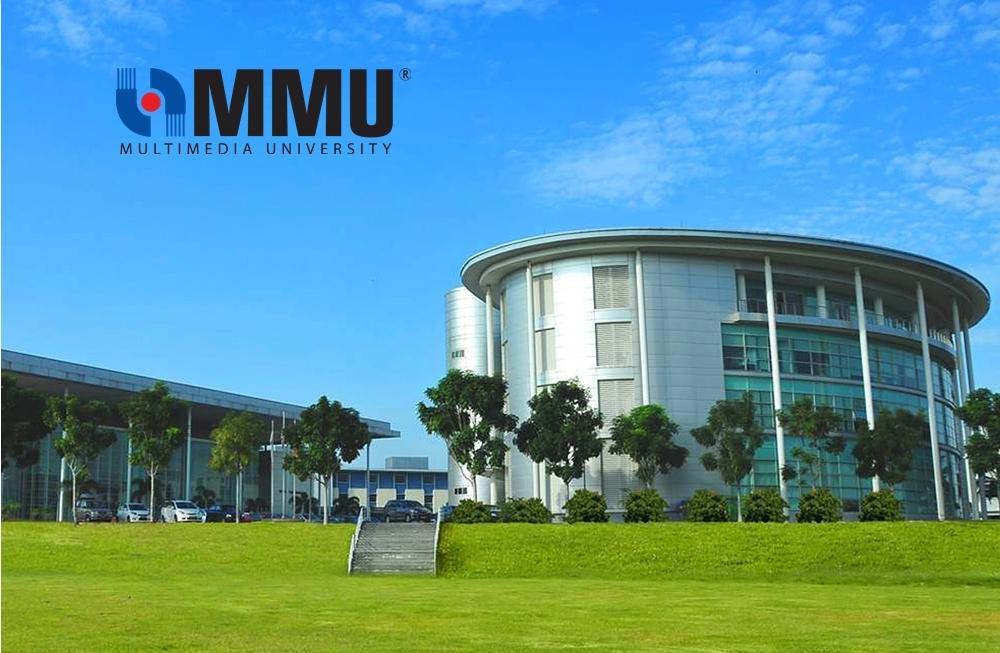
Multimedia University (MMU) is a Malaysian semi-government research university founded in 1996. MMU has three campuses in Malaysia: Cyberjaya, Johor, and Malacca. It ranked among the top five universities in Malaysia in 2025 for its outstanding teaching performance. MMU’s main campus is at Persiaran Multimedia, 63100 Cyberjaya, Selangor, Malaysia. Cyberjaya is known as the Silicon Valley of Malaysia, a prime part of the Multimedia Super Corridor.
MMU is the best private university for computer science, specializing in software engineering, game development, data science, and cybersecurity. MMU provides up to 100 percent scholarship for the master’s program by research and Ph.D. Additionally, it helps undergraduate students secure a President’s Merit and Talent Scholarship. MMU allows students to join the intake with only one semester’s tuition fees. So, local and international students can start their studies after paying one semester’s tuition fees in 2024. MMU is also an affordable university in Malaysia for international students.
11. Universiti Tunku Abdul Rahman (UTAR)
Universiti Tunku Abdul Rahman (UTAR) is a prominent private university in Malaysia that operates as a not-for-profit institution, founded in 2002 under the UTAR Education Foundation to offer quality higher education at an affordable price. The university is recognized for its robust programs across diverse disciplines, an impressive graduate employability rate, and a culturally diverse academic atmosphere.
UTAR offers more than 140 globally recognized programs, ranging from Foundation Studies to Bachelor’s, Master’s, and PhD degrees. These programs are sanctioned by the Malaysian Ministry of Higher Education (MOHE), and many have received full accreditation from the Malaysian Qualifications Agency (MQA).
Rankings and Achievements
QS World University Rankings 2026: Positioned within the #791–800 bracket worldwide.
QS Asia University Rankings 2026: Advanced to #109 in Asia and #26 in Southeast Asia.
Times Higher Education (THE): Featured in the THE World University Rankings and acknowledged for its influence on sustainability and community-focused projects.
12. University of Cyberjaya (UoC)
University of Cyberjaya (UoC) is a private university established in 2005. The main campus is located at Cyberjaya, Selangor Darul Ehsan, Malaysia. Cyberjaya is the most beautiful and organized town in Malaysia. The former name of this university is Cyberjaya University College of Medical Sciences (CUCMS). It is the most notable university for the MBBS program. UoC offers medical courses at a lower cost than other universities in Malaysia. It enrolls around 6,000 students from more than 50 countries. The University of Cyberjaya’s fees are lower than those of other universities in Malaysia.
The University of Cyberjaya offers diverse courses for international students, including Medicine & Bachelor of Medicine, Bachelor of Surgery (MBBS), Pharmacy, Homeopathic Medical Science, Psychology, Physiotherapy, and more. It also offers a Doctor of Pharmacy, a Ph.D. in Science, and a Ph.D. in Medical.
13. University Kuala Lumpur (UniKL)
Universiti Kuala Lumpur (UniKL) is another semi-government university, followed by the UNITEN and MMU. UniKL is a technology-specialized university with more than ten campuses across Malaysia. Majlis Amanah Rakyat established this university in 2002. Malaysia’s Ministry of Rural and Regional Development directly regulates and governs this university. UniKL is a remarkable university for offering an aircraft engineering technology program for local and international students.
UniKL offers a diverse range of programs for engineering students, including electrical and electronics, biomedical laboratory science, air conditioning and industrial refrigeration, automotive maintenance, avionics maintenance, helicopter maintenance, chemical engineering technology, and computer and software engineering.
Universiti Kuala Lumpur (UniKL) also offers medically related programs, including pharmacy, nursing, radiography, physiotherapy, and MBBS.
14. Mahsa University
Mahsa University operates the administrative and academic activities from its main campus in Bandar Saujana Putra, 42610, Selangor, Malaysia. The Ministry of Education in Malaysia announced the establishment of an online university. So, it offers physical and virtual classes for international students via online meeting platforms.
Mahsa is one of the top private universities in Malaysia for studying MBBS. It offers biosciences, nursing, dentistry, pharmacy, and health science programs. Mahsa also offers programs in hospitality management, business, finance, information technology, and engineering. It also offers a dual-award program for local and international students.
15. Infrastructure University Kuala Lumpur (IUKL)
Infrastructure University Kuala Lumpur (IUKL) was established in 1998. IUKL is a private university, and its campus is located in Kajang, between Universiti Tenaga Nasional (UNITEN) and Universiti Putra Malaysia (UPM). It ranked among the top 45 universities in Malaysia, including both public and private institutions. It is an exceptional university in Malaysia for offering a landscape architecture program. IUKL provides a range of courses for science, commerce, and art students.
The university address is as follows: Block 11, Infrastructure University Kuala Lumpur De Centrum City, Jalan Ikram-Uniten, 43000 Kajang, Selangor.
16. HELP University
HELP University is a notable private institute in Malaysia that offers medical and business-related programs. It was established in 1986, and its main campus is at the heart of Kuala Lumpur, Malaysia. The campus address is Bukit Damansara, 50490 Kuala Lumpur, Malaysia.
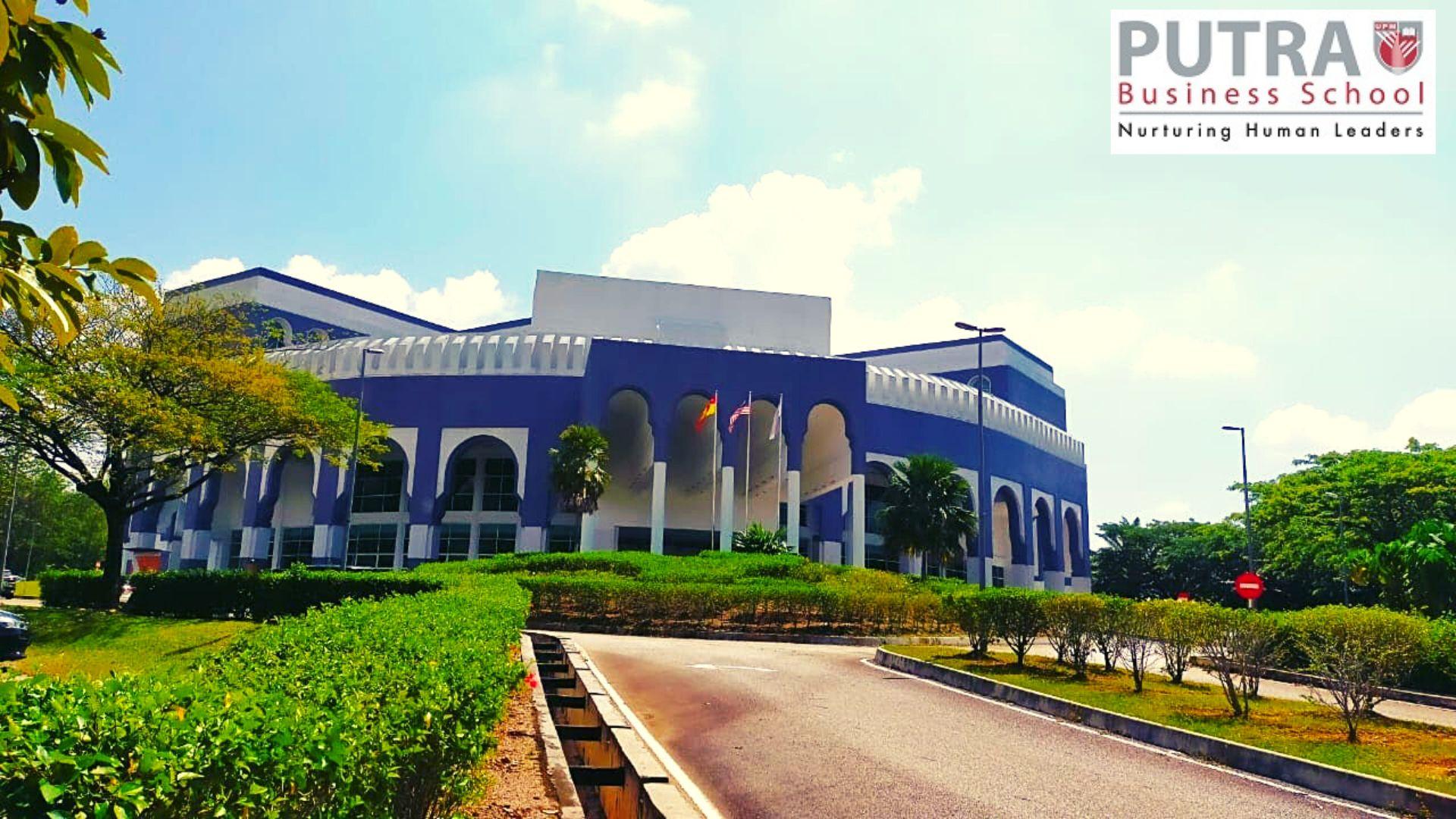
Putra Business School is an AACSB- and ABEST21-accredited private institution in Malaysia, established in 1997. This campus is located within the University Putra Malaysia campus, near University Tenaga National (UNITEN) and Infrastructure University Kuala Lumpur (IUKL). However, PBS offers only postgraduate courses, including master’s and Ph.D. It enrolls around 4000 students globally. The Master of Business Administration is the most popular program offered by PBS.
Putra Business School (PBS)
PBS produces a large number of leaders and skilled employees each year. Many students start successful new businesses. This school teaches how to start and regulate a business. It also guides the production of a business report before beginning a new business.
18. City University
City University is located in the heart of Kuala Lumpur, Malaysia. It has been in operation since 1984, making it one of the oldest private universities in Malaysia. The Malaysian Qualifications Agency accredits City University. The Ministry of Education of the People’s Republic of China has recognized city universities. City University maintains a 4-star (Excellent Rating) under the SETARA 2017. It provides a conditional offer letter, so students do not need to pay before admission.
City University is the best private university in Malaysia for graphic design & multimedia, culinary arts, fashion design, interior design, and more. It also offers diplomas in nursing, medical laboratory technology, and occupational safety & health. Besides MMU, City is another of the cheapest private universities in Malaysia for international students.
19. Nilai University
Private University is a private university in Malaysia established in 1997. It is also a remarkable university for offering a diploma in aircraft maintenance engineering. It offers numerous programs, including foundation, diploma, bachelor’s, master’s, and Ph.D. The campus is located at Putra Nilai, 71800 Nilai, Negeri Sembilan.
20. UNIRAZAK University
UNIRAZAK is a leading private university in Malaysia, established in 1997. The main is located in the heart of Kuala Lumpur. It is about 5 kilometers from the KLCC Petronas Towers. Unirazak is a particular university that offers a distance learning program.
UNITAR is a leading private university in Malaysia and the first Virtual University in Southeast Asia. It was established in 1997. It obtains the QS 5-Star Ranking. UNITAR contains around 12000 students (Local and International).
22. AIMST University
The complete form of AIMST is the Asian Institute of Medicine, Science, and Technology. This University was established on 15 March 2001. The main campus is situated in Kedah, Malaysia. It is another special university that offers medical science-related programs, including MBBS, BDS, BDT, pharmacy, Nursing Science, and more.
23. Limkokwing University
Limkokwing University has more than 1o campuses globally. The Malaysian campus was established in 1991. It is a creative technology university with over 25000 students from 100 countries.
Foreign Private University Campuses in Malaysia
However, Malaysia holds ten foreign private university campuses, including Curtin University, Monash University, Selangor Heriot-Watt University Malaysia, Putrajaya Newcastle University Medicine Malaysia, University of Southampton – Malaysia Campus, Selangor Swinburne University of Technology, Sarawak The University of Nottingham Malaysia, University of Reading Malaysia, Johor Xiamen University Malaysia Campus, Selangor Royal College of Surgeons in Ireland and University College Dublin Malaysia Campus, Penang. These are the international university branch campuses in Malaysia, not Malaysian private universities.
Ten Career Opportunities For Students Who Study in Malaysia
1. International Business: Graduates can use their cross-cultural communication and international market knowledge to pursue careers in global companies.
2. Foreign Service Officer: Students can represent their home country’s interests abroad by working for their nation’s diplomatic service.
3. Language Translation/Interpretation: Those proficient in a foreign language can facilitate communication across borders by working as translators or interpreters.
4. Nonprofit/NGO Work: Students can contribute to international development and humanitarian efforts by leveraging their understanding of diverse cultures.
5. International Education: Graduates can promote cross-cultural exchange and facilitate study abroad experiences for others by working in education abroad programs.
6. Diplomacy and International Relations: Graduates can influence global policies and relations by working in government agencies, think tanks, and international organizations.
7. Tourism and Hospitality: Students can cater to an international clientele and utilize their cultural awareness by pursuing careers in the travel industry.
8. International Law: Graduates can work in law firms specializing in cross-border legal matters or with international courts and organizations.
9. Global Health: Opportunities exist in international healthcare organizations, addressing global health challenges and promoting healthcare equity.
10. Cross-Cultural Training and Consulting: Graduates can improve international collaboration by working with businesses or organizations to bridge cultural gaps.