This article includes the following key phrases: Content and Process Theories of Motivation. The List of Content and Process Theories of Motivation with Examples. Difference Between Content and Process Theories of Motivation in Psychology and Organizational Behavior.
Content and Process Theories of Motivation
Content and process theories of motivation are two frameworks that explain which factors motivate individuals to continue working in personal and organizational contexts and how these factors operate. Indeed, these theories examine the factors that influence individuals to improve job performance and how they remain motivated. Content and process theories are among the most well-known models for motivating employees to achieve better outcomes.
Content theories explain the factors underlying individuals’ or employees’ motivation for sustained performance in the workplace.
In contrast, process theories are frameworks that explain how factors underlie individuals’ or employees’ motivation to sustain workplace performance.
Types of Motivation Theories
Content and process theories are categories of motivational models, such as Maslow’s needs theory, McGregor’s Theory X and Theory Y, Equity theory, Expectancy theory, and others. These are the most common classifications of motivational theory in psychology and organizational behavior.
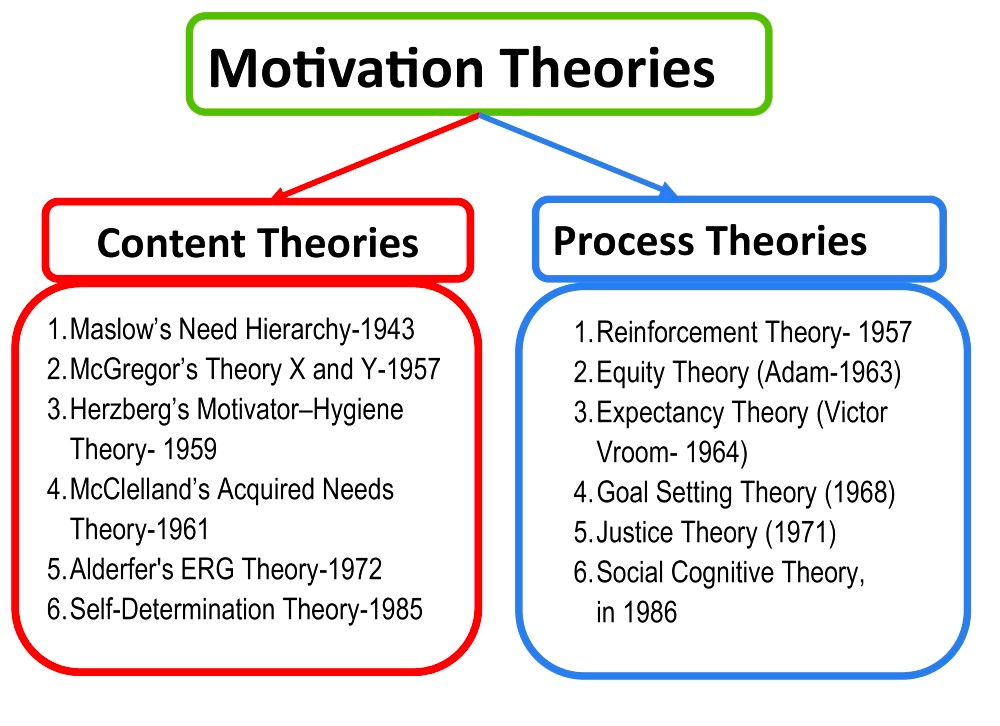
Difference Between Content and Process Theories of Motivation
Content Theories of Motivation
Content theories of motivation are designed to represent the external and internal factors, including needs, aspirations, and satisfactions, that influence individuals to continue working in personal, social, and organizational life. In an organizational context, content theory focuses on employees’ needs and gratifications that encourage them to perform in the workplace.
Content theories find the answers to the question “What factors drive human behavior?” Content theory assumes people have a set of needs that they are intended to achieve.
Example of Content Theories of Motivation
The examples of content theories of motivation are:
- Maslow’s Need Hierarchy (Abraham Maslow-1943)
- McGregor’s Theory X and Theory Y (Douglas McGregor-1957)
- Herzberg’s Motivator–Hygiene Theory (Frederick Herzberg – 1959)
- McClelland’s Acquired Needs Theory (David McClelland- 1961)
- Alderfer’s ERG Theory of Motivation (Clayton Alderfer- 1972)
- Self-Determination Theory (Deci and Ryan-1985)
Process Theories of Motivation
Process theory explains how factors motivate people to pursue goals or deter them from attempting to achieve those goals. These theories are frameworks that explore the process of motivation. Process theories of motivation are designed to explain how people’s behavior is directed and organized, sustained, or adjourned.
Process theories are designed to answer the question: “How do factors direct individual behavior?” Theory assumes people have independent and interdependent goals; therefore, they design a concise way to achieve them. It explains how they become motivated and the factors that inspire them.
Example of Process Theories of Motivation
The examples of Process theories of motivation are:
- Equity Theory (Adam-1963)
- Expectancy Theory (Victor Vroom- 1964)
- Goal Setting Theory (1968)
- Justice Theory (1971)
Content: Theories of Motivation Examples
1. Maslow’s Hierarchy of Needs Theory
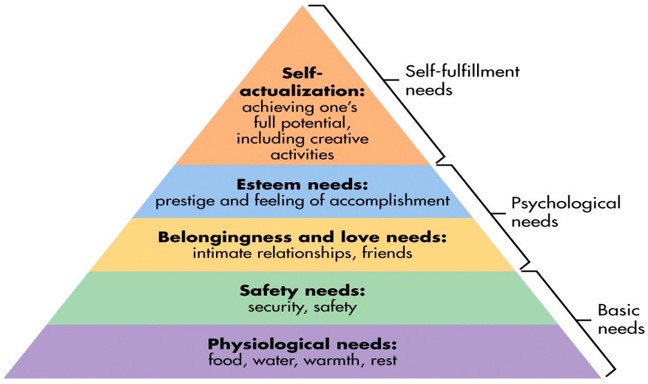
American psychologist Abraham Maslow developed the theory of Maslow’s hierarchy of needs in 1943 in his paper titled “A Theory of Human Motivation.” The five needs of Maslow’s hierarchy are physiological, safety, Love and belonging, esteem, and self-actualization. The first four needs are deficiency needs (D-needs), and the top level is growth or being needs (B-needs).
2. McGregor’s Theory X and Theory Y
American Psychologist Douglas McGregor proposed the prominent theory X and theory Y in 1957 in the book titled “The Human Side of Enterprise”. Theory X and Theory Y refer to two distinct management styles in organizations, and employees’ characteristics differ between them. Employees and managers exhibit different organizational behaviors and traits.
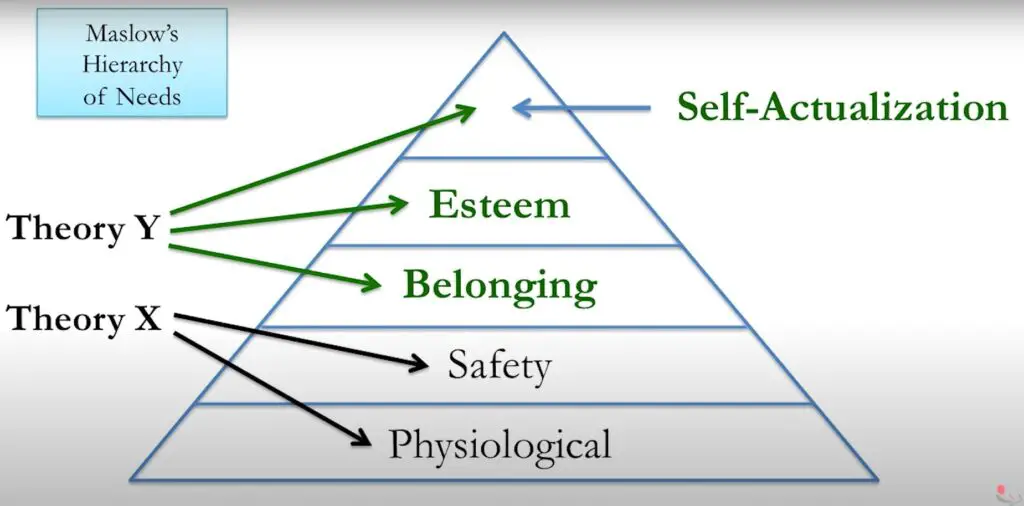
Theory X Management
The management believes that the average employee in the organization is lazy and doesn’t like to take on workloads.
These employees have limited skills, experience, and ambition; therefore, managers must compel them to work regularly. They arrive at the office late and attempt to leave early. Employees in Theory X management procrastinate in submitting reports and dislike assisting coworkers in completing tasks on time. Employees consistently find ways to avoid complex tasks. However, they are focused on lower-level needs like salary, financial security, and punishment.
Therefore, the strategy of Theory X management is a controlling, output-driven approach.
Theory Y Management
Theory Y management assumes that the average employee in the organization prefers to work spontaneously. Employees like to work without being asked and take on workloads when the organization demands it. They derive satisfaction from assigned tasks and responsibilities. Employees are responsible and supportive of one another. They are focused on high-level needs, including recognition, achievements, and honors from coworkers and organizations.
The management strategy of theory Y enhances empowerment and a trust-driven approach.
Difference Between Theory X and Y Employees
Employees of Theory X
- Employees hold pessimistic views toward organizations.
- They dislike work; therefore, managers must monitor them.
- Employees can be motivated only by money and punishment.
Employees of Theory Y
- Employees hold optimistic assumptions within the organization.
- They are self-engaged, committed, responsible, and creative.
- Recognition, achievements, and honors can motivate employees to improve job performance.
3. Herzberg’s Two Factor Motivator–Hygiene Theory (1959)
Frederick Herzberg proposed the two-factor theory of motivation in 1959. Job satisfaction and dissatisfaction arise from two distinct sets of factors, namely, motivation and hygiene. Building on Maslow’s needs hierarchy theory, published in 1943, Frederick Herzberg proposed a two-factor theory that identifies motivational and hygiene factors that motivate employees.
The motivating factors increase employees’ job satisfaction, whereas the hygiene factors prevent dissatisfaction. The hygiene factors transform employees’ state of dissatisfaction into no satisfaction (neutral position), while, in contrast, motivator factors make employees’ state of no satisfaction into satisfaction.
Elements of the Two-Factor Theory of Motivation are:
- Motivation (Intrinsic Factors)
- Hygiene (Extrinsic Factors)
Motivation (Intrinsic Factors)
Motivation includes intrinsic factors that boost job satisfaction among employees in the organization. The motivational factors include recognition, challenging tasks, achievements, Power, responsibilities, affiliation, relatedness, and opportunities. These intrinsic factors foster employees’ sense of influence over organizational decision-making. This continuous motivation arises from the job itself. Motivation may drive a person to move from a state of no satisfaction to satisfaction.
Hygiene (Extrinsic factors)
In contrast, Hygiene comprises extrinsic factors that prevent employee dissatisfaction. Hygiene (extrinsic) factors are lower-level needs, such as salary, job security, status, work environment, policies, and legal compliance. The presence of Hygiene factors may influence an employee to move from a state of dissatisfaction to a state of no dissatisfaction.
How To Use Two-Factor Theory in an Organization
Top managers and senior employees ensure that hygiene factors, such as work environments, are maintained to prevent employee dissatisfaction, and that motivator factors, such as recognition, are enhanced to improve job satisfaction.
4. McClelland’s Theory of Needs (1961)
In 1961, David McClelland developed the Need Theory, which explains three factors that motivate individuals in organizations. He proposed the Acquired- Needs Theory in his book ‘The Achieving Society’.
In addition to Maslow’s hierarchy of five needs (Physiological needs, Safety needs, Love and belongingness needs, Esteem needs, and Self-actualization), McClelland proposed three additional needs (needs for achievement, affiliation, and power) that motivate employees to work within the organization. Therefore, the three needs theory is a content theory because it examines three additional motivational factors in organizational behavior.
David McClelland’s Three Needs are:
-
Needs For Achievement (n-Ach)
- Prefers working on challenges.
- Best in situations in which performance is due to effort and ability.
- Prefers to work with other high achievers
-
Needs For Affiliation (n-Aff)
- Likes to work in teams with cooperation and collegiality.
- Tends to avoid conflict.
- Likes to achieve compliments in private.
-
Needs For Power (n-Pow)
- Likes to be in charge.
- Likes to be in control of people and events.
- Appreciates being recognized.
5. Alderfer’s ERG Theory of Motivation (1972)
Clayton Alderfer proposed the ERG theory of motivation in 1972 by extending Maslow’s hierarchy of needs. Alderfer argued that human needs are divided into three categories rather than the five proposed by Abraham Maslow.
According to Alderfer(1972), the three needs factors of human motivation are Existence, Relatedness, and Growth. The motivation factor is rooted in physiological needs, including food, water, shelter, sex, air, clothing, and physical and mental safety. The organization meets these needs through salaries, incentives, job security, and good working conditions, thereby ensuring hygiene factors.
The need factor relatedness includes love, belongings, respect, mental and physical support, and communication engagement. The organization can foster a sense of relatedness among employees by improving interpersonal communication.
The final factor of the ERG theory of motivation is growth, which enhances personal and group achievement.
6. Self-Determination Theory (1985)
Deci and Ryan proposed the self-determination theory in 1985 in a book named “Intrinsic Motivation and Self-determination in Human Behavior”. It is known as SDT in human and organizational behaviors. Self-determination theory posits that three innate needs shape employees’ behavior and well-being. This theory argues that competence, autonomy, and relatedness are the most powerful factors underlying employee motivation to enhance performance, foster continuous improvement, and cultivate creativity.
The Three Motivational Factors of Self-Determination Theory are:
- Competence
- Autonomy
- Relatedness.
Competence, Autonomy, and Relatedness are intrinsic needs that motivate employees to work continuously. Therefore, self-determination theory (SDT) is a content theory of motivation.
How To Use Self-Determination Theory in an Organization
Managers should influence behavior by creating work environments that support each need.
- Firstly, the management needs to provide tangible resources, time, contacts, and coaching to improve employees’ competence.
- Secondly, the organization must focus on empowering employees and delegating meaningful assignments and tasks to enhance employees’ sense of autonomy.
- Finally, senior employees must provide enjoyment and companionship to foster a sense of relatedness.
Lower-level and higher-level Needs of Content Theories of Motivation
Process Theories of Motivation Examples
- Equity Theory (Adam-1963)
- Expectancy Theory (Victor Vroom- 1964)
- Goal Setting Theory (1968)
- Justice Theory (1971)
1. Adam’s Equity Theory (1963)
John Stacey Adams proposed equity theory in 1963 to explain how individuals strive for fairness and justice in an organizational context. Adam’s equity theory explains the process of motivation; therefore, it is a process theory. Equity theory examines the resources provided by organizations to employees and the outcome ratio they receive. It is a give-and-take relationship, characterized by reciprocity.
According to Adams’ Equity Theory (1963), a fair balance between employees’ inputs and outputs motivates employees to increase productivity. A strong and positive relationship between employees and organizations yields better outcomes.
The input factors in equity theory include employees’ dedication, hard work, effort, skill, experience, and enthusiasm.
The dimensions of equity include salary, respect, acknowledgment, recognition, and others.
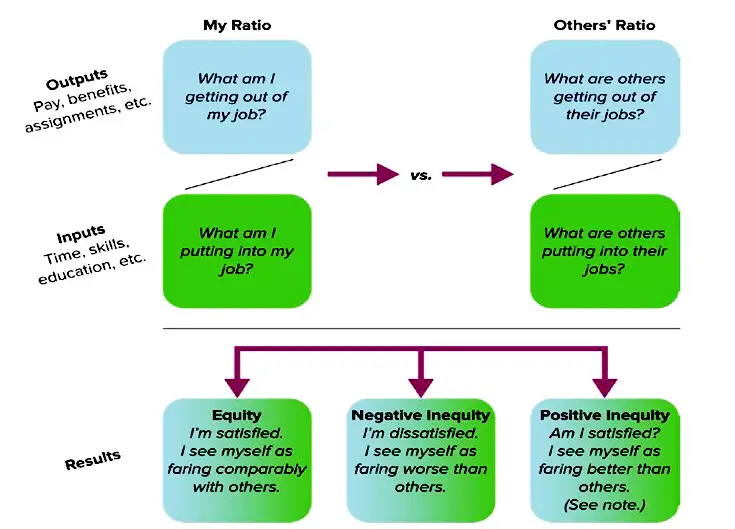
The model is based on our evaluation and comparison of outputs and inputs with relevant others.
2. Vroom Expectancy Theory (1964)
Victor H. Vroom proposed the expectancy theory of motivation in 1964 with three elements: expectancy, instrumentality, and valence. It is a process theory of motivation that demonstrates the process of motivation. People are motivated to behave in ways that produce desired combinations of expected outcomes.
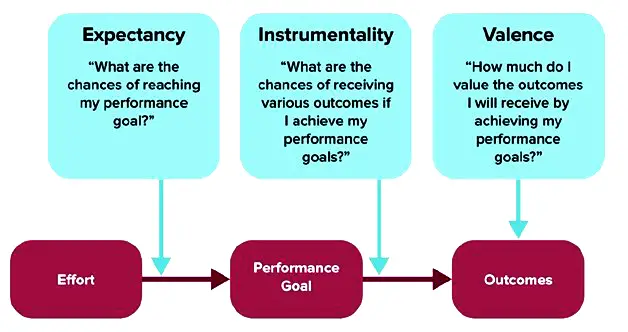
The Elements of Expectancy Theory are:
- Expectancy
- Instrumentality
- Valence
Expectancy (Efforts)
The expectancy factor in Vroom’s expectancy theory refers to employees’ expectation that, if they make an effort to complete the job, they will achieve performance goals. For example, the employee must sell 100 phones to meet the monthly product sales target. To achieve the company’s monthly goal, employees continually strive.
Expectancy provides an answer to the question: “Can I achieve my target if I work hard?”
Instrumentality (Performance)
Instrumentality is the employees’ belief that they will receive the expected outcome if their performance meets the demands. For example, the employee will get rewards if they achieve the target. The expected outcome may include a salary increase, promotion, and recognition.
Expectancy refers to the answer to the question: “Will I get rewards if I can achieve the target?”
Valence (Outcome)
Valence refers to the perceived value of received rewards from the organization.
Expectancy refers to the answer to the question: “Will I become happy if I get the particular reward?”
Vroom Expectancy Theory Organizational Implication
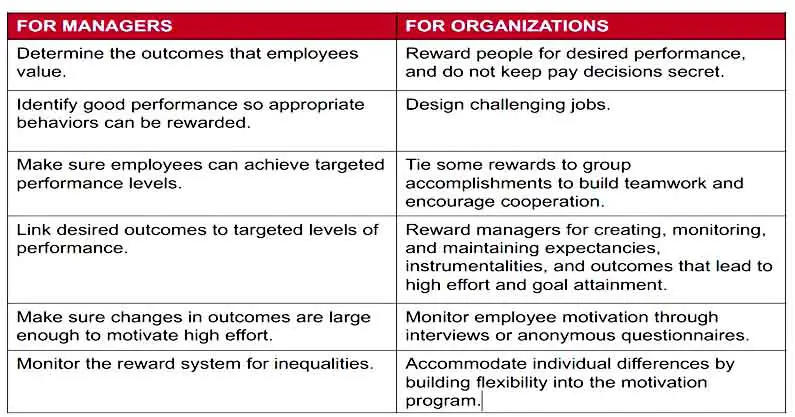
The Use of Expectancy Theory To Evaluate How Pay Influences Individual Employees
- Expectancy theory emphasizes expected rewards.
- Compensation mainly influences instrumentality.
Extrinsic Motivation:
- Depends on rewards (such as pay and benefits) controlled by external sources.
Intrinsic Motivation:
- Depends on rewards that flow naturally from work itself.
- Extrinsic incentives generally do not harm intrinsic motivation.
3. Goal Setting Theory (1968)
In 1968, Professor Edwin Locke proposed the goal-setting theory, explaining that clear goals and feedback are crucial to employee motivation. This theory has been widely accepted in the economic and organizational sectors as an explanation of human motivation.
In 1990, Edwin Locke and Gary Latham extended goal-setting theory, articulating five principles for organizations.
According to Locke and Latham’s goal-setting theory published in 1990, the five principles that inspire employees are:
- Clarity
- Challenge
- Commitment
- Feedback
- Task complexity
Certain conditions are necessary for goal setting to work.
- People must have the ability and resources.
- People need to be committed to the goal.
Performance feedback and participation in goal-setting are necessary but not sufficient. Goal achievement leads to job satisfaction.
Mechanisms Behind the Power of Goal Setting
- Goals regulate effort.
- Goals direct attention.
- Goals increase persistence.
- Goals foster task strategies and action plans.
4. Justice Theory (1971)
The American Philosopher John Rawls proposed the Theory of Justice in 1971. Organizational justice refers to the extent to which people perceive that they are treated fairly at work. Three types of justice: 1. Distributive Justice. 2. Procedural Justice. 3. Interactional Justice.
Using Equity and Justice Theories
- Employee perceptions
- Employees want a voice in decisions that affect them.
- Employees should have an appeals process.
- Leader behavior
- A climate for justice makes a difference.
References
| Adams, J. S. (1963). Towards an understanding of inequity. The Journal of Abnormal and Social Psychology, 67(5), 422–436. https://doi.org/10.1037/h0040968
Deci, E. L., & Ryan, R. M. (1985). The general causality orientations scale: Self-determination in personality. Journal of research in personality, 19(2), 109-134. Locke, E. A. (1968), Toward a theory of task motivation and incentives, Organizational Behavior and Human Performance, 3(2): 157-189 Locke, E.A. and Latham, G. P. (1990), A theory of goal setting and task performance, Prentice Hall College Locke, E.A. and Latham, G. P. (2013), New developments in goal setting and task performance, Routledge |