3 Idiots Film Review For Students Example: Writing Example

3 Idiots movie review for students, example. The movie review of 3 Idiots is important for students because it highlights the pressures of academic life, promotes the value of creativity and passion over rote learning, encourages critical thinking about societal norms around education, and inspires discussions about personal goals and success. It serves as a catalyst for students to reflect on their own educational experiences and aspirations.

Film Review

A film review is a feature article that strategically analyzes a film’s quality. It is the process of providing an opinion based on the film’s strengths and weaknesses. The film review is the most common type of feature writing, followed by the travelogue, how-to, and personal feature story.

The film review statement is based on the film’s plot, dialogue, acting, themes, locations, sound, music, and more. A film review is a process of analyzing a film thoroughly and critically. The 3 Idiots is the most famous Indian film for writing a film review feature story. The film review story-writing article includes a description, an analysis of strengths and weaknesses, and the writer’s opinion.

 3 idiots movie review for students class 11
Film Review of 3 Idiots For Students

Film Review of 3 Idiots For Students

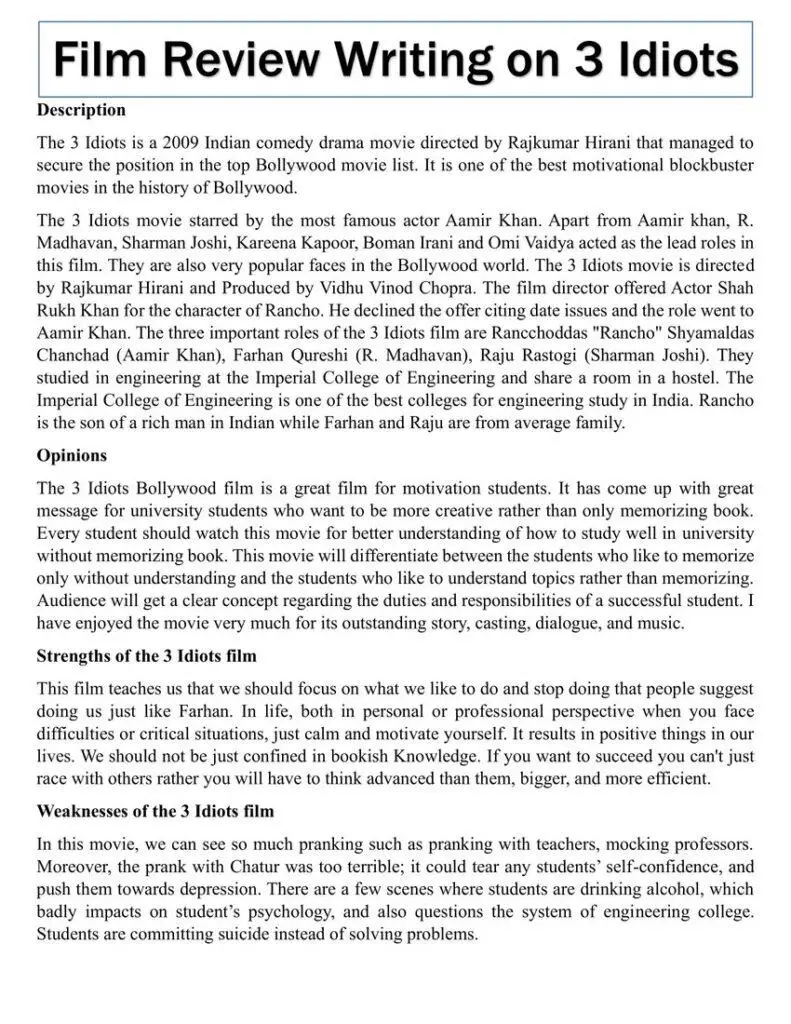
Description of the 3 Idiots Film

The 3 Idiots is a 2009 Indian comedy-drama film directed by Rajkumar Hirani. It has secured a position on the top list of Bollywood movies (Chopra & Hirani, 2009). It is one of the best motivational blockbuster films in Bollywood history. The film 3 Idiots has become the highest-grossing film in terms of opening-day collection. It has also become the highest opening weekend collection film in India’s history of Bollywood films. It is one of the first Indian films to earn Rs 200 Crore net at the box office (Hirani, Khan, Kapoor, Madhavan, Joshi, Irani & Vaidya, 2016). Finally, it earned Rs 395 crores globally.

This 3 Idiots Movie Review for Students outlines the film’s impact on academic life.

In this 3 Idiots Movie Review for Students, we analyze the film’s character development and storytelling techniques.

The most famous Indian actor, Aamir Khan, played the leading role in the film 3 Idiots. Apart from Aamir Khan, R. Madhavan, Sharman Joshi, Kareena Kapoor, Boman Irani, and Omi Vaidya acted in the lead roles. They are also very familiar faces in the Bollywood world. The 3 Idiots film is directed by Rajkumar Hirani and produced by Vidhu Vinod Chopra. The film director offered Actor Shah Rukh Khan the character of Rancho. He declined the offer, citing date issues, and the role went to Aamir Khan.

Cast 

The three essential roles of the 3 Idiots film are Aamir Khan as Rancchoddas “Rancho” Shyamaldas Chanchad or Phunsukh Wangdu, R. Madhavan as Farhan Qureshi, and Sharman Joshi as Raju Rastogi. They studied engineering at the Imperial College of Engineering and shared a room in a hostel. Apart from them, the additional stars are Kareena Kapoor as Pia, Omi Vaidya as Chatur Ramalingam (Silencer), Boman Irani as Viru Sahastrebuddhe (Virus), Parikshit Sahni as Mr. Qureshi,  and Mona Singh as Mona Sahastrebuddhe (Pia’s sister).

Story

The Imperial College of Engineering is one of India’s best engineering colleges. Rancho was admitted as a rich man’s son in India, while Farhan and Raju are from an average family. Farhan dreamed of being a wildlife photographer, but his father insisted he study engineering because it was his wish. Indeed, Rancho was the son of a gardener.

Raju has come to study to uplift his family’s fortunes because he is from an impoverished family. Rancho’s passion is acquiring knowledge rather than the other students’ conventional obsession with exam ranks. With his unconventional approach, Rancho suffers the wrath of the college dean, Professor Viru Sahastrabudhhe (ViruS) (Boman Irani). Rancho terms the dean as ViruS.

He irritates his lecturers by giving creative and unique answers. Joy was also a student of the Imperial College of Engineering. She had requested the dean to extend his major project on compassionate grounds that his father had suffered a stroke. But, Virus refused, saying he was utterly unmoved by his son’s accidental death after being hit by a train. Rancho condemns the learning system of the institution, blaming it for Lobo’s death.

Threatened by Rancho’s talent and free spirit, ViruS labels him an “idiot,” and he attempts to destroy his friendship with Raju and Farhan. In contrast, (Omi Vaidya) Chatur Ramalingam, or “Silencer,” is the model student in the eyes of ViruS, who always wants to get high marks through memorizing rather than understanding.

Finally, Rancho comes first and is awarded ViruS’s pen, which he had been keeping for a few decades, to give to the most brilliant student.

Ultimately, this 3 Idiots Movie Review for Students serves as a motivational text for aspiring students.

The themes explored in this 3 Idiots Movie Review for Students promote a deeper understanding of the pressures of education.

3 Idiots Film Review- Opinions

This film is highly relevant to the 3 Idiots Movie Review for Students for its portrayal of friendship.

Therefore, this 3 Idiots Movie Review for Students encourages viewers to embrace their passions.

Your takeaways from this 3 Idiots Movie Review for Students should inspire your academic journey.

This 3 Idiots Movie Review for Students provides a comprehensive evaluation of its educational themes.

We summarize key points in this 3 Idiots Movie Review for Students that resonate with many students today.

The Bollywood film 3 Idiots is a great way to motivate students. It has come up with an excellent message for university students. The film The Three Idiots teaches us to be more creative rather than just memorizing from books. Every student should watch this film to better understand how to study well at University without memorizing books. This is the perfect 3 Idiots Movie Review for Students.

The film 3 Idiots will help differentiate between students who prefer memorizing without understanding and those who prefer understanding rather than memorizing. The audience will get a clear concept of the duties and responsibilities of a successful student. I immensely enjoyed this film for its fantastic story, casting, dialogue, and music.

Strengths of the 3 Idiots Film

This film teaches us to focus on what we like to do and stop doing what others suggest we do, just like Farhan. From a personal or professional perspective, calm and motivate yourself when you face difficulties or critical situations. It leads to positive outcomes in our lives. We should not be just confined to bookish Knowledge. Only getting higher ranks won’t help you succeed, but you will surely succeed if you get excellent at your work.

Don’t chase success; achieve excellence first; success will automatically come looking for you. Always be creative in your answers, work, & everything you do, which helps you become more capable in your own life.

This 3 Idiots Movie Review for Students not only critiques the film but also offers personal insights.

In conclusion, this 3 Idiots Movie Review for Students is an essential read for anyone interested in cinema.

Thus, this 3 Idiots Movie Review for Students aims to provoke thought and discussion.

Raju’s journey in this 3 Idiots Movie Review for Students becomes a metaphor for overcoming challenges.

Rancho’s philosophy, discussed in this 3 Idiots Movie Review for Students, is a call to follow one’s dreams.

These lessons are embodied in this 3 Idiots Movie Review for Students, encouraging thoughtfulness.

Believing in ourselves is very important. If you want to achieve something, you must think you can fully achieve it. It will surely get easier to achieve your goal. If you’re going to succeed, you can’t just race with others; instead, you will have to think more advanced than them, more significantly, and more efficiently.

Based on 348,000 IMDB responses, the film 3 Idiots received a rating of 8.4/10 (IMDb, n.d.).

Weaknesses of the 3 Idiots Film

This film has many pranking scenes, such as pranking teachers and mocking professors. Moreover, the prank with Chatur was too terrible; it could tear up any student’s self-confidence and push them towards depression. There are a few scenes where students drink alcohol, which badly impacts students’ psychology and questions the engineering college system. Students die of suicide instead of solving problems.

Additionally, in this film, the audience can see the delivery of a baby with a suction tube, exams being given after time is up, and students fleeing quickly by mixing their papers with others’.

We think the filmmakers haven’t done enough research on baby delivery. Otherwise, they would have known that the placenta was also delivered after the baby’s delivery. Doctors can find such mistakes in the film.

The leading role in this film is Aamir Khan, who did not struggle enough to achieve success. But it is a fact that struggle and hard work are inevitable for success.

Additionally, the writer Chetan Bhagat claimed that the story of the 3 Idiots film was taken from his novel “Five Point Someone.” This controversy came up just after the movie. However, Rajkumar Hirani explained that he had taken permission from Chetan Bhagat while writing the script.

3 Idiots Film Evaluation with Evidence

Based on the evidence, it is safe to say that this is one of the most successful films in Bollywood history. The 3 Idiots film earned around US$90 million, making it the highest-grossing Bollywood film. Additionally, the film has won six Filmfare Awards, including Best Film, and three National Film Awards. It has won overseas awards, such as Japan’s Videoyasan Awards Grand Prize. Further, the film 3 Idiots has been nominated for Best Outstanding Foreign Language Film at the Japan Academy Awards and for Best Foreign Film at the Beijing International Film Festival in China. The film The 3 Idiots was a hit in China, and they were even interested in remaking it.

 Lessons from the 3 Idiots Film

Raju: I have learned to stand on my feet after breaking my legs.

Rancho: Follow your passion. Don’t study something you know you are not interested in or are bad at.

Rancho: Learning is not memorizing the exact words from the textbook. Learning means understanding the topic and describing it in your own words, using your own ideas.

Recommendations to Watch the 3 Idiots Film

I want to recommend that people watch this motivational film. Firstly, it is a family-friendly film. So, all family members, from the eldest to the youngest, can sit together to watch this film. There is no intimate sexual scene except a kissing scene. In addition, this film’s story is appropriate to student life, so students will enjoy it very much. Students can be motivated by this film to study well. It is a motivational film and gives positive thoughts to achieve success in life.

3 idiots movie review for students
The 3 Idiots Film Review PDF Download Link- Download PDF

FAQ (Frequently Asked Questions): 3 Idiots Movie

Why the 3 idiots movie review is important for students

The review of 3 Idiots is important for students because it teaches how to apply theoretical knowledge in their personal and professional lives to achieve goals.

References (APA-7th) & Scholarly Sources

Chopra, V. V. (Producer), & Hirani, R. (Director). (2009). 3 idiots [Film]. Vinod Chopra Films.

Hirani, R., Khan, A., Kapoor, K., Madhavan, R., Joshi, S., Irani, B., & Vaidya, O. (2016). 3 idiots. Reliance Big Home Video.

IMDb. (n.d.). 3 Idiots (2009). https://www.imdb.com/title/tt1187043/

Proofreading vs. Editing: Key Differences, Purpose, Steps and Symbols

Proofreading Symbols: Editing Symbols in Journalism. What is Proofreading? Difference Between Proofreading and Editing. Proofreading Steps, Tips & Process. Do’s and Don’ts of Proofreading.

What is Proofreading?

Proofreading is the reading of a galley proof or an electronic copy of a publication to find and correct production errors of text or art. Proofreading is the final step in the editorial cycle, and it focuses purely on finding and marking transcription or typographical errors that slipped through the earlier editing stages.  Proofreading is a key factor in maintaining and achieving high-quality writing and articles (Shellenbarger & Shellenbarger, 2025).

What is Editing?

Editing is a crucial part of creating any document or content that aims for perfection, or as close to it as possible, to effectively engage a specific audience. Numerous scholars have interpreted editing in various contexts and applications, including journalism, audio, video, text, and essays(Sullivan, Pidd, Whittle, Wessels, Kurzmeier & Murphy, 2025). It is a process of enhancing, correcting, and reorganizing a specific piece to improve its quality and align it with its purpose. Successful editing requires a combination of technical skills, expertise, and creativity across any context imaginable. There are numerous forms of editing, including, but not limited to, copyediting, line editing, proofreading, content editing, fact-checking, developmental editing, substantive editing, and other types (Appelman, Hettinga, & Morales, 2025).

Key Differences Between Editing and Proofreading

Proofreading and editing are similar, but they are distinct parts of the publishing process. They also ought to be very distinct parts of the draft-writing process. Proofreading should be done at the end of the writing process, as the final writing stage before the draft is ready.

Editing must be done earlier to perfect the document. Editing deals with basic language usage and communication. Editors will look at word choice and whether a document uses too much passive voice. They also check whether or not they have used too many words in general. Editing is concerned with improving the content of a text in ways that relate to its quality, not just its presentation.

Proofreading Symbols

Proofreading symbols are the marks that a proofreader makes on a paper when they edit it. They are a coded set of instructions that point out where mistakes have been made and how a piece of writing can be improved.

Proofreading, or ‘copy checking,’ originally referred to newspapers, where an editor would take typeset paper and check the text for errors against an original manuscript. These days, even in newspapers and magazines, which often have their sub-editors proofread on-screen, it’s all done digitally.

Proofreading is a surface-level check and final check on a document. A proofreader will look for misspellings, incorrect/missed punctuation, inconsistencies (textual and numerical), etc. On the other hand, editing corrects issues at the core of writing, like sentence construction and language clarity. Although editing will help improve the readability, transparency, and tone of the text. An editor will scrutinize and polish your writing for a smooth narration.

Proofreading Steps
Proofreading Steps and Process

The steps of proofreading are a set of instructions that proofreaders must follow thoroughly. The proofreading steps are essential to check the errors in an original manuscript.

Don’t Rely On Spelling and Grammar Checkers.

Spell checkers are great as the first port of call and will help assist you to identify high-level errors. However, automated spelling and grammar checkers are severely inadequate, and they cannot identify many common grammatical errors. Furthermore, they often make serious mistakes that can mislead even the most diligent writer.

Proofread For One Error at a Time

Proofreading really is a meticulous and time-consuming process, but the more you put into it, the more you get out of it. If you attempt to identify and correct all errors in one sitting, you risk losing focus and may miss significant mistakes. Sometimes it’s helpful to check for spelling mistakes and punctuation errors separately. This will make it easier to spot issues, and you can vary the proofreading technique you use on each pass to suit the type of mistakes you are searching for.

Read Each Word Slowly

One technique that most professional proofreaders use is to read the text they are proofreading aloud. This forces you to voice every single word and engages your auditory senses, so you can hear how the text actually sounds when it is read. Trying to read something quickly forces your brain to skip some words and make unconscious corrections.

Break the Text Into Manageable Chunks

Breaking the text into separate sections provides you with more manageable tasks. Read each section carefully, and then take a break before you progress to the next. This will prevent you from feeling overwhelmed by the task ahead and allow you to concentrate more effectively on the writing section you are proofreading. This technique is especially useful when proofreading a very large document, such as a thesis or dissertation.

Circle Punctuation Marks

This method may seem over the top, but it is one of the most effective ways to spot punctuation mistakes. By circling every single punctuation mark, you force yourself to look at each one in turn and question if it has been used correctly.

Read the Writing Backward

This proofreading method helps identify spelling mistakes by forcing you to concentrate on each word in isolation. Start with the last word in your text and follow each one separately until you reach the beginning of the document. While doing this, you are not interested in punctuation and grammar; you focus entirely on how the words have been spelled. Many proofreaders also recommend reading papers backward, sentence by sentence.

Note the Errors You Make Frequently

Regularly proofreading your writing can help you identify your strengths and weaknesses and understand where you make mistakes. If you are aware of the common errors you make, you can learn to look for them during the writing process itself and will learn to avoid them altogether over time. Keep style guides and grammar rules to hand as you proofread, and look up any areas you are uncertain about. Over time, you will develop your knowledge, and your writing skills will improve.

The Purpose of Proofreading Symbols

1. For better or worse, people tend to dismiss the value of almost any piece of writing based on a few spelling errors or other minor surface language errors.
2. It is also essential to proofread because poorly checked writing would be harder to read. Well-read people learn through word recognition.

The Process of Proofreading a Paper

First, you will need to note all the errors you need to fix. Otherwise, you might end up proofreading for spelling errors but not for punctuation errors. Start picking every sentence apart once you have familiarized yourself with everything you should do during the proofreading process. Look for potential surface-level language errors. While reading in each sentence, check the spelling, punctuation, and grammatical errors as well as typing mistakes.

When the paper or piece of writing is proofread the first time, read through it a second time. Just use the same proofreading process. People who have missed a few errors should manage to find them during the second reading. Depending upon the nature of the situation and the importance of the writing, it might be a good idea to do a third reading.

Proofreading & Editing Symbols in Journalism

proofreading symbols: editing symbols in journalism
Editing & Proofreading Symbols in Journalism

Proofreading Tips

Tip 1. It is important not to rely on spell-checkers entirely. Some of them might misdiagnose words as misspelled due to the dictionary’s limitations. Some of them might not pick up on misused words.

Tip 2. Certain words are more likely to be mistyped than others based on the position of the letters on the keyboard. For instance, the word ‘the’ is often typed as ‘teh’ by people typing quickly. It would help if you remembered which words these are, so you can scrutinize them more carefully when writing.

Tip 3. People who are prone to misspell certain words should keep in mind which words these are. You might want to avoid using them altogether. Otherwise, just keep your eyes on these words.

Tip 4. Getting a rhythm going is an essential part of proofreading. And it is not the most exciting writing task that is out there. People who try to view the task mechanically will be that much more likely to get through it.

Do’s and Don’ts of Proofreading

• Do repeat the proofreading process more than once.
Don’t proofread during the writing and editing process.
• Do look for grammatical errors, typing errors, spelling errors, and punctuation errors.
Don’t proofread only certain sections of the document to the exclusion of others.
• Do pay attention to words that are frequently mistyped, misspelled, or misused.
Don’t spend too much time on the proofreading process.

Bibliography or References
(APA 7th Edition)

Appelman, A., Hettinga, K., & Morales, O. (2025). “Real Effort” and “Real Skill”: Editors Emphasize Their Contributions in a Changing Field. Journalism Practice, 1-16.

O’Sullivan, J., Pidd, M., Whittle, S., Wessels, B., Kurzmeier, M., & Murphy, Ó. (2025). Digital editing and publishing in the twenty-first century. Scottish Universities Press.

Shellenbarger, T., & Shellenbarger, T. (2025). Proofreading for perfection. The Writer’s Camp Journal1(2), 19-19.