Learn How to Write a Simple Job Application Email Sample For Freshers. This article educates us on writing a Job application email Format and Template, with and without experience
Simple Job Application Email
A simple job application email is a concise template used by applicants to apply for jobs. It is a significant factor in convincing recruiters. The HRM managers focus on job application emails and CVs to assess applicants’ potential. Therefore, job seekers should write an engaging email to demonstrate their suitability for the position. It should not be very short or very long. An ideal job application email includes 150 to 250 words. Therefore, candidates should write a simple job application email within 15o to 250 words. The job application email is shorter than the email cover letter.
Applicants email their CV and cover letter with their job application. The email cover letter explains the applicant’s potential, including experience and qualifications. Similarly, job application emails prompt recruiters to review the CV and Cover letter for further assessment. Therefore, the email should be attractive and professional.
Simple Job Application Email Sample For Freshers
The author has collected the following simple job application email samples from international companies. The applicants sent their CVs with these job application email samples. We have provided examples of job application emails for experienced and fresh candidates. A few samples have been collected from experienced candidates seeking employment.
On the other hand, we have presented some samples for freshers. Freshers are amateurs at writing convincing emails to attract recruiters. However, they look for jobs after completing their degrees. In this regard, the author presented some easy job application email samples. Freshers can use these samples to draft a job application email. Additionally, job seekers may find the following article helpful: “Sample email cover letter with an attached resume.”
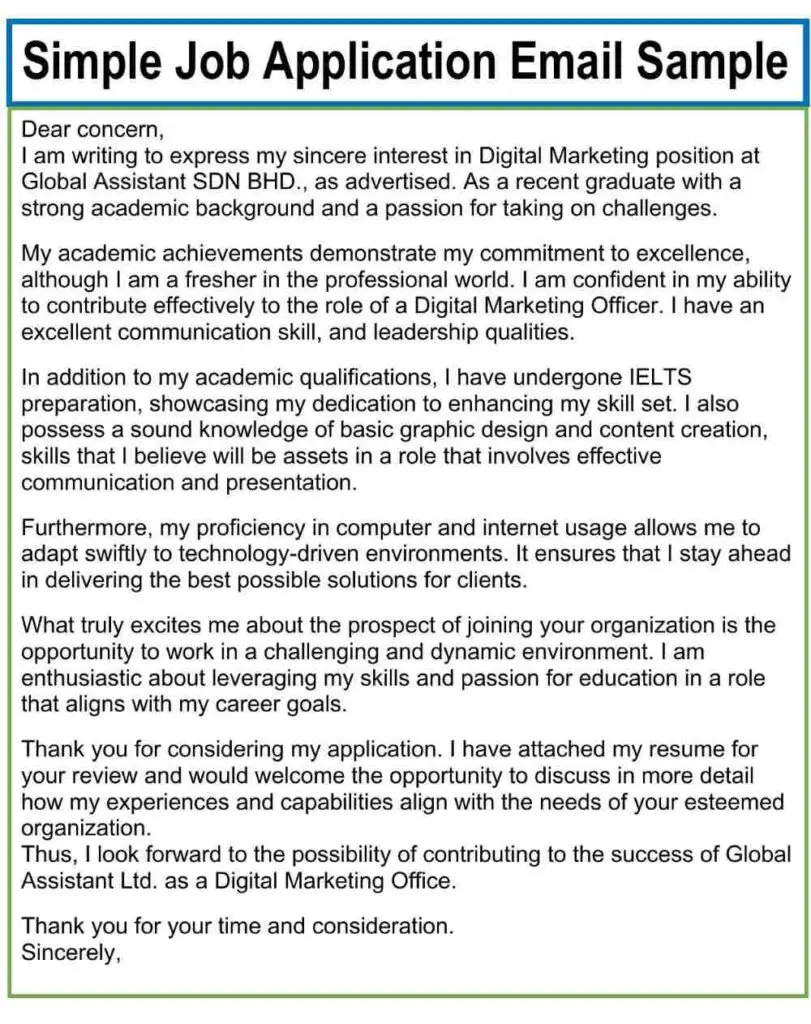
Simple Job Application Email Sample For Freshers-1
Greetings,

I trust this email finds you in good health. My name is Maena, and I'm a recent graduate with a degree in Psychology from UCSI University, Malaysia. I am interested in working as a sales and marketing executive position.

Despite my psychology background, I'm eager to pivot into sales, believing my skills are transferrable. With strong communication skills, I'm confident in my ability to contribute to this field.

I bring a blend of motivation, detail orientation, and a startup-hustle mentality, showcased through my roles as a marketing advertising specialist in Qatar and various leadership activities at UCSI University. Additionally, my active involvement in clubs and associations underscores my passion for engaging with people and fostering effective communication.

I am genuinely enthusiastic about the opportunity to contribute to your organization and am keen on further growth and learning in this role.

Thank you for considering my application. I look forward to the possibility of discussing how I can add value to your team.

Best regards,
Maeen
Simple Job Application Email Sample With Internship Skills-2
Greetings!
This is Wanita Afsana, a graduate of Monash Business School. I saw this job vacancy on Facebook and am highly interested in the Human Resources Officer Position at your company, and eager to work with you.
My academic background includes a major in Human Resource Management, providing me with a solid foundation in these areas. Furthermore, I have done my internship at Shopee Malaysia Sdn. Bhd. I have learned about HRM responsibilities, including recruitment and selection, marketing plans, and writing and modifying business plans.
I was a dedicated team member in my previous organization. With my interpersonal skills, I would like to work with your company. Moreover, I am keen to develop my professional skills and look forward to discussing my application with you at an interview. I have enclosed my resume for your consideration. I can be contacted at any time using the details provided in my resume.
Thank you in advance for your time and consideration.
Simple Job Application Email Sample-3
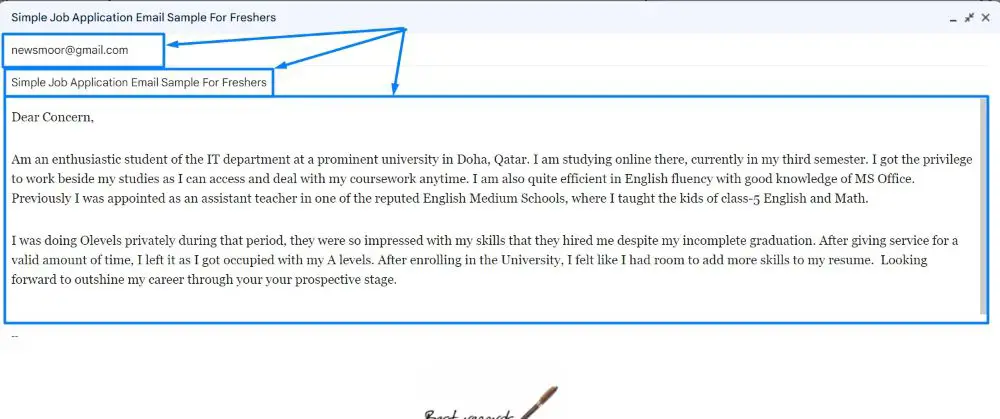
Simple Job Application Email Sample-4
Respected Concern,
I hope you are doing well. I am employed as a social media manager at Tanz IT. I’m highly interested in working with your team to showcase my verbal skills, communication, and marketing ideas. I would like to change jobs because of my Qualifications and Experience.
As requested, I have already attached my resume. Please don’t hesitate to contact me by phone or email at your convenience. Thank you for this opportunity, and I look forward to hearing from you soon.
Best Regards
Simple Job Application Email Sample-5
Hello,
I was excited to see your job listing for the “Ticket Reservation Officer” position in the BD Vacancy Announcement. With more than two years of professional experience, I’m confident that I would be a valuable asset to the team. I can book air tickets and draft travel itineraries for trips to Canada, New Zealand, the USA, and European countries. My proven track record of an excellent work ethic, unparalleled attention to detail, and high-performing service will make me an immediate asset and enable me to contribute to the team’s success.
I look forward to discussing the position and my qualifications with you in more detail. I’m enclosing my Resume for your kind consideration, and I’m available to speak at your convenience. Thank you so much for your time and consideration.
Simple Job Application Email Sample-6
I heard there is an opening at your organization. As a fresher, I wish to start my career in a reputed organization like yours.
I recently earned my B.Sc. in Textile Engineering from Southeast University. I have attached my current resume for your reference.
I am a hardworking, honest person who learns quickly. If you believe my profile meets your needs, please call me to schedule an interview.
Thanking you.
Simple Job Application Email Sample-7
Dear Sir/Madam,
I want to introduce myself. This is Gourav Nandy, a marketing major fresher from North South University. I came across this job posting on Facebook and, after reviewing the job description, I am interested in applying, as my qualifications and interests align with your needs.
I have attached my CV to this email and look forward to discussing the position and my qualifications in detail. I hope to hear from you soon. Thank you for your time and consideration.
Simple Job Application Email Sample-8
Dear Concern,
Greetings. I hope you are doing well.
I’m very interested in the position and would like to apply for the role of “education consultant.” After completing my graduation, I wanted to apply to an MBA program in Sweden. I have studied extensively about studying in Sweden, and I now understand Swedish University Fees for International Students.
I believe my expertise would contribute to your organization. My qualifications and skills align closely with your specifications. Please take a moment to review my attached CV. It would be a sincere pleasure to hear back from you soon to discuss this opportunity.
Thanks & Regards
Simple Job Application Email Sample-9
Dear Concern,
I am an enthusiastic student of the IT department at a prominent university in Doha, Qatar. I am studying online there and am currently in my third semester. I have the privilege of working alongside my studies, as I can access and complete my coursework anytime. Also, I am fluent in English and have strong proficiency in MS Office. Previously, I was appointed as an assistant teacher at a reputable English-medium school, where I taught students in Class 5 English and Math.
I was doing Olevels privately during that period, they were so impressed with my skills that they hired me despite my incomplete graduation. After providing the service for the required period, I left because I became occupied with my A levels. After enrolling in the University, I felt like I had room to add more skills to my resume.
Looking forward to advancing my career through your prospective stage.
Simple Job Application Email Sample With No Experience-10
I am writing to apply for the Education Consultant position at Global Assistant. I have completed my Bachelor’s in Linguistics with a 3.39/4.00 GPA. In 2015, I worked as an Assistant Teacher of English at Virginia International School in Araihazar, Narayanganj. I have consistently refined my work to make it more practical and relevant to real-world situations. I served as a Mentor in the English Department at Green University of Bangladesh. This mentorship program helped me develop my communication and leadership skills. My other work experience is listed in my Curriculum Vitae.
I believe as a newcomer, I can assure you that I will try to give my best.
It would be an excellent opportunity for me to work with an institution like yours. I look forward to hearing from you soon.
Simple Job Application Email Sample -11
Dear Hiring Manager,
I hope this message finds you well. I am writing to express my interest in the Education Consultant position at your company. With my background in Student Counseling & Visa Processing, client success, and my passion for helping students navigate their educational journey, I am confident that I can contribute effectively to your team.
Throughout my career, I have gained experience providing consultative services, understanding clients’ needs, and guiding them toward the best solutions. I am highly skilled in managing client relationships, providing tailored advice, and delivering exceptional support, all of which align with this role’s responsibilities.
Please find my resume attached for your consideration. I would love the opportunity to discuss how my experience and skills can benefit your team.
Thank you for your time and consideration. I look forward to the possibility of contributing to your company
Simple Job Application Email Sample -12
Dear Sir/Madam,
This email finds you well. I am writing to express my interest in the Digital Marketing Officer or Education Consultant position at the Global Association’s Kuala Lumpur Office.
I have listed my degrees from Government Bangla College, affiliated with Dhaka University, on my resume. Therefore, I am confident in my ability to help your clients by providing them with accurate information about your Company and making it a valuable resource for your organization. I believe I can make a positive contribution to your company.
Attached is my resume for your consideration. I would love the opportunity to discuss in more detail how I can contribute to your company. Thank you for your time, and I look forward to hearing from you.
Best regards,
SIRAJUM MUNIRA
Simple Job Application Email Sample -13
Dear HR,
I’m responding to your job vacancy posting on your website for the HR/Accounts Manager position and would like to be considered. I have attached my CV for your perusal.
Thank you for taking the time to consider my application for this position, and I look forward to hearing from you soon. Kind regards.
Yours sincerely,
Simple Job Application Email Sample -14
Dear Sir,
Please find my application for the education consultant post. I’ve attached a Resume. I’m excited to apply for the position. I’ve reviewed the job specification and researched your company, and I believe I have the skills and approach to perform in the role.
You can find details of my qualifications and achievements in my Resume. If you have any questions, please contact me at this email address or via the contact information in my Resume.
Please provide me with details on the next steps in the process.
Simple Job Application Email Sample -15
Simple Job Application Email Sample -16
Simple Job Application Email Sample -17
Dear Sir,
I hope this message finds you well. I am writing to express my interest in the Account Executive / HR position at Global Assistant. I recently graduated with an MBA from Dhaka University and am eager to apply my skills and knowledge in client relations, sales strategies, and communication in a dynamic, growth-driven environment like yours.
During my academic career, I developed a strong foundation in marketing, business development, and customer relationship management. I also interned at NCC Bank, where I gained hands-on experience in LCs and General Banking. This experience strengthened my ability to collaborate and deliver results in a fast-paced environment.
I am confident that my proactive approach, strong communication skills, and enthusiasm for client relationship management would make me a valuable addition to your team.
Therefore, I am keen to bring my dedication and fresh perspective to help this company achieve its business goals.
I have attached my resume for your review and would appreciate the opportunity to discuss how my background and skills align with your team’s needs. Thank you for considering my application. I look forward to the opportunity to contribute to your company’s success.
Simple Job Application Email Sample -18
Respected Hiring Manager,
Take my salam. I hope this email finds you well.
Thanks for the fantastic opportunity. I am enthusiastic about submitting my resume for the position advertised. I understand you have specific requirements for this position, and I believe I meet them. Recently, I completed my BBA in Accounting from the Department of Accounting at Bangladesh University of Business & Technology & MBA in Human Resource Management from the Department of Human Resource Management at Prime University.
In my academic work, I have studied the content and process theories of motivation, including McGregor’s Theory X and Theory Y and Herzberg’s Motivator–Hygiene Theory. Therefore, I know how to boost self-motivation to adjust to new contexts.
At present, I am serving as a “Section Officer” at Prime University. I am self-motivated, energetic, enthusiastic, and ever-ready to learn new things. I am also dedicated to delivering the highest-quality performance within my professional expertise. I believe I am the perfect candidate for this position. Please take a moment to review my attached resume. I believe you will learn more about my experience, education, and achievements.
Looking forward to hearing a positive response from your side. If you need any further information, please let me know. Thank you for taking the time.
Simple Job Application Email Sample -19
Enclosed
Simple Job Application Email Sample -20
Dear Hiring Manager,
Simple Job Application Email Sample -21
Sir/Ma’am,
Thank you for considering my application. I look forward to the opportunity to contribute to your initiatives.
Best Regards, Urbi.
Simple Job Application Email Sample -22
Simple Job Application Email Sample -23
To
Simple Job Application Email Sample -24
I am writing to express my interest in the Digital Marketing Officer position. My resume is attached for your consideration. I believe my qualifications and experience will benefit your organization’s short-term and long-term goals. I appreciate you taking the time to review my resume. You can also view my portfolio.
Looking forward to hearing from you.
Sincerely, Sonia.
Simple Job Application Email Sample -25
Dear Sir,
Simple Job Application Email Sample -26
My resume includes all the necessary qualifications, skills, and information. After conducting research, I found that my goals and values align with this institution’s requirements. I also found that I am a qualified candidate for this position.
Simple Job Application Email Sample -27
Dear HR Manager,
I hope this email finds you well. I am writing to express my interest in the Accounts Manager position. With an MBA in Accounting and a decade of experience, I am confident that my expertise in accounting, auditing, and financial management will make me a valuable asset to your team.
I have a strong background in financial analysis, financial reporting, cost control, VAT, and taxation, as well as significant experience with ERP and cloud-based accounting systems. I am also proficient in fund management, accounts receivable and payable management, payroll management, banking, account and bank reconciliation, and internal audit procedures. My previous role involved managing complex financial data, optimizing accounting systems, and ensuring accurate, timely financial reporting.
Please find my resume attached for your review. I would love the opportunity to discuss how my skills and experience align with the requirements of this role. I am available for an interview at your earliest convenience and can join immediately.
Thank you for considering my application. I look forward to the opportunity to contribute to continued success.
Simple Job Application Email Sample -28
Dear Hiring Manager,
Simple Job Application Email Sample -29
Dear Concern,
Good day! Hope that you are satisfied with everything.
I’m Tonmoy Ahmed. I have some experience in the Factory RMG, CNF, Freight Forwarding & Shipping Line Office as Assistant Manager (Accounts & Finance). I have maintained a strong reputation in the manufacturing sector for a long time. I am primarily an expert in Tally ERP 9 (Tally Prime), Redbook, Factura, and related systems.
I think just like a skilled employee is needed to maintain a factory or an office, a prudent employee is needed. If you give me an opportunity, then I will do it, Insha Allah
I need this job, sir. I can handle any challenge and make you happy (Insha Allah). If you give me a chance, I’ll try my best and won’t disappoint you
Please feel free to call me
Fresher Job Application Email Sample -30
Dear Concern,
As a graduate of the BBA in Finance & Banking and a current EMBA student at Dhaka University, I am applying for the “Education Consultant” position at your Company. My educational qualifications and skills align with the required role. I believe I would be an ideal fit for the Global Assistant Education Consultant role. I would appreciate the opportunity to demonstrate my value for this role.
Kindly find attached my CV. It would be a pleasure to discuss this exciting opportunity with you. I am looking forward to making this work.
Simple Job Application Email Sample -31
Dear Hiring Manager,
Short Job Application Email Sample -32
I am writing to express my interest in the Education Counselor position. Although my formal experience in education consulting is limited, I have worked extensively in counseling students on various aspects, including country-specific requirements, university options, and visa processes. My comprehensive knowledge allows me to provide thorough support to prospective students.
I am passionate about guiding individuals through their educational journeys and believe I would be a valuable addition to your team. Please find my CV attached for your consideration.
Short Job Application Email Sample -33
Job Application Body Email Sample -34
I wish him every success in life
Dear Sir/Madam,
In response to your job advertisement published on Facebook’s social media site. I would like to introduce myself and believe I have the skills, qualifications, and experience to make a significant contribution to your organization.
First, I have 7 years of professional experience. I work in Sales and Marketing for the Traders Sector and Real Estate Developers Company; in IT Graphics Design and Digital Marketing; and in the Consumer Products Site HR-Admin Department. Secondly, I am self-motivated, energetic, enthusiastic, and ever-ready to learn new things. Finally, I am confident I can deliver the highest level of professionalism and commitment to my work.
I am excited about the opportunity to join your team and contribute to Global Assistant’s ongoing success. Enclosed is my resume, which provides additional details about my professional background. I would welcome the opportunity to discuss in more detail how my skills and experience align with your needs.
Thank you for considering my application. My resume is attached for your consideration. If you select me for the interview, you may have the opportunity to demonstrate how my education, skills, knowledge, and experience will help you achieve your company’s goals and objectives.
Job Application Body Email Sample -35
I am confident that my qualifications, skills, and experience best suit the needs of this position.
Job Application Body Email Sample -36
Resected Hiring Manager,
I am very interested in applying for the open “Education Consultant” position at your company. I hope my qualifications align closely with your specifications. I have worked as a Campaign Manager at Frontstory (an international digital media publisher) for the last 2 years. I have worked on ad operations, media Buying, N2S, and S2S (Taboola, Baidu, Outbrain, and Zemanta). My resume is attached to this email. It would be a sincere pleasure to hear back from your reputable company soon to discuss this exciting opportunity.
Thanks and Regards,
Job Application Body Email Sample -37
Dear Sir,
Please find my application for the education consultant post. I’ve attached a Resume. I’m excited to apply for the position. I’ve reviewed the job specification and researched your company, and I believe I have the skills and approach to perform in the role.
You can find details of my qualifications and achievements in my Resume. If you have any questions, please contact me at this email address or via the contact information in my Resume.
Please provide me with details on the next steps in the process.
Job Application Body Email Sample -38
Job Application Email Writing Sample -39
Greetings!!
Thanks for the excellent opportunity. I am keen to apply for the Education Consultant position you recently advertised on an online portal. My qualifications and experience closely match your specifications.
Please take a moment to review my attached Application Documents:
– CV. It would be a sincere pleasure to hear back from you soon to discuss this exciting opportunity.
Job Application Email Writing Sample -40
Dear Sir/Ma’am
I hope you are doing well. I, Mou, have recently been working as a student counselor at an overseas education consultant, where my primary responsibilities include handling telemarketing, face-to-face counseling, SOP writing, university applications, and Visa processing. It would be an outstanding achievement for me to have the opportunity to work as an “Education Consultant” at your organization, which would inspire me to make further progress in my career.
I firmly believe it would be a significant platform for me if I get the chance to work with your organization. Additionally, I believe I am well-suited for the position and will not disappoint you. I can assure you that I will do my best for this position. Hope to hear from you soon.
Thank You, Best Regards
Short and Simple Email Example For Job Application- 41
Dear Hiring Concern,
I am writing in response to the Facebook advertisement. I am interested in the Human Resources Professional position.
On 16th October 2024, I found this job advertisement on the Vacancy Group Facebook page. I have completed my SSC, HSC & BBA in Finance and Banking. I would be an ideal candidate for the position.
I would be grateful if you could consider me for the position.
Short and Simple Email Example For Job Application- 42
With due respect, having seen your advertisement on Facebook, I would like to apply for the position of Senior Executive. I have experience with similar products and a strong overall knowledge that may be of interest.
I am confident I am a strong candidate for the position you are seeking. I would very much like the opportunity to discuss your offer further.
Email Example For Content Writing Job Application- 43
Here I enclose my Curriculum Vitae and Photograph for your kind consideration, which I will gratefully acknowledge. I hope this helps evaluate my qualifications for the position.
Thanks for the fantastic opportunity. I am keen to apply for the “Sr. Content/Article Writer” position you recently advertised. My qualifications and passion align closely with your specifications. Please take a moment to review my attached CV.
It would be a sincere pleasure to hear back from you soon to discuss this exciting opportunity.
Email Writing Sample For Job Application- 44
Thank you for considering my application. Please accept my sincere apologies for the delay in responding to this email. I am interested in learning more about the job’s jurisdiction and discussing my experience and skills with you.
For your kind information, I am not in Dhaka at the moment. I can join an online interview on April 5, 2023, or any day thereafter. If the interview must be in person, I can attend as well. In that case, I need at least one day before the interview to travel to Dhaka.
Please let me know the specific date and time for the interview, and I will adjust my schedule accordingly. Thank you for your time and consideration.
Email Writing Sample For Job Application- 45
Dear Sir / Madam
With the enclosed CV, I would like to express my sincere interest in a suitable opportunity in your organization. Firstly, I am a professional with strong expertise in customer interactions, team management, channel development & strategy planning. Additionally, I have worked at companies such as Mohammadi Group (Digi Jadoo Broadband Ltd) and MGH Group for the past 14 years, and my performance has been exemplary. I have become adept at overseeing a wide range of operational responsibilities to ensure optimal business performance and achieve substantial revenue growth. My additional success in managing and mentoring teams positions me to make a significant contribution to your organization.
I look forward to hearing from you soon.
Email Writing Example For Job Application- 46
Dear Concern,
I am writing regarding the Education Consultant position recently posted at your company. I came across this position on a social media platform and was pleasantly surprised to find that I met all the required qualifications.
I would be grateful for the opportunity to interview with you. Please have a look at the resume and cover letter attached to this email at your convenience. I have provided my contact number, should you be interested in learning more about me.
Simple Email Writing Sample For Job Application- 47
Simple Email Writing Sample For Job Application- 48
Dear Recruiter,
I am excited to submit my application for the “ Admission Officer ” position. I am interested in working for your organization and would appreciate the opportunity to be considered for employment. Hence, I feel I can make a positive contribution to your company.
In 2021, I completed a B.Sc. in Computer Science & Engineering at the University of Development Alternative (UODA). I work effectively under pressure and handle my time efficiently. I have developed excellent communication skills through my supervisory experience and campus leadership roles.
Please review my attached CV for additional details regarding my expertise. I think it will help to evaluate my qualifications for this position. I look forward to hearing something better from you.
Thank you for your time and consideration.
Job Application Email Body Sample- 49
Dear HR Manager,
I hope this email finds you well. I am writing to express my interest in the HR internship opportunity at your company, recommended by Noushin Nower Urbi. Recently, I completed my BBA at United International University. It is my final semester. My major is Human Resource Management. I am excited to contribute to such innovative work. I attached my resume here.
Thank you for considering my application. I look forward to the opportunity.
Job Application Email Body Sample- 50
Dear Concern,
I am writing to apply for the Education Consultant position at your company. I have over 4 years of experience working as a Visa Processing Officer at a well-known recruiting agency. During this time, I have developed strong skills in visa processing and in counseling both agents and candidates.
I believe my experience and skills would make me an excellent fit for your team, and I would love the opportunity to contribute to your company’s success.
Thank you for considering my application. I look forward to hearing from you.
Sincerely,
Jannatul Ferdaus Sakia
Job Application Email Body Sample-51
Dear Hiring Manager,
Greetings! Hope this email finds you well.
I’m writing to express my interest in the Admission Officer position at Global Assistant Education Consultant. I came across the opportunity recently and was drawn to your company’s role in guiding students through their educational journey.
With a background across sectors and as a master’s student at the University of Malaya, I’ve developed strong communication, coordination, and organizational skills that align well with this role. I enjoy working in student-centered environments and supporting processes that help learners achieve their academic goals.
Please find my CV attached for your review. I would appreciate the opportunity to discuss how I can contribute to your team and support your admissions operations.
Thank you for your time and consideration.
Simple Job Application Email Sample for Freshers-52
Simple Job Application Email Sample for Freshers-53
Visa Application Job Application Email Sample-54
Dear Hiring Team,
Digital Marketing Job Application Email Sample -55
Dear Hiring Manager,
I hope you are doing well. I am writing to apply for the Digital Marketing Officer position at Global Assistant Education. With over four years of practical experience in digital marketing—specializing in Meta Ads, Google Ads, SEO, content strategy, and organic marketing—I believe I am a strong fit for this role.
I have successfully managed high-budget campaigns, handled lead-generation strategies for education companies, and optimized overall marketing performance to increase conversions. I am confident that my skills, experience, and passion for digital marketing will add value to your team.
I would be grateful for the opportunity to contribute to Global Assistant Education.
My updated CV is attached for your review.
Thank you very much for your time and consideration. I look forward to your response.
Warm regards,
Tanvir
Digital Marketing Professional
Receptionist Job Application Email Sample for Freshers-56
Consultant Job Application Email Sample- 57
Dear Sir,
I hope this email finds you well. I am writing to formally apply for the Student Consultant position at your esteemed institution. I am highly interested in continuing my professional journey with your organization, where I previously worked as a Student Consultant (Intern).
During my internship at Global Assistant Education Consultant, I gained hands-on experience in assisting students with university application procedures, preparing CVs and Statements of Purpose, completing application and health declaration forms, managing student portals, and maintaining academic documentation. This experience allowed me to develop strong communication, organizational, and student counseling skills, while also giving me a clear understanding of the institution’s work culture and professional standards.
I am currently pursuing a Bachelor of Arts in English at Stamford University in Bangladesh and have worked as a private tutor for several years. My academic background, combined with my internship experience and dedication to student support services, has prepared me well for the responsibilities of a Student Consultant role.
I have attached my updated CV for your kind consideration. I would be grateful for the opportunity to discuss how my skills and prior experience with your institution can contribute positively to your team.
Thank you very much for your time and consideration. I look forward to hearing from you.
Content Writing Job Application Email Sample- 58
Dear Hiring Team at Global Assistant Education Consultant,
My name is Md. I am Rashidur Rahman, and I am writing to apply for the Content Writer position at your Mogbazar office. I am excited about the opportunity to contribute to your team by creating engaging, SEO-friendly content while supporting students in achieving their educational goals.
I hold a Bachelor of Science in Electrical and Electronic Engineering (EEE) from BRAC University and have strong written and verbal communication skills, as evidenced by an overall IELTS band score of 7, with all bands at 7. I have experience in content creation, academic support, and data annotation through my work at Acme AI, which has strengthened my attention to detail, research skills, and ability to deliver high-quality written materials under deadlines.
I am passionate about education and have prior experience interacting with students, providing guidance, and explaining academic concepts clearly. I am proficient in SEO best practices, keyword research, and digital content creation, and highly skilled with MS Office and Google Workspace for managing and organizing content efficiently.
Thank you for considering my application. I would welcome the opportunity to discuss how my skills and experience align with the Content Writer role and how I can contribute to your organization’s goals.
Sincerely,
Content Writing Job Application Email Sample- 59
Dear Hiring Manager,
I hope you are well. I am writing to apply for the 𝐂𝐨𝐧𝐭𝐞𝐧𝐭 𝐖𝐫𝐢𝐭𝐞𝐫 𝐟𝐨𝐫 𝐆𝐥𝐨𝐛𝐚𝐥 𝐀𝐬𝐬𝐢𝐬𝐭𝐚𝐧𝐭 𝐄𝐝𝐮𝐜𝐚𝐭𝐢𝐨𝐧 𝐂𝐨𝐧𝐬𝐮𝐥𝐭𝐚𝐧𝐭 position at your organization. I have experience in social media marketing, content creation, and basic digital advertising, and I am eager to contribute my skills to your team.
Please find my CV attached for your review. I would appreciate the opportunity to discuss how I can add value to your company.
Thank you for your time and consideration. I look forward to hearing from you.
Best regards,
Content Writing Job Application Email Sample- 60
Dear Hiring Team,
I hope you are doing well. I am writing to apply for the Content Writer position at Global Assistant Education Consultant. With strong English communication skills, hands-on content-creation experience, and a solid understanding of SEO and digital strategy, I am confident I can contribute effectively to your team.
I have practical experience writing engaging articles, scripts, and social media content, gained through my work as a YouTube content creator and my background in broadcasting. My professional experience in customer-facing roles has also strengthened my communication, organizational, and attention-to-detail skills—all of which help me support students and collaborate effectively with marketing teams.
I have attached my CV for your review. I would be grateful for the opportunity to discuss how I can add value to your organization.
Thank you for considering my application.
Best regards,
Content Writing Job Application Email Sample- 61
Dear Sir,
Content Writing Job Application Email Sample- 62
Content Writing Job Application Email Sample- 63
Content Writing Job Application Email Sample- 64
Content Writing Job Application Email Sample- 65
Dear Hiring Manager,
I was excited to see your opening for a Content Writer position. I am confident that my background and abilities are an excellent match for the post.
I currently work at Hat Bakso, an E-commerce platform serving Bangladesh’s souvenir industry. I oversee the end-to-end content & operations for the retail business. I create, edit, and proofread content for social media platforms (Facebook, Instagram, YouTube, TikTok, Website) and work closely with the R&D team on product development. I also serve as the spokesperson for Hat Bakso, representing the company at fairs, events & exhibitions.
Lastly, I worked at Niama International, where I primarily focused on inventory management for their e-commerce platforms and oversaw the digital marketing function. I worked closely with the design & content team to develop compelling content for buyers. I also manage customer communication on behalf of the company to drive sales and resolve issues. Previously, I worked at Quantanite, a BPO, where I collected over 10,000 leads for 3 UK-based organizations.
Please review my attached CV for additional details regarding my expertise and career achievements. Thank you for your time and consideration. I look forward to speaking with you about this employment opportunity.
Sincerely,
Content Writing Job Application Email Sample- 66
Air Ticket Reservation Officer Job Application Email Sample- 67
Dear Hiring Manager,
I hope this email finds you well. I am writing to express my interest in the Visa Application & Air Ticket Reservation Officer position at Global Assistant Education Consultant, as advertised.
I am a seasoned professional with extensive hands-on experience in consulting, client management, documentation management, administrative operations, and customer-focused services. Through my professional journey, I have developed strong expertise in handling client documentation, preparing formal written materials, maintaining accuracy, and managing multiple cases efficiently-skills that closely align with visa application processing and embassy documentation requirements.
In addition, my background in client relationship management, reporting, and coordination has strengthened my ability to communicate clearly with clients, guide them through procedures, and ensure compliance with required documentation. I am highly detail-oriented, organized, and capable of handling time-sensitive tasks with professionalism. My experience in administrative support and system-based work enables me to adapt quickly to airline booking portals, ticket reservation processes, and operational tools.
I am confident that my strong communication skills, client-focused mindset, and disciplined work ethic will allow me to contribute positively to your organization. I am eager to learn, grow, and add value as a Global Assistant Education Consultant while supporting students and travelers with accurate, efficient visa and travel services.
Please find my CV attached for your kind consideration. I would welcome the opportunity to discuss how my skills and experience can support your team.
Thank you for your time and consideration.
Job Application Email for Bangladeshi 68
Dear Sir/Madam,
I hope you are doing well.
My name is Md Fahad Sheikh, and I have completed my Bachelor of Social Science (BSS) in Social Welfare from the University of Dhaka. I am very interested in working with a Global Assistant Education Consultant and contributing to supporting students who wish to pursue higher education abroad.
I have experience in community engagement, student support activities, and volunteering, which have helped me develop strong communication and teamwork skills. I believe these skills would enable me to effectively assist students in their educational journey.
Please find my CV attached for your kind consideration. I would be grateful for the opportunity to discuss how I can contribute to your organization.
Thank you for your time and consideration.