This feature article explains the advantages and disadvantages of small-group communication. It also describes the six benefits and drawbacks of small-group communication.
List of Contents
Small-Group Communication
Small-group communication refers to the intercommunication among a small number of people who regularly communicate to achieve a shared goal. It is also known as a small group discussion or team interaction. Small group communication is essential for group learning. The vital features of group communication are Goals, Members, Interaction, Interdependence, and Working. These elements are essential to conduct small group communication. The members are the primary elements of the group communication who form the small group to achieve a common goal. For example, a small group of students communicates regularly to complete group assignments.
Small Group Communication Definition By Scholars
The definitions of small group communication by different scholars are as follows:
A small group is an interaction between two or more individuals who interact over time to achieve common group goals or achieve individual goals valued by each member who believes that this group can help them achieve them (Harris & Sherblom, 2018).
A limited number of people who communicate face-to-face share a common understanding of an interdependent goal, influence one another, and express a sense of belonging to the group (Schultz, 1996).
Two or more people interact so that each influences the other (Jones, George, and Hill, 2000).
According to David and Chris (2009), a small group of people engaged in communication interaction over time in a face-to-face or computer-mediated environment with common goals and norms, and has developed a communication pattern for meeting their goals in an Interdependent manner.
Small-group members encounter several stages and barriers to achieving individual and group goals. According to Tuckman’s group discussion theory, the five stages of small-group communication are forming, storming, norming, performing, and adjourning. The four barriers in group communication are ethnocentrism, stereotyping, prejudice, and discrimination.
Examples of Small Group Communication
Five Examples of small group communication are:
- Nuclear family members communicate with each other.
- A small group of students communicates to complete assignments.
- A few employees discuss completing office projects.
- The football team members discuss how to achieve victory.
- The Political leaders discuss how to ensure victory in the election.
Recently, virtual communication has become very prevalent in our society. Politicians, students, employees, and businessmen create a virtual group to communicate via virtual meeting platforms. People also build small groups to achieve personal, educational, and professional goals. Students hold a virtual group study meeting.
Small Group Communication Example for Students
Small-group communication occurs across various contexts and settings, involving a limited number of individuals who interact and collaborate to achieve common goals.
The author represents five examples of small-group communication:
1. Team Meetings at Organization
A group of employees gathers regularly to complete office tasks. They meet and sit together to discuss project updates, brainstorm ideas, allocate tasks, and address challenges. Team meetings facilitate collaboration, decision-making, and problem-solving among members working towards a shared goal. They keep meeting minutes to keep records.
2. Study Groups in College
Students form small study groups to review course material, prepare for exams, and work on group assignments. These study groups offer opportunities for peer learning, knowledge sharing, and academic support in a more informal, collaborative environment.
3. Family Discussions
Family members come together to discuss important decisions, such as planning a vacation, resolving conflicts, or addressing household responsibilities. Small group communication within families promotes understanding, cohesion, and shared decision-making.
Community Task Forces
A small group of community members forms a task force to address a specific issue or concern, such as improving neighborhood safety or organizing a community event. Task force meetings involve brainstorming ideas, coordinating efforts, and mobilizing resources to achieve community goals.
Support Groups
Individuals facing similar challenges or experiences come together in support groups to share their stories, offer encouragement, and provide emotional support. Whether it’s a support group for addiction recovery, grief counseling, or mental health, small-group communication fosters empathy, validation, and healing among participants.
These examples illustrate how small-group communication occurs across various contexts, serving purposes such as collaboration, learning, decision-making, support, and community engagement.
Characteristics of Small Group Communication
The five characteristics of small group communication are members, goals, interactions, working, and interdependence.
Advantages and Disadvantages of Small Group Communication
Every group communication is intended to achieve a common goal. Thus, group members communicate to achieve their individual and shared goals. However, every group discussion or communication has its advantages and disadvantages. For example, the benefits of Small Group communication include superior performance, greater member satisfaction, greater civic engagement, More learning, More creativity, Enhanced cultural understanding, and so on. In contrast, the disadvantages of small-group communication include greater time, energy, and resource demands; conflict; social loafing; blaming for shared errors; sleeping members; and scheduling problems.
Based on the study, the author has outlined the advantages and disadvantages of Small Group Communication.
Firstly, the author will discuss six advantages of small-group or team communication and discussion. After that, discuss six disadvantages of small-group or team communication or debate.
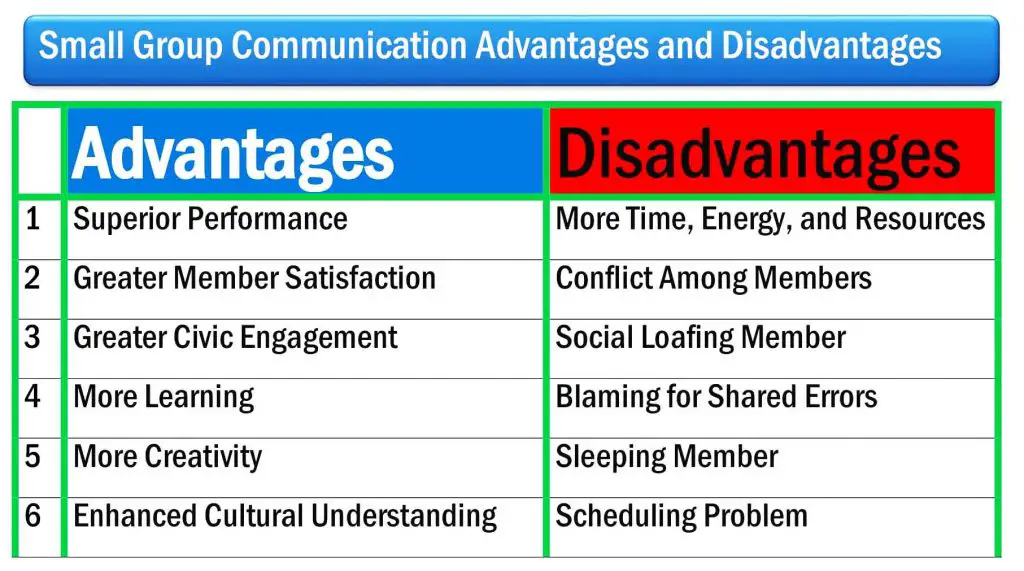
Six Advantages of Small Group Communication
- Superior performance
- Greater member satisfaction
- Greater civic engagement
- More learning
- More Creativity
- Enhanced cultural understanding
1. Superior Performance
According to MIT Management Professor Peter Senge: “If you want something really creative done, you ask a team to do it, instead of sending one person off to do it on their own.” Groups make better decisions and solve incredibly complex, unclear problems. Finally, groups share the workload among group members.
2. Greater Member Satisfaction
Social benefits – the opportunity to make friends, socialize, receive peer support, and feel part of a unified and successful team or group. The more opportunities group members have to communicate with one another, the more satisfied they are with the group experience.
3. Greater Civic Engagement
You can apply theories, methods, and tools to better engage in service to the community you learn in a group communication course.
4. More Learning
- A group provides many resources to work on a problem
- “Synergistic” effect (Buckminster Fuller, the architect of the geodesic)
- Synergy = the sum is more significant than its parts
- Members can also learn from other members
- New members learn from veterans; similar amateurs learn from experts.
- They also learn more about working as a group, rather than merely discussing topics.
- It also helps in the decision-making process.
- It is the result of interacting individuals stimulating one another, so that what emerges is something no single member could accomplish working alone.
- Additionally, it allows group members to share collective information, stimulate critical thinking, challenge assumptions, and raise achievement standards.
- In the academic context, collaborative learning promotes higher individual achievement in knowledge acquisition, retention, accuracy, problem-solving, creativity, and higher-level reasoning.
5. More Creativity
The key to creativity is the mental flexibility to blend ideas from our many experiences. Groups provide a creative multiplier effect by tapping more information, brainpower, and insights.
6. Enhanced Cultural Understanding
Members differ in characteristics, life experiences, cultures, interests, and attitudes. Therefore, group members get a chance to enhance their cultural understanding of others. Working effectively = understanding, respecting, and adapting to differences in members’ skills, experiences, opinions, behavior, and differences in gender, age, ethnicity, nationality, religion, race, status, and worldviews.
Six Disadvantages of Small Group Communication
- More time, energy, and resources
- Conflict
- Social Loafing
- Blaming for shared errors
- Sleeping Member
- Scheduling
1. More Time, Energy, and Resources
A group needs more time, energy, and resources to discuss issues, analyze, and resolve problems. In contrast, less time, energy, and resources are required when an individual works alone.
A group does not have a long attention span; instead, it has a short one (David Berg, 1967). However, a long attention span is necessary to complete the task within the allotted time.
In group communication, they tend to get sidetracked. Similarly, topics that do not pertain to the discussion may be brought up.
2. Conflict
Disagreement = aggressive, also disruptive
Group members are often confronted with an individual who wants to take over, leading to conflict in group communication.
3. Social Loafing
Social loafing refers to the tendency of a person or group member to put less effort into achieving a goal than other members. They work very well alone to complete their tasks but put less effort into working in a group. Therefore, sometimes, social loafing makes a group less productive.
4. Blaming for shared errors
A proverb says that to err is human. Errors arise from personal and group activities; therefore, it is essential to identify the root cause of errors and the person responsible for them. Sometimes, group members do not acknowledge shared mistakes; instead, they blame each other. Therefore, blaming for shared mistakes might increase conflict among group members, which reduces productivity.
5. Sleeping Member
Sleeping members are always a barrier to reducing production in Small groups because they do not achieve the goal.
6. Scheduling Problem
Scheduling a group or team meeting is a challenge the group faces regularly. Usually, all group members are unavailable to join the meeting at the same time due to their busy schedules. Hence, it reduces group productivity, not for scheduling regular meetings among members. Therefore, scheduling group meetings is essential in increasing group members’ commitment.
Conclusion
The advantages and disadvantages of small-group communication have been discussed in detail in this article so that readers understand small-group or team communication. Of course, the group or team must take the necessary steps to ensure effective communication among members. However, reducing the disadvantages of small-group communication will surely increase productivity.
The Rationale for Studying Small Group Communication
Firstly, we live among many small groups; for example, your family group and groups of close friends. Additionally, colleagues at work, social and recreational clubs, athletic teams, and many more. In addition, the world of work—government, politics, health, a business groups. The work relies on small groups of experts to gather, interpret, and present data to the decision-makers in their organizations. Similarly, Learning how to act and react in a group can help you overcome anxiety and uncertainty. Finally, it enables you to diagnose and improve your performance.
Citation for this Article (APA 7th Edition)
|
Kobiruzzaman, M. M. (2026). Advantages and Disadvantages of Small Group Communication PDF. Newsmoor. https://newsmoor.com/advantages-and-disadvantages-of-small-group-communication-pros-cons/ |
References
- Berg, D. M. (1967). A thematic approach to the analysis of the task‐oriented, small group. Communication Studies, 18(4), 285-291.
- Harris, T. E., & Sherblom, J. C. (2018). Small group and team communication. Waveland Press. Schultz, D. E. (1996). The inevitability of integrated communications. Journal of Business Research, 37(3), 139-146.

M M Kobiruzzaman is a researcher, academic content writer, traveler, and the founding editor of Newsmoor.com. Specializing in communication, management, technology adoption models, and frameworks analysis, and journalism, his work bridges the gap between theory explanation and cultural communication. With a strong background in communication and management, he is dedicated to providing authoritative guides that elevate business and media literacy and academic writing standards.
"." Newsmoor,

Comments are closed.