Understanding Minutes of Meeting Examples is essential for effective communication and organization within any group. This content demonstrates the elements, examples, and importance of meeting minutes.
List of Contents
Minutes of Meeting
Meeting Minutes are a written record of the activities of a company, organization, or group. It is also known as the meeting notes. Meeting minutes record what happened during a meeting. Additionally, it records the decisions taken during the discussion. Furthermore, the employee can revisit the important issue discussed in the conference. Finally, the purpose of minutes is to take detailed notes during the meeting on attendance, discussion, who is responsible for which tasks, how to solve problems, vision and mission, and more. Therefore, taking meeting minutes with specific notes is an essential part of every formal meeting discussion.
Minutes of Meeting Types
Examples of Minutes of Meeting Examples
The two types of meeting minutes are physical and online. Physical meeting minutes include the meeting location and venue. On the other hand, virtual meeting minutes are recorded on platforms such as Google Meet, Zoom, and Microsoft Teams. The physical meeting minutes are also known as minutes.
Minutes of Meeting Example
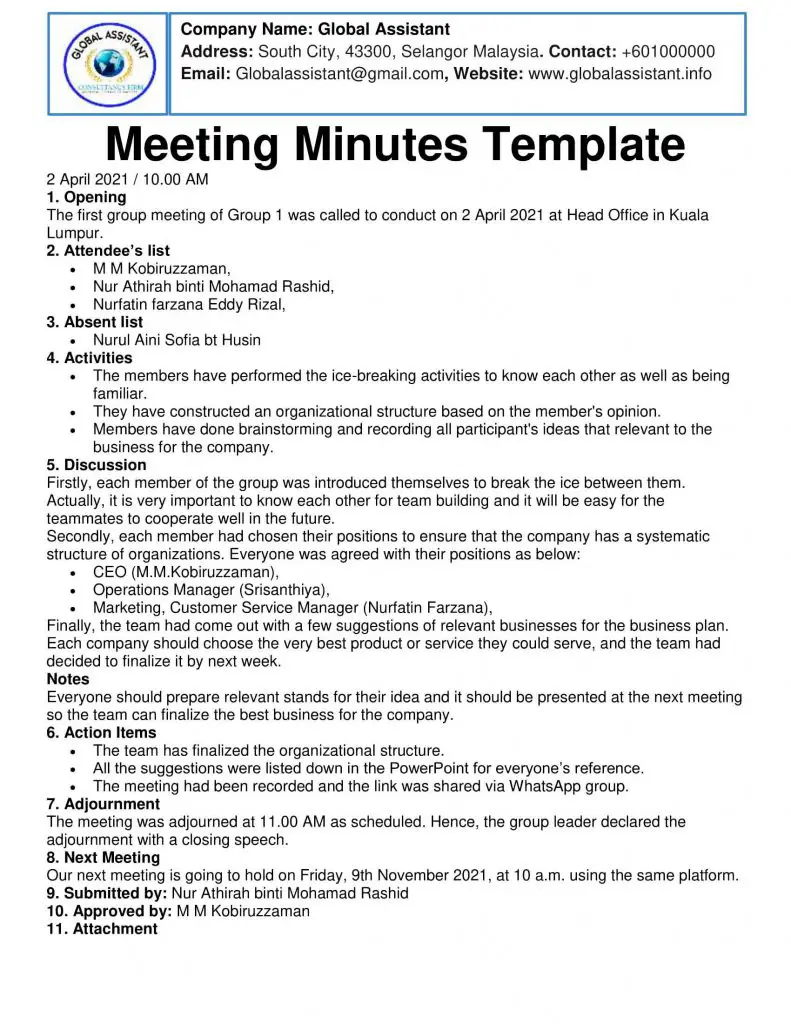
In addition to noting the location, physical meeting minutes should capture key discussions and decisions made during the meeting. For online meetings, it’s crucial to include participant names and their contributions to maintain clarity. Both types of minutes should be distributed promptly to all attendees to ensure everyone is informed. Regularly reviewing past minutes can help track progress on action items. Proper documentation fosters accountability and enhances the effectiveness of future meetings.
The example of physical and virtual meeting minutes has been discussed here for better understanding.
Elements of Meeting Minutes
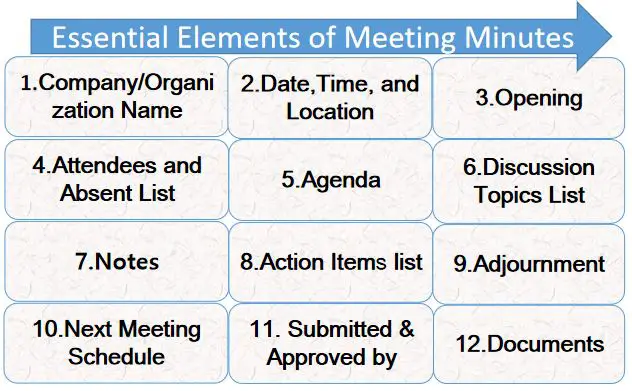
The 12 elements of meeting minutes are:
1. Company or organization name
2. Date, Time & Location
3. Opening
4. List of attendees and Absent
5. Agenda
6. Discussion
7. Note
8. Action Items
9. Adjournment
10. Submitted by
11, approved by
12. Documents.
1. Company or Organization Name
The company name is the essential element of meeting minutes. Every minute of the meeting needs to include the exact organization name at the top of the letter, and include a logo if you have one.
2. Date, Time & Location
The precise date, time, and location are the prime components of minutes to express the profound meaning of discussion meetings.
3. Opening
For example, the regular weekly meeting of the Demigods Bullies group was called to order on 24 June 2024 at 4:00 PM in room 202 of the Faculty of Modern Language and Communication.
4. List of attendees
The list of attendees includes all the participants of the meeting. For example, the members who participated in the meeting.
List of Absences
It notifies those who did not join the meeting. For example, the members who did not join the meeting discussion. It also updates and reminds members who are absent from the meeting.
5. Agenda
The agenda includes the discussion issues in the meeting. It seems the main plan is a list of activities—topics to be discussed at the meeting.
6. Discussion
This is similar to the agenda, but it provides a brief discussion of the main point. The members discuss issues briefly. Every member tries to provide their opinions.
7. Note
It is a way to record key points from the discussion. Take a record of who will do which task later. The note here implies a list of people assigned specific tasks.
8. Action Items
Based on the discussions, I identified a few issues that must be completed within a set timeframe. For example, how many decisions were made during the meeting? In this stage, you have to follow the 5W and 1H rules to accomplish.
9. Adjournment
It is written evidence of when and how the meeting was dismissed.
10. Submitted by
It represents who writes the meeting minutes and submits them to the authority.
11. Approved by
It describes the top management individual who accepts and approves the meeting.
12. Documents
Documents are the items we attach to the meeting minutes, such as photos, Word files, and PDF files.
In conclusion, you can add some extra elements if necessary, but they should be more specific and meaningful. Above all, these components of meeting minutes will make your minutes of meeting minutes more significant.
Minutes of Meeting Elements
Minutes of Meeting Example For Students
University students designed the following meeting minutes. The author wrote these meeting minutes based on group meetings to complete an assignment. It was not a business meeting. However, it represents how to write business minutes.
Demigod Anti-Bullying Students Group
Minutes of Meeting
24 June 2024/ 4:00 PM
Opening
The regular weekly meeting of Demigods Bullies was called to order on 24 June 2024 at 4:00 PM in room 202 of the Faculty of Modern Language and Communication, Universiti Putra Malaysia.
Attendees List
Kobiruzzaman, Joshua, and Samuel.
Absent List
MaXiaojie, Rania.
Agenda
Capturing photos and making a video
Active on Social media
Planning for a drama and talk show program.
Discussion
First, we must create photos and videos to illustrate the negative impact of bullying and cyberbullying. These photos and videos will represent our activity with diverse creativity.
In addition, all group members must emphasize social media activities such as uploading photos and videos regarding bullying and cyberbullying.
Finally, we must prepare adequately to perform effectively in the final program at Dewan Za’ba. Every group member will rehearse according to the script.
Notes
Kobiruzzaman will be responsible for booking the Dewan Za’ba hall room for our final program by next week.
Additionally, Joshua will print out all posters with proposals.
Samuel and Jiven will go to the departmental office to get the necessary signatures to approve these posters for hanging on the boards.
Action Items
A group session on dividing group members’ duties for the social campaign, focusing on the negative impact of bullying and cyberbullying, will be held on 29 November 2019. Additionally, we have finalized the dress code, food, and beverages for the program.
The member has approved the program budget; therefore, everyone must deposit payment before the due date.
Adjournment
The meeting was adjourned at 6 PM by the anonymous decision of group members. Hence, the group leader announced the adjournment loudly.
Next Meeting
According to today’s meeting decision, our next meeting will be held on Tuesday, 5th November 2019, at 3 pm in the same venue.
Submitted by
The person who creates the meeting minutes. For example, M M Kobiruzzaman
Approved by
For example, the group leader’s name.
Importance of Meeting Minutes
Firstly, the meeting minutes record the exact date, time, location, and meeting activities. It is a form of formal evidence that documents your whereabouts. Also, it keeps clear records of attendees who attended and those who didn’t.
Further, it elaborates on the agenda and discussion topics, who will be responsible, and how to solve the problem or achieve the goals. Usually, group discussion doesn’t have a long attention span. So, minutes help to divert from sidetracking and facilitate staying on track.
Furthermore, minutes record the list of action items and the adjournment time precisely. Typically, the action list indicates members’ awareness of their respective duties and their proper, on-time performance.
Finally, the minutes of the meeting state the upcoming schedule, including specific dates and times, and list the names of those who submitted and approved it. It is an alarming directive for group members to prepare for a new meeting.

M M Kobiruzzaman is a researcher, academic content writer, traveler, and the founding editor of Newsmoor.com. Specializing in communication, management, technology adoption models, and frameworks analysis, and journalism, his work bridges the gap between theory explanation and cultural communication. With a strong background in communication and management, he is dedicated to providing authoritative guides that elevate business and media literacy and academic writing standards.
"." Newsmoor,

Comments are closed.