Questionnaire Introduction Example. Survey Introduction Sample For Students. Also, the Survey Questionnaire Introduction Sample For the Research Paper
Survey Questionnaire
A survey questionnaire is a set of questions designed to conduct survey research for academic and business purposes. The researchers set survey questionnaires to collect data for quantitative analysis. The survey questionnaire aims to collect data from respondents. The survey questionnaire has three sections: questionnaire introduction, demographic questions or respondents’ personal information, and research questions. Many researchers term quantitative research questionnaires as survey questions or surveys. However, the questionnaire differs from the quantitative survey and qualitative interview questions. The Survey and questionnaire introduction is the opening section of the questionnaire.
Questionnaire Introduction
The questionnaire introduction refers to the explanation part of the research questions and the preface of the questionnaire. It is also known as the survey introduction, which explains 5WS and 1 H questions regarding the research, such as who is collecting the data, the objective of the study, and how to collect the data. The questionnaire’s introduction also describes how the researcher collects data from where. It also includes the objective of the research for the respondents and informants. Finally, the questionnaire introduction section ensures that the participants or recipients will keep the survey data anonymous and confidential.
The four elements of the questionnaire introduction are the student or researcher’s name, representing the Institute or Organization name, the objective of the research, data confidentiality, and anonymity.
The author has collected a few examples of questionnaire introductions from the final-year students at UPM to present to new researchers. So, these examples will surely assist undergraduate, master’s, and Ph.D. students in completing their thesis and dissertation. In addition, the researchers might obtain comprehensive knowledge on how to write the questionnaire’s introduction and set questions.
Questionnaire Sample For Research Paper
Survey Questionnaire Introduction Example
The author shows questionnaire introduction examples for the thesis, dissertation, and research paper. So, the undergraduate and postgraduate students get ideas on how to write a survey questionnaire introduction. Additionally, examples of questionnaire introductions for research have been displayed for researchers. The questionnaire introduction is also known as the survey introduction.
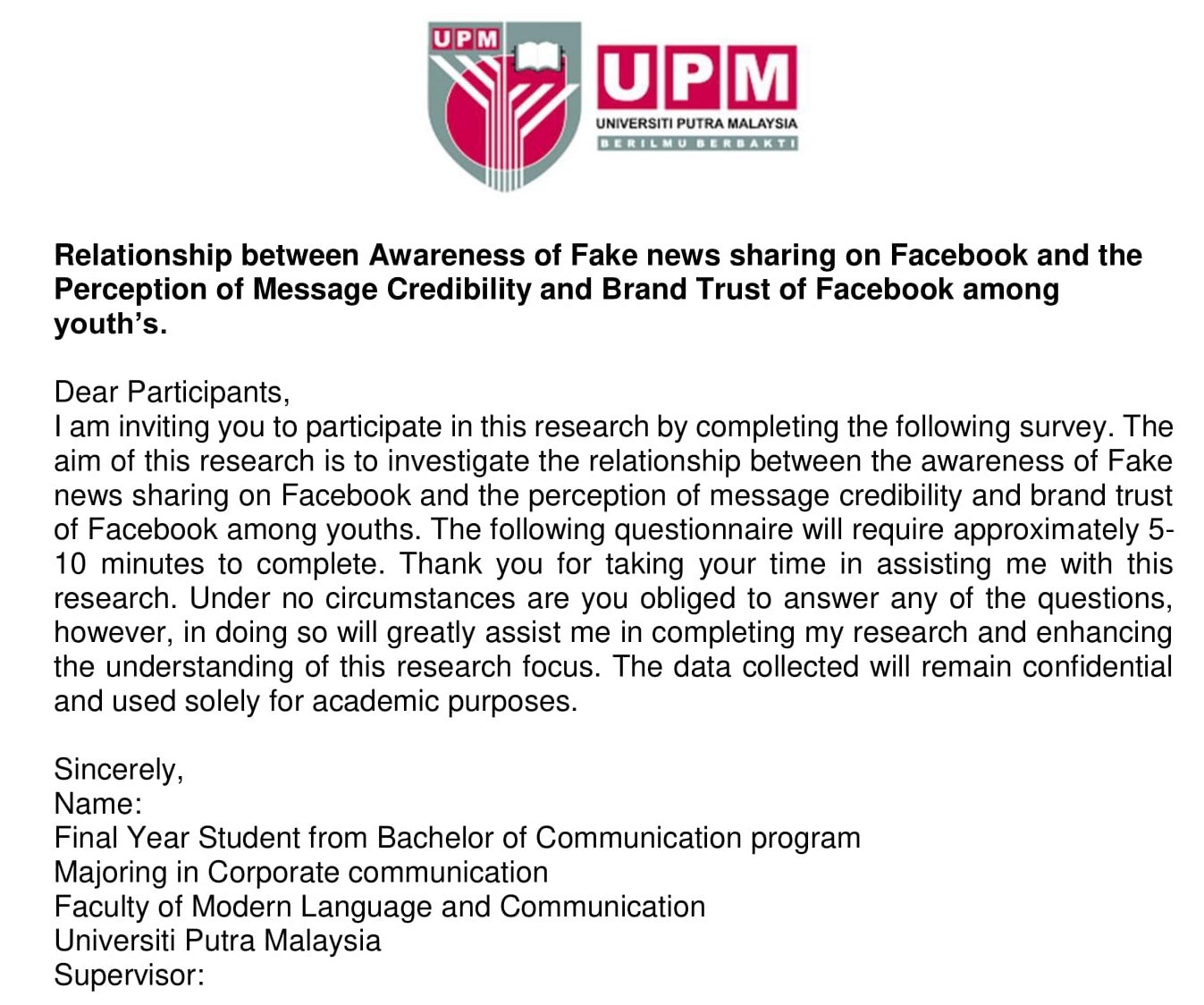
Example of Research Questionnaire Introduction
Thesis Title: An Examination of the Relationship Between Social Media Engagement and Citizen Journalism Practice

Dear Participants,
I am inviting you to participate in this research by completing the following survey. The aim of this research is to examine the Relationship Between Social Media Engagement and Citizen Journalism Practice. The following questionnaire will require approximately 5-10 minutes to complete. Thank you for taking your time in assisting me with this research. Under no circumstances are you obliged to answer any of the questions, however, doing so will greatly assist me to complete my research and enhance the understanding of this research focus. The data collected will remain confidential and used solely for academic purposes.
Sincerely,
M M Kobiruzzaman
Faculty of Modern Languages and Communication
University Putra Malaysia
Supervisor: Associate Professor Dr. Mohd Nizam Osman

Online Questionnaire Link
Questionnaire Introduction Example For a Quantitative Thesis
Title: The Antecedent of Artificial Intelligence Adoption Among Human Resource Professionals in Tourism & Hospitality Industry in Malaysia.
Dear Participants,
I am inviting you to participate in this research by providing information based on the following survey questions. This research aims to examine the antecedents of Artificial Intelligence (AI) adoption among HR professionals in the tourism and hospitality industry in Malaysia. The following questionnaire will require approximately 5-10 minutes to complete. Thank you for investing your time in this research. Under no circumstances are you obliged to answer any of the questions; however, doing so will greatly assist me in completing my research and enhancing my understanding of this research focus. The data collected will remain confidential and will be used solely for academic purposes.
Sincerely,
M M Kobiruzzaman
SCHOOL OF BUSINESS AND ECONOMICS
Universiti Putra Malaysia
Example of Quantitative Research Questionnaire-1
Survey Questionnaire Introduction Sample For Research Paper
I am a student studying corporate communication in the last year student of the University of Putra Malaysia. My final year project is currently underway to examine the Goals and Effectiveness of Internal Communication among UPM Faculty of Modern Languages and Communications Students. I sincerely invite you to participate in this survey by filling in the following questionnaire. Your contribution to insight is precious. As per the survey questionnaires, you need about five minutes to complete them. Finally, I assure you that I will keep the information confidential and only use it for academic purposes. Glad to get your help! Thank you!
Email: for example, abc@gmail.com
Questionnaire Introduction Example-2
Research Title: The Emotional Impact of Peer Influence And Sexting Among University Students.
Survey Questionnaire Introduction Sample For Research Paper
I am a final year undergraduate student with a bachelor of communication at UPM. I request you to join my project by completing the following survey questionnaire. It may take around 3-5 minutes to complete the survey. However, we will use the research information for academic purposes. Additionally, we will keep your responses anonymous and confidential. Your support towards my following research will help me conduct the study ideally. Thank you very much.
Questionnaire Introduction Example-3
Dissertation Title: Investigation of the influence of Infordemic on UPM students’ attitude towards Social Media
Survey Introduction Sample
I am a final year postgraduate student from the Faculty of Modern Languages and Communication at UPM. I am surveying to help better understand how accurate and inaccurate information affects students’ attitudes toward social media during the pandemic. To better understand the impact of the information epidemic, I would like to ask you some questions about the information you may be exposed to during the epidemic and your experience and feelings in the face of inaccurate and accurate information. Based on your experience, this survey may take you 5 to 8 minutes, not more than 10 minutes. Thank you for your participation.
Questionnaire Introduction Example-4
Survey Title: Social Media Influence on Corporate Branding for Universiti Putra Malaysia
Survey Introduction Example
Dear respondent, my name is Athaya, also a final year student at the Universiti Putra Malaysia. I am currently working on my final year research project to examine social media influence on corporate branding for Universiti Putra Malaysia. This survey questionnaire is open to local and international students from FBMK and FEP. This survey might not take more than 5 or 6 minutes.
Your participation is entirely voluntary, and all information collected in this survey will be kept strictly confidential. The information gathered will only be used for the following study purposes. You have the right to refuse to answer any questions/items or to avoid participating at any time for any reason. If you have any queries regarding the survey questions, do contact me via e-mail. Thank you for giving your valuable time to complete the following survey questionnaires.
Sincerely, (For example, Athaya)
Questionnaire Introduction Example-5
Thesis Title: The Relationship Between Cyberbullying on Social Media and The Impacts on Mental Health of Young Adults In Upm
Survey Questionnaire Introduction Sample For Research Paper
Dear participants, I am Raisa, also a student at the University of Putra Malaysia. I am requesting you to participate in this research by completing the following questionnaire. This study aims to determine the relationship between cyberbullying on social media and the impacts on the mental health of young adults in UPM. However, this questionnaire will require approximately 5-10 minutes of your cooperation.
Everyone’s experience matters in this study, and it is assured that your responses will be treated with extreme confidentiality. Thank you.
Sincerely, (For example, Raisa)
Questionnaire Introduction Example-6
Survey Questionnaire Introduction Sample For Research Paper
Dear participants, my name is Alya. I am researching ‘A Language Structure Analysis on Politeness Strategies in Mobile Media and Communication Between Instagram Sellers and Undergraduates’, focusing on the interactions between Instagram small business owners and their customers. This questionnaire is open to all undergraduate students in Malaysia who have experience interacting with small Instagram sellers in Malaysia.
This questionnaire has three sections and will not take more than 10 minutes to complete. However, in one of the sections, you must upload a screenshot of conversations between the Instagram sellers.
This research is solely for academic purposes, and your assistance in completing the following questionnaire will be greatly appreciated. With the consent given by answering this survey, your participation and information will remain confidential, and anonymous and only be used for the following research purposes.
Thank you.
Sincerely, (For example, Alya)
Questionnaire Introduction Example-7
Survey Questionnaire Introduction Sample For Research Paper
Dear participants, this is Rocky, and I am inviting you to join my research project by completing the following survey questions. This study aims to understand the perception of the UPM students’ academic performance towards online university newspapers in their research. This questionnaire will require approximately 5-10 minutes of your cooperation. Your assistance in my following research will significantly help me complete my research and enhance my research ability. Thank you in advance for your cooperation.
Sincerely, (For example, Rocky)
Questionnaire Introduction Example-8
Greetings from the Faculty of Human Ecology, University Putra Malaysia. I am Law Kai Wei, a student of Bachelor of Consumer Studies. I am currently researching my final year project entitled “Determinants of UPM Students’ Purchase Behaviour for Green Personal Care Products.”
This research investigates the factors that influence the intention and behavior to purchase green personal care products among UPM students.
This questionnaire has eight (8) sections and will only take around 10 minutes of your time. You agree that you will answer truthfully and consent to share your personal information by answering this questionnaire. Your participation will determine the accuracy and, most importantly, contribute to the success of this research. Any information given is confidentially assured, and participants will be kept anonymous.
I will very much appreciate your time and cooperation! Thank you.
Questionnaire Introduction Example-9
Thesis Title: Impact of COVID-19 on the Physical Activities and Social Interaction on the Psychological Wellbeing of Universiti Putra Malaysia (UPM) Students
Greetings! I am Ho Chang Xian from the Faculty of Human Ecology, Universiti Putra Malaysia. I am conducting a final year project research entitled “Impact of COVID-19 on the Physical Activities and Social Interaction on the Psychological Wellbeing of Universiti Putra Malaysia (UPM) students.”
This research aims to determine the impact of COVID-19 on physical activity and social interaction on the psychological well-being of UPM students.
The questionnaire consists of 4 sections which are: A (Demography), B (Physical Activity), C (Social Interaction), and D (Psychology well-being).
This questionnaire should take less than 10 minutes to complete.
You hereby agree to participate in this research by clicking the following button voluntarily. Rest assured that your data will be kept confidential, and you may withdraw anytime before you submit this questionnaire.
If you have any inquiries or questions, you may contact me at:
Questionnaire Introduction Example-10
Thesis Survey Introduction Example
Dear Participants,
I am researching “The Influence of The Star Online Political News on The Perception of Political Issues in Malaysia Among UPM Students.” I invite you to participate in this research by completing the following survey. This research aims to analyze the relationship between Star Online political news consumption and its influence on the perception of political issues in Malaysia among UPM students. The following questionnaire will take approximately only 5-10 minutes to complete.
I truly appreciate your valuable time and effort in helping me with this research. Under no circumstances are you obliged to answer any of these questions; however, doing so will be very helpful for me to complete my research and improve my understanding of this research. I ensure that all your information and data collected for this research will remain confidential and will be used for academic purposes only. In conclusion, the questionnaire introduction sample applies to all types of research designed to survey. Sometimes, researchers should include self-introduction shortly.
Questionnaire Introduction Example-11
Dear All,
All students are invited to participate in a study entitled, “An Exploratory Study of Cyber Sexual Harassment Among Female University Students at Higher Learning Institutions in Malaysia”.
This study aims to study the cyber sexual harassment experience among female students at higher learning institutions in Malaysia and its impact on their academic performance, health, and self-esteem. The identity of the respondents and the higher learning institutions will be maintained anonymous and the results will remain confidential.
A copy of the questions and the questionnaire link is enclosed here for your reference and further action :
https://forms.gle/v7ccusd9m3GT
Survey Questionnaire Introduction Example-12
INVITATION TO PARTICIPATE IN THE “USER’S SATISFACTION SURVEY: PERPUSTAKAAN SULTAN ABDUL SAMAD UNIVERSITI PUTRA MALAYSIA.
We wish to inform you that Perpustakaan Sultan Abdul Samad, UPM is conducting a ‘User’s Satisfaction Survey’ for the year 2023. Please assist us in our efforts to improve our existing services by spending a few minutes of your time answering the survey questions. This survey is designed for students and staff in Universiti Putra Malaysia. This survey aims to acquire users’ feedback on the services, facilities, and infrastructure provided by the library. Please provide your comments and suggestions for further improving our services and facilities.
Please note that all responses are confidential and anonymous. The link to the survey questionnaire is as below:
Thank you.
Final Year Project Survey Introduction Sample-13
Final Year Project: Perception of Green Consumption Intention Among Undergraduate Students in UPM.
Good day everyone! I am Teh Hooi Wen, a final year Bachelor of Accounting student at Universiti Putra Malaysia.
I am currently researching “Perception of Green Consumption Intention Among Undergraduate Students in UPM”. If you are a present UPM undergraduate student, I would like to invite you to participate in my research by completing this questionnaire.
It would be greatly appreciated if you could spend around 5 minutes to complete this survey. Kindly click the link below to access the questionnaire: https://forms.
Please rest assured that all the information you provide will be kept confidential and solely used for this research. Your participation in answering this questionnaire would be greatly appreciated.
If you have any inquiries, feel free to reach out to me at 206539@student.upm.edu.my.
Thank you for your time and effort.
Sincerely,
Teh Hooi Wen
Bachelor in Accounting (Honours)
School of Business and Economics
Universiti Putra Malaysia
Survey Questionnaire Introduction Sample-14
I am Divya, a PhD student and Graduate Research Assistant from the Faculty of Education, University of Malaya, Malaysia. Currently, my supervisor, Associate Professor Dr. Lau Poh Li and I are conducting a study under the FRGS Grant entitled “The Development of Career Adaptability Model for Students in Public Universities”. The study involves exploring the career development of undergraduate and postgraduate students in research public universities in Malaysia.
I would like to humbly request if it is possible to send the research survey link to the students at Universiti Putra Malaysia. I have reached out to each faculty individually. They have forwarded the link to the students, however, the response is still low and we’re in the final stage of data collection. I have attached the ethics approval received from the University of Malaya.
If you require any further information, please do not hesitate to contact me on 012-000000 or e-mail me at divy@um.edu.my. Thank you for your time and consideration in this matter.
Survey Introduction Sample-15
Survey Introduction Sample for Students- 16
Virtual Work in the Global South
This survey is titled “Facing the Realities of Flexibility: Shaping the Future of Virtual Work in Developing Countries”.
Purpose of the Survey: We aim to examine how HRM practices facilitate or hinder effectiveness and inclusivity in virtual work in developing countries. Your participation will help us understand how virtual work is being designed, utilized, and experienced in developing countries.
By virtual work, we mean work done remotely or from home.
Who can complete the survey?
Anyone who resides in Bangladesh, Ghana, Malaysia, or Nigeria and works/has worked virtually, remotely, or worked from home for at least one day a week for a minimum of one year.
Confidentiality: All your responses will be kept confidential. Your answers will not be identifiable in any reports or publications that may result from this study. Your anonymity and confidentiality will be protected throughout the research process. All data will be stored securely and only used for this study. We will not share your personal information with any third parties without your consent.
Participation:
Time Commitment: We estimate that completing this survey will take approximately 15-20 minutes.
Risks and Benefits: There are no known risks associated with participating in this survey. Please note that there are no financial benefits associated with completing this survey; however, we appreciate your time and effort. The potential benefits include valuable insights that will help us understand how virtual work is designed, used, and experienced in developing countries.
Contact Information:
By clicking “Next” or proceeding with the survey, you indicate that you have read and understood this information and consent to participate in this study.
Thank you for your willingness to participate!
Survey Questionnaire Cover Sample- 17
This survey is titled “Facing the Realities of Flexibility: Shaping the Future of Virtual Work in Developing Countries”.
Purpose of the Survey: We aim to examine how HRM practices facilitate or hinder effectiveness and inclusivity in virtual work in developing countries. Your participation will help us understand how virtual work is being designed, utilized, and experienced in developing countries.
By virtual work, we mean work done remotely or from home.
Who can complete the survey?
Anyone who resides in Bangladesh, Ghana, Malaysia, or Nigeria and works/has worked virtually, remotely, or worked from home for at least one day a week for a minimum of one year.
Confidentiality: All your responses will be kept confidential. Your answers will not be identifiable in any reports or publications that may result from this study. Your anonymity and confidentiality will be protected throughout the research process. All data will be stored securely and only used for this study. We will not share your personal information with any third parties without your consent.
Participation: Participation in this survey is entirely voluntary. You may skip any questions that make you uncomfortable, and you are free to withdraw from the survey at any time.
Time Commitment: We estimate that completing this survey will take approximately 15-20 minutes.
Risks and Benefits:
There are no known risks associated with participating in this survey. Please note that there are no financial benefits associated with completing this survey; however, we appreciate your time and effort. The potential benefits include valuable insights that will help us understand how virtual work is designed, used, and experienced in developing countries.
Contact Information: If you have any questions about this survey or your rights as a participant, please contact Dr. Olatunji Adekoya (Sheffield Hallam University) at O.Adekoya@shu.ac.uk
By clicking “Next” or proceeding with the survey, you indicate that you have read and understood this information and consent to participate in this study.
Thank you for your willingness to participate!

M M Kobiruzzaman is a researcher, academic content writer, traveler, and the founding editor of Newsmoor.com. Specializing in communication, management, technology adoption models, and frameworks analysis, and journalism, his work bridges the gap between theory explanation and cultural communication. With a strong background in communication and management, he is dedicated to providing authoritative guides that elevate business and media literacy and academic writing standards.