Natural and Human Causes of Climate Change PDF 2026

This Content Demonstrates the Natural and Human Causes of Climate Change in 2026.

Climate Change

Climate change refers to the long-term changes in weather conditions, such as temperature, precipitation, tsunamis, and drought, on Earth. It means different weather on the Earth compared to earlier decades. So, climate change refers to global warming on Earth.  For example, now the Earth is warmer than it was thousands of years ago. NASA scientists have stated that the Earth’s temperature has increased rapidly in the past 150 years. It is estimated that the average temperature has risen by approximately 2 degrees Fahrenheit over the last 100 years. Although Earth’s temperature has been evolving, the previous five years were the warmest of the century. Therefore, climate change has been a much-talked-about topic for global leaders. Scientists mention the natural and human causes of climate change on the Planet.

Causes of Climate Change

The causes of climate change include natural factors and human activities that alter the Earth’s atmosphere. Scientists have identified many natural factors and human activities that influence the global atmosphere.

Natural Causes of Climate Change

Natural causes of climate change refer to the factors and activities that change the Earth’s atmosphere. It might occur throughout the Earth’s cycle of motion, ocean currents, plate movement, volcanic eruptions, natural forest fires, and greenhouse gases. Natural causes are natural factors that occur mostly automatically, rather than people’s contributions.

What are the natural causes of climate change?
The Nine Natural Causes of Climate Change are:
  1. Solar Variation
  2. Volcanic Eruptions
  3. Axial Tilt
  4. Precession
  5. Eccentricity
  6. Continental Drift
  7. Ocean Current
  8. Natural Forest Fire
  9. Natural Greenhouse Gases. 
Causes of Climate Change Diagram in 2024
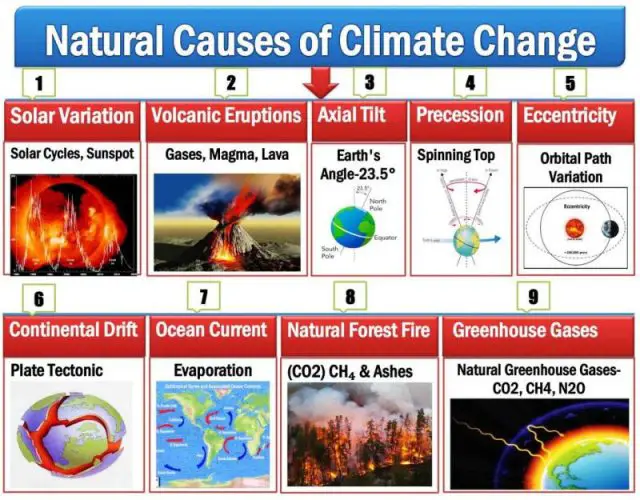
nine causes of climate change & natural cause of climate change
Natural Causes of Climate Change 2024
1. Solar Variation (Sunspot)
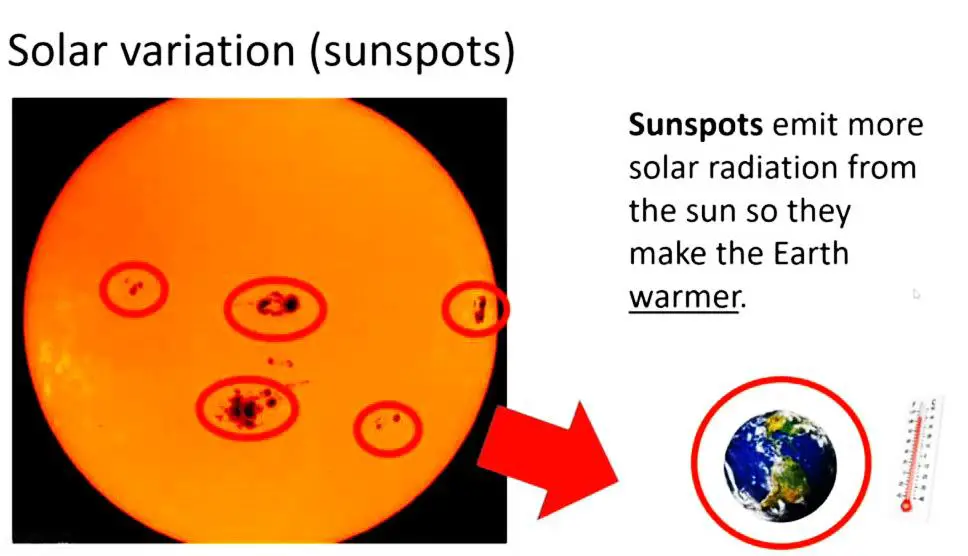
The most significant natural cause of climate change is solar variation, which gradually changes the global atmosphere. Solar variation refers to the Sun emitting different amounts of radiation. The amount of solar radiation depends on the number of sunspots, driven by the Sun’s magnetism. Sunspots emit more heat from the Sun, and that makes the Earth warmer. They look like black holes that emit more solar radiation toward the Planet than the Sun does naturally. However, solar variations and sunspots are related to the solar magnetic cycle and solar activity. Sunspots are also known as storms on the Sun’s outer layer.  It plays a critical role in ejecting solar gas and flares from the Sun’s corona.
solar variation (sunspots)
Solar Variation (Sunspots)
Although the temperature of the sunspot is lower than that of other parts of the Sun, the outer layer of the sunspot releases giant ultraviolet rays and throws them on the Earth’s surface. The number of sunspots reaches a peak during 11 years of solar activity- it is called the solar maximum. In the last century, many sunspots have been identified on the Sun, and at the same time, Earth’s temperature increased. The sunspots and solar variations have raised the Earth’s temperature by about 0.1 degrees Celsius. The Sun has been brighter than it was 100 years ago due to solar cycle activity driven by sunspots, and the Earth has been warmer.
2. Volcanic Eruptions

Volcanic eruptions involve the emission of large amounts of gas, ash, lava, rock, and dust from the Planet’s surface. Volcanic eruptions are among the most devastating natural disasters, altering the environment in the disaster area. Therefore, it is another natural cause of climate change. The most adverse impact of the volcanic eruption is increasing the temperature of the Earth.  Lava emitted during volcanic eruptions can raise the surrounding area’s temperature by about 1200 degrees Celsius.

However, it emits a considerable amount of flash and creates ash clouds in the sky. This ash cloud acts like a blanket in the sky, redirecting the Sun’s rays. The solar radiation is reflected on the ash cloud in the sky. The prolonged ash cloud reflects solar radiation; therefore, the Earth’s surface cools. In sum, volcanic eruptions are natural disasters that cause climate change.
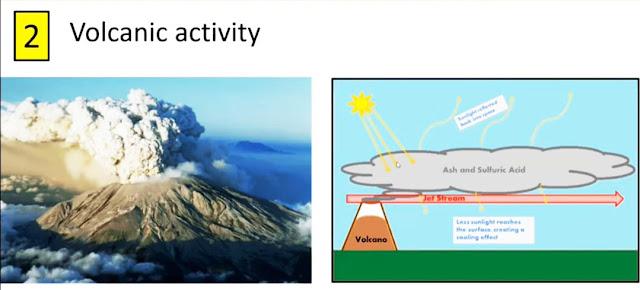
volcanic eruptions
Volcanic Eruptions- Natural Causes of Climate Change

Does a volcanic eruption increase or decrease the Earth’s temperature?

Volcanic activity decreases the average temperature of surrounding areas. Although lava increases the surrounding area’s temperature, the ash cloud reflects solar radiation, reducing Earth’s temperature. So, a volcanic eruption cools the Planet and changes the climate.

3. Axial Tilt

According to Milankovitch Cycles, the Earth orbits the Sun, taking 365 days to complete one orbit. Additionally, the Sun takes 24 hours to rotate. Axial tilt is a crucial natural driver of climate change, as it determines how much solar radiation a region receives based on its position. Axial tilt is the angle between the Earth’s orbital plane and its equatorial plane during rotation. It is also known as obliquity, which represents the Earth’s angle. Axial tilt makes different seasons in the same area of the Planet.

According to statistical reports, the Earth has been tilted by 23.5 degrees relative to the plane. The axial tilt differs by 22.1 and 24.5 degrees from its orbital plane around the Sun. The seasons of the Earth depend on its axial tilt; therefore, the greater the axial tilt, the greater the seasons. The Sun provides more solar radiation when the Earth’s hemisphere tilts towards it in the summer. On the other hand, the Earth receives less solar radiation when it tilts away from the Sun’s orbital plane. According to Milankovitch (1930), it takes 41,000 years to complete the ice age cycle. So, the ice age comes back every 41,000 years.

For example, the Earth is currently tilted 23.45 degrees; therefore, one hemisphere receives more solar radiation, creating an extreme summer, while the other hemisphere experiences an extreme winter. The axial tilt is decreasing; thus, the Earth gets extremely hot in summer and extremely cold in winter. Based on the discussion, it is optimal to say that the axial tilt causes climate change on Earth.
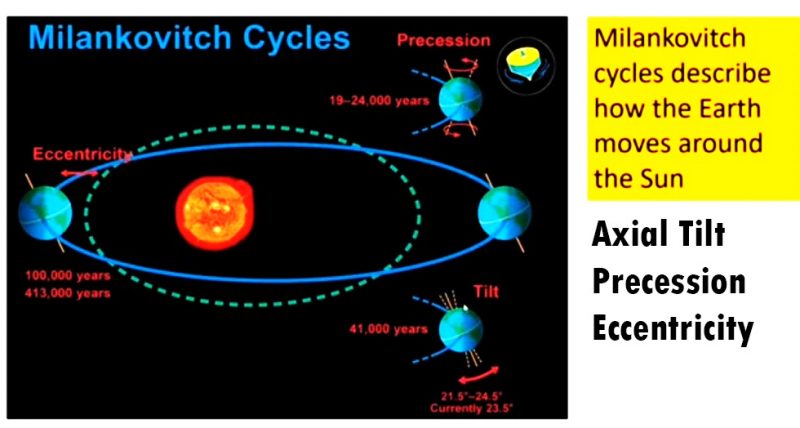
milankovitch cycles (axial tilt, precession, eccentricity)
Milankovitch Cycles of Climate Change
4. Precession

Precession refers to the movement in the orientation of the rotational axis due to the gravitational force of the Sun and the Moon. It is a type of movement that occurs when it starts to wobble and change the direction of the first axis. The Earth rotates once every 24 hours. However, it wobbles slightly roughly after every 19 to 24 thousand years.  If it’s leaning towards the Sun, it gets more heat. On the other hand, the Earth receives less heat if it leans away from the Sun. The Earth’s precession affects climate change; hence, precession is another natural cause of climate change.

5. Eccentricity
Eccentricity, also known as orbital eccentricity, describes how the Earth moves around the Sun. The Earth does not move the Sun in the same circular motion. Orbital eccentricity measures the variation of the orbital path from a perfect circular shape. It is also known as the orbital parameter that controls the amount of solar radiation received by the Earth. Variation in the orbital path affects the distance between the Sun and the Planet. It controls the lengths of the summer and winter seasons. According to statistical reports, the summer is approximately 4.5 days longer than winter due to the orbital eccentricity. It is all about the distance between the Sun and Earth. The Sun is about 152.1 million kilometers from Earth in summer, the farthest distance.
The Earth gets closer to the Sun during winter in the Northern Hemisphere. On the other hand, during the winter season, the distance between the Sun and Earth is 147.1 million kilometers, which is the closest distance. NASA scientists have declared the current orbital eccentricity of Earth is e ≈ 0.01671. Now, the Earth orbits the Sun in an elliptical orbit. It is slowly reducing the 100,000-year cycle. The Earth gets warmer as it orbits the Sun. In contrast, the Earth gets colder when it moves around the Sun in an elliptical orbit or egg shape. The discussion proves that orbital eccentricity is a significant natural cause of climate change.
6. Continental Drift by Plate Tectonics

Continental drift refers to the slow movement of Earth’s tectonic plates, also known as the shifting of Earth’s crust. Initially, Alfred Wegener proposed continental drift in 1912. There are seven continents on Earth; however, their positions are not fixed. Some continents are getting closer year by year; on the other hand, some are growing farther apart. The movement is a prolonged process. The motion of the continental drift movement is around 0.6 cm to 10.5 cm per year. Hence, continental drift is the critical natural cause of climate change on the Earth.

The tectonic plates are the separated pieces of the Earth’s crust. The outer face of the crust is rocky and solid and consists of two types of material: less-dense oceanic crust and more-dense continental crust. These tectonic plates can move freely, causing earthquakes and volcanoes on Earth. Most ocean volcanoes and Earthquakes are the direct consequences of continental drift. The movement of tectonic plates can be described in four patterns: transform faulting, spreading, subduction, and collision.

For example, the collision between the Indian and Eurasian plates has extended the Himalayan Mountain range. Magma is created from molten rock beneath the crust and is emitted from volcanic vents, which can change the climate. In sum, continental drift by plate tectonics is a natural cause of climate change.

7. Ocean Current

Ocean currents are a natural driver of climate change on Earth, formed by the continuous movement of ocean water. It is generated by ocean winds, the moon’s gravitational pull, breaking waves, temperature, and the rotation of the Earth. Ocean currents play a crucial role in driving climate change by warming the Earth. The ocean absorbs most of the solar radiation, while land areas receive some. The land surface radiates some heat back into space after sunset. However, the sea absorbs solar radiation and eventually redistributes it around the Planet. The heat from the sun evaporates ocean water continuously, raising the temperature and humidity in surrounding areas on Earth. Ultimately, the evaporation process creates rain and storms that reduce the temperatures.

If the current system collapses, it will lead to dramatic changes in worldwide weather patterns. Ocean currents could rapidly freeze parts of North America. If this circulation shuts down, it could bring extreme cold to Europe and parts of North America.

8. Natural Forest Fire

Natural forest fires are a significant natural driver of climate change, increasing temperatures in surrounding areas. There are two causes of forest fires: natural and human. A natural forest fire is a wildfire that burns thousands of acres, including trees and animals.  According to the Environmental Protection Agency report, 20 percent of forest fires occur naturally, while around 80 percent are caused by human activities.

natural forest fire
Natural Forest Fire Causes Climate Change

Natural forest fires can be sparked by lightning or by drought that sets trees ablaze. Usually, warm temperatures encourage setting fires, and strong winds spread them rapidly to surrounding areas.  A forest fire transforms green vegetation into a desert for a while.

Forest fires release large amounts of greenhouse gases, including carbon dioxide (CO2), methane, and ash. These gases trigger atmospheric warming and deplete soil nutrients.  Therefore, a natural forest fire is a significant natural cause of climate change.

9. Natural Greenhouse Gases

Greenhouse gases are gases that change the climate by trapping infrared radiation, or heat, in the atmosphere. GHG is the short form or abbreviation of greenhouse gases. There are two types of causes of greenhouse gas emissions: natural and human-induced. Natural greenhouse gases are produced on Earth without human activity. For example, permafrost is frozen ground that naturally contains and releases greenhouse gases such as carbon dioxide (CO2) and methane (CH4). 

The most common natural greenhouse gases on the Earth are water vapor (H2O), carbon dioxide (CO2), methane (CH4), nitrous oxide (N2O), and ozone (O3). Greenhouse gases help sunlight reach the Earth’s surface and block heat from returning to the atmosphere. These natural gases prevent the heat released from the Earth’s surface from escaping. Natural greenhouse gases contribute to the atmospheric temperature rise directly and indirectly. In essence, natural greenhouse gases warm the Earth’s atmosphere by trapping the heat. So, it is another natural cause of climate change that warms the atmosphere.

There are two sources of greenhouse gases: natural and human. Human activities, such as burning fossil fuels, contribute to the emission of greenhouse gases. They also produce greenhouse gases such as chlorofluorocarbons (CFCs), hydrofluorocarbons (HFCs), and Perfluorocarbons (PFCs). People cut down forests for agriculture, which also contributes to global warming. Now, researchers and political leaders are working together to reduce human-induced causes of climate change. They raise awareness to prevent global warming. Social etiquette and social awareness among people can protect the environment from pollution. In a nutshell, greenhouse gases cause global warming and alter the global climate.

Conclusion

In conclusion, these nine natural causes of climate change (Solar Variation, Volcanic Eruptions, Axial Tilt, Precession, Eccentricity, Continental Drift, Ocean Current, Natural Forest Fires, and Natural Greenhouse Gases) contribute to changes in the global atmosphere. These factors are natural contributors to global warming, altering the atmosphere and the Earth’s environment directly and indirectly.

What are the human causes of climate change?

The Major Human Causes of Climate Change are
  1. Burning Fossil Fuels
  2. Deforestation
  3. Livestock Production
  4. Fluorinated Gases
  5. Chemical Fertilizers
  6. Fluorinated Gases
  7. Industrial Gases
  8. Food Waste
  9. Transport Vehicles.

These are the crucial human activities that cause climate change on the Planet.
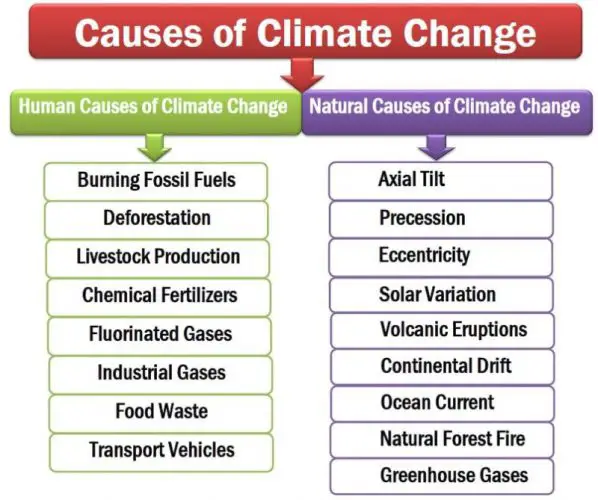
 causes of climate change
Human and Natural Causes of Climate Change

 1. Burning Fossil Fuels

Fossil fuel burning is the most significant human cause of global warming. Fossil fuels contain carbon and hydrogen gases beneath the Earth’s crust. They are made from the remains of animals and plants. The most common examples of fossil fuels are natural gas, bitumen, oil, coal, tar sands, and petroleum. People burn fossil fuels to generate electricity and power transportation. Fossil fuels release greenhouse gases, including carbon dioxide (CO2), that trap heat in the atmosphere. So, burning fossil fuels is a catastrophic cause of global warming. They are the source of 80% of Earth’s energy, which is not renewable.  The Earth’s average temperature has risen by about 1 degree Celsius, and sea levels have increased. As a result, people experience scorching summer weather. It is also caused by biodiversity destruction, plant and animal extinction, and global health conditions.

2. Deforestation

Deforestation is another human-caused environmental change on the Planet that results from people’s activities. People are directly associated with deforestation, which affects biodiversity and the Earth’s ecosystems. Deforestation is the cutting down of forest areas by humans. People cut trees in the forest for urbanization, crop cultivation, and mining. Since 1960, deforestation has reduced forest areas worldwide, contributing to changes in the atmosphere. According to the oxygen cycle, people inhale oxygen and exhale carbon dioxide that trees consume. On the other hand, trees take in carbon dioxide and release oxygen during respiration.

The more trees on the Planet consume, the more carbon dioxide (CO2) is produced. Carbon dioxide levels in the atmosphere are increasing due to deforestation. Deforestation destroys the carbon stores and releases carbon dioxide into the Planet. It is a primary human cause of rising greenhouse gases and climate change. According to a 2019 study, deforestation is responsible for a 11 percent increase in carbon dioxide (CO2) emissions.

3. Livestock Production

Livestock production is another primary human cause of climate change. It contributes to the production of greenhouse gases that trap heat in the atmosphere. Livestock production is the agricultural process of farming domestic animals, including breeding, caring for, and raising them. Nowadays, people farm domestic animals for commercial purposes to produce meat, milk, leather, etc. The most common animals in livestock farms are cows and sheep. These animals generate methane(CH4) when they consume and digest food. A report shows that cows generate around 150 billion gallons of methane gas daily.

Methane is one of the greenhouse gases that contribute to rising global temperatures. Livestock production accounts for 14.5 percent of greenhouse gas emissions. Domestic animal farming has a large carbon footprint that contributes to climate change. Given people’s close association with livestock, it is reasonable to say that livestock production is an essential human driver of climate change.

4. Chemical Fertilizers

Chemical fertilizers are responsible for altering Earth’s climate. People produce chemical fertilizers to use in modern agriculture.

Chemical fertilizers are modern fertilizers produced by chemical synthesis, such as nitrogen, phosphorus, potassium, and sulfur. These ingredients contain nutrients for the plants—fertilizers containing nitrogen produce nitrous oxide emissions. Farmers use chemical fertilizers to get greater benefits from their farms. Although these fertilizers help plants grow and produce more corn and fruit, chemical fertilizers can harm the environment.

For example, nitrogen-based chemical fertilizers emit nitrous oxide (N2O), a greenhouse gas (GHG). It is said that nitrous oxide (N2O) is a long-lived greenhouse gas produced by agricultural activities. Chemical fertilizers contain nitrate (NO3) and ammonia (NH4+).  As a result, chemical fertilizers in agriculture generate the critical greenhouse gas nitrous oxide (N2O). Nitrous oxide (N2O) traps the heat in the atmosphere, allowing shortwave Infrared to enter the Earth and obstructing the longwave Infrared from returning toward the sun. The percentage of nitrous oxide in greenhouse gases is 10-14 percent. People are responsible for producing 80% nitrous oxide through modern agriculture. The scientists warned modern farmers to reduce the use of chemical fertilizers in agriculture to combat climate change.

5. Fluorinated Gases

Fluorinated gases are also a human-caused contributor to climate change, as people produce them for commercial purposes. The most common fluorinated gases are hydrofluorocarbons (HFCs), nitrogen difluoride, perfluorocarbons (PFCs), and sulfur hexafluoride (SF6). People produce these fluorinated gases as the elements of aerosol cans, air conditioners, refrigerators, and so on. These gases are crucial materials for producing semiconductors in the factory.

Fluorinated Greenhouse Gases

  1. Hydrofluorocarbons (HFCs)
  2. Sulfur hexafluoride (SF6)
  3. Nitrogen trifluoride (NF3)
  4. Perfluorocarbons (PFCs)

The fluorinated gases are also powerful GHGs that trap heat in the atmosphere. Fluorinated greenhouse gases, also known as F-gases, contribute to global warming. According to the report, fluorinated greenhouse gases cause more than 23,000 times as much global warming as carbon dioxide (CO2).

6. Industrial Gases

Industrial gases include carbon dioxide, nitrogen, oxygen, hydrogen, helium, and noble gases. Two types of human activities can produce these gases: people intentionally produce them, and industrial factories emit them. Firstly, these industrial gases are produced in factories for commercial purposes. They compress these gases into liquid in the cylinder to sell them in the market. Secondly, electrical factories generate carbon dioxide and nitrogen when producing goods and energy. In the United States, power plants emit 40 percent of carbon dioxide (CO2).

Industrial gases such as carbon dioxide and nitrogen are greenhouse gases that affect ozone depletion. The volume of industrial gas emissions is increasing as factories worldwide expand.

7. Food Waste

Food waste is one of the silent human causes of climate change that many people are unaware of.  For example, many people intentionally waste food without realizing the negative consequences. Food waste occurs during processing and distribution from the seller to the buyer. It is estimated that Americans waste about 40 percent of their food each year. Additionally, Americans waste around 27,000 gallons of water annually by throwing away vegetables, fruits, eggs, and beef. Food waste produces methane(CH4) gas when it decomposes in landfills. Methane (CH4) is a potent greenhouse gas that contributes to global warming and climate change on Earth. The study shows that around 6-8 percent of methane is emitted from food waste. Therefore, food waste is a significant factor in climate change that many people do not know about.

8. Transport Vehicles

Transport vehicles consume fossil fuels and emit greenhouse gases such as carbon dioxide (CO2). Carbon dioxide (CO2) is the most devastating greenhouse gas, as it raises temperatures. It is estimated that vehicles account for around 30 percent of greenhouse gas emissions. Greenhouse gas emissions have increased rapidly in the last 30 years.

Significance of this Article

This article offers in-depth insights into the natural and human causes of climate change. It also provides ways for humans to prevent global warming from destroying this beautiful world. International organizations and global leaders highlight this issue. For example, the United Nations schedule for the 2024 UN Climate Change Conference (UNFCCC COP 29), to be held from 11 to 22 November 2024 in Baku, Azerbaijan. People from different groups in society have to come up with solutions to prevent global warming. Students can download the PDF.

Natural Causes of Climate Change PDF
Citation For This Article (APA 7th Edition)
Kobiruzzaman, M. M. (2026). Cause of Climate Change- 9 Natural Causes of Climate Change in 2026. Newsmoor- Educational Website For Online Learning. https://newsmoor.com/natural-causes-of-climate-change-9-natural-causes-of-climate-change/

Survey Questionnaire Sample For Research Paper

This academic content provides detailed information about the Survey Questionnaire Sample and Example for Research Paper, Proposal, & Project. It also demonstrates how to write a survey questionnaire for effective research.

What is a Survey Questionnaire in Research?

The survey questionnaire is a key tool for researchers to collect data efficiently and validate the hy. Creating a well-structured survey questionnaire is essential for gathering valuable data. A well-designed survey questionnaire helps to ensure that the data collected is accurate and relevant. When formulating your survey questionnaire, consider your research objectives to guide your questions effectively. Using examples, such as previous survey questionnaire templates, can facilitate your design process.

A questionnaire is a quantitative survey instrument comprising multiple questions used to collect data from respondents and informants. The survey questionnaire comprises five standard 5W1H questions: who, what, when, why, and how. The most common questionnaires are product usability and customer satisfaction survey questionnaires.

By following a structured format, you can create a survey questionnaire that meets your research needs. Each section of your survey questionnaire should align with your overall research objectives. Moreover, a well-crafted survey questionnaire can lead to more insightful data analysis and conclusions. Ensure that your survey questionnaire is concise to encourage participant engagement. It’s vital to test your survey questionnaire before full deployment to catch any potential issues. Remember that clarity in your survey questionnaire will lead to more accurate and reliable responses.

Additionally, questionnaires are crucial for collecting information in both quantitative and qualitative research. Quantitative survey questions typically address ‘what’, ‘why’, and ‘how’ to quantify phenomena. These questions are designed to identify relationships among the independent, dependent, mediator, and moderator variables. The respondents are a sample of the population who participated in the survey. Quantitative survey questions are part of the data collection process in quantitative research.

In contrast, qualitative questionnaires focus on ‘what’ and ‘how’ to elicit in-depth opinions about a topic. Qualitative research avoids why questions intended to identify cause-and-effect relations. The survey can be conducted face-to-face or online. However, each questionnaire includes an introduction that provides a concise overview of the research.

Once you’ve designed your survey questionnaire, seek feedback to improve its effectiveness. To enhance your research findings, utilize your survey questionnaire across diverse demographic groups. A comprehensive survey questionnaire allows for a deeper understanding of your research topic.

What are Quantitative Survey Questionnaires?

Quantitative survey questionnaires are structured instruments that feature closed-ended questions. The examples of open-ended questions are multiple-choice, rating scales (Likert scale measuring agreement or disagreement), dichotomous (yes/no), and ranking options, concentrating on descriptive (what is), comparative (differences among groups), and relationship-focused (correlation between variables) inquiries to obtain numerical data for statistical evaluation, typically utilizing methods like mail, phone, or online surveys.

A Quantitative research questionnaire is a set of survey questions used by a researcher to collect data. The author designs some questionnaire samples for students and researchers. These samples help new researchers develop a questionnaire tailored to the research topic. The questionnaire sample has been collected from University students. New researchers will learn how to create a survey questionnaire to collect data.

The author has provided several research questionnaires and download links here so readers can access the PDF forms. This sample and example of research questionnaires may provide a clearer understanding for new researchers.

Questionnaire Sample For Quantitative Research

Quantitative survey research includes the title, abstract, introduction, methods, results, discussion, questionnaire, bibliography, and appendix. The questionnaire sample for the research paper will provide specific guidance on designing survey questions for a quantitative study. Many undergraduate and postgraduate students are unfamiliar with how to design questionnaires for their theses or dissertations. Therefore, the author has designed and collected a few questionnaire samples for quantitative research. We do not encourage students to copy these questionnaires; however, you may use them as inspiration to develop your own. Students should read and follow the examples to draft questionnaires for their quantitative research projects.

Quantitative Survey Questionnaire Sample: AI Adoption

The following questionnaires are adopted from the UTAUT model. Therefore, this sample will help a student design a survey questionnaire based on the Unified Theory of Acceptance and Use of Technology. It includes the research title, demographic questions, and items to validate the hypothesis.

research survey questionnaire

Research Title: The Antecedents of Artificial Intelligence Adoption Among Human Resource Professionals in the Tourism & Hospitality Industry in Malaysia.

Online Survey Questionnaire Form

SECTION A. Demographic Questions

Instructions: Please complete this section by circling the following answers

A1. What is your gender?

  1. Male
  2. Female

A2. How old are you?

  1. 20-30
  2. 31-40
  3. 41-50
  4. 51-60

A3. What is your level of education?

  1. Undergraduate
  2. Masters/MBA
  3. MPhil/DBA/PhD

A6. What is your marital status?

  1. Single
  2. Married

A7. What is your job tenure?

  1. 1-2 Years
  2. 3-4 Years
  3. 5-6 Years
  4. 7 Years and above

Section B: Artificial Intelligence Adoption (AIA)

Instruction: Please answer the following section based on the following scale:

  • Strongly Disagree
  • Disagree
  • Somewhat Agree
  • Agree
  • Strongly Agree
No Statement 1 2 3 4 5
B1 A timely plan for the acceptance, implementation, and application migration of AI technology has been developed.
B2 Managers have already endorsed the AI adoption plan.
B3 A financial budget and a migration schedule have been approved.
B4 Our customers highly value new products and services that use AI innovations.
B5 Organizations are embracing and utilizing AI to drive practical business innovation.
B6 Organizations accept and use AI tools to align with their business strategy.
B7 Organizations accept and use AI for better coordination.
B8 Organizations accept and use AI tools in decision-making.
B9 Adopting Artificial Intelligence will allow better communication with customers.

Item 1-4 adapted from Islam et al. (2023), Item 5-8 adapted from Almarashda et al. (2021), Item 8-10 adapted from Jadhav (2021).

Section C: Performance Expectancy (PE) and Artificial Intelligence Adoption

No Statement 1 2 3 4 5
C1 I find AI a helpful technology in the HR department.
C2 Using AI increases my chances of making important decisions.
C3 Using AI helps me make decisions more quickly.
C4 Using AI increases my productivity in organizations.
C5 AI enhances the HR department’s performance.
C6 AI enables us to work faster in the organization.
C7 AI enhances employees’ effectiveness in performing.
C8 Using AI in the HR department increases my chances of achieving important goals.

Item 1-4 adapted from Baabdullah (2024), Item 5-8 adapted from Cao et al. (2021)

questionnaire sample for performance expectancy (pe) and artificial intelligence adoption

Section D: Effort Expectancy (EE) and Artificial Intelligence Adoption

No Statement 1 2 3 4 5
D1 Learning how to use AI technology is easy for me.
D2 My interaction with AI tools is clear and understandable.
D3 I find AI effortless to use.
D4 It is easy for me to become skillful at using AI.
D5 It is easy for me to use AI tools to manage my workload in the organization.
D6 Learning how to use AI tools for communication is easy for me.
D7 It is convenient to provide service using AI tools.
D8 It is easy to complete complex HR tasks.

Item 1-4 adapted from Baabdullah (2024), Item 5-8 adapted from Venkatesh (2012).

Section E: Social Influence and AI Adoption

No Statement 1 2 3 4 5
E1 People who are important to me think that I should use AI technology in the workplace.
E2 People who influence my behavior think that I should accept and use AI tools.
E3 People whose opinions I value prefer that I use AI technology.
E4 Coworkers who are important to me would think that I should use AI.
E5 Peers who influence my behavior would think that I should use AI to complete the tasks.
E6 My superiors, who influence my behavior, would think that I should use AI.
E7 My superiors, to whom I report, would think that I should use AI.
E8 My business partners would think that I should use AI.

Item 1-3 adapted from Venkatesh et al. (2012), Item 3-8 adapted from Cao et al. (2021)

Section F: Facilitating Condition and AI Adoption

No Statement 1 2 3 4 5
F1 I have the resources necessary to use AI.
F2 I know what is necessary to understand AI.
F3 AI is compatible with other technologies I use.
F4 I can get help from others when I have difficulties using AI.

Item 1-4 adapted from Cao et al. (2021)

Section G: Technology competency (TC) and AI Adoption

No Statement 1 2 3 4 5
G1 Our company’s technology infrastructure is available to support AI tools.
G2 Our company is dedicated to ensuring that HR employees are familiar with AI tools.
G3 Our company has a high level of expertise with AI tools.

Item 1-3 adapted from Islam et al. (2023)

Section H: Top management support (TMS) and AI Adoption

No Statement 1 2 3 4 5
H1 Top managers support AI adoption by providing labor resources, finances, and materials.
H2 Top management inspires employees to apply the latest AI technologies in daily work.
H3 The top management of my organization encourages innovation.
H4 My organization’s top management is willing to take the risks involved in adopting AI technologies.
H5 My organization’s top management is likely to consider implementing AI strategically important.

Item 1-5 adapted from Islam et al. (2023)

Section I: Competitive pressure (CP)and AI Adoption

No Statement 1 2 3 4 5
I1 The company thinks that AI adoption influences competitiveness in the industry.
I2 The company is under pressure from competitors to adopt AI.
I3 Some competitors have already started using AI for Risk forecasting and premium calculations.
I4 My organization’s top management is willing to take the risks involved in adopting AI technologies.

Item 1-4 adapted from Islam et al. (2023)

Section J: Emotional Intelligence (EI) and AI Adoption

No Statement 1 2 3 4 5
J1 Overall, I’m a highly motivated person to use AI technology in an organization.
J2 I feel that I have several good qualities.
J3 I’m usually able to influence the way other people feel.
J4 Overall, I’m able to handle stress.

Item 1-4 adapted from Lipson, A. (2020).

Quantitative Survey Questionnaire Sample: Communication Research

An example of a complete survey questionnaire is shown below. The title of the research project is “An Examination of the Correlation Between Social Media Engagement and Citizen Journalism Practice”. It is a sample Google Form questionnaire. The author shares a link to the online questionnaire with respondents, who complete it at their convenience. It is the most recent example of a questionnaire designed in accordance with APA 7th edition guidelines.

Quantitative Research Title: An Examination of the Correlation Between Social Media Engagement and Citizen Journalism Practice.

Dear Participants,
I invite you to participate in this quantitative research project by completing the following survey questionnaires. This study intends to examine the Correlation Between Social Media Engagement and Citizen Journalism Practice. It requires approximately 5-7 minutes to complete the questionnaires. Thank you for taking the time to assist me with this research. Under no circumstances are you obliged to answer any of the questions; however, doing so will greatly assist me in completing my research and enhance my understanding of this research focus. The data collected will remain confidential and will be used solely for academic purposes.

SECTION A. Demographic Questions

Instructions: Please complete this section by circling the following answers

A1. What is your gender?

  1. Male
  2. Female

A2. How old are you?

  1. 18-23
  2. 24-28
  3. 29-33
  4. Above 33

A3. What is Your Nationality?

  1. Malaysian
  2. Non-Malaysian

A4. What is your race?

  1. Malay
  2. Chinese
  3. Indian
  4. Please specify

A5. What is your level of education?

  1. STPM
  2. Matric
  3. Diploma
  4. Foundation
  5. Undergraduate
  6. Masters
  7. PhD

A6. What is the Year of Study

  1. Year 1-2
  2. Year 3-4
  3. Above 5

A7. What is your family’s monthly income?

  1. Less thanRM2000
  2. RM2001 – RM4000
  3. RM4001 to RM6000
  4. Over RM6000

Section B: The Use of Social Media for Citizen Journalism

Please read the definition of social media-based citizen journalism and keep it in mind when you answer the following questions. Social media-based citizen journalism refers to the generation and sharing of news events (personal, social, educational, entertainment, political, and crime-related) on social networking sites by ordinary people.

B1. What types of social networking sites do you use most to practice citizen journalism?

  1. Facebook
  2. Twitter
  3. LinkedIn
  4. Instagram
  5. WhatsApp
  6. Please specify…

B2. How much time do you spend on social media-based citizen journalism in a day?

  1. Less than 1 hour per day
  2. About 1 – 2 hours per day
  3. About 2 – 4 hours per day
  4. More than 5 hours per day

B3. Why do you use social media to practice citizen journalism?

  1. To report real-time news
  2. To entertain friends
  3. For educating people about social awareness
  4. To shape public opinion
  5. For others, please specify

B4. How many social media sites do you use to practice citizen journalism?

  1. Only 1 account
  2. 2 – 4 accounts
  3. 5 accounts and above

B5. What time of the day do you normally access social media?

  1. Morning
  2. Afternoon
  3. Evening
  4. At night

B6. Which day of the week do you mostly access social media?

  1. During weekdays
  2. During weekends

Section C: Performance Expectancy of Social Media Engagement for Citizen Journalism

C8. What is your performance expectancy of the use of social media to practice citizen journalism?

Instruction: Please answer the following section based on the following scale:

  1. Strongly Disagree
  2. Disagree
  3. Somewhat Agree
  4. Agree
  5. Strongly Agree
No Statement 1 2 3 4 5
C1 I would find social media useful in practicing citizen journalism.
C2 Using social media enables me to share news events more quickly.
C3 Using social media increases my productivity in reporting real-time news.
C4 Social media increases my mastery of what is happening globally.
C5 Social media helps me see what news is important to my friends and co-workers.
C6 Using social media can increase my chances of creating and sharing informative news events.
C7 Using social media will allow me to spend less time reporting and consuming news.

Items 1-3 were adapted from Venkatesh et al. (2003), Items 4-5 were adapted from Peng and Miller (2021), and Item 6-7 was adapted from Puriwat and Tripopsakul (2021).

Section D: Effort Expectancy of Social Media Engagement for Citizen Journalism

D9. What is your expected effort in the use of social media to practice citizen journalism?

In conclusion, an effective survey questionnaire is paramount for successful data collection.

No Statement 1 2 3 4 5
D1 My citizen journalism exercise using social media would be straightforward and easy to understand.
D2 It would be easy for me to apply my content writing skills on social media.
D3 I would find social media-based citizen journalism easy to use.
D4 Learning to operate social media to practice citizen journalism is easy for me.
D5 It is easy for me to become a freedom journalist using social media for news updates.
D6 It is easy for me to consume news on social media.
D7 It is convenient to share the news with friends on social media.
D8 Using social media will help me to spread the emergency news faster.

Items 1-3 were adapted from Venkatesh et al. (2003), Items 4-7 were adapted from Peng and Miller (2021), and Item 8 was adapted from Puriwat and Tripopsakul (2021).

Section E: Social Influence of Social Media Engagement for Citizen Journalism

What is the social influence of social media engagement for citizen journalism?

No Statement 1 2 3 4 5
E1 People who are important to me think that I should use social media for news sharing.
E2 The senior students at my university recommend that I use social media to find academic news.
E3 People important to me talk with me about the news they saw on social media.
E4 I observed my friends sharing news on social media.
E5 I found my important friends discussing the news they read on social media.
E6 It makes me feel proud when my friends praise me for sharing informative news on social media.
E7 I become motivated when my social media friends benefit from my reporting.
E8 People around me consider it appropriate to use social media for news.

Items 1-2 were adapted from Venkatesh et al. (2003), Items 3-5 were adapted from Peng and Miller (2021), Items 6-7 were set by the Authors, and Item 8 was adapted from Puriwat and Tripopsakul (2021).

Section F: The Use of Social Media to Practice Citizen Journalism

No Statement 1 2 3 4 5
E1 I often use social media to share news content.
E2 I have been using social media regularly to report real-time news with friends.
E3 To report real-time news to friends, I use social media regularly.
E4 In my daily life, I use social media to share news events.
E5 I use online social networking sites to keep up with hard news.
E6 I use social networking sites to post about events in my area.
E7 Whenever I need to read viral news, I check social media.

Item 1-5 adapted from Puriwat and Tripopsakul (2021), Item 5-7 set by the Authors

This research emphasizes the importance of designing a robust survey questionnaire. Importance of robust survey questionnaire design:

  • Ensures accurate data collection
  • Enhances reliability and validity
  • Improves respondent engagement
  • Facilitates better analysis and insights

References (APA-7th Edition): Scholarly Sources

  • Almarashda, H. A. H. A., Baba, I. B., Ramli, A. A., Memon, A. H., & Rahman, I. A. (2021). Human resource management and technology development in artificial intelligence adoption in the UAE energy sector. Journal of Applied Engineering Sciences11(2), 69-76.
  • Baabdullah, A. M. (2024). The precursors of AI adoption in business: Towards efficient decision-making and functional performance. International Journal of Information Management75, 102745.
  • Cao, G., Duan, Y., Edwards, J. S., & Dwivedi, Y. K. (2021). Understanding managers’ attitudes and behavioral intentions towards using artificial intelligence for organizational decision-making. Technovation106, 102312.
  • Islam, M. A., Aldaihani, F. M. F., & Saatchi, S. G. (2023). Artificial intelligence adoption among human resource professionals: Does market turbulence play a role?. Global Business and Organizational Excellence42(6), 59-74.
  • Jadhav, D. (2021). Understanding artificial intelligence adoption, implementation, and use in small and medium enterprises in India (Doctoral dissertation, Walden University).
  • Lipson, A. (2020). The Moderating Role of Emotional Intelligence on the Relationship between Job Resources and Employee Engagement (Doctoral dissertation, San Jose State University).
  • Venkatesh, V., Thong, J. Y., & Xu, X. (2012). Consumer acceptance and use of information technology: extending the unified theory of acceptance and use of technology. MIS Quarterly, 157-178.