This article defines group communication, its elements, examples, importance, and barriers. Studying group communication is essential for students and professionals seeking to improve collaboration, enhance problem-solving skills, foster creativity, build relationships, and increase overall team productivity.
Group Communication
Group communication refers to regular discussion among a group of people who continue communicating to achieve a goal (Beebe & Masterson, 2015). Group members communicate to improve teamwork; therefore, it is also known as team discussion. They come together to discuss how to accomplish both an independent and an interdependent goal. An interdependent goal is a shared objective in which many people work together to achieve a common purpose.
On the other hand, an independent goal is a personal objective. Group discussion occurs when people converse regularly to complete a group task.
Group communication is a crucial element in forming small groups and social groups in society. The different types of social groups are primary groups, secondary groups, self-help groups, learning groups, service groups, civic groups, work groups, public groups, virtual groups, and political groups. The five examples of small group communication are regular discussions among nuclear family members, classmates, roommates, and project members.
Group Definition in Organizational
A group consists of two or more employees who freely interact with one another and share standard norms, goals, and identity. The two most common types of groups are formal and informal, which can overlap.
Formal Groups: An organization assigns a formal group to accomplish specific goals. The formal groups fulfill two basic goals: organizational and individual.
Informal Groups. The association is formed by more than two people who come to meet their psychological and physiological needs. Group members maintain friendships and fulfill common interests. They hold informal communication.
Examples of Group Communication
A real-life example of group communication is a conversation among classmates for completing a group assignment. For example, a few students regularly sit together to discuss how to complete the tasks given by the lecturers. The group members meet before or after the class to share their opinions and suggestions. They continue their discussion until the project is completed. So, the continuous interaction among a group of students to complete an assignment is an example of group discussion.
The most common example of group discussion is virtual group communication. Nowadays, educational institutes offer long-distance learning. It allows students to connect beyond geographical borders. To complete the group assignment, students create a virtual group to communicate via platforms such as Zoom, Google Meet, Skype, and others. They communicate regularly to complete the assignment and presentation. Many lecturers instruct their students to submit the virtual meeting minutes sample.
Group Communication Elements
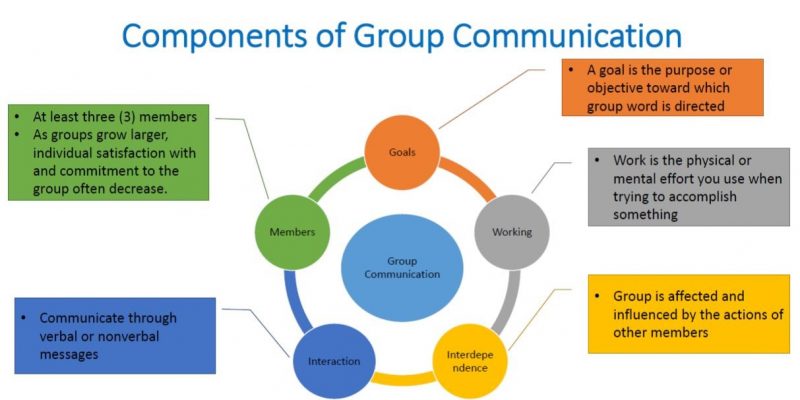
The elements of group communication are essential components for regular group discussion. These elements are critical to forming an active group and achieving a common goal. An active group must have or fulfill all elements to accomplish the goal. The essential characteristics of group communication are common goals, members, interaction, interdependence, and working.
The 5 Key Elements of Group Communication are:
- Goals
- Members
- Interaction
- Interdependence
- Working
1. Goal
A group goal is the fundamental objective of maintaining communication among more than three people. The goal is essential to group communication because every group or team aims to achieve it. A goal is a purpose or objective toward which the group’s work is directed; therefore, all group members are aware of the need to achieve that goal. Every group has a specific common goal or an interdependent goal, as well as the independent goals of its members. The opinions of group members have been used to select the common goal.
2. Members
Group members seem to be another crucial component of the active group. At least three members can form a small group, and the maximum is 18. As groups grow larger, individual satisfaction with and commitment to the group often decrease. A Group cannot be formed without members, so every group must consist of at least one member. Members are the most important in forming groups; hence, they must follow some ethical principles in group communication.
Ethical Principles of Group Members
1. Group members should be willing to speak
2. They should embrace and work with diversity within the group
3. Members should always treat one another with respect
4. They should be thorough in gathering information as well as diligent in evaluating it.
5. They must contribute their fair share to the group’s effort.
6. Group members must conduct themselves with honesty and integrity.
Social Loafer in Groups
A social loafer is a person who makes a minimal contribution to the group and assumes the other members will take up the slack—the willingness of every group member to participate. The group members should be collaborative and exhibit cohesive behavior, but not engage in social loafing. Effective group communication is about what you can do in groups and what you should do.
3. Interaction
Interaction denotes communication among group members through verbal or nonverbal communication messages. Additionally, it will occur among group members, intentionally or unintentionally, through verbal or nonverbal cues.
4. Interdependence
The group is affected and influenced by the actions of other members. Therefore, group communication must be interdependent to motivate team or group members.
5. Working
Work is the physical or mental effort you use to accomplish something. It is also an essential element of group communication, in which the group moves forward.
The components are also known as characteristics or features of group communication. These characteristics ensure the effectiveness of the group discussion.
Group Communication Importance in Business
The importance of group communication in business is: fostering collaboration and teamwork, improving critical thinking, enhancing productivity, building total quality management, and ensuring customer satisfaction.
Group Communication Barriers
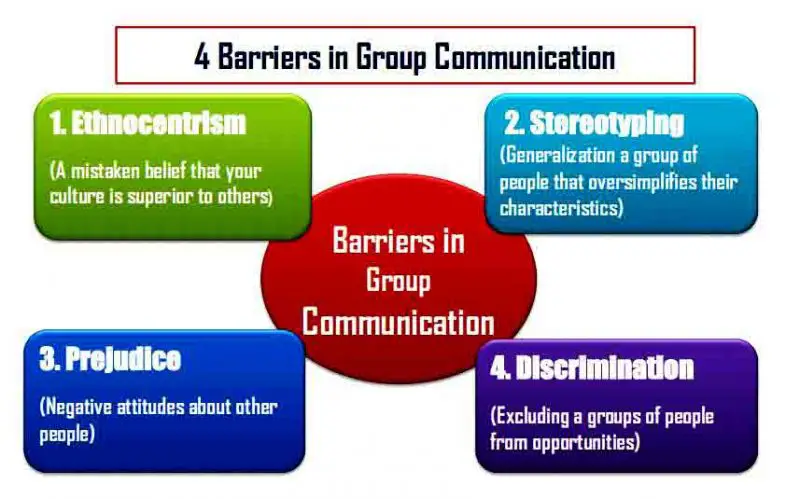
Barriers to Group Communication are disturbances that hinder interactive communication among group members. The barrier in group discussion usually hinders understanding other members of the group or team. The group discussion has many stages, tensions, conflicts, and so on. According to Tuckman’s model, the five stages of group discussion are Forming, Storming, Norming, Performing, and Adjourning. Members need to overcome all these stages to achieve the independent and interdependent goals. The four types of barriers in group communication are Ethnocentrism, Stereotyping, Prejudice, and Discrimination.
Group Communication Barriers
Barriers in group communication are also known as noise. These barriers to communication are prevalent across all contexts of communication, such as face-to-face, mediated, corporate, and group communication. Barrier or noise is an unwanted element of the communication process.
The 4 Barriers to Group Communication
- Ethnocentrism
- Stereotyping
- Prejudice
- Discrimination.
1. Ethnocentrism
Ethnocentrism refers to the mistaken belief that your culture is superior to others, with special rights and privileges that are, or should be, denied to others (Jandt, 2021). It is not about patriotism or pride. Ethnocentrism is an unwanted barrier that impedes effective communication among the group or team members.
For example, my culture should be a role model for other cultures. People would be happier if they lived like people in my culture.
- Furthermore, most other cultures are backward when compared with my culture.
- For example, have you ever been insulted by someone who implies that their religious beliefs are “true,” whereas yours are not?
- For instance, have you been disrespected by someone who believes that his traditions, language, or music preferences are “better” than yours?
2. Stereotyping
Stereotyping means generalization about a group of people that oversimplifies their characteristics. It relies on exaggerated beliefs to make judgments about a group of people. For example, Malays are lazy; Chinese are greedy and rich; Indians are drunker; Singaporeans are “kiasu”. Negative traits are attributed to an entire group when, in reality, only a few members of that group may possess them. In another instance, Asian students are good at Mathematics(Positive stereotypes).
3. Prejudice
Prejudice refers to negative attitudes toward other people based on faulty, inflexible stereotypes. Prejudice mostly brings negative consequences. For example, “He cannot be brilliant if he only has a Bachelor’s degree from XX University or College. In addition, “I don’t want a person with disabilities working on our group project.”
- Stereotyping ⇒ Prejudice
- Characteristics of Prejudice:
-
- Firstly, they are rarely based on extensive direct experience and first-hand knowledge.
- Secondly, the result is irrational feelings of dislike, and even hatred, toward specific groups.
- Finally, they justify harmful and unjust behavior toward group members.
4. Discrimination
Discrimination describes how we act out and express prejudice. When we discriminate, we exclude people from opportunities granted to others: employment, promotion, housing, political expression, and equal rights. For example, Racial, ethnic, religious, gender, sexual harassment, sexual orientation, disability, age, and people from different social and political classes.
Difference Between Group and Team
According to our review of previous studies, the group and the team share many characteristics, although they differ in performance levels. The team members are more collaborative, dedicated, and competent than the group members (Francis & Young, 1992).
Group Communication
Group discussion occurs when a group of people regularly interacts to achieve a common goal.
For example, the Student Learning Group, the Morning jogging group, and so on
Team Communication
Francis and Young (1992) defined a Team as a “high-performing task group whose members are actively interdependent and share common performance objectives. A group of members (people) shows closer cooperation and cohesiveness.
For example-Football Team
Players come together to win the match. Here, winning the game is the shared goal, and players are team members, like the group.
Team Types
Teams can be distinguished by purpose, duration, and level of member commitment.
1. Work Teams: The work team operates to achieve a common objective; typically, these teams are permanent and demand full commitment from members.
Project Teams: Project teams are formed to complete specific problems, tasks, or projects—usually, members of this group form for a particular period to complete a project.
Self-managed Teams: Admin authority from this team to regulate the task domain, including staffing, oversight, and scheduling.
Cross-functional Teams: These groups are composed of diverse members, for example, when experts from different areas are placed on the same team.
Virtual teams. Teams that work together over time and distance via electronic media to combine effort and achieve common goals.
How are Teams Different from Groups?
A group becomes a team when:
- Leadership becomes a shared activity.
- Accountability shifts from strictly individual to both individual and collective.
- The group develops its purpose or mission.
- Problem-solving becomes a way of life, not a part-time activity.
- Effectiveness is measured by the group’s collective outcomes and products.
FAQ (Frequently Asked Questions): Group Communication Elements
Q: What are the elements of group communication?
The five elements of group communication are Goals, Members, Interaction, Interdependence, and Working.
What is the noise in group communication?
The 4 Barriers to Group Communication are Ethnocentrism, Stereotyping, Prejudice, and Discrimination (Jandt, 2021).
References (APA-7th) & Scholarly Sources
Beebe, S. A., & Masterson, J. T. (2015). Communicating in small groups: Principles and practices (11th ed.). Pearson.
Francis, D., & Young, D. (1992). Improving work groups: A practical manual for team building (2nd ed.). Pfeiffer & Company.
Jandt, F. E. (2021). An introduction to intercultural communication: Identities in a global community (10th ed.). SAGE Publications.

M M Kobiruzzaman is a researcher, academic content writer, traveler, and the founding editor of Newsmoor.com. Specializing in communication, management, technology adoption models, and frameworks analysis, and journalism, his work bridges the gap between theory explanation and cultural communication. With a strong background in communication and management, he is dedicated to providing authoritative guides that elevate business and media literacy and academic writing standards.