This academic content provides the technology acceptance models questionnaire, including research items used to measure specific questions. The author compiled all the technology acceptance model questionnaire items, including TAM 1, 2, & 3, for students and researchers. The TAM questionnaire helps students, scholars, and professionals understand the factors that influence people’s acceptance of new technology.
List of Contents
The technology acceptance model questionnaire addresses key factors influencing users’ acceptance of technology, such as perceived ease of use and perceived usefulness. Each item is designed to capture respondents’ attitudes and beliefs regarding technology adoption. Researchers can utilize the comprehensive TAM model research items to gather valuable data for their studies. By analyzing the results, insights into user behavior and preferences can be gleaned. The original TAM technology acceptance model questionnaire will ultimately contribute to the development of more effective technology solutions. Perceived usefulness and perceived ease of use are the core components of the technology acceptance model. Hence, most questionnaire items are set to validate these prevalent variables in the TAM 1, 2, and 3.
TAM Model Questionnaire
The Technology Acceptance Model questionnaire refers to the research constructs and question items of technology adoption models published by Davis, Venkatesh, and Bala in 1986, 1989, 1996, 2000, and 2008. TAM is the most popular short form of the technology acceptance model. In 1986, Fred Davis introduced the technology acceptance model; however, he officially published it in 1989. Venkatesh, Bala, and Davis extended the TAM model by adding additional variables. The technology acceptance model questionnaire examines why people accept or reject new systems and devices.
Technology Acceptance Model (Davis, 1986)
Fred D. Davis introduced the technology acceptance model (TAM) in his PhD thesis in 1986.
Research Title: A Technology Acceptance Model for Empirically Testing New End-User Information Systems: Theory And Results
Variables: Perceived Usefulness, Perceived Ease of Use, and Attitude toward using the system. (Feature: X1, X2, and X3)
Technology Acceptance Model Questionnaire (Davis, 1986)
Perceived Ease of Use (PEOU) Original 6-Items
- PEOU-1: Learning to operate CHART- MASTER would be easy for me.
- PEOU-2: I would find it easy to get CHART-MASTER to do what I want it to.
- PEOU-3: My interaction with CHART- MASTER would be clear and understandable.
- PEOU-4: I would find CHART-MASTER flexible to interact with.
- PEOU-5: It would be easy for me to become skillful at using CHARTMASTER.
- PEOU-6: I would find CHART- MASTER easy to use.
Research Items PEOU 1-6 were adopted from Davis (1986).
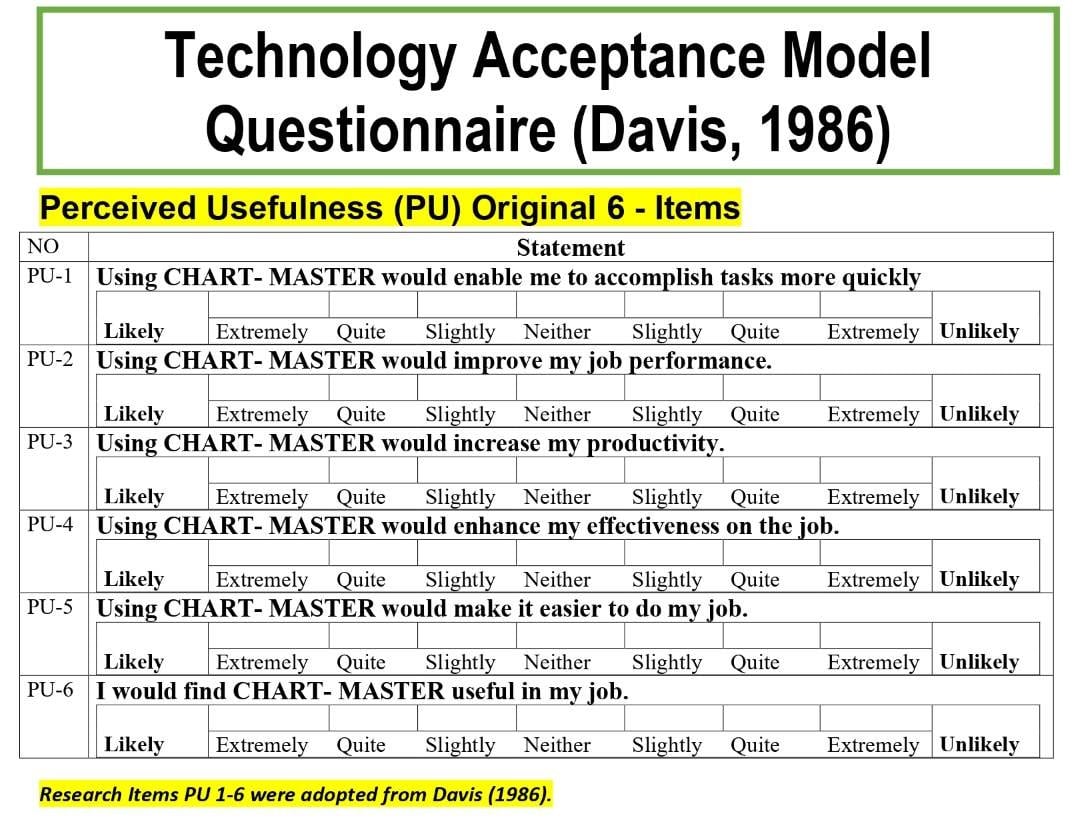
Perceived Usefulness (PU) Original 6 – Items
- PU-1: Using CHART- MASTER would enable me to accomplish tasks more quickly.
- PU-2: Using CHART- MASTER would improve my job performance.
- PU-3: Using CHART- MASTER would increase my productivity.
- PU-4: Using CHART- MASTER would enhance my effectiveness on the job.
- PU-5: Using CHART- MASTER would make it easier to do my job.
- PU-6: I would find CHART- MASTER useful in my job.
Research Items PU 1-6 were adopted from Davis (1986).
Technology Acceptance Model (Davis, 1989)
In 1989, Fred D. Davis published his foundational research, “Perceived Usefulness, Perceived Ease of Use, and User Acceptance of Information Technology,” with the Management Information Systems Research Center at the University of Minnesota (Davis, 1989). This pivotal paper officially established the framework universally known today as the Technology Acceptance Model (TAM).
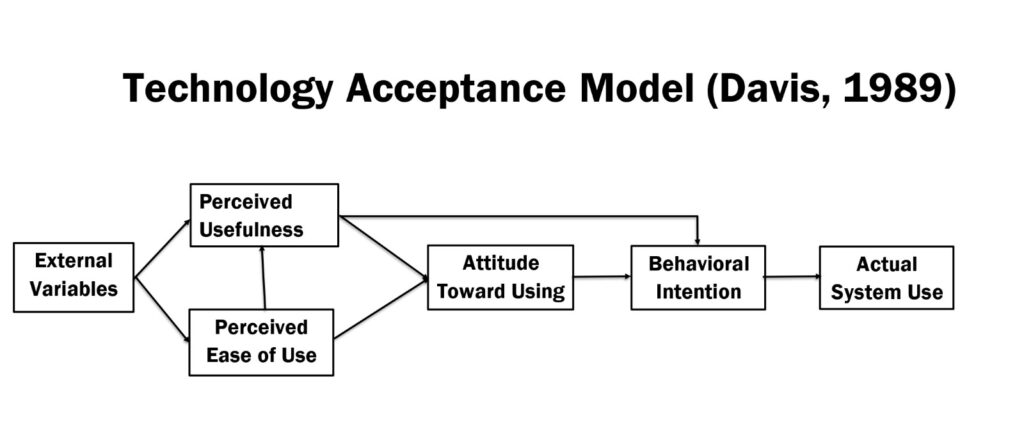
Research Title: “Perceived Usefulness, Perceived Ease of Use, and User Acceptance of Information Technology.”
Variables: Perceived Usefulness, Perceived Ease of Use, and User Acceptance of Information Technology.
Technology Acceptance Model Questionnaire (Davis, 1989)
Final Measurement Scales for Perceived Usefulness and Perceived Ease of Use
Perceived Usefulness: Questionnaire Constructs
- PU-1: Using CHART-MASTER in my job would enable me to accomplish tasks more quickly.
- PU-2: Using CHART-MASTER would improve my job performance.
- PU-3: Using CHART-MASTER in my job would increase my productivity
- PU-4: Using CHART-MASTER would enhance my effectiveness on the job.
- PU-5: Using CHART-MASTER would make it easier to do my job.
- PU-6: I would find CHART-MASTER useful in my job.
Research Items PU 1-6 were adopted from Davis (1989).
Perceived Ease of Use: Original 6 Question Items
- PEOU-1: Learning to operate CHART-MASTER would be easy for me.
- PEOU-2: I would find it easy to get CHART-MASTER to do what I want it to do.
- PEOU-3: My interaction with CHART-MASTER would be clear and understandable.
- PEOU-4: I would find CHART-MASTER to be flexible to interact with.
- PEOU-5: It would be easy for me to become skillful at using CHART-MASTER.
- PEOU-6: I would find CHART-MASTER easy to use.
Research Items PEOU 1-6 were adopted from Davis (1989).
Technology Acceptance Model (TAM) (Davis, 1993)
In 1993, Fred D Davis extended the TAM model to examine why users accept information technology in the workplace. This model posits that system design features positively influence perceived usefulness and ease of use, which in turn influence actual system use. It focuses on the antecedents of information technology adoption and extends the TAM model.
Research Title: User Acceptance of Information Technology: System Characteristics, User Perceptions, and Behavioral Impacts.
Author: Fred D. Davis
Journal: International Journal of Man-Machine Studies, Volume 38, Issue 3, pp. 475–487
Variables: System Design features, Perceived Usefulness, Perceived Ease of Use, Attitude Towards Use, Actual System use.
Technology Acceptance Model Questionnaire (Davis, 1993)
Respondents typically rate these items on a 7-point Likert scale ranging from “Strongly Disagree” (1) to “Strongly Agree” (7).
Perceived Usefulness of Electronic Mail: Questionnaire 14 Items
- UOEM-1: Using electronic mail improves the quality of the work I do.
- UOEM-2: Using electronic mail gives me greater control over my work.
- UOEM-3: Electronic mail enables me to accomplish tasks more quickly.
- UOEM-4: Electronic mail supports critical aspects of my job.
- UOEM-5: Using electronic mail increases my productivity.
- UOEM-6: Using electronic mail improves my job performance.
- UOEM-7: Using electronic mail allows me to accomplish more work than would otherwise be possible.
- UOEM-8: Using electronic mail enhances my effectiveness on the job.
- UOEM-9: Using electronic mail makes it easier to do my job.
- UOEM-10: Overall, I find the electronic mail system useful in my job.
Questionnaire Items 1-10 were adopted from Davis (1993)
Perceived Ease of Use of Electronic Mail: Questionnaire 14 Items
- EOUOEM-1: I find the electronic mail system cumbersome to use.
- EOUOEM-2: Learning to operate the electronic mail system is easy for me.
- EOUOEM-3: Interacting with the electronic mail system is often frustrating.
- EOUOEM-4: I find it easy to get the electronic mail system to do what I want it to do.
- EOUOEM-5: The electronic mail system is rigid and inflexible to interact with.
- EOUOEM-6: It is easy for me to remember how to perform tasks using the electronic mail system.
- EOUOEM-7: Interacting with the electronic mail system requires a lot of mental effort.
- EOUOEM-8: My interaction with the electronic mail system is clear and understandable.
- EOUOEM-9: I find it takes a lot of effort to become skillful at using electronic mail.
- EOUOEM-10: Overall, I find the electronic mail system easy to use.
Questionnaire Items 1-10 were adopted from Davis (1993)
Technology Acceptance Model (TAM-1) Questionnaire (Venkatesh & Davis, 1996)
In 1996, Viswanath Venkatesh and Fred D. Davis added an additional variable, “External Variable,” to the 1989 TAM model and outlined the final version of the Technology Acceptance Model. It is a popular model in the technology adoption field, also known as TAM-1. Venkatesh and Davis removed “attitude toward use” from the model because empirical studies proved it was a bottleneck. Instead, research has confirmed that perceived usefulness and ease of use act as direct, powerful drivers of a user’s behavioral intention (Davis & Venkatesh, 1996).
Research Title: “A Model of The Antecedents Of Perceived Ease of Use: Development and Test.”
Variables: Perceived Usefulness, Ease of Use, User’s Behavioral Intention, and (External Variables)
Technology Acceptance Model (TAM-1) Questionnaire (Venkatesh & Davis, 1996)
Computer Self-Efficacy Scale-Original 10 Items
Not at all confident to Totally confident circling a number from (1-10)
“I could complete a job using a software package if…”
- Item 1: …there was no one around to tell me what to do.
- Item 2: …I had never used a package like it before.
- Item 3: …I had only the software manuals for reference.
- Item 4: …I had seen someone else using it before trying it myself.
- Item 5: …I could call someone for help if I got stuck.
- Item 6: …someone else had helped me get started.
- Item 7: …I had a lot of time to complete the job for which the software was provided.
- Item 8: …I had just the built-in help facility for assistance.
- Item 9: …someone showed me how to do it first.
- Item 10: …I had used similar packages before this one to do the same job.
Question Items 1 to 10 were adopted from Davis & Venkatesh (1996).
Perceived Ease of Use (PEOU) of Computer: Original 4 Items
“(Strongly Agree to Strongly Disagree)”
- PEOU-1: My interaction with a computer is clear and understandable.
- PEOU-2: Interacting with a computer does not require a lot of mental effort.
- PEOU-3: I find a computer easy to use
- PEOU-4: I find it easy to get a computer to do what I want it to do.
Question Items PEOU 1-4 were adopted from Davis & Venkatesh (1996).
Perceived Ease of Use (PEOU) of WordPerfect: Original 4 Items
- PEOU-1: My interaction with WordPerfect is clear and understandable.
- PEOU-2: Interacting with WordPerfect does not require a lot of mental effort.
- PEOU-3: I find WordPerfect easy to use
- PEOU-4: I find it easy to get WordPerfect to do what I want it to do.
Question Items 1 to 4 were adopted from Davis & Venkatesh (1996).
Intention to Use WordPerfect (ITUW): Original 2 Items
- ITUW-1: Assuming I had access to WordPerfect, I intended to use it.
- ITUW-2: Given that I had access to WordPerfect, I predict that I would use it.
Question Items ITUW 1 and 2 were adopted from Davis & Venkatesh (1996).
Perceived Usefulness (PU) of WordPerfect: Original 4 Items
- PUOW-1: Using WordPerfect would improve my performance in my degree program.
- PUOW-2: Using WordPerfect in my degree program would increase my productivity.
- PUOW-3: Using WordPerfect would enhance my effectiveness in my degree program.
- PUOW-4: I find WordPerfect would be useful in my degree program.
Question Items PUOW 1 to 4 were adopted from Davis & Venkatesh (1996).
TAM-2 Model (Venkatesh and Davis, 2000)
In 2000, Venkatesh and Davis expanded the original framework by introducing the Extended Technology Acceptance Model, universally referred to as TAM-2 or ETAM. This upgraded TAM -2 model incorporated two major clusters of determinants for predicting user adoption: social influence processes (comprising subjective norms, voluntariness, and image) and cognitive-instrumental processes (including job relevance, output quality, and result demonstrability) (Venkatesh & Davis, 2000).
Research Title: “A Theoretical Extension of the Technology Acceptance Model: Four Longitudinal Field Studies”.
Variables: Perceived Usefulness, Ease of Use, Intention to Use, Use Behavior, and (Subjective Norm, Voluntariness, Image, Job relevance, Output Quality, Result Demonstrability, Experience, and Voluntariness)
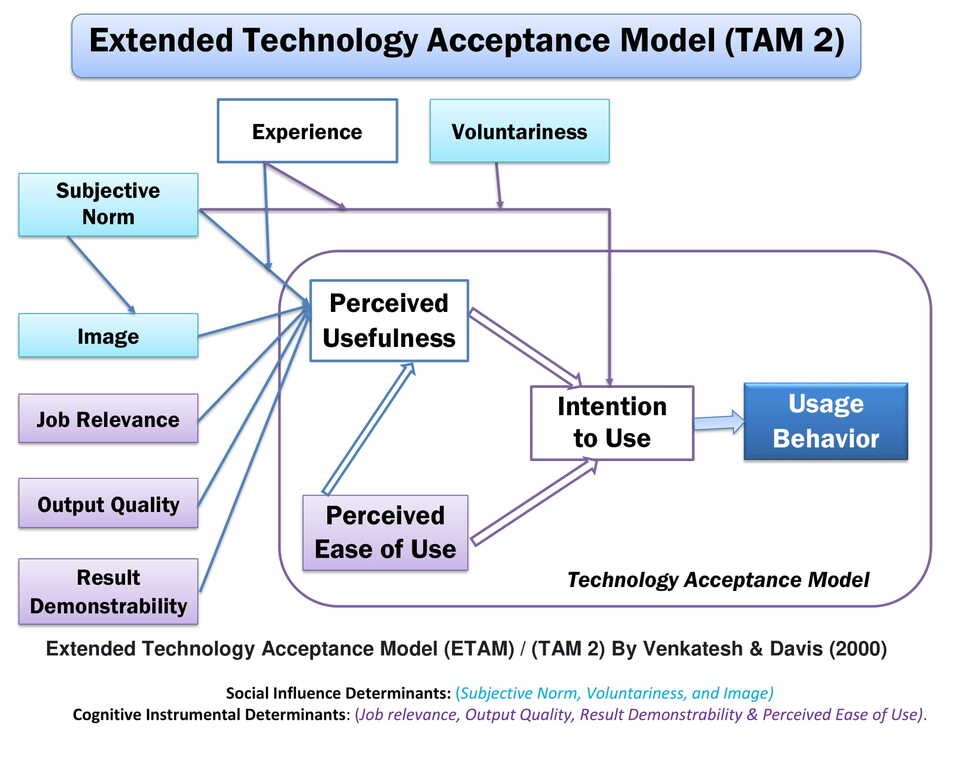
Technology Acceptance Model (TAM-2) Questionnaire (Venkatesh & Davis, 2000)
All items were measured on a 7-point Likert scale, where 1 = strongly disagree, 2 = moderately disagree, 3 =somewhat disagree, 4= neutral (neither agree nor disagree), 5= somewhat agree, 6= moderately agree, and 7= strongly agree.
Item Short Form:
U = Perceived Usefulness
EOU = Perceived Ease of Use
SN = Subjective Norm
IMG= Image
JR = Job Relevance
QUAL=Output Quality
RD = Result Demonstrability
BI = Behavioral Intention to Use
Intention to Use: Original 2 Items
- IU-1: Assuming I have access to the system, I intend to use it.
- IU-2: Given that I have access to the system, I predict that I would use it.
Items IU-1 and 2 were adopted from Venkatesh & Davis (2000).
Perceived Usefulness(U): Original 4 Items
- U-1: Using the system improves my performance in my job.
- U-2: Using the system in my job increases my productivity.
- U-3: Using the system enhances my effectiveness in my job.
- U-4: I find the system to be useful in my job.
Question items U-1 to 4 were adopted from Venkatesh & Davis (2000).
Perceived Ease of Use(EOU): Original 4 Items
- EOU-1: My interaction with the system is clear and understandable.
- EOU-2: Interacting with the system does not require a lot of my mental effort.
- EOU-3: I find the system to be easy to use.
- EOU-4: I find it easy to get the system to do what I want it to do.
Question items EOU-1 to 4 were adopted from Venkatesh & Davis (2000).
Subjective Norm (SN): Original 2 Items
- SN-1: People who influence my behavior think that I should use the system.
- SN-2: People who are important to me think that I should use the system.
Question items SN-1 and 2 were adopted from Venkatesh & Davis (2000).
Voluntariness: 3 Question Items
- V-1: My use of the system is voluntary.
- V-2: My supervisor does not require me to use the system.
- V-3: Although it might be helpful, using the system is certainly not compulsory in my job.
Question items V-1, 2, and 3 were adopted from Venkatesh & Davis (2000).
Image(IMG): Original 3 Items
- IMG-1: People in my organization who use the system have more prestige than those who do not.
- IMG-2: People in my organization who use the system have a high profile.
- IMG-3: Having the system is a status symbol in my organization.
Question items IMG-1, 2, and 3 adopted from Venkatesh & Davis (2000).
Job Relevance: 2 Items
JR-1: In my job, usage of the system is important.
JR-2: In my job, usage of the system is relevant.
Question items JR-1 and 2 were adopted from Venkatesh & Davis (2000).
Output Quality (QUAL): Original 2 Items
QUAL-1: The quality of the output I get from the system is high.
QUAL-2: I have no problem with the quality of the system’s output.
Question items QUAL-1 and 2 were adopted from Venkatesh & Davis (2000).
Result Demonstrability: Original 4 Items
RD-1: I have no difficulty telling others about the results of using the system.
RD-2: I believe I could communicate to others the consequences of using the system.
RD-3: The results of using the system are apparent to me.
RD-4: I would have difficulty explaining why using the system may or may not be beneficial.
Question items RD-1 to 4 adopted from Venkatesh & Davis (2000).
TAM-3 Model (Venkatesh and Bala in 2008)
In 2000, Viswanath Venkatesh and Hillol Bala introduced the Technology Acceptance Model 3 (TAM-3). This iteration expanded the framework by integrating a comprehensive network of determinants that directly drive a user’s perceived ease of use (Venkatesh & Bala, 2008). Specifically, the TAM-3 model delves deeper into user psychology by incorporating variables such as computer anxiety, computer self-efficacy, perceptions of external control, computer playfulness, and intrinsic enjoyment.
Research Title: “Technology Acceptance Model 3 and a Research Agenda on Interventions.”
Variables: Perceived Usefulness, Perceived Ease of Use, Behavioral Intention, Use behavior, and (Subjective Norm, Voluntariness, Image, Job relevance, Output Quality, Result Demonstrability, Experience, Voluntariness, Computer Self- Efficacy, Perception of External Control, Computer Anxiety, Computer Playfulness, Perceived Enjoyment, Objective Usability).
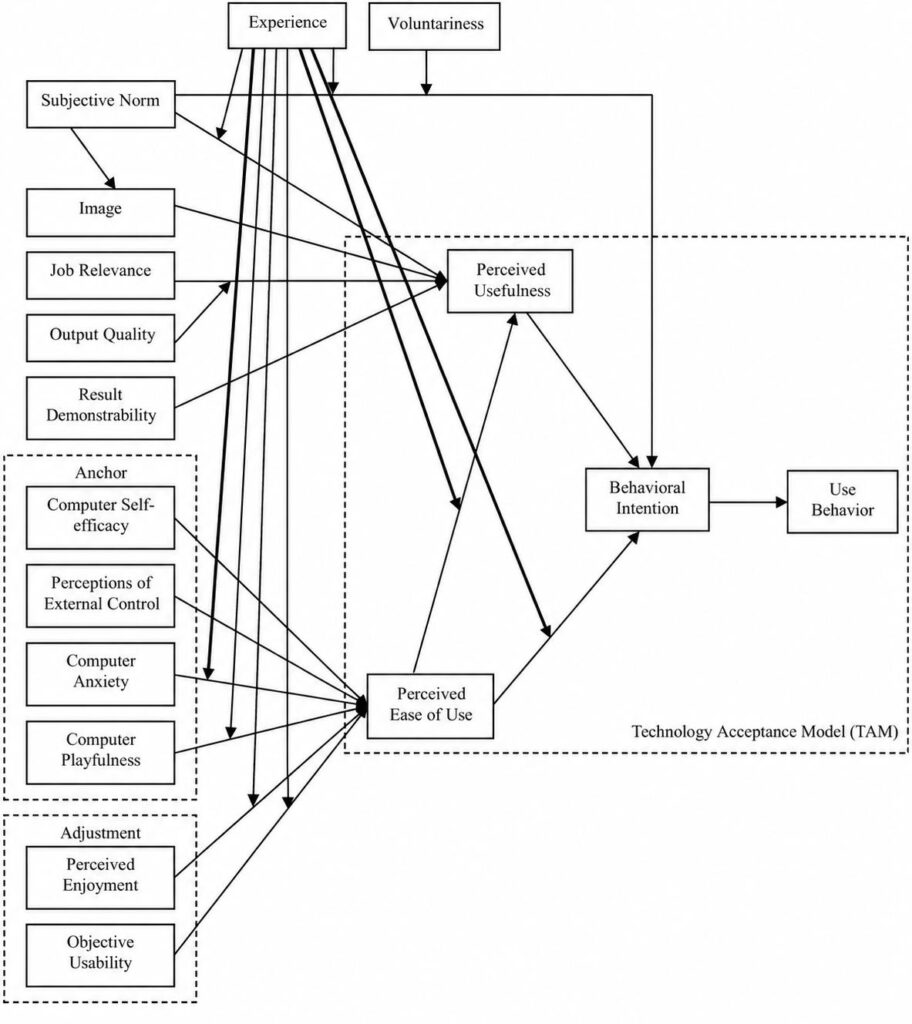
Technology Acceptance Model (TAM-3) Questionnaire (Venkatesh & Bala, 2008)
“All items were measured on a 7-point Likert scale (where 1: strongly disagree; 2: moderately disagree, 3: somewhat disagree, 4: neutral (neither disagree nor agree),5: somewhat agree, 6: moderately agree, and 7: strongly agree), except computer self-efficacy, which was measured using a 10-point Guttman scale.”
Objective Usability (OU): Questionnaire Constructs
No specific items were used. It was measured as a ratio of the time spent by the subject to the time spent by an expert on the same set of tasks.
Subjective Norm (SN): 4 Questionnaire Constructs
- SN-1: People who influence my behavior think that I should use the system.
- SN-2: People who are important to me think that I should use the system.
- SN-3: The senior management of this business has been helpful in the use of the system.
- SN-4: In general, the organization has supported the use of the system.
Research Constructs SN-1 to 4 adopted from Venkatesh & Bala (2008).
Voluntariness (VOL): 3 Questionnaire Constructs
- VOL-1: My use of the system is voluntary.
- VOL-2: My supervisor does not require me to use the system.
- VOL-3: Although it might be helpful, using the system is certainly not compulsory in my job.
Research Constructs VOL-1 to 3 adopted from Venkatesh & Bala (2008).
Image (IMG): 3 Questionnaire Constructs
- IMG-1: People in my organization who use the system have more prestige than those who do not.
- IMG-2: People in my organization who use the system have a high profile.
- IMG-3: Having the system is a status symbol in my organization.
Research Constructs IMG-1 to 3 were adopted from Venkatesh & Bala (2008).
Job Relevance (REL): Questionnaire Constructs
- REL-1: In my job, usage of the system is important.
- REL-2: In my job, usage of the system is relevant.
- REL-3: The use of the system is pertinent to my various job-related tasks.
Research Constructs REL-1 to 3 adopted from Venkatesh & Bala (2008).
Output Quality (OUT): Questionnaire Constructs
- OUT-1: The quality of the output I get from the system is high.
- OUT-2: I have no problem with the quality of the system’s output.
- OUT-3: I rate the results from the system to be excellent.
Constructs OUT-1 to 3 adopted from Venkatesh & Bala (2008).
Result Demonstrability (RES): Questionnaire Constructs
- RES-1: I have no difficulty telling others about the results of using the system.
- RES-2: I believe I could communicate to others the consequences of using the system.
- RES-3: The results of using the system are apparent to me.
- RES-4: I would have difficulty explaining why using the system may or may not be beneficial.
Constructs RES-1 to 4 adopted from Venkatesh & Bala (2008).
Behavioral Intention (BI): Questionnaire Constructs
- BI-1: Assuming I had access to the system, I intend to use it.
- BI-2: Given that I had access to the system, I predict that I would use it.
- BI-3: I plan to use the system in the next months.
Constructs BI-1 to 4 adopted from Venkatesh & Bala (2008).
Use (USE): Questionnaire Constructs
USE-1: On average, how much time do you spend on the system each day?
Perceived Usefulness (PU): Questionnaire Constructs
- PU-1: Using the system improves my performance in my job.
- PU-2: Using the system in my job increases my productivity.
- PU-3: Using the system enhances my effectiveness in my job.
- PU-4: I find the system to be useful in my job.
Constructs 1-4 adopted from Venkatesh & Bala (2008).
Perceived Ease of Use (PEOU): Questionnaire Constructs
- PEOU-1: My interaction with the system is clear and understandable.
- PEOU-2: Interacting with the system does not require a lot of my mental effort.
- PEOU-3: I find the system to be easy to use.
- PEOU-4: I find it easy to get the system to do what I want it to do.
Constructs 1-4 adopted from Venkatesh & Bala (2008).
Computer Self-Efficacy (CSE): Questionnaire Constructs
I could complete the job using a software package…
- CSE-1: …if there was no one around to tell me what to do as I go.
- CSE-2: …if I had just the built-in help facility for assistance.
- CSE-3: … if someone showed me how to do it first.
- CSE-4: .. if I had used similar packages before this one to do the same job.
Perceptions of External Control (PEC): Questionnaire Constructs
- PEC-1: I have control over using the system.
- PEC-2: I have the resources necessary to use the system.
- PEC-3: Given the resources, opportunities and knowledge it takes to use the system, it would be easy for me to use the system.
- PEC-4: The system is not compatible with other systems I use.
Research Constructs 1-4 adopted from Venkatesh & Bala (2008).
Computer Playfulness (CPLAY): Constructs
The following questions ask you how you would characterize yourself when you use computers:
CPLAY-1: … spontaneous
CPLAY-2: … creative
CPLAY-3: … playful
CPLAY-4: …unoriginal
Computer Anxiety (CANX): Questionnaire Constructs
CANX-1: Computers do not scare me at all.
CANX-2: Working with a computer makes me nervous.
CANX-3: Computers make me feel uncomfortable.
CANX-4: Computers make me feel uneasy.
Research Constructs 1-4 adopted from Venkatesh & Bala (2008).
Perceived Enjoyment (ENJ): Questionnaire Constructs
ENJ-1: I find using the system to be enjoyable.
ENJ-2: The actual process of using the system is pleasant.
ENJ-3: I have fun using the system.
Research Constructs 1-3 adopted from Venkatesh & Bala (2008).
Technology Acceptance Model Questionnaire for Artificial Intelligence (AI) Adoption
Perceived Usefulness(U): AI Adoption Questionnaire
- PU 1- Using Artificial Intelligence (AI) improves my performance in the office.
- PU-2: Using Artificial Intelligence (AI) in my job increases my productivity.
- PU-3: Using Artificial Intelligence (AI) enhances my effectiveness in my job.
- PU-4: I find the Artificial Intelligence (AI) to be useful in my job.
Perceived Ease of Use (PEOU): AI Adoption Questionnaire
- PEOU-1: My interaction with Artificial Intelligence (AI) is clear and understandable.
- PEOU-2: Interacting with Artificial Intelligence (AI) does not require a lot of my mental effort.
- PEOU-3: I find Artificial Intelligence (AI) to be easy to use.
- PEOU-4: I find it easy to get Artificial Intelligence (AI) to do what I want it to do.
FAQ (Frequently Asked Questions): TAM Model Questionnaire
Q: What is the first TAM model?
A: The Technology Acceptance Model (Davis, 1986) is the initial TAM model officially published by Fred D. Davis in 1986. However, he introduced this framework in his 1985 thesis and published it the following year.
Q: Who is the pioneer of the TAM model?
Fred D. Davis is the inventor of the Technology Acceptance Model. He is an academic researcher from Texas Tech University who completed a PhD from the Massachusetts Institute of Technology.
What measurement scale is used for the TAM questionnaire?
TAM-2 and TAM-3 questionnaire constructs are traditionally measured using a 7-point Likert scale ranging from 1 (Strongly Disagree), 2 (Moderately Disagree), 3 (Somewhat Disagree), 4 (Neutral), 5 (Somewhat Agree), 6 (Moderately Agree), to 7 (Strongly Agree).”
What is the Technology Acceptance Model (TAM) questionnaire?
“The Technology Acceptance Model (TAM) questionnaire is a research tool based on frameworks published by Fred Davis, Viswanath Venkatesh, and Hillol Bala (1986, 1989, 2000, 2008). It features standardized item constructs used to examine and predict why users accept or reject new technologies, software, or devices.”
Q1: Are the TAM model questions safe to use for AI and Gemini adoption research?
A: Yes, the technology acceptance model (TAM) questionnaires are adopted from the original research paper and are suitable for use in AI and Google Gemini AI adoption research.
Q: Is the TAM model questionnaire a perfect construct for new tools adoption in any kind of organization?
A: Yes, TAM and UTAUT frameworks are widely recognized for technology and the latest system adoption models in E-Commerce, Corporate & IT Software Implementations, E-Learning, Healthcare, Tourism & Hospitality, AI & Emerging Tech context.
Q: What are the original technology acceptance model questionnaires?
A: The questionnaire items adopted from the Technology Acceptance Model (TAM) (Davis, 1986) are original and widely recognized.
Q: What is the latest technology acceptance model questionnaire after the TAM model?
A: The Unified Theory of Acceptance and Use of Technology (UTAUT questionnaire) is the latest technology adoption research item after the TAM model.
Q: What is the best model to adopt for the questionnaire for Artificial Intelligence (AI) Adoption?
A: The Technology Acceptance Model and the UTAUT are the best theories to adopt and adapt questionnaire items for AI adoption.
Which TAM model questionnaire is perfect for information technology adoption studies? The The
Technology Acceptance Model (Davis, 1993) questionnaire includes questionnaire items to accept and use electronic mail in the workplace. Therefore, the TAM model (Davis, 1993) questionnaires are ideal to use for information technology adoption.
References APA 7th Edition: Scholarly Sources
Davis, F. D. (1986). A technology acceptance model for empirically testing new end-user information systems: Theory and results (Doctoral dissertation, Massachusetts Institute of Technology, Sloan School of Management). Massachusetts Institute of Technology.
Davis, F. D. (1989). Perceived usefulness, perceived ease of use, and user acceptance of information technology. MIS Quarterly, 13(3), 319–340. https://doi.org/10.2307/249008
Davis, F. D. (1993). User acceptance of information technology: System characteristics, user perceptions, and behavioral impacts. International Journal of Man-Machine Studies, 38(3), 475–487. https://doi.org/10.1006/imms.1993.1022
Davis, F. D., & Venkatesh, V. (1996). A critical assessment of potential measurement biases in the Technology Acceptance Model: Three experiments. International Journal of Human-Computer Studies, 45(1), 19–45. https://doi.org/10.1006/ijhc.1996.0040
Venkatesh, V., & Bala, H. (2008). Technology acceptance model 3 and a research agenda on interventions. Decision Sciences, 39(2), 273-315.
Venkatesh, V., & Davis, F. D. (2000). A theoretical extension of the technology acceptance model: Four longitudinal field studies. Management Science, 46(2), 186–204. https://doi.org/10.1287/mnsc.46.2.186.11926

M M Kobiruzzaman is a researcher, academic content writer, traveler, and the founding editor of Newsmoor.com. Specializing in communication, management, technology adoption models, and frameworks analysis, and journalism, his work bridges the gap between theory explanation and cultural communication. With a strong background in communication and management, he is dedicated to providing authoritative guides that elevate business and media literacy and academic writing standards.
"." Newsmoor,
