Social Groups Types and Examples In Sociology PDF. Also, Ten Types of Social Groups
Social Groups
Social groups are groups of people in society who communicate regularly to achieve individual and collective goals. Every social group comprises more than two people. People in the same group share similar characteristics, mutual expectations, and a common identity. These groups have been prevalent in society for thousands of years, including learning groups, work groups, and self-help groups. The social groups are divided into smaller subgroups. A small social group consists small number of people in society. The members of these small social groups communicate regularly and share common objectives. Group communication is significant to achieving the group’s goal.
Group development models posit that group communication has multiple stages, tensions, and conflicts, and that members must address these challenges to achieve the final goal. According to Tuckman’s Theory, the five stages of group discussion are Forming, Storming, Norming, Performing, and Adjourning. Members must overcome all these stages to achieve the independent and interdependent goals. The four types of barriers in group communication are Ethnocentrism, Stereotyping, Prejudice, and Discrimination.
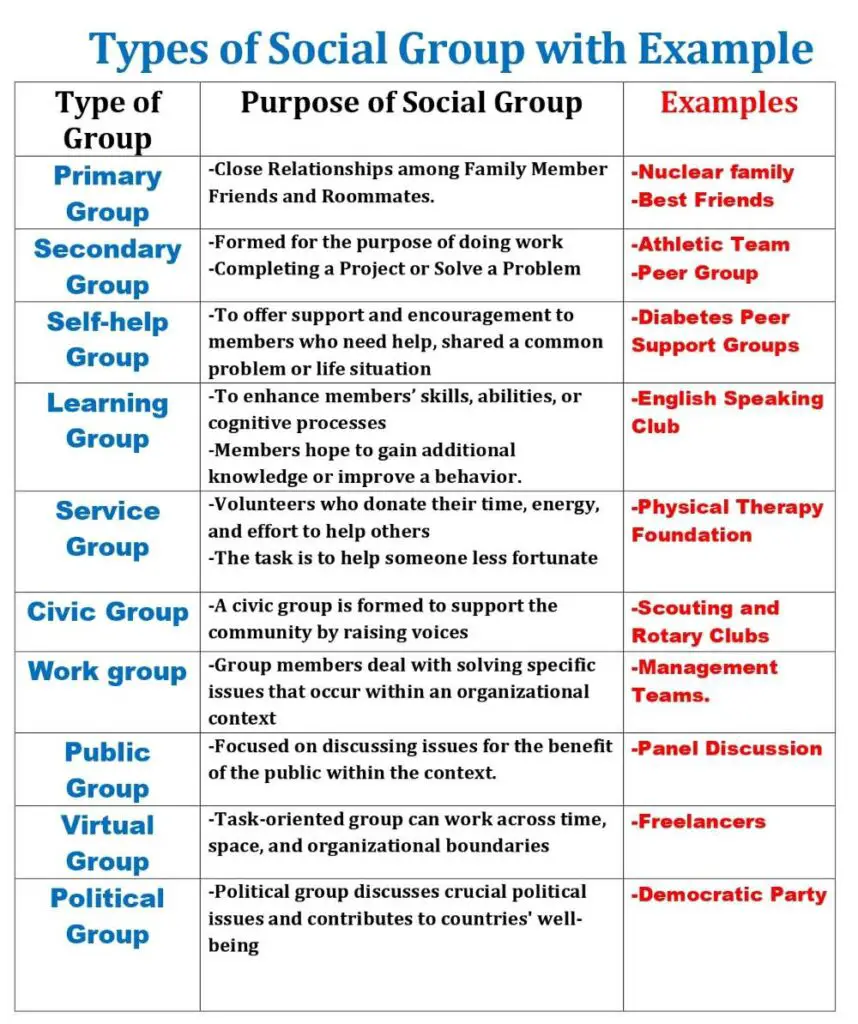
Types of Social Groups
The 10 Types of Social Groups are:
- Primary Group
- Secondary Group
- Self-help Group
- Learning Group
- Service Group
- Civic Group
- Work-Group
- Public Group
- Virtual Group
- Political Group
Based on the research, the author presents a list of the top 10 types of social groups, along with their overall purposes and examples, provided below.
Types of Social Groups with Examples
1. Primary Group
The primary group refers to close relationships among family members, friends, and roommates. The members satisfy primary needs, including affiliation, belonging, love, and esteem. The primary group maintains interpersonal communicative behaviors among members, such as self-disclosure, empathy, trust, and perceived understanding. Researchers often refer to the primary group as a long-standing group in many textbooks because of its long-term relationships.
For example, the Nuclear family, Roommates, Several friends who meet daily around a table (best friends), and co-workers who regularly share Coffee breaks are primary groups.
2. Secondary Group
A secondary group is formed when a few people communicate to complete daily tasks. Most scholars have noted that the secondary group is typically formed to perform work. The group members form this group to complete a project and solve a problem. Similar to primary groups, members of secondary groups share a common interest or engage in a shared activity.
For example, Athletic Teams and Peer Groups are social groups.
3. Self-Help Group (SHG)
A self-help group comprises voluntary members who meet to improve their living, physical, and financial conditions. Group members face similar health conditions, common problems or life situations, and financial crises. This group’s goal is to pursue a shared approach to problem resolution. It provides support and encouragement to members seeking individual development. Self-help groups are available online and address health, personal, or relationship issues.
For example, Diabetes Peer Support Groups, Cancer self-help and support groups, and Early Morning Running Groups.
4. Learning Group
A learning group is a collective of individuals who come together to develop skills and abilities. Usually, the educational or learning group primarily discovers and develops new ideas and ways of thinking.
This group is intended to enhance members’ skills, abilities, and cognitive processes. Group members gain additional knowledge to improve their behavior.
For example, members of the English-speaking club come together to practice and improve their English proficiency. Professional workshops and health and fitness classes (Yoga) are examples of learning groups.
5. Service Group
The service group comprises volunteers who donate their time, energy, and effort to assist individuals who require specific support. This group of members seeks to support individuals who need assistance in leading their lives. They foster social etiquette and responsibility towards others in society. The task of this group is to help someone less fortunate.
For example, the Physical Therapy Foundation and Kiwanis are service groups.
6. Civic Group
A civic group is formed to support the community by raising voices. In this group, members help people within the community. Civic groups play a vital role in promoting civic engagement, fostering social cohesion, and advancing positive social changes. Members mobilize resources, raising awareness, and advocating for policy reform. They provide opportunities for individuals to come together, voice their concerns, and take collective action to address pressing issues facing their communities and societies
For example, Parent-Teacher Associations, Churches, Mosques, Scouting, and Rotary Clubs.
7. Work-group
The working group is also known as a decision-making and problem-solving group. The group members address specific issues that arise within an organizational context. Members complete particular tasks and routine duties on behalf of an organization whose members take collective responsibility for the job. The group’s goal is to collaborate on collective work.
For example, Standing Committees, Task Forces, and Management Teams are workgroups.
8. Public Group
A public group focuses on discussing important issues for the public benefit. The group members focus on the common goals that benefit everyone within the context. They are key decision-makers and address matters of public concern. Social media users are part of this group.
For instance, symposiums, panel discussions, and forums are examples of public groups.
9. Virtual Group
The task-oriented group can work across time, space, and organizational boundaries. Virtual meeting group members work interdependently on a task but from different physical locations via communication technology. This group evolves into a virtual community or a group that meets regularly in cyberspace for members to share their experiences, opinions, and knowledge on a particular topic or interest. Virtual groups communicate via meeting platforms such as Google Meet, Zoom, and Microsoft Teams.
For example, a freelancer works from a different country via online meetings.
10. Political Group
A political group discusses crucial economic and political issues and contributes to a country’s well-being. Political leaders meet, in person or virtually, to make decisions and take appropriate actions. Political Group members have similar beliefs, goals, and shared ideology.
For example, the Democratic Party and the Republican Party are the two major political groups. From a political perspective, most American voters are members of the Democratic or Republican political parties.
Importance of Social Group
The seven key aspects of a social group are social network, mental support, social engagement, skill development, problem-solving, safety, and social identity.
Conclusion
In conclusion, the ten types of social groups are primary group, secondary group, self-help group, learning group, service group, civic group, work group, public group, virtual group, and political group. Members of these groups then communicate and collaborate to promote people’s well-being. The advantages of small-group communication include enhanced performance, member satisfaction, and greater civic engagement.