Deming PDCA Cycle Four Stages, Advantages and Disadvantages

This article explains the Deming PDCA Cycle- Four Stages, Advantages, and Disadvantages. It also describes PDSA Cycle Revolution with Pros and Cons.

Deming PDCA Cycle

Deming PDCA cycle refers to a repeated four-step management model that ensures the continuous improvement of products and services in the industry. In the 1950s, a famous management scholar, Dr. William Edwards Deming, introduced the PDCA method; therefore, it is also known as the Deming Cycle or Deming Wheel. It is a famous method for solving problems to yield the highest quality results. The full meaning of PDCA is the Plan–Do–Check–Act, a four-step action method.

Apart from PDCA, it has multiple names, such as the PDSA abbreviation of the Plan–Do–Check–Adjust, the Deming cycle or circle, or wheel, the Shewhart cycle, and the control cycle or circle. The Plan-Do-Study-Act (PDSA) cycle is a quality improvement framework commonly used in various industries, including healthcare, manufacturing, and education.

The Four Stages of the Deming Cycle

The Four Stages of the Deming Cycle are Plan, Do, Study or Check, and Act. These are the four core elements or principles of the Deming cycle model. Deming’s principles for pdca cycle include Plan, Do, Study, or Check, and Act. 
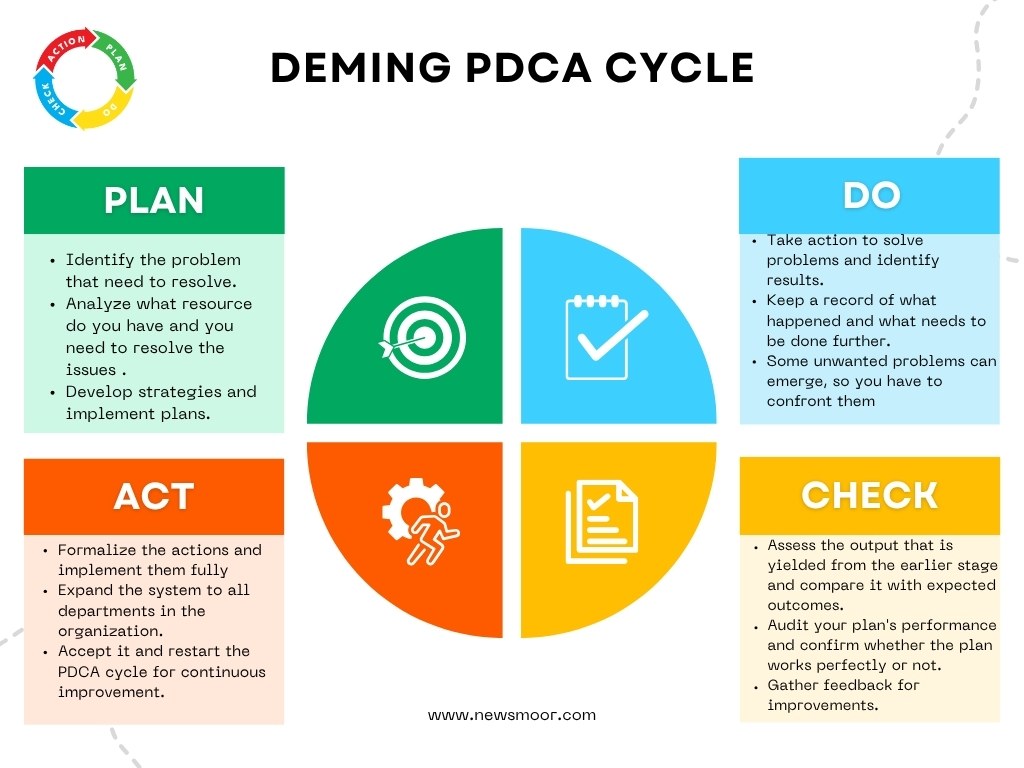
deming pdca cycle four stages

1. Plan

PLAN is the initial step of the four-step method that identifies the problem and opportunities to suggest recommendations. In addition, it analyzes and describes the overall current situation of the project. The authority recruits a team to understand the full process of the project in this stage; they  identify the problems that need to be changed and find solutions to fix the problems.

In this stage, you have to find out the answers to some basic questions regarding the project. The questions are as follows;

Firstly, you have to identify the main problem that needs to be solved in your organization. The customers demand to resolve this problem be resolved.
Secondly, what kind of resources do you have now that you use regularly?
In addition, what resources do you need to resolve the problem?
Moreover, what is the solution that you have taken with resources?
Finally, how long will it take to analyze the problems and implement the planning?

2. Do

The DO phase is the second stage of the Deming cycle, where the testing of the solution starts to be executed to identify the results. After completing the planning step, you have to take action to solve the problems. You will apply all the plans that you have taken in the first stage. Some unwanted problems can emerge in this stage, so you have to be aware to confront them. To increase your confidence level, you can apply your actions to a small arena in the project. It is a subtle way to control the situation properly as well as avoid an unpredictable big mistake. All team members stay alert at this stage to play their roles and responsibilities.

In this stage, you, with your team members, will take some initiatives mentioned below:

  • Keep a record of what happened and what needs to be done further.
  • When do you apply the planning?
  • Collect data from the planning stage.
  • Try to use a check sheet, swim lane map, and flowchart to capture data.
3. Study or Check

Study or check is probably the most important step of the Deming cycle. You must pay attention to the CHECK stage if you want to scrutinize the output that is yielded from the earlier stage. It will help you to avoid repeating mistakes and clarify the success of your planning and application of steps. This stage will allow you to audit your plan’s performance; you will be confirmed whether the plan works perfectly or not.  Additionally, your team will identify the problematic portions of the project to eliminate them in the future. You would be able to discover the root cause of the problem if something went wrong. In short, this stage will assess the system’s effectiveness and help you decide whether the theory is helpful or not.

Example: Appraisals or  Gap analysis.

In this stage, you have to capable to answer some questions mentioned below.

  • Is the system effective or not to resolving the issues?
  • Do you want to continue this system or need to change it?
  • Have you outlined a list including the unexpected results, failures, successes, and outcomes?
4. Act

ACT is the final stage of the system that finalizes the perfect solution to implement. In this stage, your organization should follow the adapt, adopt, and abandon factors.

Adapt refers to changing and modifying the PDSA circle for the next test.

Adopt indicates considering expanding the system to all departments in the organization.

Abandon means modifying your full approach and repeating the PDCA circle.  In sum, it is the step of standardization that is considered standardized when goals are exceeded.

In this stage, you need to answer the questions below.

  • Do you want to formalize the actions and implement them fully?
  • Do you want to expand the system to all departments in the organization?
  • Do you want to accept it and restart the PDCA cycle for continuous improvement?

Deming PDCA Cycle Pros and Cons

Firstly, PDSA is a simple and effective process for addressing new and recurring problems in the industry. In addition, it is a repeated approach that will allow you to measure results without wasting time. Moreover, it is a risk-free approach to apply a small scale to the project; therefore, there is no need to change the full process if it doesn’t work.

In contrast, the full PDSA process is slow when applied in industry to yield the final result. It is not a straightforward execution process that can be applied to urgent problem-solving issues. Additionally, you need to use some resources, including effective team members, to ensure that each circle step is directed perfectly.

Advantages of the PDSA Cycle

The eight benefits of the PDSA or PDCA cycle are systematic strategy, flexibility, an iterative process, a focus on learning, team empowerment, evidence-based decision-making, rapid improvement, and a continuous improvement culture.

advantages of the pdsa cycle

Systematic Strategy

The PDSA framework offers a structured strategy for resolving problems and ensuring continuous improvement. It shows the step-by-step (Plan, Do, Study or Check, Act), process to assess the improvement. We can address the complex issues and refine them in every section methodically. It allows us to follow systematically, one by one.

Flexibility

The PDSA cycle is flexible and adaptable to a wide range of settings and industries. It can be applied to small-scale projects or larger initiatives, making it suitable for organizations of all sizes and types.

Iterative Process

The iterative nature of the PDSA cycle allows organizations to make incremental improvements over time. By continually cycling through the steps of the PDSA cycle, organizations can refine their processes, systems, and practices to achieve greater efficiency and effectiveness.

Focus on Learning

The PDSA cycle emphasizes learning and experimentation as essential components of improvement. By studying the results of each cycle, organizations gain valuable insights into what works and what doesn’t, enabling them to make informed decisions and adjustments.

Empowerment of Teams

The PDSA cycle encourages collaboration and engagement among teams involved in improvement efforts. By involving frontline staff in the planning, execution, and evaluation of improvement initiatives, organizations empower employees to take ownership of the process and contribute their expertise and insights.

Data-Driven Decision-Making

The PDSA cycle relies on data and evidence to drive decision-making. By collecting and analyzing data throughout the improvement process, organizations can identify trends, root causes, and opportunities for improvement, enabling them to make informed decisions and prioritize actions effectively.

Rapid Implementation

The PDSA cycle enables organizations to implement changes quickly and test their impact in a controlled manner. By breaking down improvement initiatives into small, manageable steps, organizations can avoid delays and minimize the risks associated with large-scale changes.

Continuous Improvement Culture

The PDSA cycle fosters a culture of continuous improvement within organizations. By encouraging ongoing reflection, learning, and adaptation, organizations can create an environment where innovation and excellence are valued and rewarded.

Disadvantages of the PDSA Cycle

While the PDSA cycle offers numerous benefits for continuous improvement, it also has eight potential weaknesses, including time-consuming, complexity, risk of inefficiency, resistance to change, limited scope, data quality issues, lack of sustainability, and cost.
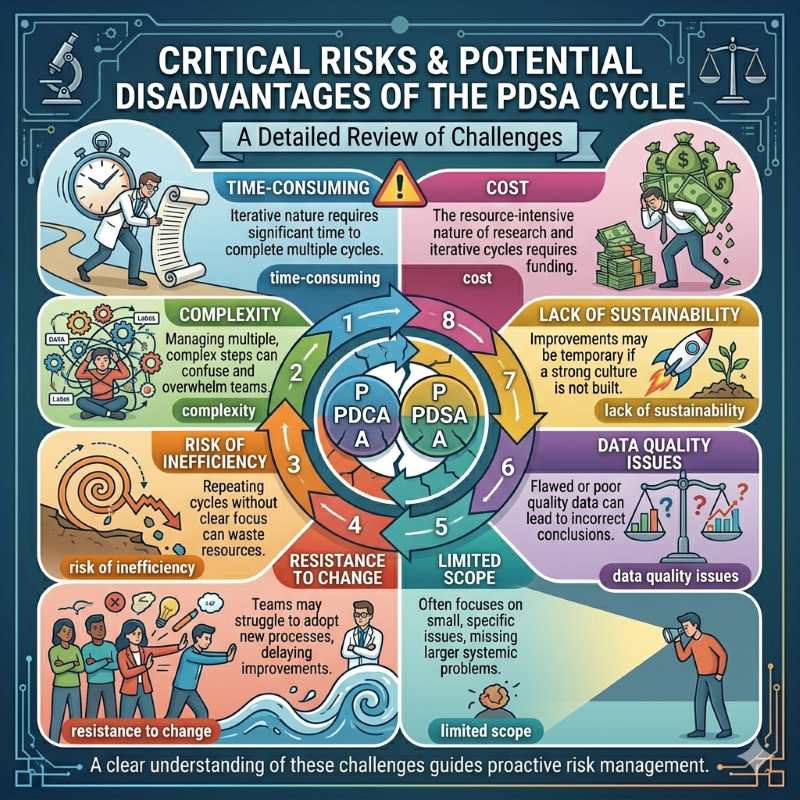
weakness of the pdsa cycle

Time-consuming

Implementing the PDSA cycle requires time and effort to plan, execute, and evaluate improvement initiatives. For organizations with limited resources or competing priorities, the PDSA cycle may add to the workload and strain resources.

Complexity

The PDSA cycle involves multiple steps, including planning, implementation, data collection, and analysis. This complexity can be daunting for individuals or teams unfamiliar with quality improvement methodologies, leading to confusion or errors in implementation.

Risk of Inefficiency

In some cases, organizations may engage in the PDSA cycle without clear goals or objectives, leading to inefficient use of resources. Without proper planning or alignment with strategic priorities, improvement efforts may yield minimal results or fail to address critical issues.

Resistance to Change

Implementing the PDSA cycle often requires changes to existing processes, workflows, or behaviors. Resistance to change from stakeholders, including employees, management, or customers, can impede the effectiveness of improvement initiatives and hinder progress.

Limited Scope

The PDSA cycle is best suited for small-scale, incremental improvements rather than large-scale organizational change. For complex or systemic issues requiring comprehensive restructuring or transformation, alternative methodologies may be more appropriate.

Data Quality Issues

Effective implementation of the PDSA cycle relies on accurate and reliable data for decision-making. However, organizations may encounter challenges with data collection, measurement, or analysis, leading to flawed conclusions or ineffective interventions.

Lack of Sustainability

Improvement initiatives resulting from the PDSA cycle may struggle to sustain long-term gains without ongoing support, monitoring, and reinforcement. Without a culture of continuous improvement or organizational commitment, improvements may regress over time.

Cost

While the PDSA cycle can lead to cost savings through efficiency gains or error reduction, there are also associated costs with implementing quality improvement initiatives. These costs may include training, technology investments, or hiring additional staff to support improvement efforts.

Overall, while the PDSA cycle offers a systematic approach to continuous improvement, organizations must carefully consider its limitations and potential drawbacks to maximize its effectiveness and achieve sustainable results.

The Evolution of the Deming Cycle or PDSA

The Deming cycle has evolved over time to become an effective process. I will discuss how the Deming cycle came to be and how it has evolved over time.

Dr. W. Edwards Deming

Deming was an American management consultant who graduated as an electrical engineer and later concentrated in mathematical physics. He has become a famous person in the Japanese industry for his work and initiatives after WWII. In addition, Dr. W. Edwards Deming got recognition as one of the most influential figures in the Japanese manufacturing industry, who was not Japanese but American. He championed the work of Walter Shewhart, including total quality management, statistical process control, and renamed the Shewhart Cycle. After all, he made a significant contribution to the rise of post-war economic growth in Japan.

The Shewhart Cycle

Deming had been inspired by an American engineer, Walter Andrew Shewhart, who was also a physicist and statistician. In 1939, Shewhart published a book on the Viewpoint of Quality Control. It was the first book that articulated a three-stage systematic process of specification, production, and inspection. These three stages were developed to test the hypothesis of experiments. Finally, he mentioned that these stages should not proceed in a straight line but rather in a cycle. Thus, the Shewhart Cycle took the form of a circle.

The Deming Wheel

In 1950, Deming analyzed Shewhart’s Cycle to modify it. He introduced a new version of Shewhart’s Cycle: a four-step process of design, production, sales, and research. This cycle has been known as the Deming Circle or Deming Wheel.

PDCA

Some Japanese executives probably modified the Deming cycle, or Deming wheel, to Plan-Do-Check-Act (PDCA), although the exact reason for changing the name is unclear. This four-step cycle was introduced to identify the problems in the industry and solve them by applying the four steps together. The primary objective of this cycle is to standardize the assessment of whether the results are satisfactory.
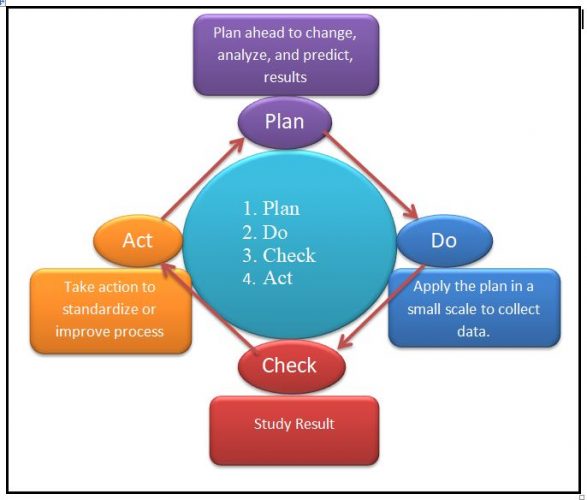
deming cycle- four stages of deming cycle & pdsa cycle pros and cons
Deming PDCA Cycle or PDSA Cycle
PDSA
Deming was not satisfied with the name of PDCA; therefore, he amended it in 1986. He emphasized the core meaning of checking and noted that it does not incorporate the cycle. Hence, the PDSA emerged from Deming’s recommendation.

When to Apply PDSA

The PDSA or PDCA framework can be used to develop any process or product by breaking it down into smaller steps. This cycle can be used in all kinds of organizations across many areas, such as change management, new service or product deployment, product lifecycle, and so on. This framework is beneficial for assisting in the improvement of the Six Sigma and total quality management processes. It is the best option for identifying problems and practical solutions.

Deming Cycle or PDSA Quality Improvement

The Deming cycle is an essential part of the quality improvement process in large-scale industry. Apart from that, organizations apply other quality improvement programs that are much more complex QI processes.

Continuous Quality Improvement

It is also known as the CQI process that organizations apply to reduce waste, increase efficiency, and increase internal and external satisfaction. It is a management philosophy that assesses how the industry operates and develops its processes. These more complex quality improvement programs include the following:

Lean

The lean process is a manufacturing approach that improves efficiency and reduces waste. This program focuses more on improving products and services based on customer demand.

Six Sigma

The Six Sigma process is a set of tools and techniques that improve process quality by eliminating defects and minimizing variability in manufacturing.

Total Quality Management

It is a process of a management system based on practicing a principle that instills a good business culture, where every employee maintains a high standard of work. It influences the organization to maintain a high quality of service in every aspect of the company.

Quality Improvement Collaboratives

It is a process that usually applies to healthcare centers, where many organizations work together to develop services for patients.

Conclusion

The Deming cycle is a four-step (PLAN, DO, STUDY, ACT) process that ensures continuous improvement of products and services in industry. Today, many organizations worldwide use this method to improve their products and services by solving problems.

Hofstede’s 6 Cultural Dimensions Examples

Hofstede’s Cultural Dimensions Theory. Also, Definition and Examples of Geert Hofstede’s Six Cultural Dimensions.

Hofstede’s Cultural Dimensions

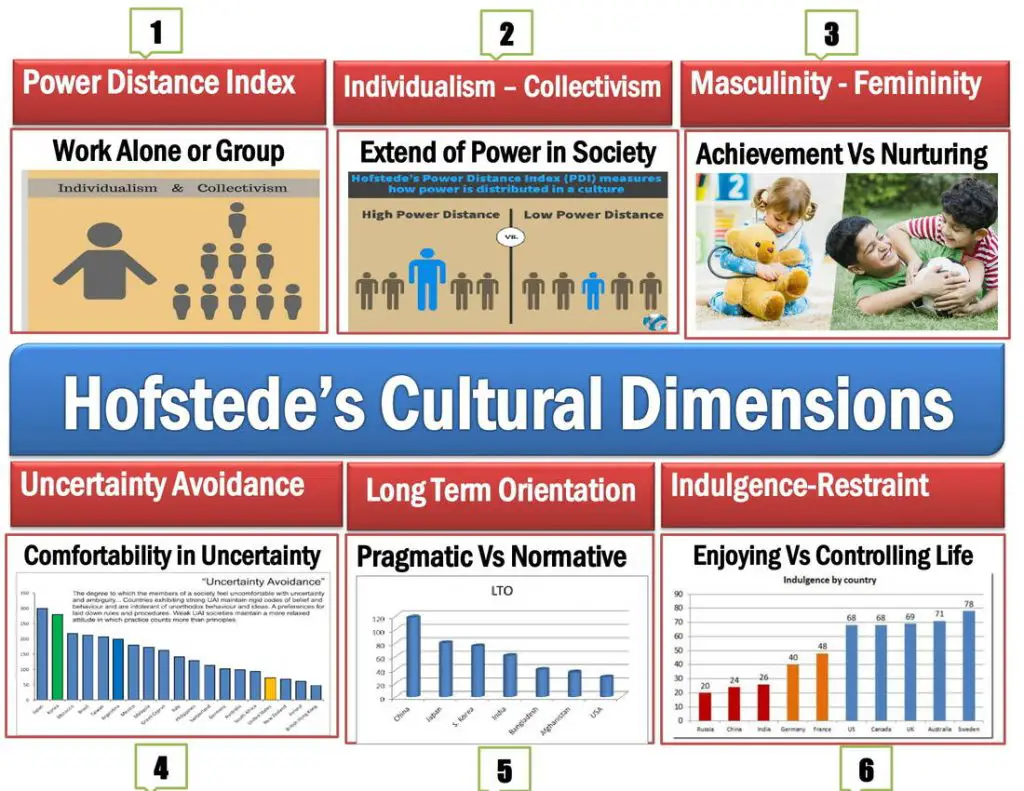
Hofstede’s cultural dimension was developed in 1980 by Dutch management scholar Geert Hofstede. It is also known as Hofstede’s model and theory. Geert Hofstede’s cultural dimensions are a conceptual framework for identifying cultural differences worldwide. It systematically compares the nations based on beliefs, values, behaviors, and attitudes. Hence, Hofstede’s cultural dimensions theory explains how a society’s culture shapes its members’ values. It also uses a factor-analytic structure to show how these values relate to behavior.

Initially, Hofstede’s cultural dimensions theory had only four dimensions: power distance index, individualism vs. collectivism, masculine vs. feminine, and uncertainty avoidance index. In 1988, Michael Harris Bond added the 5th dimension, “Long-Term versus Short-Term Orientation,” to Hofstede’s model. Similarly, in 2010, Michael Minkov described and added the 6th dimension- indulgence vs. restraint — to Geert Hofstede’s theory. Therefore, it is also known as Hofstede’s dimensions of national culture that evaluate and represent cultural differences globally.

This model generates a rank for each country through contained scores on a specific dimension. Each dimension of the Hofstede model differs from the others in its unique factor analysis. Hence, it is one of the critical theories to understand the cultural differences prevalent across the country. Cultural differences create cultural conflict, also known as cultural noise in communication.

Hofstede’s Six Cultural Dimensions

Geert Hofstede’s 6 Cultural Dimensions are Power Distance Index (PDI), Individualism Vs. Collectivism, Masculinity Vs. Femininity, Uncertainty Avoidance Index (UAI), Long Vs. Short-Term Orientation and Indulgence Vs. Restraint. This cultural dimensions theory is beneficial for understanding and changing the work attitudes of organizations, groups, team members, and so on. This model enables group members to negotiate with one another during group communication. It also helps negotiators understand the other party during international negotiations. Hofstede’s cultural dimensions are a significant model of communication that contributes to global and cross-cultural communication.

Hofstede’s 6 Cultural Dimensions are:

  1. Power Distance Index (PDI)
  2. Individualism Vs. Collectivism
  3. Masculinity Vs. Femininity
  4. Uncertainty Avoidance Index (UAI)
  5. Long Vs. Short Term Orientation
  6. Indulgence Vs. Restraint
hofstede’s 6 cultural dimensions- geert hofstede’s six cultural dimensions theory
Geert Hofstede’s Six Cultural Dimensions

1. Power Distance Index(PDI)

(Extent of Inequality and Power Distributed in Society)

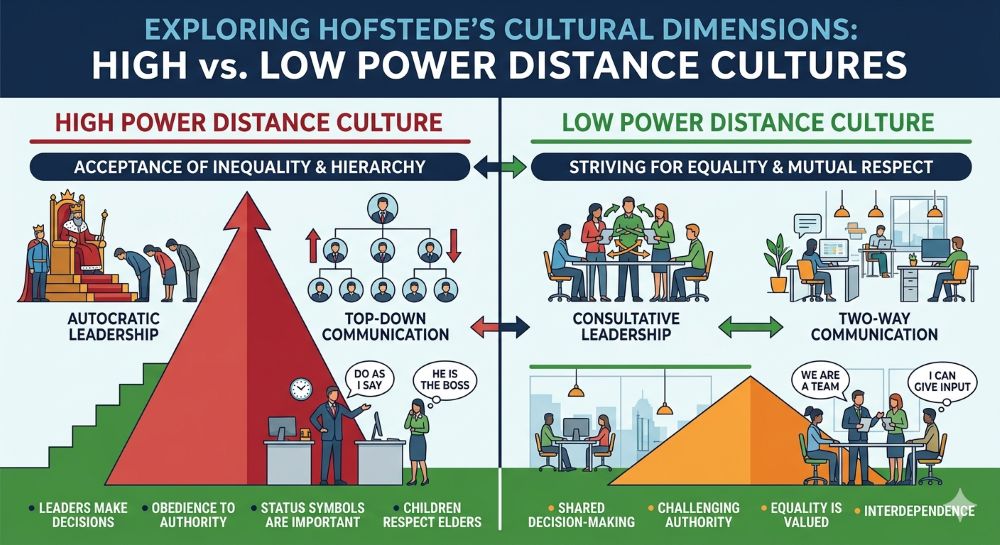
The power distance index refers to the degree to which members of a society accept hierarchical distance between power and authority. It is a crucial element of Hofstede’s six cultural dimensions that assesses the inequality (more versus less) among group members of society. Additionally, it has a significant impact on international business negotiations. The power distance index falls into high and low power distance.

High Power Distance

High power distance refers to a society in which less powerful people readily accept an unequal power distribution within the community. It means accepting the inequity between high- and low-status members of society. People with High PDI expect power to be distributed unequally, so they do not complain about inequality. It has become a tradition that is passed down from generation to generation. They value traditional norms and social rules. Therefore, people in high-power-distance countries accept inequity in organizations.

Examples of High Power Distance Countries

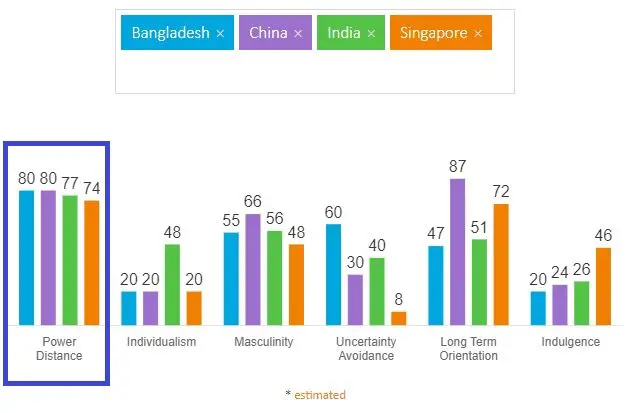
Bangladesh, China, India, Singapore, Malaysia, and Arab countries have very high power distance scores; therefore, these countries are examples of high PDI in 2023. For example, Bangladesh and China ranked as high-power-distance countries, with scores of 80. Additionally, India scores 77, and Singapore scores 74 in the power distance dimension. People from the following countries are more likely to accept inequalities between people with high and low power status. People in these countries do not complain; they admit it as a social order.

Hofstede country comparison website: www.hofstede-insights.com. Anyone can compare the country’s culture through the following link.

example of high power distance countries- high power distance countries- hofstede’s cultural dimensions
Low Power Distance

Low power distance refers to a culture in which less powerful people do not readily accept unequal power distribution in society. It means accepting equity and equality between high- and low-status members of society. Members of the community practice fairness and interdependence in society. People in a low-PDI society are pragmatic; hence, they are less oriented toward traditional values. They also complain about the subsisting inequity between high- and low-status members in communities and organizations.

examples of low power distance

Examples of Low Power Distance Countries

Austria, Israel, Denmark, New Zealand, Norway, Germany, and the United Kingdom are examples of low-power-distance countries in 2023. According to Hofstede’s cultural dimensions theory, Austria has the lowest PDI score at 11, followed by Israel at 13, Denmark at 18, New Zealand at 22, Norway at 31, Germany at 35, and the United Kingdom at 35. People from these countries do not accept the inequity between high- and low-influence people in society, communities, and organizations. They also raise their voices against injustice and discrimination in society.

example of low power distance index countries in 2022- hofstede’s cultural dimensions

Differences Between High and Low Power Distance Cultures
High Power Distance Culture
Low Power Distance Culture
People certainly accept unequal power distribution in society. In contrast, people complain about unequal power distribution.
Juniors respect older people in society. Senior and junior people respect each other equally.
Discrimination is prevalent across every sector of the country, including social, government, and non-governmental organizations. On the other hand, people raise their voices against discrimination.
The political leader and organizational Boss are autocratic people. The political leader and organizational Boss are democratic people.
For example, high power distance cultures exist in Bangladesh, China, India, Singapore, Malaysia, and Arab countries. For example, low power distance cultures exist in Austria, Israel, Denmark, New Zealand, Norway, Germany, and the United Kingdom.

2. Individualism Vs. Collectivism

(Prefer To Work Independently or Interdependently)

Individualism and collectivism are the most significant cultural dimensions that separate societies in which people prefer to work individually or interdependently. According to Hofstede’s model, a high score in a country indicates an individualistic culture. On the other hand, the low score suggests a collectivistic culture. Hofstede’s cultural dimensions theory emphasizes collectivism, so members of an individualistic society should understand that they are part of a larger group. Therefore, they should make all-out efforts to achieve a shared goal. Tuckman’s communication model discusses how to work together in a group to reach common goals.

Individualism

Individualism refers to a culture in which people prefer to work independently and seek freedom in the workplace. Individualistic members prefer working alone and seek credit for their work. In this culture, task prevails over relationships in the workplace. People in individualistic cultures do not want to work in groups, so they set independent goals and appreciate freedom. Thus, they are assertive, self-reliant, competitive, and value individual achievement.

Individualistic Countries Examples

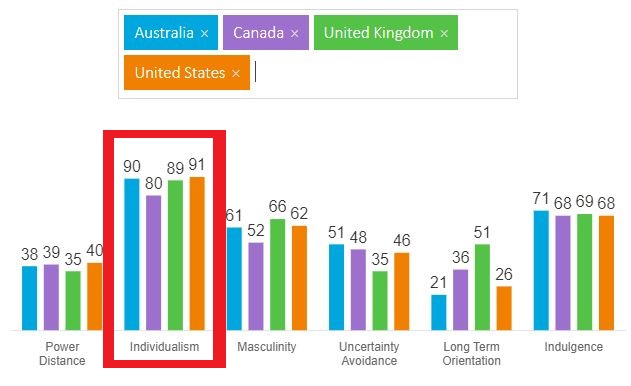
Usually, individualist cultures are prevalent in Western countries. For example, the United States, Australia, the United Kingdom, Canada, the Netherlands, New Zealand, and Ireland are individualistic countries. According to Hofstede’s Dimensions of National Culture, the United States scores 91, followed by Australia with 90, the United Kingdom with 89, Canada with 80, the Netherlands with 80, New Zealand with 79, and Ireland with 70. Therefore, people from these countries prefer working alone and value independent achievement.

individualistic countries examples

Collectivism

Collectivism refers to a culture in which people prefer to work together and foster interdependent achievement. Collectivist members like working in groups and helping each other. They like working in groups rather than alone. In this culture, relationship prevails over tasks in the business setting. They also enhance group identity and group success. Hence, they are cooperative, obedient, and self-sacrificing. In collectivist cultures, family members maintain strong relationships with other members. On the other hand, family members do not focus on maintaining strong relationships in an individualistic society.

Collectivistic Countries Examples

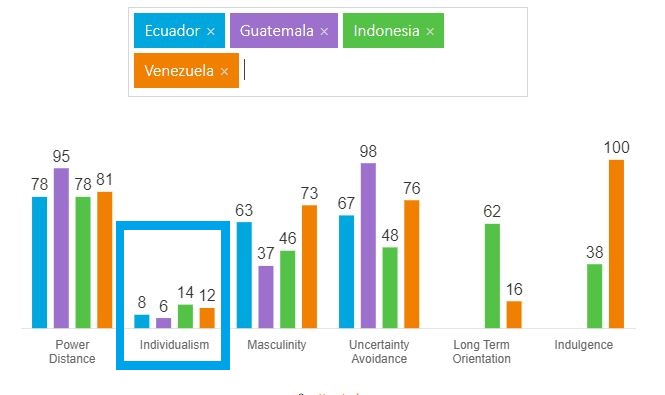
Collectivist cultures are common in Asian and Latin American countries. Guatemala, Ecuador,  Venezuela, Indonesia, Pakistan, Taiwan, South Korea, China, Bangladesh, and Malaysia are considered the most collectivistic nations globally. According to Hofstede’s cultural dimensions model, a low score in this dimension indicates a collectivistic society. For example, Guatemala has ranked as the most collectivistic country in the world, with a score of 06, followed by Ecuador with 08, Venezuela with 12, Indonesia with 14, Pakistan with 14, Taiwan with 17, South Korea with 18, China with 20, Bangladesh with 20, and Malaysia with 26. So, people from these countries prefer to work in groups and intend to achieve shared goals.

collectivistic countries examples

Hofstede Cultural Dimensions: Masculinity vs. Femininity

Differences Between Individualistic and Collectivistic Cultures

Individualistic Culture
Collectivistic Culture
Firstly, People are intended to work alone. In contrast, people are intended to work in groups or teams.
Additionally, people foster personal achievement. People foster group achievement.
In this culture, the member takes responsibility only for the immediate family, including the wife and children. On the other hand, in a collectivistic society, members take responsibility for the extended family, including parents and grandparents.
In the workplace, employees are supposed to focus on their personal tasks and compete for positions. In contrast, employees are supposed to share the workload.
Tasks control the relationship However, relationship prevails over functions. The government
plays a small role in society. The government certainly plays the most critical role in society.
Above all, people are assertive, self-reliant, self-interested, competitive, and independent. Whereas People are obedient, self-sacrificing, cooperative, and interdependent.
I- Consciousness We- Consciousness
For example, individualistic cultures are prevalent in the United States, Australia, the United Kingdom, Canada, the Netherlands, New Zealand, and Ireland. For example, collectivistic cultures are prevalent in Guatemala, Ecuador,  Venezuela, Indonesia, Pakistan, Taiwan, South Korea, China, Bangladesh, and Malaysia.

3. Masculinity Vs. Femininity

(Assertiveness and Nurture Society)

Masculinity versus femininity is another dimension of Hofstede’s theory that distinguishes societies by gender roles and traits. The dimension’s high score refers to a masculine culture driven by competition and material success. On the other hand, the low score indicates a feminine society driven by the quality of life.

In business circumstances, masculinity versus femininity refers to “tough versus tender” cultures.

Masculinity

Masculinity pertains to traits associated with an assertiveness culture in society. According to Geert Hofstede’s cultural dimensions, men in a masculine culture focus on personal tasks and material success. The roles of males and females overlap less than in a feminine society. The men are more assertive, decisive, dominant, and focused on success. On the other hand, women are more humble, loving, and focused on the quality of life. In this society, men concentrate on assertiveness, heroism, and performance. The men of these societies are more competitive than the women of these societies. In China, children learn the importance of personal achievement from a young age. So, they compete with each other for self-success.

In business settings, masculinity refers to the rough culture in the organization. The Boss does less discussion with employees to make decisions.

Examples of Masculine Countries

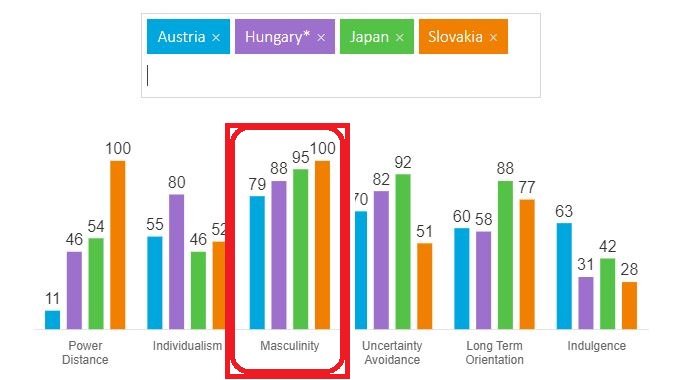
Slovakia, Japan, Hungary, Austria, Venezuela, Italy, Mexico, and China are considered masculine countries for their high score in this dimension. For example, Slovakia scores 100, following Japan(95), Hungary(88), Austria (79), Venezuela (73), Italy 70, Mexico (69), and China (66). So, the gender roles of these countries are specific and overlap very little.

examples of masculine countries and culture in 2022- hofstede’s cultural dimensions
Examples of Masculine Countries in the World (High Score)
Feminine

Femininity denotes traits associated with a nurturing culture. The members of feminine society focus on relationships and quality of life. They are nurtured, cooperative, modest, and caring toward others in society. They also maintain modest behavior in the community and organization.

In the business context, femininity refers to the organization’s tender culture. The Boss does great discussion and intuitive analysis to make decisions.

Examples of Feminine Countries

Sweden, Norway, the Netherlands, Denmark, Costa Rica, and Finland are considered the most feminine countries globally, as indicated by their low MAS scores in this dimension. According to Hofstede’s cultural dimensions theory, Sweden ranked the most feminine country in the world with a score of 5, followed by Norway (8), the Netherlands (14), Denmark (16), Costa Rica (21), and Finland (26). So, the gender roles of these countries are fluid and overlap significantly.

examples of most feminine countries in the world
Examples of Most Feminine Countries (Low Score)

4. Uncertainty Avoidance Index (UAI)

(Extent of Comfort in Uncertain Situations)

The uncertainty avoidance index describes how people across countries handle ambiguous situations. It also identifies the people who are comfortable in uncertain moments and who are scared to encounter unwanted difficulties. According to Geert Hofstede’s cultural dimensions, the uncertainty avoidance index is divided into two categories: high uncertainty avoidance and low uncertainty avoidance.

High Uncertainty Avoidance

People in high-uncertainty-avoidance societies closely follow rules and regulations to avoid undesirable situations. They prefer to follow routines and make plans to prevent unpredictable moments. They also believe proper planning is essential for achievement; hence, parents control their children’s lives excessively. People in high UAI-scoring countries are more traditionalistic, stiff, and structured. The structured person tends to do the right things and avoid unwanted consequences.

Examples of High Uncertainty Avoidance Countries

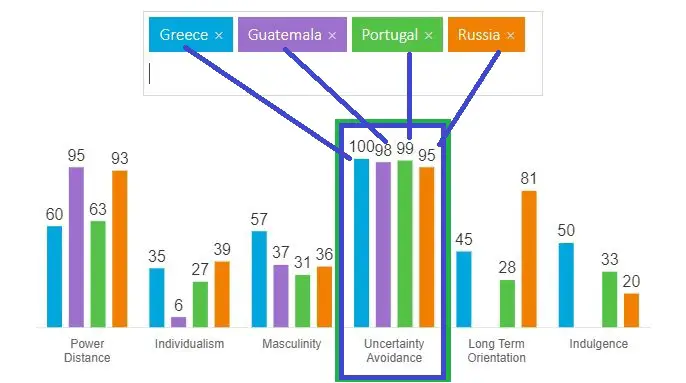
Greece, Guatemala, Russia, Portugal, Belgium, and Japan are the highly uncertain avoidance countries. According to Hofstede’s cultural dimensions theory, Greece ranks highest in uncertainty avoidance, with a score of 100, followed by Guatemala (98), Russia (95), Portugal (95), Belgium (94), and Japan (92). So, people in these countries prefer a planned life to avoid unwanted risks.

examples of high uncertainty avoidance countries- hofstede’s cultural dimensions
Examples of High Uncertainty Avoidance Countries
Low Uncertainty Avoidance

People in low-uncertainty-avoidant societies are comfortable with undesirable situations. They act first, then gather enough information. They are not intended to follow all rules and regulations thoroughly, so they work to reduce unnecessary rules in society and organizations. People in low-UAI countries are relaxed and open-minded; therefore, they are not afraid of uncertainty or unpredictability.

Examples of Low Uncertainty Avoidance Countries

Singapore (8), Jamaica (13), Denmark (23), Hong Kong (29), Sweden (29), and Malaysia (36) are examples of low uncertainty avoidance countries. People from these low-UAI countries accept risk easily and are not afraid to encounter unwanted situations.

examples of low uncertainty avoidance countries- hofstede’s cultural dimensions
Low Uncertainty Avoidance Countries in the World

5. Long Vs. Short Term Orientation

(Pragmatic Versus Normative)

Long versus short-term orientation is a crucial dimension of the Geert Hofstede theory that categorizes society based on pragmatic and normative actions. Michael Harris Bond added this dimension in 1988. It helps measure the tendency toward long-term or short-term results. It also describes how people deal with the past, present, and future.

Long Term Orientation

People in long-term orientation are focused on the future and consider it more valuable than the past. They tend to spend a lot of time achieving long-term results. Members of a long-term-oriented society are practical, modest, and more careful. They also encourage others to utilize time and money properly to achieve the goal.

Examples of Long-Term Orientation Countries

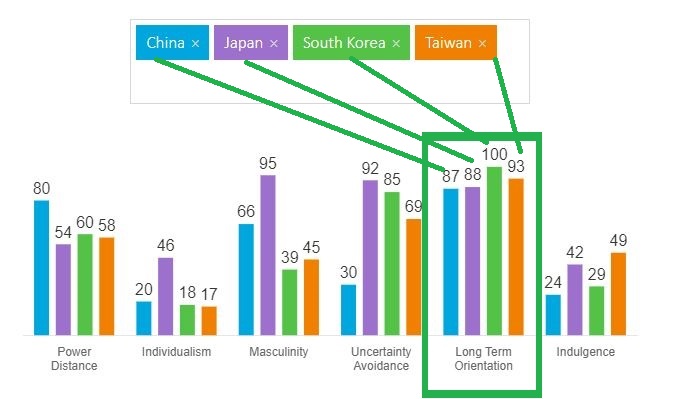
According to Geert Hofstede’s cultural dimensions theory, South Korea (100), Taiwan (93), Japan (88), China (87), Germany (83), and Singapore (72) are the countries with the highest long-term orientation in the world. So, people from these countries set long-term goals and expect perseverance and satisfaction.

long term orientation countries example in 2022- hofstede’s cultural dimensions
Examples of Long-Term Orientation Countries
Short Term Orientation

People with a short-term orientation are focused on the past and present, considering them more valuable than the future. They prefer to enjoy the current situation regardless of their future goal. Members of the short-term-oriented society are spiritual, normative, and nationalistic.

Examples of Short-Term Orientation Countries

According to Hofstede’s cultural dimensions model, Ghana (4), Nigeria (13), Australia (21), the United States (26), the Philippines (27), and Norway (35) are considered short-term-oriented countries worldwide. So, people from these countries set short-term goals and expect immediate satisfaction.

examples of long term orientation countries- hofstede’s cultural dimensions- hofstede’s 6 cultural dimensions examples
Examples of Long-Term Orientation Countries

6. Indulgence Vs. Restraint

Indulgent versus restrained stands for cultures that allow people to enjoy or suppress gratification. In the 21st century, Michael Minkov described the six dimensions and extended the Hofstede theory.

Indulgence

Indulgence refers to a society in which many people acknowledge that they are leading happy lives. People in an indulgent society enjoy life freely; as a result, they have fun and adopt optimistic attitudes. They prioritize having friends, playing games, and spending leisure time appropriately.

Examples of Indulgent Countries

According to Hofstede’s cultural model, the most indulgent countries in the world are Venezuela(100), Mexico(97), Puerto Rico(90), El Salvador(89), Nigeria(84), Colombia(83), Germany(83), Trinidad and Tobago(80), Sweden(78), Australia (71), Canada(68), Australia(68), and also Argentina(62).

example of indulgent and restraint countries in the world in 2022
Example of Indulgent and Restraint Countries in the World in 2023
Restraint

Restraint refers to a society in which fewer people report leading happy lives. People in a restrained community suppress their gratifications and do not focus on freedom of speech. Additionally, they handle life according to traditional norms and have pessimistic attitudes.

Examples of Restraint Countries

According to Hofstede’s model, the restraint countries in the world are Pakistan(0), Egypt(4), Latvia(13), Ukraine(14), Albania(15), Belarus(15), Estonia(16), Iraq917), Russia(20), and also China(24).

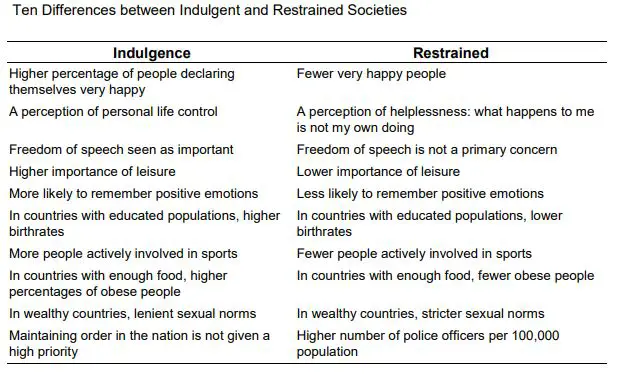
Differences Between Indulgent and Restrained Societies
differences between indulgent and restrained societies
Indulgent Versus Restraint

The two additional dimensions of global cultural differences are high context versus low context and monochronic versus polychronic time. In 1976, Edward T. Hall introduced these cultural dimensions that distinguish one nation from another.

High Context Vs. Low Context

High context: Members consider background, interpersonal history, and nonverbal cues when communicating. Messages are implied and context-sensitive, for example, Japan, China, Greece, and Mexico.

Low Context: Low-context members want facts and clear, direct communication. Messages are explicit, factual, and objective—for example, the US, England, and Germany.

 Monochronic Versus Polychronic

Monochronic: Monochronic members focus on one task at a time and work hard to meet deadlines. They also adhere to plans, schedules, and time because time is valuable. For example, people in North America and Northern Europe are mostly monochronic.

Polychronic: Polychronic members are continually late, do many things at once, are easily distracted, and endure interruptions. Additionally, they are not obsessed with schedules because time is not highly valued. For example, people in Kenya, Argentina, African America, and Asia are polychronic. Monochronic versus polychronic time is a chronemic form of nonverbal communication.

Conclusion

In conclusion, Hofstede’s Dimensions of National Culture are the Power Distance Index (PDI), Individualism Vs. Collectivism, Masculinity vs. Femininity, Uncertainty Avoidance Index (UAI), Long Vs. Short-Term Orientation and Indulgence Vs. Restraint. It is an essential tool for a friendly environment in an international organization.

Hofstede’s Cultural Dimensions Theory: Strengths and Weaknesses

Strengths:

Cross-Cultural Understanding: Hofstede’s dimensions provide a systematic framework for understanding cultural differences across nations. By identifying key dimensions such as individualism-collectivism, power distance, and uncertainty avoidance, the theory helps individuals and organizations better understand cultural nuances and adapt their behavior accordingly in cross-cultural interactions.

Practical Applications: The dimensions can be applied across international business, education, healthcare, and diplomacy. For example, understanding cultural differences in communication styles or leadership preferences can help multinational corporations tailor their strategies and operations to be more effective in diverse cultural environments.

Research Validity: Hofstede’s research was based on extensive surveys of IBM employees across different countries, providing a solid empirical foundation for his dimensions. While the data may be somewhat dated, subsequent research in cross-cultural psychology and sociology has validated and extended the theory.

Weaknesses:

Simplification of Cultures: Geert Hofstede’s dimensions reduce complex cultural phenomena to a limited number of dimensions, potentially oversimplifying cultural diversity. Cultural traits are often more nuanced and multifaceted than can be captured by a few dimensions, which can lead to the risk of stereotyping or generalizing about cultural groups.

Limited Contextual Consideration: The dimensions may not fully account for the influence of historical, social, economic, and political factors on cultural differences. Cultural dynamics can vary within countries or regions and change over time, challenging the universality and stability of Hofstede’s dimensions.

Ethnocentrism and Bias: Critics argue that Hofstede’s research was conducted from a Western-centric perspective, potentially biasing the dimensions toward Western cultural values and norms. The dimensions may not fully capture the diversity of non-Western cultures or adequately represent marginalized or minority groups within societies.

  1. Lack of Individual Variation: The dimensions primarily focus on broad cultural tendencies at the national level, potentially overlooking individual variation within cultural groups. People within the same culture may exhibit different behaviors and values due to factors such as age, gender, education, and socioeconomic status.
What is Culture?

Culture is a set of values, beliefs, attitudes, behaviors, symbols, and norms people share in a society or community. The cultures vary from country to country and community to community. For example, Malaysian culture is not similar to Australian culture. Additionally, the culture of African Americans is not identical to that of  White Americans.

Citation for this Article (APA 7th Edition)
Kobiruzzaman, M. M. (2025). Hofstede’s Cultural Dimensions- Hofstede’s 6 Cultural Dimensions Examples. Newsmoor- Best Online Learning Platform. https://newsmoor.com/cultural-dimensions-hofstedes-cultural-dimensions-theory-with-six-dimension/