Active vs Passive Audience: Differences With Examples

Understanding the distinction between passive and active audiences is central to media and communication studies. While early media theories viewed audiences as easily influenced by media messages, contemporary perspectives recognize that individuals actively interpret, evaluate, and respond to information. Examining how different audiences process and engage with media helps explain the psychological and social dynamics shaping today’s information environment.

Active and Passive Audience

What is Active Audience?

An active audience receives media information and makes sense of the messages based on their social and personal contexts. They listen to media messages rather than hear them. However, active audiences receive media information, and the act of receiving it is natural (Lazarsfeld, Berelson & Gaudet, 1948). So, active audiences pay close attention to the information they receive and interpret it to give feedback. The most common listening styles are people-oriented, content-oriented, action-oriented, and Time-oriented listening.

Examples of Active Audiences

For example, people are the active audience that comments on social media content to express their opinions.

Another example, based on the story shared in the active and passive audience example below, is that Ela is an active audience member who scrutinizes messages before accepting them and always tries to provide feedback.

Characteristics of Active Audiences

Active audiences actively listen carefully to provide feedback, making them complicated and critical thinkers. Additionally, they have good schemata. Feedback is an essential component of interactive communication.

What is a passive audience?

Passive audiences watch and observe media information without making sense of it (Bineham, 1988). Hence, they are recognized as inactive receivers. Passive audiences have low motivation to process information, low ability to process information, and focus on simple cues (e.g., appearances instead of content)

Examples of Passive Audiences

For example, passive audiences dislike commenting on social media content. Audiences like to watch Television and read newspapers without providing opinions. They prefer a linear communication process where feedback is not essential.

Another example, based on the story shared in the active and passive audience example below, is that Bela is a passive audience member who accepts the message without challenging it.

Characteristics of Passive Audiences

The Passive audience merely hears something rather than listens. Passive audiences merely observe the message; therefore, they are cognitive misers, lazy in their thinking.

Examples of Active and Passive Audiences

For example, Ela and Bela are siblings watching the news on television. The news reporter is providing tips on how to stay healthy. Ela actively listens to the news reporter’s tips to follow them. Then she asks her sister Bela to confirm whether these tips work. In contrast, Bela readily accepts those tips. Here, Ela is an active audience member who is a critical thinker. Therefore, she carefully focuses on the news presenter’s dress, speaking style, and messages’ meaning.

On the other hand, Bela watches the news without focusing on the message. Here, Bela is a passive audience member who is a cognitive miser. Therefore, she does not focus on interpreting the message; she only focuses on the news reporter’s appearance. As a result, she believes the news reporter’s tips quickly and becomes manipulated.
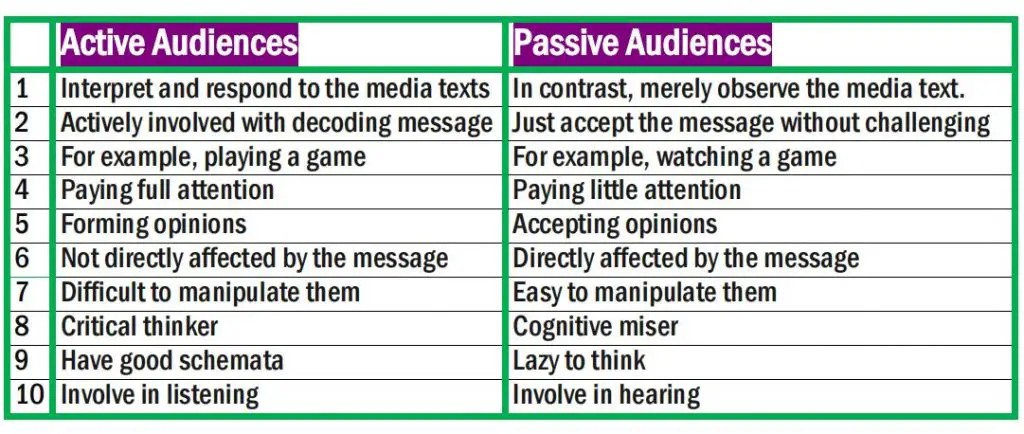
active and passive audience
Difference Between Active and Passive Audience

Comparison: Active vs. Passive Audiences

Criteria Active Audiences Passive Audiences
Media Engagement Actively interpret, question, and respond to media texts. Merely observe and consume media texts without interaction.
Message Processing Decode, analyze, and critically evaluate the message. Accept the message at face value without evaluation.
Feedback & Opinion Form independent opinions and actively provide feedback. Adopt predetermined opinions provided by the media.
Attention Level Maintain close cognitive attention and focus on the content. Display low attentional focus, superficial processing.
Direct Influence Resistant to direct, unmediated media influence. Vulnerable to immediate, direct media effects.
Manipulability Highly difficult to manipulate due to critical evaluation. Easily manipulated or conditioned by media messaging.
Cognitive Style Act as critical thinkers who actively process information. Act as cognitive misers, minimizing mental effort.
Mental Framework Utilize well-developed schemata to contextualize information. Avoid deep cognitive reflection or analytical thinking.
Listening Dynamic Practice active, discriminative, and comprehensive listening. Engage in passive, uncritical hearing rather than listening.
Example (Case Study) Ela: Scrutinizes news reports, checking facts against her own knowledge before accepting them. Bela: Absorbs news reports completely, accepting the reporter’s narrative without scrutiny.

Active and Passive Audience Theories

Active Audience Theories

The theory of the active audience holds that media audiences do not passively accept information but interpret messages in light of their personal and social contexts.

The Models of Active Audience posits that audiences are not passive recipients of media messages but rather actively engage with and interpret media content based on their own experiences, values, and beliefs. This theory challenges the notion of passive audience effects proposed by earlier media theories, such as the Hypodermic Needle Theory, and emphasizes the agency and autonomy of audience members in their interactions with media texts. According to Active Audience Theory, individuals actively select, interpret, and make meaning from media content, drawing upon their personal backgrounds, social contexts, and cultural frameworks. This theory acknowledges the diversity of audience responses to media messages and highlights the importance of audience participation and engagement in shaping the reception and interpretation of media content.

List of Active Audience Theories:
  1. Uses and Gratifications Theory
  2. Reception Theory
  3. Cultural Studies
  4. Active Audiences Theory
  5. Two-Step Flow Theory
  6. Agenda-Setting Theory
  7. Participatory Culture Theory
  8. Media Literacy Theory
  9. Social Learning Theory
  10. Social Cognitive Theory

Passive Audience Theories

Passive audience theories, also known as media effects theories, propose that audiences are passive recipients of media messages and highly susceptible to mass media influence. These theories suggest that media content directly and powerfully shapes audience attitudes, beliefs, and behaviors, with little active engagement or resistance from the audience.

List of Passive Audience Theories:
  1. Hypodermic Needle Theory (Magic Bullet Theory)
  2. Mass Society Theory
  3. Passive Audience Theory
  4. Limited Effects Theory
  5. Reinforcement Theory
  6. Encoding-Decoding Model
  7. Spiral of Silence Theory
  8. Dependency Theory
  9. Selective Exposure Theory
  10. Cumulative Effects Theory

FAQ (Frequently Asked Questions): Active and Passive Audience

Q1: Which theory explains active and passive audiences in media communication?

A: The Hypodermic needle theory explains the active and passive audiences. According to this theory, audiences are highly susceptible to media influence, and media messages are believed to have an immediate, direct effect on audience perceptions.

References APA 7th Edition: Scholarly Sources

Lazarsfeld, P. F., Berelson, B., & Gaudet, H. (1948). The people’s choice: How the voter makes up his mind in a presidential campaign (2nd ed.). Columbia University Press.

Bineham, J. L. (1988). A historical account of the hypodermic model in mass communication. Communication Monographs, 55(3), 230–246. https://doi.org/10.1080/03637758809376169

Tuckman’s Theory of Communication Stages With Advantages and Disadvantages

Tuckman’s Theory of Communication. Bruce Tuckman’s Five Stages of Group Development are Forming, Storming, Norming, Performing, and Adjourning.  Advantages and Disadvantages of Tuckman Theory PDF.

Tuckman’s Theory of Communication

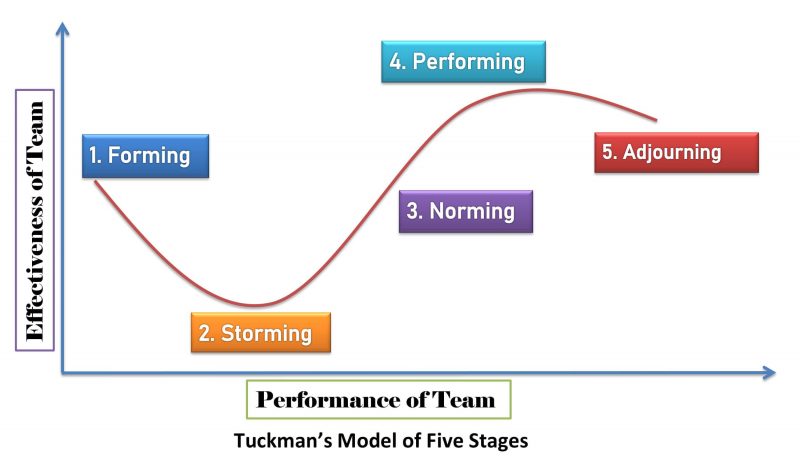
Tuckman’s theory refers to the five stages of the group development model developed by Bruce Tuckman in 1965. It is also known as Tuckman’s model, Tuckman’s theory, Tuckman’s ladder, five stages of group development theory, Tuckman’s team development model, Tuckman’s theory of communication, and Tuckman’s stages.

Bruce Tuckman introduced his four stages of group development theory in 1965. However, in the 1970s, he added the fifth stage to his four stages of group development theory. In 1977, Tuckman and Mary Ann Jensen included the fifth and final stage in Tuckman’s theory. The name of the fifth stage is Adjourning, which represents the happiness of achieving the interdependent group goal by the group members. So, it became known as Tuckman and Jensen’s theory after adding the fifth stage.

Tuckman’s Stages of Group Development

Tuckman’s five stages of group development are Forming, Storming, Norming, Performing, and Adjourning. It is one of the appropriate theories for explaining the behavior of group members with dynamic characteristics. Additionally, a perfect theory describes how group members adjust and adapt to a group gradually.

tuckman's theory of communication five stages framework
Bruce Tuckman’s Theory of Communication

Five Stages of Tuckman’s Theory

The five Stages of Bruce Tuckman’s Theory of Communication are:

  1. Forming Stage
  2. Storming Stage
  3. Norming Stage
  4. Performing Stage
  5. Adjourning Stage

1. Forming Stage of Tuckman’s Theory: (Orientation)

Forming is the first stage of Tuckman’s theory of communication, also known as the five stages of the group development model. Usually, members carefully explore both personal and group goals in this stage. They feel uncomfortable working with a group of strangers or unfamiliar colleagues, trying to understand and test personal relationships. A member also orients itself to itself.

Group Develops in the Forming Stage: 
  • Ice-breaking” stage.
  • Group members are uncertain about their roles.
  • Mutual trust is low.
  • There is a good deal of holding back to see who is in charge.
  • Conflict is beneficial and leads to increased creativity.
Primary Tension

Firstly, group members feel social unease and stiffness accompanying the getting-acquainted stage in a new group. They become overly polite with one another. Additionally, members don’t interrupt one another. They often speak softly and avoid expressing strong opinions, also talk less, and provide little in the way of content.

How to Solve the Tension?

Firstly, the members should be positive and energetic so that other members build positive attitudes toward them. Secondly, smile and laugh at others when interacting with them. Additionally, nodding in agreement and exhibiting enthusiasm a useful non-verbal cue to hold effective interactions. Group members should also be patient and open-minded, knowing that the primary tension will decrease with time. Finally, be prepared and informed before your first meeting to help the group focus on its task.

2. Storming Stage of Tuckman’s Theory: (Power Struggle)

Storming is the second stage of Tuckman’s theory of Group Development. Group members become argumentative also emotional. The most confident members begin to compete for both social acceptance and leadership. Many groups try to skip this stage to avoid competition and conflict is necessary to establish a climate in which members understand the value of disagreeing. The conflicts among group members are also known as group communication noise.

Group Develops in the Storming Stage:
  • Time of testing (Testing the leader’s policies and assumptions and how they fit into the power structure).
  • Subgroups take shape
  • Subtle forms of rebellion occur
  • Conflict ⇒ cohesion dialectic.
  • Leadership ⇒ follower ship dialectic.
Secondary Tension in Tuckman’s Model

Firstly, frustrations and personality conflicts are experienced by group members as they compete for acceptance and achievement within a group. Members have gained enough confidence to become assertive and even aggressive as they pursue positions of power and influence. They gain a high level of energy and agitation. The group becomes noisier, more dynamic, and physically active in this stage of group development. Usually, members start to speak in louder voices, interrupting and overlapping one another so that two or three people may be speaking simultaneously. Members sit up straight, lean forward, or squirm in their seats. Finally, everyone is alert and listening intently.

How to Solve the Tension?

Making jokes is very important to avoid tension in the second stage of Tuckman’s theory. They should work outside the group setting to discuss group members’ difficulties and anxieties.

3. Norming Stage of Tuckman’s Theory (Cooperation)

Norming is the third stage of Tuckman’s 5 Stages of Group Development, and members cooperate with each other in this stage. Members start learning to work as a cohesive team and be task-oriented. They start developing “rules of engagement.” However, they feel more comfortable with one another and are willing to disagree and express opinions – communication becomes open. Finally, a feeling of trust and clear goals emerge within the group.

Group Develops in the Norming Stage:
  • The group is more cohesive.
  • Less conflict with increasing team member interactions and interdependence of work tasks.

4. Performing Stage of Tuckman’s Theory: (Synergy)

Performing is the fourth stage of Tuckman’s 5 Stages of Group Development theory. Members become fully engaged and eager to work at this stage. Members adjust and adapt to the situation and also start solving critical problems. Group identity, loyalty, and morale are generally high in this stage. However, disagreements occur, but members usually resolve them intelligently and amicably. Finally, Interaction patterns reflect virtually no tension; the members are cheerful, loud, boisterous, laughing, and verbally backslapping each other”. The group members are motivated to work together as family members.

Group Develops in the Performing Stage:
  • Activity focused on problem-solving.
  • Work done without hampering others.
  • The climate of open communication and full engagement.

5. Adjourning Stage of Tuckman’s Theory: (Closure)

Adjourning refers to the fifth stage of Tuckman’s 5 Group Development Theory. Members have usually achieved their common goal and may begin to disband. It also represents whether the group members will work together or form a new group. Finally, they are happy with their achievements but feel lost when the group dissolves.

  • Disband = confront relational issues (For example, how to retain friendships with other members).
Group Develops in the Adjourning Stage:
  • Work completed; group moves on to other activities.
  • Opportunity for leaders to emphasize valuable lessons.

Tuckman’s Theory of Communication Significance

Tuckman’s theory of communication has significant theoretical and practical contributions to research. The Five Stages of Tuckman’s Theory of Communication are Forming, Storming, Norming, Performing, and Adjourning. Although in 1965, Tuckman proposed a four-stage group development theory, but later added the fifth stage called adjourning. Tuckman’s theory assists group members in overcoming the group barriers. It also helps to adjust them in the group gradually.  Therefore, it is known as a group facilitation theory. Tuckman’s group development theory consists of five stages that facilitate group formation and development.

Tuckman identified both the advantages and disadvantages of group communication; therefore, he provided suggestions for reducing the barriers to group communication.

Advantages and Disadvantages of Tuckman’s Theory

The Tuckman model has both theoretical and practical advantages and disadvantages. Many researchers have identified the pros and cons of the Tuckman theory. It is also known as the strengths and limitations of the Tuckman model.

Advantages of Tuckman’s Theory

1. Concise Framework for Understanding Group Dynamics

Tuckman’s model provides a structured framework for understanding the natural stages of group development. It clarifies the specific stages of any group and team discussion; for instance, the five stages of group development are forming, storming, norming, performing, and adjourning. Tuckman’s theory helps to understand more about primary and secondary tension generated from group communication. It also recommends reducing the tensions among members and influencing group activities. It is essential to reduce the tension among the group because the tensions are obstacles to achieving the group’s goal. Additionally, the theory strengthens the relationship among group members and motivates them to be productive. Finally, the Tuckman group’s developing theory shows the perfect and successful way of solving group uncertainty issues and gaining interdependent goals.

2. Predictive Capability

By recognizing the typical stages of group development outlined in the model, leaders can predict potential challenges and issues. This predictive capability enables proactive intervention to address conflicts, facilitate communication, and foster cohesion within the group.

3. Facilitates Team Building

Tuckman’s model emphasizes the importance of communication, trust-building, and goal-setting in group development. It guides leaders to actively promote team-building activities and create an environment conducive to collaboration and goal achievement.

4. Enhanced Leadership Effectiveness

Understanding Tuckman’s model allows leaders to adapt their leadership style to the group’s needs at each stage of development. Effective leaders can provide support, direction, and empowerment as necessary, facilitating the group’s progress toward maturity and productivity.

Guides Leadership Style: The model suggests that the appropriate leadership style changes as the team develops.

  • In the Forming stage, the leader needs to be directive and provide structure.
  • In the Performing stage, the leader can adopt a more delegating and supportive role, as the team becomes autonomous and self-managing.
  • This guidance helps leaders adjust their approach to maximize team effectiveness at each stage.
5. Highlights the Path to High Performance

It clearly illustrates that effective team performance (Performing stage) is an achievement that follows successful resolution of structure (Forming), conflict (Storming), and cohesion/norms (Norming). This emphasizes that time and intentional effort are required to reach a high-performing state.

Disadvantages of Tuckman’s Theory

1. Oversimplification

Critics argue that Tuckman’s model oversimplifies the complexities of group dynamics. Real-world groups may not always linearly progress through the stages, and the model may overlook individual differences, cultural influences, and external factors that can impact group development.

2. Focus on Conflict

The emphasis on conflict in the Storming stage of Tuckman’s model may reinforce negative stereotypes about group dynamics. While conflict can be a natural part of group development, an overemphasis on conflict may neglect the importance of relationship-building and collaboration in achieving group goals.

3. Limited Practical Application

In dynamic and rapidly changing environments, Tuckman’s model may have limited practical application. Groups operating in fast-paced settings may not have the luxury of progressing through each stage sequentially and may need to adapt more quickly to changing circumstances.

4. Neglect of External Influences

Tuckman’s model primarily focuses on internal group dynamics and may neglect external factors such as organizational culture, leadership style, and external pressures. Ignoring these influences may limit the model’s applicability in diverse organizational contexts.

5. Difficult to Maintain

Tuckman’s theory consists of five important stages that are difficult to maintain one by one. Group members need to follow different instructions to maintain effective communication and a good relationship with group members. Additionally, there is no instant solution to solve all conflicts in group communication, although it suggests some recommendations to reduce conflicts. Furthermore, Tuckman’s model did not mention what would have happened if the storming stage had not ended. Finally, Tuckman’s model has failed to discuss why the group changes over time. These are the Advantages and Disadvantages of Tuckman’s Theory.

Conclusion

This article offers elaborate information about Tuckman’s theory of group development. It explains the five stages of group development in social groups. The author suggests tricks to reduce group conflicts and noise in communication. Finally, this article mentions the advantages and disadvantages of Tuckman’s theory. Thus, this content benefits students, researchers, instructors, researchers, group members, and leaders. It enables the group leader to regulate the team properly to achieve common goals.

Citation for this Article (APA 7th Edition)
Kobiruzzaman, M. M. (2025). Tuckman Theory of Communication, Advantages, and Disadvantages. Educational Website For Online Learning. https://newsmoor.com/tuckmans-model-five-stages-of-group-and-team-development-theory/
Tuckman 1965 Reference APA 7th Edition

Tuckman, B. W. (1965). Developmental sequence in small groups. Psychological Bulletin63(6), 384.