This academic content provides detailed information about the Survey Questionnaire Sample and Example for Research Paper, Proposal, & Project. It also demonstrates how to write a survey questionnaire for effective research.
What is a Survey Questionnaire in Research?
The survey questionnaire is a key tool for researchers to collect data efficiently and validate the hy. Creating a well-structured survey questionnaire is essential for gathering valuable data. A well-designed survey questionnaire helps to ensure that the data collected is accurate and relevant. When formulating your survey questionnaire, consider your research objectives to guide your questions effectively. Using examples, such as previous survey questionnaire templates, can facilitate your design process.
A questionnaire is a quantitative survey instrument comprising multiple questions used to collect data from respondents and informants. The survey questionnaire comprises five standard 5W1H questions: who, what, when, why, and how. The most common questionnaires are product usability and customer satisfaction survey questionnaires.
By following a structured format, you can create a survey questionnaire that meets your research needs. Each section of your survey questionnaire should align with your overall research objectives. Moreover, a well-crafted survey questionnaire can lead to more insightful data analysis and conclusions. Ensure that your survey questionnaire is concise to encourage participant engagement. It’s vital to test your survey questionnaire before full deployment to catch any potential issues. Remember that clarity in your survey questionnaire will lead to more accurate and reliable responses.
Additionally, questionnaires are crucial for collecting information in both quantitative and qualitative research. Quantitative survey questions typically address ‘what’, ‘why’, and ‘how’ to quantify phenomena. These questions are designed to identify relationships among the independent, dependent, mediator, and moderator variables. The respondents are a sample of the population who participated in the survey. Quantitative survey questions are part of the data collection process in quantitative research.
In contrast, qualitative questionnaires focus on ‘what’ and ‘how’ to elicit in-depth opinions about a topic. Qualitative research avoids why questions intended to identify cause-and-effect relations. The survey can be conducted face-to-face or online. However, each questionnaire includes an introduction that provides a concise overview of the research.
Once you’ve designed your survey questionnaire, seek feedback to improve its effectiveness. To enhance your research findings, utilize your survey questionnaire across diverse demographic groups. A comprehensive survey questionnaire allows for a deeper understanding of your research topic.
What are Quantitative Survey Questionnaires?
Quantitative survey questionnaires are structured instruments that feature closed-ended questions. The examples of open-ended questions are multiple-choice, rating scales (Likert scale measuring agreement or disagreement), dichotomous (yes/no), and ranking options, concentrating on descriptive (what is), comparative (differences among groups), and relationship-focused (correlation between variables) inquiries to obtain numerical data for statistical evaluation, typically utilizing methods like mail, phone, or online surveys.
A Quantitative research questionnaire is a set of survey questions used by a researcher to collect data. The author designs some questionnaire samples for students and researchers. These samples help new researchers develop a questionnaire tailored to the research topic. The questionnaire sample has been collected from University students. New researchers will learn how to create a survey questionnaire to collect data.
The author has provided several research questionnaires and download links here so readers can access the PDF forms. This sample and example of research questionnaires may provide a clearer understanding for new researchers.
Questionnaire Sample For Quantitative Research
Quantitative survey research includes the title, abstract, introduction, methods, results, discussion, questionnaire, bibliography, and appendix. The questionnaire sample for the research paper will provide specific guidance on designing survey questions for a quantitative study. Many undergraduate and postgraduate students are unfamiliar with how to design questionnaires for their theses or dissertations. Therefore, the author has designed and collected a few questionnaire samples for quantitative research. We do not encourage students to copy these questionnaires; however, you may use them as inspiration to develop your own. Students should read and follow the examples to draft questionnaires for their quantitative research projects.
Quantitative Survey Questionnaire Sample: AI Adoption
The following questionnaires are adopted from the UTAUT model. Therefore, this sample will help a student design a survey questionnaire based on the Unified Theory of Acceptance and Use of Technology. It includes the research title, demographic questions, and items to validate the hypothesis.
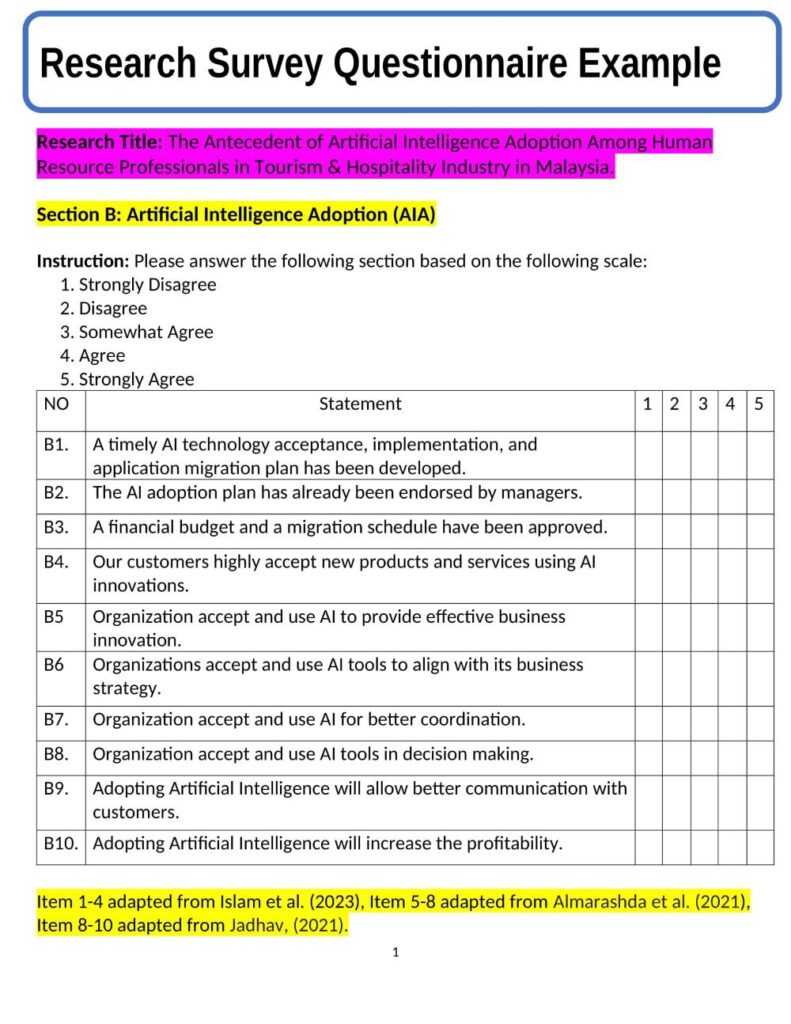
Research Title: The Antecedents of Artificial Intelligence Adoption Among Human Resource Professionals in the Tourism & Hospitality Industry in Malaysia.
Online Survey Questionnaire Form
SECTION A. Demographic Questions
Instructions: Please complete this section by circling the following answers
A1. What is your gender?
- Male
- Female
A2. How old are you?
- 20-30
- 31-40
- 41-50
- 51-60
A3. What is your level of education?
- Undergraduate
- Masters/MBA
- MPhil/DBA/PhD
A6. What is your marital status?
- Single
- Married
A7. What is your job tenure?
- 1-2 Years
- 3-4 Years
- 5-6 Years
- 7 Years and above
Section B: Artificial Intelligence Adoption (AIA)
Instruction: Please answer the following section based on the following scale:
- Strongly Disagree
- Disagree
- Somewhat Agree
- Agree
- Strongly Agree
| No | Statement | 1 | 2 | 3 | 4 | 5 |
|---|---|---|---|---|---|---|
| B1 | A timely plan for the acceptance, implementation, and application migration of AI technology has been developed. | |||||
| B2 | Managers have already endorsed the AI adoption plan. | |||||
| B3 | A financial budget and a migration schedule have been approved. | |||||
| B4 | Our customers highly value new products and services that use AI innovations. | |||||
| B5 | Organizations are embracing and utilizing AI to drive practical business innovation. | |||||
| B6 | Organizations accept and use AI tools to align with their business strategy. | |||||
| B7 | Organizations accept and use AI for better coordination. | |||||
| B8 | Organizations accept and use AI tools in decision-making. | |||||
| B9 | Adopting Artificial Intelligence will allow better communication with customers. |
Item 1-4 adapted from Islam et al. (2023), Item 5-8 adapted from Almarashda et al. (2021), Item 8-10 adapted from Jadhav (2021).
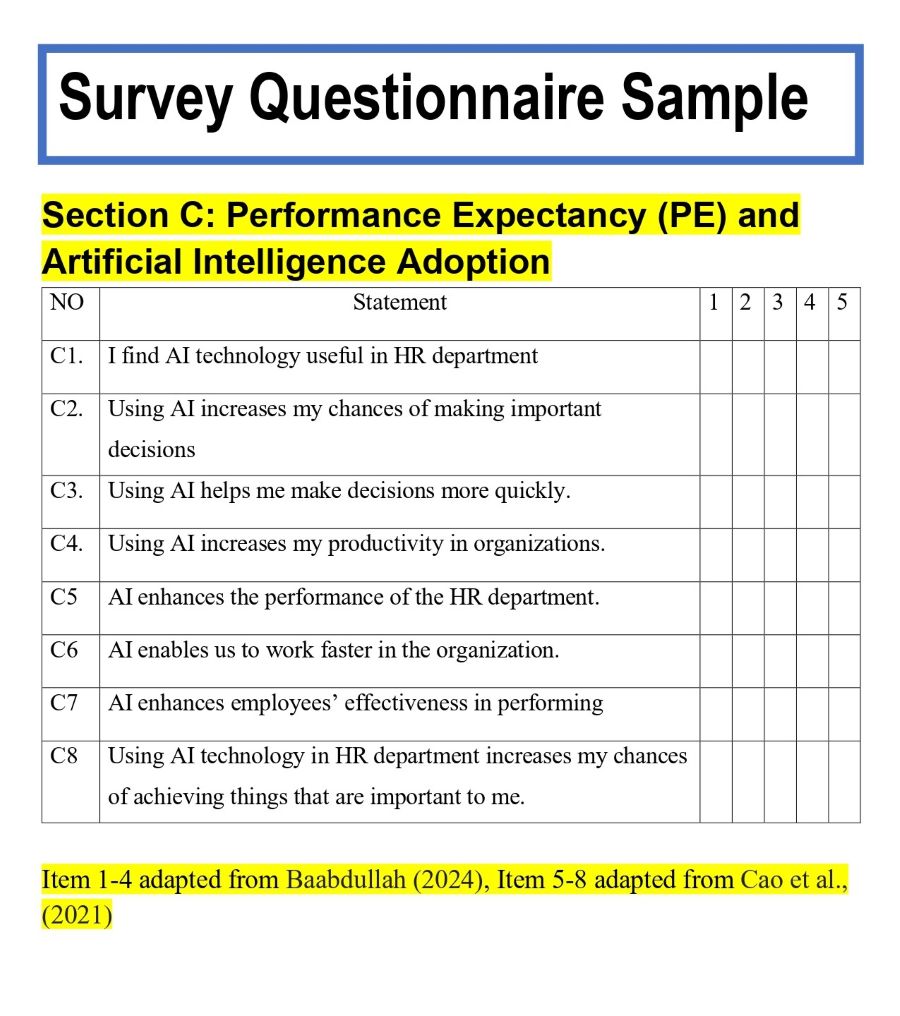
Section C: Performance Expectancy (PE) and Artificial Intelligence Adoption
| No | Statement | 1 | 2 | 3 | 4 | 5 |
|---|---|---|---|---|---|---|
| C1 | I find AI a helpful technology in the HR department. | |||||
| C2 | Using AI increases my chances of making important decisions. | |||||
| C3 | Using AI helps me make decisions more quickly. | |||||
| C4 | Using AI increases my productivity in organizations. | |||||
| C5 | AI enhances the HR department’s performance. | |||||
| C6 | AI enables us to work faster in the organization. | |||||
| C7 | AI enhances employees’ effectiveness in performing. | |||||
| C8 | Using AI in the HR department increases my chances of achieving important goals. |
Item 1-4 adapted from Baabdullah (2024), Item 5-8 adapted from Cao et al. (2021)
Section D: Effort Expectancy (EE) and Artificial Intelligence Adoption
| No | Statement | 1 | 2 | 3 | 4 | 5 |
|---|---|---|---|---|---|---|
| D1 | Learning how to use AI technology is easy for me. | |||||
| D2 | My interaction with AI tools is clear and understandable. | |||||
| D3 | I find AI effortless to use. | |||||
| D4 | It is easy for me to become skillful at using AI. | |||||
| D5 | It is easy for me to use AI tools to manage my workload in the organization. | |||||
| D6 | Learning how to use AI tools for communication is easy for me. | |||||
| D7 | It is convenient to provide service using AI tools. | |||||
| D8 | It is easy to complete complex HR tasks. |
Item 1-4 adapted from Baabdullah (2024), Item 5-8 adapted from Venkatesh (2012).
Section E: Social Influence and AI Adoption
| No | Statement | 1 | 2 | 3 | 4 | 5 |
|---|---|---|---|---|---|---|
| E1 | People who are important to me think that I should use AI technology in the workplace. | |||||
| E2 | People who influence my behavior think that I should accept and use AI tools. | |||||
| E3 | People whose opinions I value prefer that I use AI technology. | |||||
| E4 | Coworkers who are important to me would think that I should use AI. | |||||
| E5 | Peers who influence my behavior would think that I should use AI to complete the tasks. | |||||
| E6 | My superiors, who influence my behavior, would think that I should use AI. | |||||
| E7 | My superiors, to whom I report, would think that I should use AI. | |||||
| E8 | My business partners would think that I should use AI. |
Item 1-3 adapted from Venkatesh et al. (2012), Item 3-8 adapted from Cao et al. (2021)
Section F: Facilitating Condition and AI Adoption
| No | Statement | 1 | 2 | 3 | 4 | 5 |
|---|---|---|---|---|---|---|
| F1 | I have the resources necessary to use AI. | |||||
| F2 | I know what is necessary to understand AI. | |||||
| F3 | AI is compatible with other technologies I use. | |||||
| F4 | I can get help from others when I have difficulties using AI. |
Item 1-4 adapted from Cao et al. (2021)
Section G: Technology competency (TC) and AI Adoption
| No | Statement | 1 | 2 | 3 | 4 | 5 |
|---|---|---|---|---|---|---|
| G1 | Our company’s technology infrastructure is available to support AI tools. | |||||
| G2 | Our company is dedicated to ensuring that HR employees are familiar with AI tools. | |||||
| G3 | Our company has a high level of expertise with AI tools. |
Item 1-3 adapted from Islam et al. (2023)
Section H: Top management support (TMS) and AI Adoption
| No | Statement | 1 | 2 | 3 | 4 | 5 |
|---|---|---|---|---|---|---|
| H1 | Top managers support AI adoption by providing labor resources, finances, and materials. | |||||
| H2 | Top management inspires employees to apply the latest AI technologies in daily work. | |||||
| H3 | The top management of my organization encourages innovation. | |||||
| H4 | My organization’s top management is willing to take the risks involved in adopting AI technologies. | |||||
| H5 | My organization’s top management is likely to consider implementing AI strategically important. |
Item 1-5 adapted from Islam et al. (2023)
Section I: Competitive pressure (CP)and AI Adoption
| No | Statement | 1 | 2 | 3 | 4 | 5 |
|---|---|---|---|---|---|---|
| I1 | The company thinks that AI adoption influences competitiveness in the industry. | |||||
| I2 | The company is under pressure from competitors to adopt AI. | |||||
| I3 | Some competitors have already started using AI for Risk forecasting and premium calculations. | |||||
| I4 | My organization’s top management is willing to take the risks involved in adopting AI technologies. |
Item 1-4 adapted from Islam et al. (2023)
Section J: Emotional Intelligence (EI) and AI Adoption
| No | Statement | 1 | 2 | 3 | 4 | 5 |
|---|---|---|---|---|---|---|
| J1 | Overall, I’m a highly motivated person to use AI technology in an organization. | |||||
| J2 | I feel that I have several good qualities. | |||||
| J3 | I’m usually able to influence the way other people feel. | |||||
| J4 | Overall, I’m able to handle stress. |
Item 1-4 adapted from Lipson, A. (2020).
Quantitative Survey Questionnaire Sample: Communication Research
An example of a complete survey questionnaire is shown below. The title of the research project is “An Examination of the Correlation Between Social Media Engagement and Citizen Journalism Practice”. It is a sample Google Form questionnaire. The author shares a link to the online questionnaire with respondents, who complete it at their convenience. It is the most recent example of a questionnaire designed in accordance with APA 7th edition guidelines.
Quantitative Research Title: An Examination of the Correlation Between Social Media Engagement and Citizen Journalism Practice.
Dear Participants,
I invite you to participate in this quantitative research project by completing the following survey questionnaires. This study intends to examine the Correlation Between Social Media Engagement and Citizen Journalism Practice. It requires approximately 5-7 minutes to complete the questionnaires. Thank you for taking the time to assist me with this research. Under no circumstances are you obliged to answer any of the questions; however, doing so will greatly assist me in completing my research and enhance my understanding of this research focus. The data collected will remain confidential and will be used solely for academic purposes.
SECTION A. Demographic Questions
Instructions: Please complete this section by circling the following answers
A1. What is your gender?
- Male
- Female
A2. How old are you?
- 18-23
- 24-28
- 29-33
- Above 33
A3. What is Your Nationality?
- Malaysian
- Non-Malaysian
A4. What is your race?
- Malay
- Chinese
- Indian
- Please specify
A5. What is your level of education?
- STPM
- Matric
- Diploma
- Foundation
- Undergraduate
- Masters
- PhD
A6. What is the Year of Study
- Year 1-2
- Year 3-4
- Above 5
A7. What is your family’s monthly income?
- Less thanRM2000
- RM2001 – RM4000
- RM4001 to RM6000
- Over RM6000
Section B: The Use of Social Media for Citizen Journalism
Please read the definition of social media-based citizen journalism and keep it in mind when you answer the following questions. Social media-based citizen journalism refers to the generation and sharing of news events (personal, social, educational, entertainment, political, and crime-related) on social networking sites by ordinary people.
B1. What types of social networking sites do you use most to practice citizen journalism?
- Please specify…
B2. How much time do you spend on social media-based citizen journalism in a day?
- Less than 1 hour per day
- About 1 – 2 hours per day
- About 2 – 4 hours per day
- More than 5 hours per day
B3. Why do you use social media to practice citizen journalism?
- To report real-time news
- To entertain friends
- For educating people about social awareness
- To shape public opinion
- For others, please specify
B4. How many social media sites do you use to practice citizen journalism?
- Only 1 account
- 2 – 4 accounts
- 5 accounts and above
B5. What time of the day do you normally access social media?
- Morning
- Afternoon
- Evening
- At night
B6. Which day of the week do you mostly access social media?
- During weekdays
- During weekends
Section C: Performance Expectancy of Social Media Engagement for Citizen Journalism
C8. What is your performance expectancy of the use of social media to practice citizen journalism?
Instruction: Please answer the following section based on the following scale:
- Strongly Disagree
- Disagree
- Somewhat Agree
- Agree
- Strongly Agree
| No | Statement | 1 | 2 | 3 | 4 | 5 |
|---|---|---|---|---|---|---|
| C1 | I would find social media useful in practicing citizen journalism. | |||||
| C2 | Using social media enables me to share news events more quickly. | |||||
| C3 | Using social media increases my productivity in reporting real-time news. | |||||
| C4 | Social media increases my mastery of what is happening globally. | |||||
| C5 | Social media helps me see what news is important to my friends and co-workers. | |||||
| C6 | Using social media can increase my chances of creating and sharing informative news events. | |||||
| C7 | Using social media will allow me to spend less time reporting and consuming news. |
Items 1-3 were adapted from Venkatesh et al. (2003), Items 4-5 were adapted from Peng and Miller (2021), and Item 6-7 was adapted from Puriwat and Tripopsakul (2021).
Section D: Effort Expectancy of Social Media Engagement for Citizen Journalism
D9. What is your expected effort in the use of social media to practice citizen journalism?
In conclusion, an effective survey questionnaire is paramount for successful data collection.
| No | Statement | 1 | 2 | 3 | 4 | 5 |
|---|---|---|---|---|---|---|
| D1 | My citizen journalism exercise using social media would be straightforward and easy to understand. | |||||
| D2 | It would be easy for me to apply my content writing skills on social media. | |||||
| D3 | I would find social media-based citizen journalism easy to use. | |||||
| D4 | Learning to operate social media to practice citizen journalism is easy for me. | |||||
| D5 | It is easy for me to become a freedom journalist using social media for news updates. | |||||
| D6 | It is easy for me to consume news on social media. | |||||
| D7 | It is convenient to share the news with friends on social media. | |||||
| D8 | Using social media will help me to spread the emergency news faster. |
Items 1-3 were adapted from Venkatesh et al. (2003), Items 4-7 were adapted from Peng and Miller (2021), and Item 8 was adapted from Puriwat and Tripopsakul (2021).
Section E: Social Influence of Social Media Engagement for Citizen Journalism
What is the social influence of social media engagement for citizen journalism?
| No | Statement | 1 | 2 | 3 | 4 | 5 |
|---|---|---|---|---|---|---|
| E1 | People who are important to me think that I should use social media for news sharing. | |||||
| E2 | The senior students at my university recommend that I use social media to find academic news. | |||||
| E3 | People important to me talk with me about the news they saw on social media. | |||||
| E4 | I observed my friends sharing news on social media. | |||||
| E5 | I found my important friends discussing the news they read on social media. | |||||
| E6 | It makes me feel proud when my friends praise me for sharing informative news on social media. | |||||
| E7 | I become motivated when my social media friends benefit from my reporting. | |||||
| E8 | People around me consider it appropriate to use social media for news. |
Items 1-2 were adapted from Venkatesh et al. (2003), Items 3-5 were adapted from Peng and Miller (2021), Items 6-7 were set by the Authors, and Item 8 was adapted from Puriwat and Tripopsakul (2021).
Section F: The Use of Social Media to Practice Citizen Journalism
| No | Statement | 1 | 2 | 3 | 4 | 5 |
|---|---|---|---|---|---|---|
| E1 | I often use social media to share news content. | |||||
| E2 | I have been using social media regularly to report real-time news with friends. | |||||
| E3 | To report real-time news to friends, I use social media regularly. | |||||
| E4 | In my daily life, I use social media to share news events. | |||||
| E5 | I use online social networking sites to keep up with hard news. | |||||
| E6 | I use social networking sites to post about events in my area. | |||||
| E7 | Whenever I need to read viral news, I check social media. |
Item 1-5 adapted from Puriwat and Tripopsakul (2021), Item 5-7 set by the Authors
This research emphasizes the importance of designing a robust survey questionnaire. Importance of robust survey questionnaire design:
- Ensures accurate data collection
- Enhances reliability and validity
- Improves respondent engagement
- Facilitates better analysis and insights
References (APA-7th Edition): Scholarly Sources
- Almarashda, H. A. H. A., Baba, I. B., Ramli, A. A., Memon, A. H., & Rahman, I. A. (2021). Human resource management and technology development in artificial intelligence adoption in the UAE energy sector. Journal of Applied Engineering Sciences, 11(2), 69-76.
- Baabdullah, A. M. (2024). The precursors of AI adoption in business: Towards efficient decision-making and functional performance. International Journal of Information Management, 75, 102745.
- Cao, G., Duan, Y., Edwards, J. S., & Dwivedi, Y. K. (2021). Understanding managers’ attitudes and behavioral intentions towards using artificial intelligence for organizational decision-making. Technovation, 106, 102312.
- Islam, M. A., Aldaihani, F. M. F., & Saatchi, S. G. (2023). Artificial intelligence adoption among human resource professionals: Does market turbulence play a role?. Global Business and Organizational Excellence, 42(6), 59-74.
- Jadhav, D. (2021). Understanding artificial intelligence adoption, implementation, and use in small and medium enterprises in India (Doctoral dissertation, Walden University).
- Lipson, A. (2020). The Moderating Role of Emotional Intelligence on the Relationship between Job Resources and Employee Engagement (Doctoral dissertation, San Jose State University).
- Venkatesh, V., Thong, J. Y., & Xu, X. (2012). Consumer acceptance and use of information technology: extending the unified theory of acceptance and use of technology. MIS Quarterly, 157-178.

M M Kobiruzzaman is a researcher, academic content writer, traveler, and the founding editor of Newsmoor.com. Specializing in communication, management, technology adoption models, and frameworks analysis, and journalism, his work bridges the gap between theory explanation and cultural communication. With a strong background in communication and management, he is dedicated to providing authoritative guides that elevate business and media literacy and academic writing standards.