Developing a structurally sound, data-driven food product business plan is the foundational checkpoint for both aspiring culinary entrepreneurs and academic students pursuing business management qualifications. A poorly optimized proposal risks immediate rejection from institutional investors, bank underwriters, and university grading rubrics alike.
This master business plan template provides a comprehensive, real-world blueprint modeled after **Food Ville**, a highly successful micro-delivery food enterprise launched within the campus ecosystem of Universiti Putra Malaysia (UPM). By analyzing this practical, operational template, you will learn exactly how to format financial metrics, outline logistical distribution networks, and establish concrete legal frameworks for a modern food startup.
You can use this structured framework as a template to build, calculate, and pitch your own food production or catering business concept.
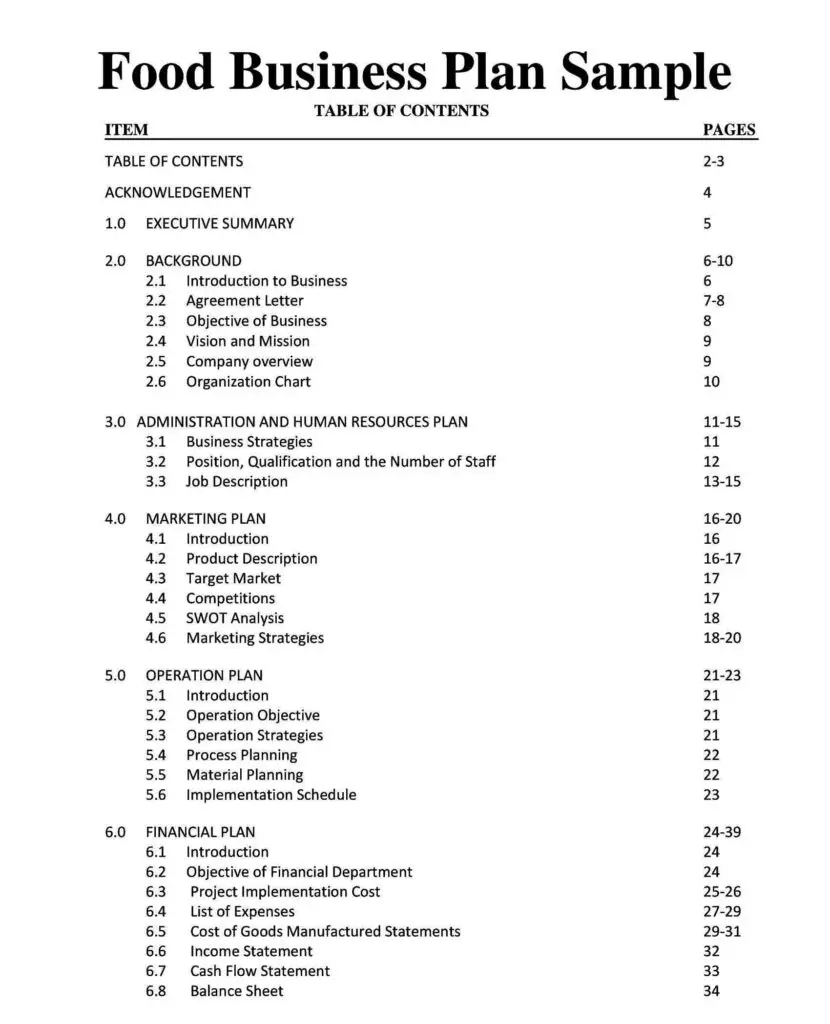
Food Business Plan Template
1.0 Executive Summary
The executive summary serves as the high-level gatekeeper of your entire business proposal. It must succinctly synthesize the market pain points, the proposed operational remedy, the target consumer demographic, and the enterprise’s overall financial viability within its first operational cycle.
We established the Food Ville around the area of the 17th residential college (Kolej Tujuh Belas) and the Faculty of Medicine and Health Science, University Putra Malaysia (UPM). Our business provides delivery services for light foods when the cafeteria is less accessible or during rush hours. The emphasis on food delivery has led to our company’s name, Food Ville.
The Problem Statement
Campus residents face two distinct food accessibility windows:
- The Morning Rush: The local campus cafeteria primarily cooks heavy morning meals. Students rushing to early classes lack the time to sit down or simply do not have an appetite for dense, heavy foods at dawn, leading to skipped breakfast.
- The Night Shift: Late at night, while students are heavily engaged in academic work, the cafeteria is entirely closed. The singular vending machine on campus is locked in Block D—proving structurally inaccessible to students residing in distant residential blocks.
The Solution
Food Ville bridges these availability gaps with a dedicated, on-demand door-to-door delivery app and messaging service, deploying staff members to fulfill orders during peak crunch times (early mornings and late nights).
2.0 Business Profile: Vision & Legal Framework
A business plan cannot rely on vague operational ideas; it must be anchored in a legitimate organizational profile and an airtight legal framework governing internal stakeholder interactions.
2.1 Corporate Identity
Official Brand Name: Food Ville Trading Enterprise
Corporate Motto: “On The Run” (Stressing corporate dedication to speed, uncompromised freshness, and punctual delivery windows)
Product Classification: Freshly prepared premium artisanal sandwiches alongside curated, portion-controlled convenience snacks.
Geographic Headquarters: Operations Hub Alpha, 17th Residential College, Universiti Putra Malaysia (UPM), 43400 Serdang, Selangor, Malaysia.
2.2 Micro-Capital & Shareholder Equity Structure
To eliminate systemic financial vulnerability from the outset, Food Ville is governed by a multi-shareholder partnership agreement comprising twelve (12) equal founders. This micro-equity structure minimizes individual risk exposure while pooling capital efficiently:
Individual Shareholder Contribution: RM 25.00 per partner
Aggregate Founder Capital Pooling: RM 300.00 (12 partners × RM 25.00)
Institutional Micro-Loan Financing: RM 50.00 (Sponsored via an academic micro-grant program under the supervision of Dr. Sabrina).
Total Initial Working Capital Asset Base: RM 350.00
2.3 The Legal Partnership Agreement (Core Clauses)
To maintain organizational integrity and mitigate internal disputes, all 12 partners have executed a binding legal contract containing the following structural clauses:
Symmetrical Profit and Loss Allocation: All net financial distributions, monthly dividends, or operational deficit balances are distributed among the 12 partners in a strict 1:1 ratio, matching their initial capital risk percentage.
Absolute Democratic Consensus: Major operational pivots, large capital expenditures exceeding RM 50.00, or vendor contractual changes require a two-thirds majority vote during formal partner board sessions.
Financial Oversight & Audit Control: The designated Administrative and Finance department holds absolute executive authority over tracking daily cash balances, issuing physical receipts, and auditing material expenses to prevent capital leakage.
2.4 Corporate Vision and Mission Statements
Corporate Vision: To scale Food Ville into the primary, universally recognized digital convenience food delivery network across all residential college ecosystems within Universiti Putra Malaysia by the end of the next fiscal year.
Corporate Mission: To deliver unparalleled customer satisfaction by providing hyper-fresh, reasonably priced breakfast and supper solutions directly to students’ doorsteps, maintaining a perfect 100% on-time delivery metric.
3.0 Administrative, Organizational, & Human Resource Strategy
Managing a 12-person entrepreneurial team without clear role definitions leads to operational chaos. Food Ville structures its human resource deployment into three dedicated, highly accountable corporate departments.
3.1 Organizational Hierarchy and Governance Structure
The operational workflow avoids top-heavy management bottlenecks by employing a flat, agile organizational hierarchy. This division ensures that executive planning transitions smoothly into daily on-the-ground execution.
Top Management Executive Board: Composed of all core founding partners, this board handles high-level strategy, reviews financial ledgers weekly, and determines overall menu pricing models.
Administration and Human Resources Department: Manages internal scheduling shifts, tracks individual courier compliance with food safety protocols, resolves internal team operational disputes, and maintains the primary organizational archive.
Marketing and Public Relations Department: Orchestrates digital campaign schedules, tracks real-time customer sentiment on social networks, optimizes localized search visibility, and creates promotional bundles to boost slow periods.
Operations and Logistics Department: Holds direct end-to-end accountability for raw material ingredient sourcing, runs daily quality control audits on kitchen assets, tracks ingredient waste margins, and manages delivery route optimization.
4.0 Comprehensive Market Analysis & Marketing Plan
An exceptional product will fail if it lacks a precise market path. This section maps out the target market, competitors’ vulnerabilities, and the exact product mix that drives Food Ville’s revenue model.
4.1 Granular Product Line Architecture
Food Ville’s menu strategy combines high-margin, freshly made items with stable, pre-packaged wholesale snacks to maximize profitability per delivery run.
Artisanal Double-Decker Egg Mayonnaise Sandwiches: Prepared using premium, density-controlled white sandwich bread chosen specifically to resist moisture absorption during transit. Hard-boiled eggs are crushed and folded into a high-emulsion, commercial-grade savory mayonnaise blend. Each sandwich features a crisp layer of fresh green loose-leaf lettuce, providing nutritional balance for health-conscious campus consumers. The items are tightly wrapped in food-grade PVC clear film to preserve structural integrity.
Premium Double-Decker Tuna Sandwiches: Developed for consumers seeking clean, high-protein options. Features premium canned skipjack tuna in brine, thoroughly drained to eliminate excess liquid, mixed with cracked white pepper, finely diced sweet onions, and light mayonnaise. Wrapped in professional tamper-evident packaging.
Assorted Gourmet Bakery Buns: Sourced via a wholesale agreement with a local certified bakery vendor. Fresh inventory is replenished every 72 hours. The rotation includes sweet and savory items such as mini pizza buns, hot dog buns, chocolate and chicken floss doughnuts, rich cream-filled buns, and classic butter-sugar rolls.
Deconstructed Cheese Nachos: High-margin snack packs created by dividing bulk restaurant-grade corn tortilla chips into individual 50g packs. Each portion includes a separate 30ml side container of warm, premium liquid cheddar cheese sauce to keep the chips crisp until delivery.
Nostalgic Ice Gem Biscuits: Sourced in bulk 4kg catering tins to secure lowest-tier wholesale pricing, then scaled down into transparent 50g convenience packs and 100g family-size share packs for late-night studying sessions.
Sweet Caramel Gourmet Popcorn: Bulk purchasing of high-expansion butterfly and mushroom popcorn kernels pre-coated in rich caramel glaze, packed in airtight 50g bags to preserve crunch in humid tropical conditions.
4.2 Target Market Identification & Demographics
The consumer ecosystem consists of three highly predictable student and faculty segments within the UPM campus:
The Medical and Health Sciences Cohort: Over 1,500 undergraduate students, postgraduate researchers, and laboratory staff members who must report to early morning hospital rounds or laboratory benches before traditional retail outlets open.
Late-Night Academic Researchers: Students staying up late for coding marathons, engineering project builds, and thesis writing inside residential halls.
Institutional Campus Organizations: University sports teams (e.g., the UPM archery squad) during intensive training camps, alongside student council committees hosting large after-hours events.
4.3 Strategic Competitor Matrix
| Competitor Entity | Core Competitive Advantages | Critical Vulnerabilities | The Food Ville Strategic Countermeasure |
| 17th Residential College Cafeteria | Large physical footprint, high menu variety, cooking volume. | Rigid operating hours; entirely closed late at night; slow queues during the morning rush. | Hyper-localized doorstep delivery that saves consumers valuable time during morning and late-night peaks. |
| Campus Cooperative Mart (Co-Op) | Established corporate brand trust, stable supply chain lines. | No delivery services; limited selection of fresh, healthy, customized items. | Freshly made, high-nutrition artisanal sandwiches delivered on demand. |
4.4 Strategic SWOT Analysis
| Strengths (S) | Weaknesses (W) |
|
|
| Opportunities (O) | Threats (T) |
|
|
5.0 Operational Processes & Supply Chain Logistics
Operational excellence requires maximizing resource efficiency. Food Ville uses a zero-mile, streamlined workflow to keep asset utilization high and product waste low.
5.1 Material Sourcing and Fixed Asset Management
Assets are divided into consumable inputs and long-term tools to protect capital reserves:
Consumable Raw Inputs (Daily JIT Inventory): Fresh baker’s white bread, canned tuna, fresh farm eggs, premium mayonnaise, fresh green lettuce, bulk popcorn, and nacho cheese sauce. Sourced every 48 hours using Just-In-Time (JIT) procurement to maintain fresh stock without costly refrigeration.
Fixed Capital Assets (Kitchen Infrastructure): Commercial rapid-boil water heaters (for efficient egg boiling), heavy-duty stainless steel utility knives, sanitizable preparation boards, and digital micro-scales to ensure precise ingredient portions.
5.2 Streamlined Order-to-Delivery Workflow
To minimize delivery times, the operational process is divided into four distinct phases:
1. Order Capture: Orders flow through the web portal or mobile chat channels and are automatically organized by residential wing and block numbers.
2. Precision Kitchen Assembly: The preparation team builds sandwiches using standardized portion weights (e.g., exactly 45g of egg mayonnaise mix per sandwich) to protect profit margins.
3. Quality Control Inspection: Couriers verify that packaging seals are intact and check order items against the digital delivery slip.
4. Wing-Optimized Delivery: On-duty delivery couriers bundle regional room drops within the same residential blocks, maximizing drops per run and ensuring meals arrive fresh and on time.
6.0 Financial Framework, Capital Projections, & Break-Even Analysis
The financial strength of the Food Ville model rests on its excellent cost-to-margin structure, yielding a strong **Net Profit Margin of 30.13%**. For every RM 1.00 earned in top-line sales, the business clears RM 0.30 in pure profit after accounting for all material costs, logistics expenses, and losses.
6.1 Key Financial Indicators
Total Startup & Implementation Capital: RM 350.00
Total Operational Break-Even Threshold: RM 266.95
Projected Return on Investment (ROI): 96.1% (Investors recover RM 0.96 in clear profit for every RM 1.00 of seed capital risked).
6.2 Granular Break-Even Analysis by Product Segment
To maintain positive cash flow, the operations team tracks sales volumes across all individual product categories. The table below outlines the exact sales volume needed to cover the production and overhead allocations for each menu item:
| Exact Product Item Description | Standard Unit Portion Weight | Unit Selling Price | Unit Break-Even Target (Value) | Minimum Sales Volume Required to Break Even |
| Assorted Fresh Bakery Buns | Standard Vendor Pack | RM 2.00 | RM 103.77 | 52 Units Sold |
| Egg Mayonnaise Sandwich | Fresh Double-Decker | RM 2.00 | RM 39.21 | 20 Units Sold |
| Premium Tuna Sandwich | Fresh Double-Decker | RM 2.80 | RM 36.58 | 13 Units Sold |
| Deconstructed Cheese Nachos | 50g Portion Pack | RM 7.00 | RM 27.26 | 4 Units Sold |
| Ice Gem Biscuits (Small) | 50g Handy Pack | RM 1.70 | RM 6.69 | 4 Units Sold |
| Ice Gem Biscuits (Large) | 100g Share Pack | RM 2.90 | RM 22.95 | 8 Units Sold |
| Caramel Gourmet Popcorn | 50g Individual Pack | RM 2.30 | RM 30.48 | 13 Units Sold |
FAQs (Frequently Asked Questions): Business Plan
Q1: What is a food business plan sample?
A: The food business plan sample is a business proposal that explains how to organize a food-selling business. It helps the start-up entrepreneur to launch a food business. It also helps students to write business plan samples for food products, including cookies, cakes, burgers, popcorn, and sandwiches. Therefore, students can use this food business plan sample to write other business plans for food products.
Q2: What are the primary components of a food business plan proposal?
A comprehensive food business plan proposal must contain six core elements: an Executive Summary, Company Profile, Administrative Plan, Marketing Plan, Operational Plan, and Financial Plan (Holcomb, Kenkel, & Kenkel, 2006).
Q3: How do you calculate the break-even point for a multi-product food startup?
To calculate the break-even point for a multi-product food startup, you divide the total fixed operational costs by the weighted-average contribution margin of the product mix. For individual product segments, calculate the specific unit break-even point by dividing the allocated fixed costs by the item’s individual contribution margin (Selling Price per Unit minus Variable Cost per Unit).
Q4: Why is a formal partnership agreement necessary for micro-enterprises and student startups?
A formal partnership agreement is essential because it establishes clear legal rules for capital contributions, profit distributions, and operational responsibilities. By explicitly outlining voting thresholds and financial audit controls early on, the business prevents internal stakeholder disputes, protects founder equity, and ensures consistent operational standards.
Editorial Authority & E-E-A-T Verification
This food product business plan proposal and strategic analysis was authored by M M Kobiruzzaman, Chief Executive Officer of Global Assistant and senior research editor for Newsmoor.com. Holding a Master of Management (By Research) from the School of Business and Economics at Universiti Putra Malaysia (UPM), he has conducted academic research on institutional communication models, macroeconomic corporate frameworks, and structural business workflows, with over 119 verified academic citations indexed on Google Scholar.
References (APA 7th Edition): Scholarly Source
Holcomb, R. B., Kenkel, P., & Kenkel, B. (2006). A Sample Business Plan for Small Food Businesses. Oklahoma State University, Food & Agricultural Products Center.

M M Kobiruzzaman is a communications researcher, media analyst, and the founding editor of Newsmoor.com. Specializing in mass communication models, journalism research frameworks, and media elements, his work bridges the gap between technical theory and everyday cultural communication. With a background in analyzing digital media dynamics and regional information systems, he is dedicated to providing authoritative guides that elevate media literacy and academic writing standards.