This article will help others learn “How to Write the Rules and Regulations of a Company.” It represents a sample of Private Company Rules and Regulations. Also, the Importance of Rules and Regulations in an Organization.
Company Rules and Regulations
Company rules and regulations are a set of written policies issued by the Company’s higher-level authority and are binding on all employees and stakeholders. Rules and regulations help the organization protect itself from legal claims and establish a positive work environment. Besides, company rules and regulations protect employees from legal claims and secure their jobs.
Company Code of Conduct
A Company Code of Conduct is a collection of rules and regulations that outline employees’ norms and responsibilities in the workplace. The code of conduct governs the employee’s daily activity and behavior. Failure to obey the organization’s code of conduct can have negative consequences.
Types of Company Rules and Regulations are:
- Company Rules and Regulations For Employees
- Company Rules and Regulations For Business
Private Company Rules and Regulations Sample
A small or large company applies rules and regulations to ensure the business runs smoothly. The Company Rules and Regulations for Employees always direct employees and protect them from being fired. The author has presented a sample of company rules and regulations for employees. It is a perfect sample of small-business rules and regulations, as well as company policies for employees.
Company Rules and Regulations For Employees
The following rules and regulations shall apply to all employees of the company. Every employee must follow and obey the acts, guidance, policies, rules, and regulations set by the company authority and applicable from time to time.
Some rules and regulations include:
Firstly, the company expects employees to exhibit formal and acceptable behavior. The company’s prime motive is to attract customers through the exemplary conduct of its employees.
Additionally, employees need to wear a face mask while working in an office. They are responsible for ensuring safety and a healthy working environment.
Moreover, employees are liable to protect the company’s belongings for office purposes. They will be responsible for damaging any official equipment, such as a computer, printer, scanner, or camera. Employees can use the official equipment only for official purposes.
Our company is aware of the importance of maintaining records; therefore, every employee must protect documents. The office will not accept any argument without proper evidence. Hence, employees should preserve official documents for future demand.
The company will not allow employees to work under the influence of alcoholic beverages during work time. Our Company does not encourage or discourage you from drinking alcohol; however, it suggests that you not drink alcohol while on duty.
Employees should have meals during break times. The Company will not allow extra meal time, so employees must utilize the break time wisely. Our company is vigilant in adhering to its employees’ ethical principles. The company will fire employees who engage in corruption or bribery without prior notice.
A Private Company Rules and Regulations Sample
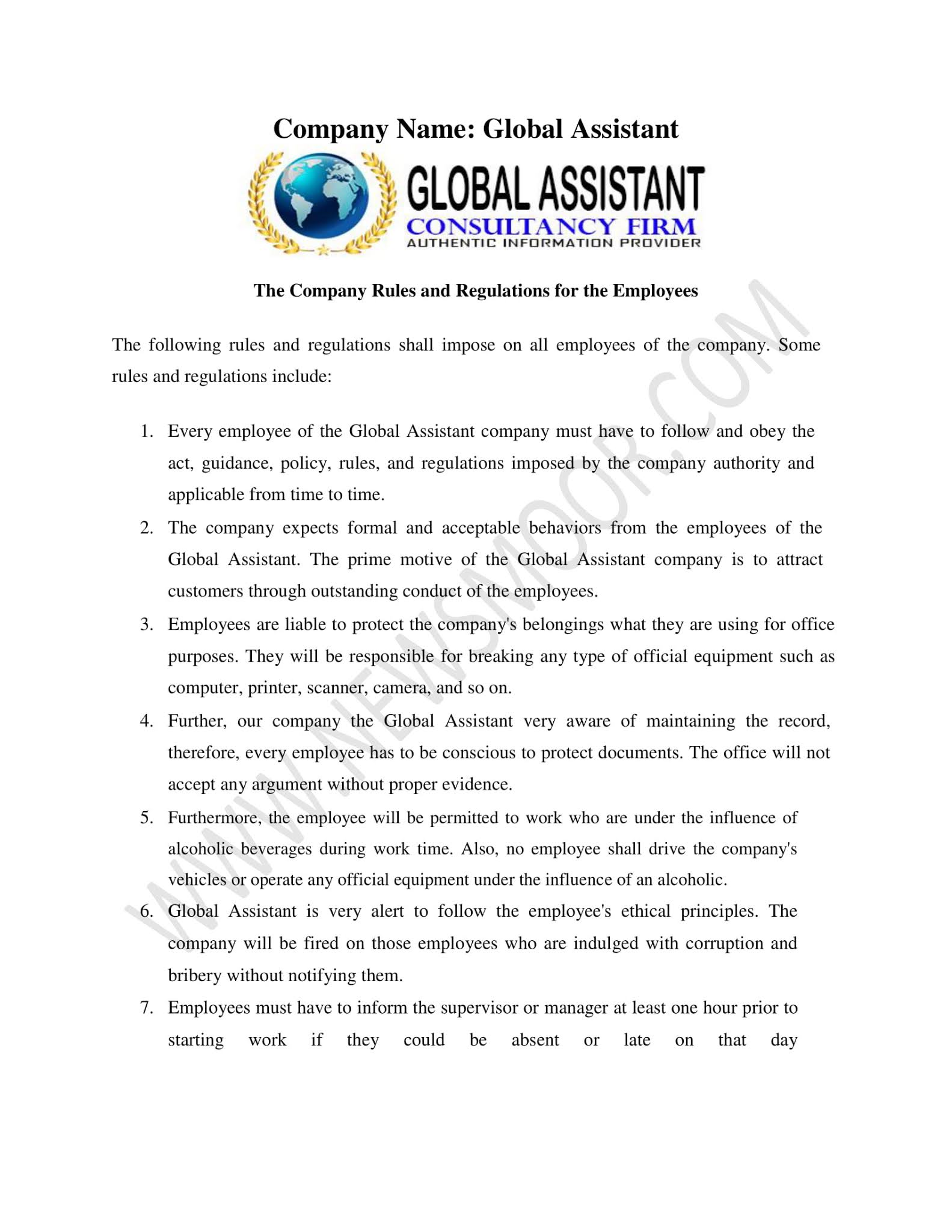
Our Company prefers to create a friendly working environment. The Company will fire those employees who engage in sexual harassment. Therefore, every employee must avoid any oral or physical harassment.
Employees must inform their supervisor or manager at least 1 hour before starting work if they will be absent or late that day. The Company hates it when employees arrive late to the office.
Every employee must apply for a memorable vacation at least 1 month before the requested date.
Employees shall adhere to the company’s dress code as directed by company authorities. The Company prefers that the employee wear formal attire.
Our Company emphasizes effective communication; therefore, every employee should maintain a productive communication process when interacting with clients, stakeholders, or colleagues. The best way to maintain effective communication is to use verbal and nonverbal communication cues during the interaction. The different types of nonverbal communication are facial expressions, gestures, vocalics, postures, smiles, and eye contact. The employees should use these cues to communicate effectively inside and outside the company.
Additionally, our company focuses on reducing the noise in communication, including interpersonal, group, and mediated communication. Communication noise or barriers can lead to misunderstandings. So, the employees must maintain noise-free communication in the organization.
The Company pays attention to an employee’s honesty, punctuality, motivation, innovation, and integration during promotion.
The Company will provide annual increments based on the employee’s performance.
Finally, if employees do not meet the company’s expectations through their conduct and performance, they can take corrective action.
Office Rules and Regulations
- Every staff member will be bound to obey all the regulations set by the official authority.
- Office attendance time is exactly 9:00 A.M., and departure time is 6.00 P.M., but the departure time can be extended due to a large number of pending tasks.
- Every assigned work must be completed on time before leaving the office. The task can be done from home with the CEO’s permission in emergencies.
- Every employee will recheck their tasks in the WhatsApp group and on Drive to confirm they are done before leaving the office.
- Employees must check the official email 2/3 times before sending it. Additionally, they can ask coworkers or the CEO if there’s any confusion.
- For student files, employees must check and verify all documents before emailing them to the university.
- If any employee wants to leave the job, they must submit an official resignation letter one month before resignation.
- Regarding office leave, every employee must submit an official leave application containing: the leave duration (exact date), reason, etc. After the application is accepted, they can take leave regardless of the medical leave. Notice that if any employee doesn’t attend the office without prior approval, their salary may be deducted.
- Sunday is a weekly off day. But for emergencies or essential office tasks, employees may have to work from home or come to the office. (Office will pay for overtime)
- Any office tool (Laptop, Documents, etc.) is forbidden to take home without permission.
N.B. The CEO can modify, extend, or cancel any rule or regulation without prior notice.
Business Rules and Regulations
Business rules and regulations are guidelines and instructions set by the company to govern its internal and external activities. The company follows business rules and regulations when dealing with employees, stakeholders, and customers. Companies follow business rules and regulations when collaborating with other companies, including competitors. The sample of business rules and regulations is as follows:
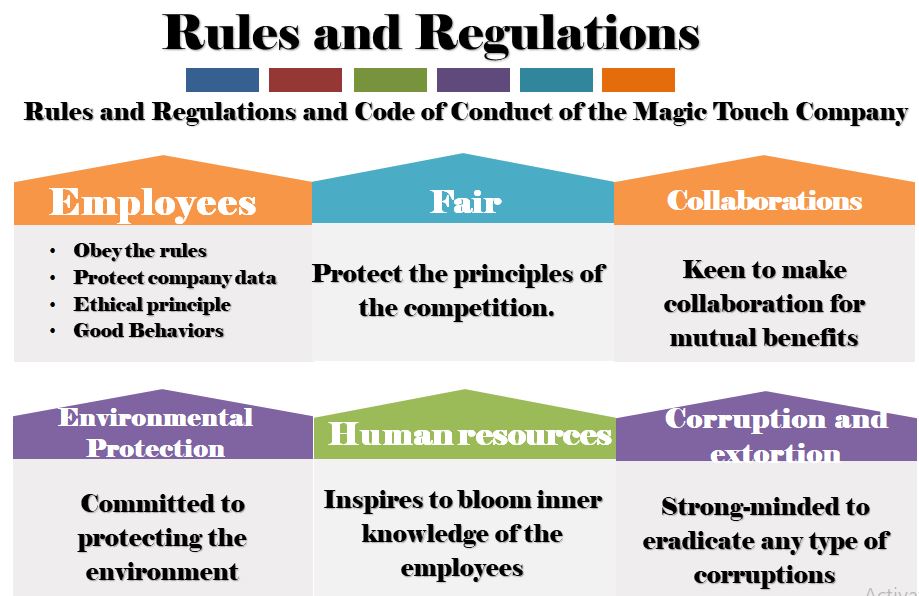
Fair Competition
Our company upholds the principles of competition and economic freedom and conducts its activities in line with them. It contests with other companies actively, autonomously, and to varying degrees, depending on each company’s strategies. The Company’s collaborators are not authorized to establish formal or informal agreements with competitors. All business units must follow the company’s rules and regulations.
Collaborations
Our company is always keen to collaborate for mutual benefit. This company is determined to keep its promise to other collaborating companies as per the agreement. We never break the collaboration contract without prior notice.
Relationships with Shareholders
Shareholders need all the relevant information available to guide them. Our company creates the conditions for shareholders’ widespread and informed participation in decisions within their remit. It promotes equality of information.
Environmental Protection
The company has always considered the environment to be a vitally important asset. So our company is committed to protecting the environment. The company is seeking a balance between financial initiatives and significant ecological concerns to consider the rights of future generations.
Confidentiality
The company safeguards the confidentiality of any data, information, and details regarding its activities. We comply with the Personal Data Protection Act to protect our employees’ and customers’ personal information. Our employees are well-trained to keep the information confidential. Additionally, we never disclose secret agreement papers to a third party.
Protection of Human Resources
Human resources are vitally important for the existence and development of our company. Therefore, we respect human resources and make room for implementing their creativity. Our company always inspires the blossoming inner knowledge of employees and outsiders alike.
Corruption and Extortion
Our company is committed to executing the necessary measures to prevent corruption. We are always aware of the need to combat bribery and extortion. The company is very strict about eradicating corruption from both inbound and outbound perspectives.
Company Rules and Regulations Sample PDF Download Link
Rule and Regulation of a Private Company PDF Download Link
An Infographic Sample of the Rules and Regulations of the Company
Company Rules and Regulations: Advantages and Disadvantages
The company rules and regulations have both pros and cons for the employees and organizations.
Advantages of Company Rules and Regulations
It is common for no two employees to be the same, and they are not motivated at the same level. That is why some specific rules and regulations need to be fixed. All lower-, mid-, and top-level employees are guided by the company or organization’s rules and regulations. They directed management toward the common goal of achievement. The overall work environment might be compromised if employees break the company’s rules and regulations. Additionally, work performance may decrease.
In short, the advantages of company rules and regulations in the workplace are as follows:
Company rules ensure the employees’ safety and security. They also protect employees and the company from prosecution.
Company rules protect employees from workplace verbal, physical, and sexual harassment.
Company rules protect employees’ and customers’ rights.
Rules help the organization comply with state and local laws.
Company rules & regulations reinforce the company’s goodwill and credibility, helping it earn more money.
They also help to provide a positive image to the customers.
These organizational rules uphold the company’s image towards its stakeholders.
Finally, the company rules build a secure and friendly working environment
Disadvantages of Company Rules and Regulations
The potential disadvantages of company rules and regulations adopted from ChatGPT.
Demotivation for Employees
According to Herzberg’s Two-Factor Theory, company rules demotivate employees to work effectively in organizations. Strict rules create a lack of trust towards the company.
Stifling Creativity and Innovation
Excessive rules and regulations can create a stifling environment that impedes employee creativity and innovation. When individuals feel constrained by rigid guidelines, they may hesitate to explore unconventional ideas or approaches, fearing repercussions for deviating from established norms. Consequently, the organization may miss out on valuable opportunities for innovation and problem-solving.
Reduced Flexibility and Adaptability
A proliferation of rules and regulations can lead to inflexibility within the organization, making it challenging to adapt to changing market conditions or emerging opportunities. In dynamic business environments, rigid bureaucratic structures can slow down decision-making processes and impede the organization’s ability to respond swiftly to evolving trends or customer needs. This lack of agility may result in missed opportunities and diminished competitiveness.
Negative Impact on Morale
Excessive rules and regulations can take a toll on employee morale and engagement. When employees perceive an overly restrictive work environment characterized by micromanagement and excessive monitoring, they may feel frustrated, disengaged, and demotivated. Such sentiments may erode trust in organizational leadership and undermine employee satisfaction, ultimately affecting productivity and retention rates.
Bureaucratic Red Tape
Complex and convoluted rules and regulations often breed bureaucratic red tape, hindering operational efficiency and productivity. Cumbersome administrative procedures, such as excessive paperwork, approval processes, and documentation requirements, can consume valuable time and resources, diverting attention away from core business activities. The bureaucratic burden may impede innovation and hinder the organization’s ability to adapt to changing market dynamics.
Risk of Compliance Failures
While rules and regulations are intended to ensure compliance and mitigate risks, overly complex or ambiguous guidelines can increase the likelihood of compliance failures. Employees may struggle to understand or adhere to intricate regulations, leading to inadvertent violations and potential legal or regulatory consequences for the organization. Compliance failures can tarnish the company’s reputation, incur financial penalties, and disrupt business operations.
Inhibiting Trust and Autonomy
Stringent rules and regulations may erode trust between employees and management, fostering a culture of skepticism and resentment. When employees feel excessively monitored or controlled, it can undermine their sense of autonomy and accountability, stifling initiative and creativity. A lack of trust in leadership may breed cynicism and diminish employee engagement, hampering collaboration and teamwork within the organization.
Resistance to Change
Established rules and regulations may create resistance to change, impeding the organization’s ability to innovate and adapt to evolving market dynamics. Employees accustomed to entrenched bureaucratic processes may be reluctant to embrace new initiatives or alternative approaches, fearing disruption or uncertainty. Resistance to change can hinder organizational growth and agility, limiting the company’s capacity to capitalize on emerging opportunities and drive strategic transformation.

M M Kobiruzzaman is a researcher, academic content writer, traveler, and the founding editor of Newsmoor.com. Specializing in communication, management, technology adoption models, and frameworks analysis, and journalism, his work bridges the gap between theory explanation and cultural communication. With a strong background in communication and management, he is dedicated to providing authoritative guides that elevate business and media literacy and academic writing standards.