Symbolic Convergence Theory: History, Description, Example and Strengths & Weaknesses. Examples of Symbolic Convergence Theory.
Symbolic Convergence Theory
Symbolic convergence theory refers to a communication model representing fantasies that transform from individuals to cohesive groups. Ernest Bormann developed it. People share common fantasies and visions, and these collections of individuals are merged into a cohesive group. SCT explains the appearance of a group’s cohesiveness, consisting of shared emotions, motives, and meanings. Symbolic Convergence Theory consists of three words: symbolic, convergence, and theory. Group members cooperatively create and sustain a shared consciousness, including shared meaning through interaction.
A diagram of the Anatomy of the Symbolic Convergence Theory has given below.
Convergence
Convergence means forming a new unified whole or evolving into one by combining two or more things. It comes from the prefix con- and the verb verge. The prefix con means together, and the verb verge means to turn toward. We can use convergence to explain things coming together, like the slow convergence of your opinions with those of your mother or for things that have already come together. For example, a crowd of mass people all move together into a group.
Theory
The theory is a set of principles on which the practice of an activity is based. It is a formal concept or idea that aims to explain something. For example, the Tw0-step flow of communication theory, Groupthink Muted Group Theory, SOCIAL IDENTITY THEORY, Tubb’s Theory- Small Group Communication, etc.
Symbolic convergence: When 2 or more private symbol worlds incline toward each other, come closer, or overlap. It is called a symbolic convergence.
History of the Symbolic Convergence Theory
Ernest Bormann established Symbolic Convergence Theory in 1972. SCT was first proposed by Ernest Bormann in the Quarterly Journal of Speech in 1972. Bormann and his colleagues at the University of Minnesota introduced SCT as a framework for discovering, describing, and explaining the dynamic process by which humans come to share symbolic reality.
SCT is a communication-related theory introduced by Ernest Bormann, a Professor at the University of Minnesota in the United States. American communication theorists, known as the originator of symbolic convergence theory (SCT) and its attendant method, fantasy theme analysis, explore how sharing narratives or “fantasies” can create and sustain group consciousness. He argued that group consciousness could occur at any level of communication, from within small groups to mass media. Thus, he identified symbolic convergence as a general theory of communication.
Description of Symbolic Convergence Theory
Symbolic Convergence Theory offers elucidation for the appearance of a group’s cohesiveness, consisting of shared emotions, motives, and meanings. Through SCT, members of the group can build a community or a group consciousness that grows stronger if they share a cluster of fantasy themes. Although this theory allows theorists and practitioners to anticipate or predict what did happen and what will happen it does not allow for control of human communication.
It attempts to explain how communication can create and sustain group consciousness through the sharing of narratives or fantasies. SCT explains that meanings, emotions, values, and motives for action are in the communication contexts by people trying to make sense out of a common experience. It is a process through which collectives create and share a consciousness and develop a common symbolic reality.
Symbolic Convergence Theory has a three-part structure
Firstly, elucidation of the recurring forms of communication involved in shared group consciousness.
Secondly, the illustration of why group consciousness begins rise and is maintained.
Thirdly, an explanation of the process of how an individual begins to share (or stops sharing) a common symbolic reality.
Anatomy of symbolic Convergence Theory
The social sciences and the communication discipline readily accept the use of several metatheoretical concepts (for example, power and scope, heuristic and isomorphic, elegance and parsimony, and validity and utility) to evaluate the quality of theories. There is less agreement about the metatheoretical concepts that would allow us to compare one theory’s anatomy (muscles, bones, arteries) with the anatomy of another.
Basic Concepts: (Fantasy themes)
A fantasy theme is a dramatizing message that depicts characters engaged in action in a setting that estimates for and explains the human experience. It is not something imaginary, but rather it is a “creative or imaginative interpretation of events which fulfills a psychological or rhetorical need.
Fantasy Theme Analysis is a form of rhetorical criticism. Rhetorical criticism explains the symbolic artifacts of discourse, including the words, phrases, images, gestures, and performances used to communicate. It shows how the artifacts work, entertain, arouse, and convince and persuade the audience. Rhetorical criticism studies and analyzes the purpose of the words, sights, and sounds that are the symbolic artifacts used for communication among people.
Collective consciousness refers to the shared beliefs, ideas, attitudes, and knowledge common to a social group or society.
The basic concept is the fantasy theme, and its associated basic concepts include symbolic cues, fantasy type, and saga.
Symbolic Cue
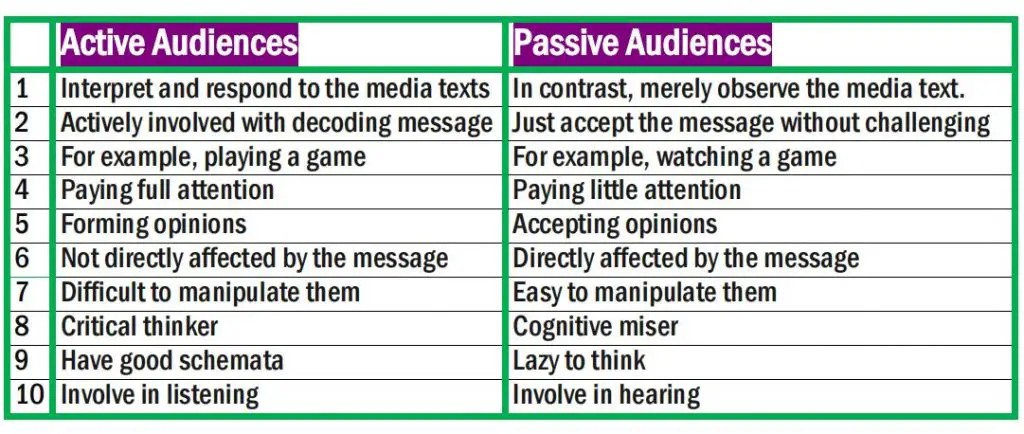
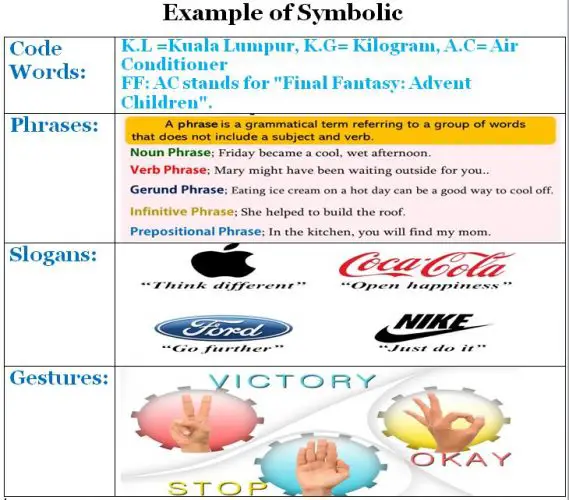
A symbolic cue is a code word, phrase, slogan, sign, or a nonverbal communication example that works to trigger previously shared fantasies and emotions. They can also heighten a group’s cohesiveness.
Fantasy types
A fantasy type is a stock scenario that explains new events in a well-known, dramatic form, such as Watergate, Irangate, and Whitewatergate. Taking stock is thinking about all the aspects of a situation or event before deciding what to do next. A fantasy type is a fantasy theme that has a large number of rhetorical visions. They help make sense of a new phenomenon by providing known references.
Notable Examples of Fantasy types
For example, a fantasy type would be when Richard Nixon was campaigning through his home state of California in 1952. Some wealthy Southern California businessman put a fund together on behalf of Nixon. The newspapers picked this up and ran headlines such as “Secret Rich Men’s Trust Fund Keeps Nixon in Style Far Beyond His Salary”. The purpose of this fund was to help Nixon pay for expenses that he could not otherwise pay for out of his income. National newspapers were two to one in the favor of dropping Nixon from the ticket after this. And, his only hope was to find a way to regain public trust and support. Six days after the crisis, Nixon addressed the public by radio to respond to the charges against him.
A fantasy theme emerging from this story would be Nixon presenting himself as the American dream. During his speech over the radio, he emphasized how he made his own way in the world and had to work for a living. Richard Nixon also said, “How does a candidate pay for political expenses not covered by the government? The first is to be a rich man, which I am not. I feel that it is essential in this country of ours that a man of modest means can run for President. He offers autobiographical references that allow him to appear like the average man. This is an appropriate fantasy theme because it developed a response to the allegations. He is not a rich man who is getting money from everyone, but a hard-working man who started from the ground and worked upwards.
Saga
A saga is a long story of heroic achievement of the life of an individual, group, organization, or larger entity such as a nation. It is a great historical achievement and event for individuals or a nation. For instance, examples of American sagas include “the spirit of entrepreneurship” and “the power of the ballot box. Symbolic convergence theorists claim that the Soviet Union had difficulty managing the coherence of the fifteen republics due to the weakening of the communist rhetorical vision and decreasing sagas.
Finally, this theory declares that communities are formed and maintained by the stories they share. The theory also suggests that humans are storytellers and share dramatization of an event. They make sense out of the complexities by creating a script or narrative to account for what happened. People share symbolic facts called fantasies, cues, and types with each other.
Message Structural Concepts: (Rhetorical vision)
A rhetorical vision is a composite drama that unifies people in a common symbolic reality. A rhetorical vision has five elements such as:
- Dramatis personae – the actors and players who give life to the rhetorical vision
- Plotline – provides the action of the rhetorical vision
- Scene – details the location of the rhetorical vision
- Sanctioning agent – legitimizes the rhetorical vision
- Master analog – the reflection of a deeper structure within the rhetorical vision
Dynamic Structure Concepts
At the meta-theoretical level of analysis, the dynamic structure concepts of any communication theory refer to the deep structure tension or war underlying a message’s cast, form, or mold. With SCT, the war occurs between righteous, social, and pragmatic fantasy themes and ultimately competing for rhetorical visions.
Righteousness refers to the quality of being morally correct and justifiable. A pragmatic way of dealing with something is based on practical considerations rather than theoretical ones. A pragmatic person practically deals with things.
Communicator Structure Concepts
At the metatheoretical level of analysis, communicator concepts focus on the names given to communicators from the lens of a particular theory. With RAT, the communicators are called arguers, audiences, and critics. With Symbolic Convergence Theory, the major communicator concepts are fantasizers and rhetorical community, along with their attributes such as the inclination to fantasize and dramatic communication style.
Medium Structure Concepts
This metatheory concept allows us to understand the medium as a propagating matter, such as in the statement: corn grows best in sandy loam soil. For example, IST grows best in open and mixed communication systems but not in closed ones. RAT grows differently in field-invariant and field-dependent media. URT operates differently in high-context, collectivist cultures than it does in low-context, individualist cultures. Likewise, NPT grows best in an open, democratic society and does not do well in a closed, totalitarian state. Fantasies (and thus SCT) grow best in a medium that fosters group sharing or public sharing as opposed to just personal fantasizing.
As Bormann (1972) noted, fantasies that begin in small groups often are worked into public speeches, become picked up by the mass media, and “spread out across larger publics”. With both group and public sharing the tendency for fantasies to be embellished, reconfigured, reworked, and evolved increases. The result is that members of groups and public rhetorical communities come to have a stake in the symbolic construction. The resultant symbolic construction has then entered their consciousness through the causative entity.
Evaluative Concepts
At the metatheoretical level of analysis, all communication theories posit one or more technical concepts. These concepts allow for the evaluation of communication that falls within the purview of a particular theory. For example, with IST, the primary evaluative concepts are fidelity, capacity, and uncertainty reduction.
With SCT, three primary technical concepts enable the evaluation of the quality and effects (outcomes) of fantasy-sharing among the members of rhetorical collectivities: shared group consciousness, and rhetorical vision reality-links, and fantasy theme artistry.
Shared group consciousness
A shared group consciousness must exist within a rhetorical community in order for a fantasy theme to chain out, a rhetorical vision to develop, a saga to exist, or a symbolic cue to imbue meaning. Some terms that portray a shared group consciousness are common ground, mutual understanding, created social reality, meeting of minds, and empathic communication. Once a group has reached shared group consciousness, they no longer think in terms of “I” or “me” but in terms of “us” and “we.” After all, communication is the drive that allows groups of people to move toward their goals. A shared group consciousness also reduces uncertainty by allowing groups to develop an identity that shapes their culture. Shaping their own culture can influence norms, roles, and even decision-making.
Rhetorical vision reality link
A rhetorical vision reality link allows for a viable rhetorical vision that includes an authentic account of the phenomena and tangible evidence. The lack of a rhetorical vision reality link, with no clear observational impressions of the facts, may lead to disprovable fantasies, characterized by rumor, innuendo, gossip, and even paranoia.
Fantasy theme artistry
Fantasy theme artistry is the rhetorical ability to present situations in a form that appears attractive to people so that they will share them by presenting situations in a form that appears attractive to an audience or showing that you understand the stories that the group shares. You can speak to their stories and turn their opinions in your favor.
Strengths and Weaknesses of the Symbolic Convergence Theory
Strengths of the Symbolic Convergence Theory
The stories or fantasies of symbolic convergence theory can help businesses, corporations, or politicians because SCT is a general theory built on the method of natural sciences. People apply it to many different cultures and timelines. They also use to account for the communicative processes created by a group, used to foster the creation and sustenance of the group’s so-called “consciousness.”
Strengths
Below are a few points of how and why SCT can be useful in everyday situations. Determining communication malfunctions. A question that happens a lot within SCT is, “Why do some fantasy themes spark a chain of sharing while others fail?”
Groups fate, as a part of a group, has everyday experiences that predispose them to share fantasies that relate to their concerns. Therefore, these groups will have successful fantasy chains because they have more in common and can share more. Group members often find the confrontation of such issues unsettling when issues of power, sexism, role conflict, social rejection, and other touchy topics come into play. These fantasy chains may begin but often do not last very long. Assessing communication efforts and persuasive campaigns. This theory can provide insight into small groups, meetings, lectures, and speeches. However, it provides a more effective use of assessing effects within the media.
In the 1976 campaign, the investigators included the relationship between the media messages and the audience’s effects in their study. These studies analyzed the extent to which actual voting behavior can be anticipated by participation. By being able to predict voting behaviors, political representatives could carefully craft their messages for different groups of people before giving their speeches and lectures to benefit themselves best—the role of consciousness. Within fantasy chains, three phases keep the chains going. They are consciousness-creating, consciousness-raising, and consciousness-sustaining. In the first phase, people create a commonality among their group. If the groups share this common fantasy, consciousness-raising will often fall in line next. And lastly, the two first points combined will create a sustaining fantasy chain that will last.
Weaknesses of the Symbolic Convergence Theory
The dangerous phenomenon is an essential element of symbolic convergence theory. It is the propensity of the phenomenon that people use against public goodwill. SCT can be seen at work in revisionist history, whether unintentionally or intentionally. The intentional malevolent use of SCT principles against the public good. People can use it in the rash of “Fake News” campaigns. Therefore, false perceptions are feed to society in order to create a false, but widely believed, consensus (convergence) of belief. This is tantamount to intentionally creating false representation on the walls of Plato’s cave.