Deming PDCA Cycle Four Stages, Advantages and Disadvantages

This article explains the Deming PDCA Cycle- Four Stages, Advantages, and Disadvantages. It also describes PDSA Cycle Revolution with Pros and Cons.

Deming PDCA Cycle

Deming PDCA cycle refers to a repeated four-step management model that ensures the continuous improvement of products and services in the industry. In the 1950s, a famous management scholar, Dr. William Edwards Deming, introduced the PDCA method; therefore, it is also known as the Deming Cycle or Deming Wheel. It is a famous method for solving problems to yield the highest quality results. The full meaning of PDCA is the Plan–Do–Check–Act, a four-step action method.

Apart from PDCA, it has multiple names, such as the PDSA abbreviation of the Plan–Do–Check–Adjust, the Deming cycle or circle, or wheel, the Shewhart cycle, and the control cycle or circle. The Plan-Do-Study-Act (PDSA) cycle is a quality improvement framework commonly used in various industries, including healthcare, manufacturing, and education.

The Four Stages of the Deming Cycle

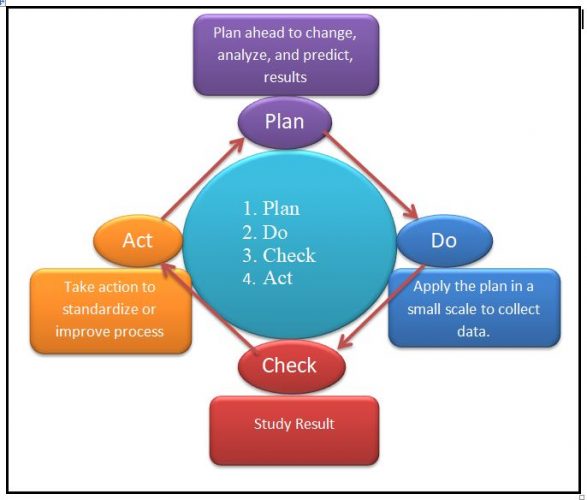
The Four Stages of the Deming Cycle are Plan, Do, Study or Check, and Act. These are the four core elements or principles of the Deming cycle model. Deming’s principles for pdca cycle include Plan, Do, Study, or Check, and Act. 
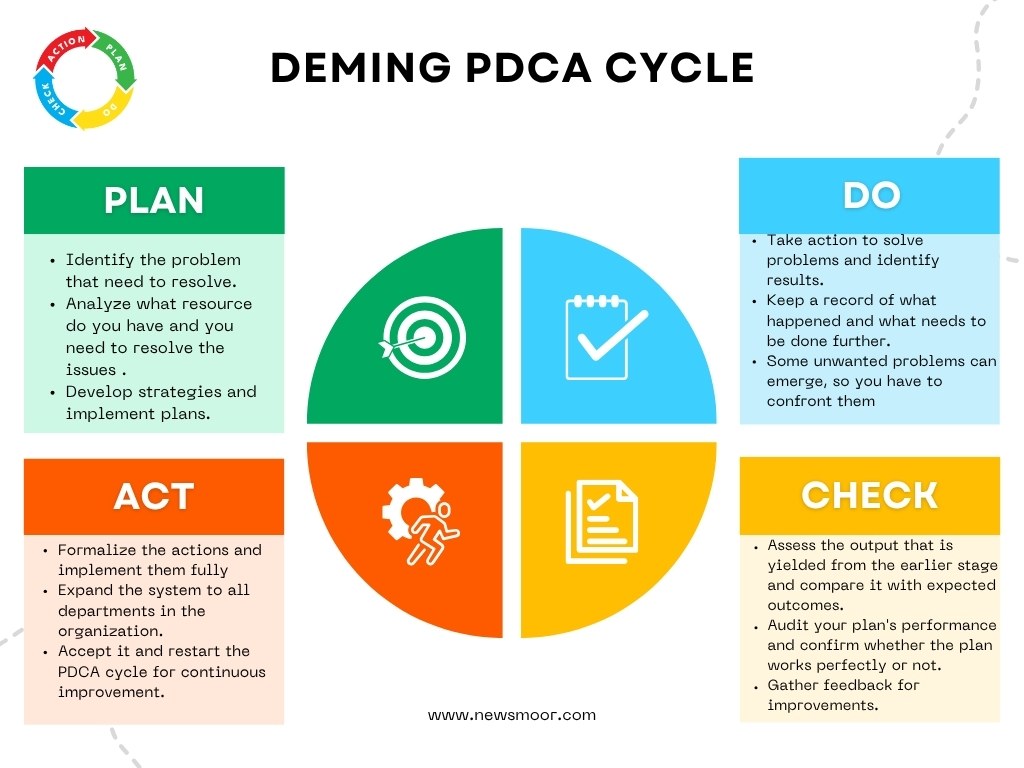
deming pdca cycle four stages

1. Plan

PLAN is the initial step of the four-step method that identifies the problem and opportunities to suggest recommendations. In addition, it analyzes and describes the overall current situation of the project. The authority recruits a team to understand the full process of the project in this stage; they  identify the problems that need to be changed and find solutions to fix the problems.

In this stage, you have to find out the answers to some basic questions regarding the project. The questions are as follows;

Firstly, you have to identify the main problem that needs to be solved in your organization. The customers demand to resolve this problem be resolved.
Secondly, what kind of resources do you have now that you use regularly?
In addition, what resources do you need to resolve the problem?
Moreover, what is the solution that you have taken with resources?
Finally, how long will it take to analyze the problems and implement the planning?

2. Do

The DO phase is the second stage of the Deming cycle, where the testing of the solution starts to be executed to identify the results. After completing the planning step, you have to take action to solve the problems. You will apply all the plans that you have taken in the first stage. Some unwanted problems can emerge in this stage, so you have to be aware to confront them. To increase your confidence level, you can apply your actions to a small arena in the project. It is a subtle way to control the situation properly as well as avoid an unpredictable big mistake. All team members stay alert at this stage to play their roles and responsibilities.

In this stage, you, with your team members, will take some initiatives mentioned below:

  • Keep a record of what happened and what needs to be done further.
  • When do you apply the planning?
  • Collect data from the planning stage.
  • Try to use a check sheet, swim lane map, and flowchart to capture data.
3. Study or Check

Study or check is probably the most important step of the Deming cycle. You must pay attention to the CHECK stage if you want to scrutinize the output that is yielded from the earlier stage. It will help you to avoid repeating mistakes and clarify the success of your planning and application of steps. This stage will allow you to audit your plan’s performance; you will be confirmed whether the plan works perfectly or not.  Additionally, your team will identify the problematic portions of the project to eliminate them in the future. You would be able to discover the root cause of the problem if something went wrong. In short, this stage will assess the system’s effectiveness and help you decide whether the theory is helpful or not.

Example: Appraisals or  Gap analysis.

In this stage, you have to capable to answer some questions mentioned below.

  • Is the system effective or not to resolving the issues?
  • Do you want to continue this system or need to change it?
  • Have you outlined a list including the unexpected results, failures, successes, and outcomes?
4. Act

ACT is the final stage of the system that finalizes the perfect solution to implement. In this stage, your organization should follow the adapt, adopt, and abandon factors.

Adapt refers to changing and modifying the PDSA circle for the next test.

Adopt indicates considering expanding the system to all departments in the organization.

Abandon means modifying your full approach and repeating the PDCA circle.  In sum, it is the step of standardization that is considered standardized when goals are exceeded.

In this stage, you need to answer the questions below.

  • Do you want to formalize the actions and implement them fully?
  • Do you want to expand the system to all departments in the organization?
  • Do you want to accept it and restart the PDCA cycle for continuous improvement?

Deming PDCA Cycle Pros and Cons

Firstly, PDSA is a simple and effective process for addressing new and recurring problems in the industry. In addition, it is a repeated approach that will allow you to measure results without wasting time. Moreover, it is a risk-free approach to apply a small scale to the project; therefore, there is no need to change the full process if it doesn’t work.

In contrast, the full PDSA process is slow when applied in industry to yield the final result. It is not a straightforward execution process that can be applied to urgent problem-solving issues. Additionally, you need to use some resources, including effective team members, to ensure that each circle step is directed perfectly.

Advantages of the PDSA Cycle

The eight benefits of the PDSA or PDCA cycle are systematic strategy, flexibility, an iterative process, a focus on learning, team empowerment, evidence-based decision-making, rapid improvement, and a continuous improvement culture.
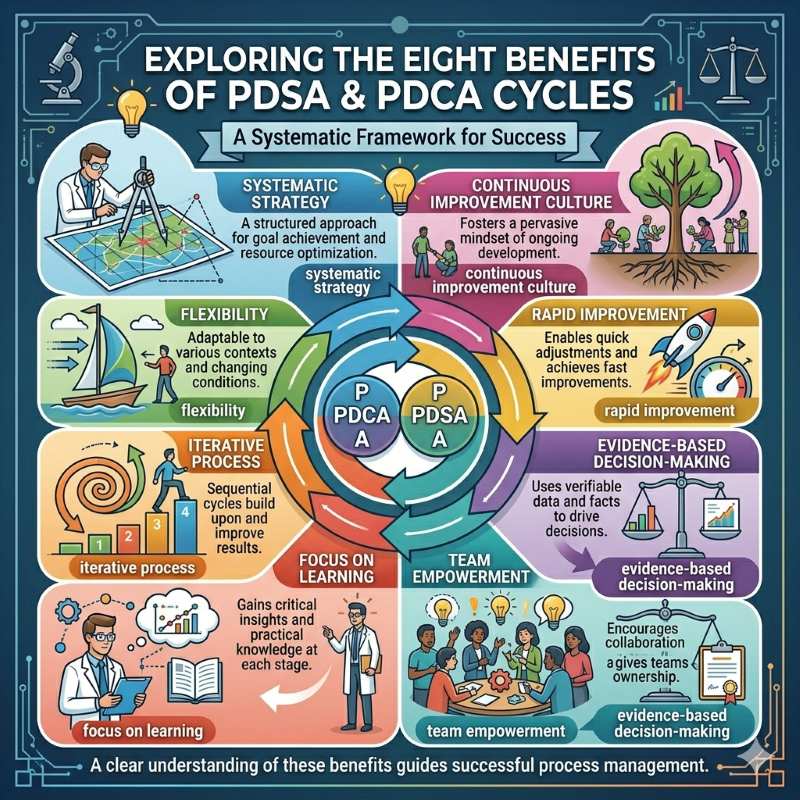
advantages of the pdsa cycle

Systematic Strategy

The PDSA framework offers a structured strategy for resolving problems and ensuring continuous improvement. It shows the step-by-step (Plan, Do, Study or Check, Act), process to assess the improvement. We can address the complex issues and refine them in every section methodically. It allows us to follow systematically, one by one.

Flexibility

The PDSA cycle is flexible and adaptable to a wide range of settings and industries. It can be applied to small-scale projects or larger initiatives, making it suitable for organizations of all sizes and types.

Iterative Process

The iterative nature of the PDSA cycle allows organizations to make incremental improvements over time. By continually cycling through the steps of the PDSA cycle, organizations can refine their processes, systems, and practices to achieve greater efficiency and effectiveness.

Focus on Learning

The PDSA cycle emphasizes learning and experimentation as essential components of improvement. By studying the results of each cycle, organizations gain valuable insights into what works and what doesn’t, enabling them to make informed decisions and adjustments.

Empowerment of Teams

The PDSA cycle encourages collaboration and engagement among teams involved in improvement efforts. By involving frontline staff in the planning, execution, and evaluation of improvement initiatives, organizations empower employees to take ownership of the process and contribute their expertise and insights.

Data-Driven Decision-Making

The PDSA cycle relies on data and evidence to drive decision-making. By collecting and analyzing data throughout the improvement process, organizations can identify trends, root causes, and opportunities for improvement, enabling them to make informed decisions and prioritize actions effectively.

Rapid Implementation

The PDSA cycle enables organizations to implement changes quickly and test their impact in a controlled manner. By breaking down improvement initiatives into small, manageable steps, organizations can avoid delays and minimize the risks associated with large-scale changes.

Continuous Improvement Culture

The PDSA cycle fosters a culture of continuous improvement within organizations. By encouraging ongoing reflection, learning, and adaptation, organizations can create an environment where innovation and excellence are valued and rewarded.

Disadvantages of the PDSA Cycle

While the PDSA cycle offers numerous benefits for continuous improvement, it also has eight potential weaknesses, including time-consuming, complexity, risk of inefficiency, resistance to change, limited scope, data quality issues, lack of sustainability, and cost.
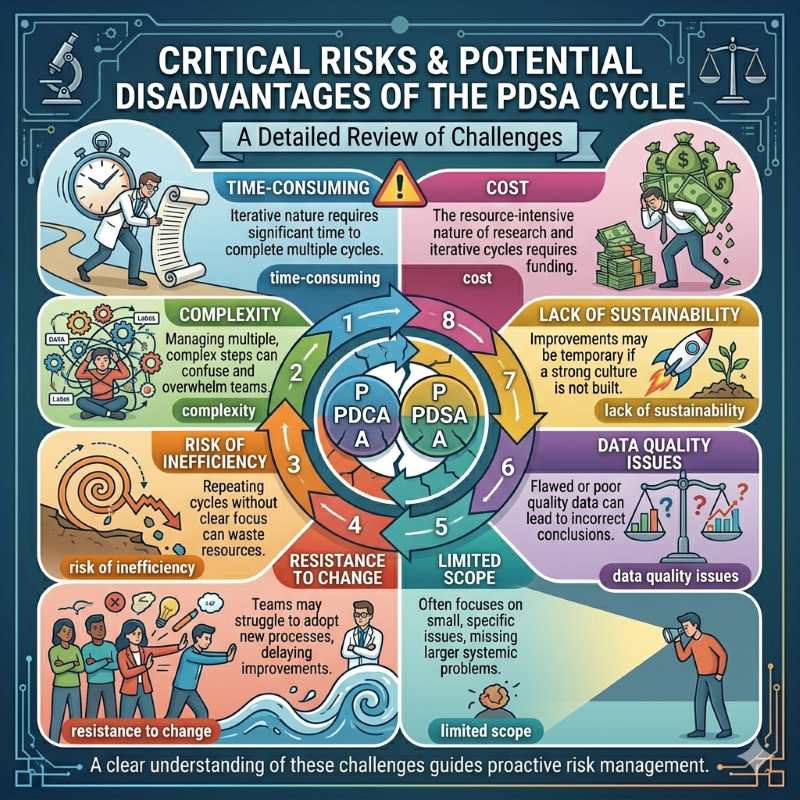
weakness of the pdsa cycle

Time-consuming

Implementing the PDSA cycle requires time and effort to plan, execute, and evaluate improvement initiatives. For organizations with limited resources or competing priorities, the PDSA cycle may add to the workload and strain resources.

Complexity

The PDSA cycle involves multiple steps, including planning, implementation, data collection, and analysis. This complexity can be daunting for individuals or teams unfamiliar with quality improvement methodologies, leading to confusion or errors in implementation.

Risk of Inefficiency

In some cases, organizations may engage in the PDSA cycle without clear goals or objectives, leading to inefficient use of resources. Without proper planning or alignment with strategic priorities, improvement efforts may yield minimal results or fail to address critical issues.

Resistance to Change

Implementing the PDSA cycle often requires changes to existing processes, workflows, or behaviors. Resistance to change from stakeholders, including employees, management, or customers, can impede the effectiveness of improvement initiatives and hinder progress.

Limited Scope

The PDSA cycle is best suited for small-scale, incremental improvements rather than large-scale organizational change. For complex or systemic issues requiring comprehensive restructuring or transformation, alternative methodologies may be more appropriate.

Data Quality Issues

Effective implementation of the PDSA cycle relies on accurate and reliable data for decision-making. However, organizations may encounter challenges with data collection, measurement, or analysis, leading to flawed conclusions or ineffective interventions.

Lack of Sustainability

Improvement initiatives resulting from the PDSA cycle may struggle to sustain long-term gains without ongoing support, monitoring, and reinforcement. Without a culture of continuous improvement or organizational commitment, improvements may regress over time.

Cost

While the PDSA cycle can lead to cost savings through efficiency gains or error reduction, there are also associated costs with implementing quality improvement initiatives. These costs may include training, technology investments, or hiring additional staff to support improvement efforts.

Overall, while the PDSA cycle offers a systematic approach to continuous improvement, organizations must carefully consider its limitations and potential drawbacks to maximize its effectiveness and achieve sustainable results.

The Evolution of the Deming Cycle or PDSA

The Deming cycle has evolved over time to become an effective process. I will discuss how the Deming cycle came to be and how it has evolved over time.

Dr. W. Edwards Deming

Deming was an American management consultant who graduated as an electrical engineer and later concentrated in mathematical physics. He has become a famous person in the Japanese industry for his work and initiatives after WWII. In addition, Dr. W. Edwards Deming got recognition as one of the most influential figures in the Japanese manufacturing industry, who was not Japanese but American. He championed the work of Walter Shewhart, including total quality management, statistical process control, and renamed the Shewhart Cycle. After all, he made a significant contribution to the rise of post-war economic growth in Japan.

The Shewhart Cycle

Deming had been inspired by an American engineer, Walter Andrew Shewhart, who was also a physicist and statistician. In 1939, Shewhart published a book on the Viewpoint of Quality Control. It was the first book that articulated a three-stage systematic process of specification, production, and inspection. These three stages were developed to test the hypothesis of experiments. Finally, he mentioned that these stages should not proceed in a straight line but rather in a cycle. Thus, the Shewhart Cycle took the form of a circle.

The Deming Wheel

In 1950, Deming analyzed Shewhart’s Cycle to modify it. He introduced a new version of Shewhart’s Cycle: a four-step process of design, production, sales, and research. This cycle has been known as the Deming Circle or Deming Wheel.

PDCA

Some Japanese executives probably modified the Deming cycle, or Deming wheel, to Plan-Do-Check-Act (PDCA), although the exact reason for changing the name is unclear. This four-step cycle was introduced to identify the problems in the industry and solve them by applying the four steps together. The primary objective of this cycle is to standardize the assessment of whether the results are satisfactory.
deming cycle- four stages of deming cycle & pdsa cycle pros and cons
Deming PDCA Cycle or PDSA Cycle
PDSA
Deming was not satisfied with the name of PDCA; therefore, he amended it in 1986. He emphasized the core meaning of checking and noted that it does not incorporate the cycle. Hence, the PDSA emerged from Deming’s recommendation.

When to Apply PDSA

The PDSA or PDCA framework can be used to develop any process or product by breaking it down into smaller steps. This cycle can be used in all kinds of organizations across many areas, such as change management, new service or product deployment, product lifecycle, and so on. This framework is beneficial for assisting in the improvement of the Six Sigma and total quality management processes. It is the best option for identifying problems and practical solutions.

Deming Cycle or PDSA Quality Improvement

The Deming cycle is an essential part of the quality improvement process in large-scale industry. Apart from that, organizations apply other quality improvement programs that are much more complex QI processes.

Continuous Quality Improvement

It is also known as the CQI process that organizations apply to reduce waste, increase efficiency, and increase internal and external satisfaction. It is a management philosophy that assesses how the industry operates and develops its processes. These more complex quality improvement programs include the following:

Lean

The lean process is a manufacturing approach that improves efficiency and reduces waste. This program focuses more on improving products and services based on customer demand.

Six Sigma

The Six Sigma process is a set of tools and techniques that improve process quality by eliminating defects and minimizing variability in manufacturing.

Total Quality Management

It is a process of a management system based on practicing a principle that instills a good business culture, where every employee maintains a high standard of work. It influences the organization to maintain a high quality of service in every aspect of the company.

Quality Improvement Collaboratives

It is a process that usually applies to healthcare centers, where many organizations work together to develop services for patients.

Conclusion

The Deming cycle is a four-step (PLAN, DO, STUDY, ACT) process that ensures continuous improvement of products and services in industry. Today, many organizations worldwide use this method to improve their products and services by solving problems.

Demographic Geographic Psychographic Market Segmentation Factors

This article explains the 3 basic types of market segmentation: Demographic Segmentation, geographic segmentation, and psychographic. It also demonstrates Target Market Segmentation Theories- Maslow’s Hierarchy and VALS Segmentation Model in Consumer Behavior.

Demographic Geographic Psychographic

Demographic, Geographic, and Psychographic segmentation refers to the market segmentation technique based on the different factors related to the audience. These are the most effective strategies for dividing people into identical subgroups. The purpose of demographic, geographic, and psychographic segmentation is to segment audiences into subgroups to inform political campaigns, commercial marketing, and advertising.

Market Segmentation

Market segmentation separates people into similar subgroups based on geographic, demographic, and psychographic factors. It is an essential process for social, political, and commercial campaigns and advertising. It is an effective way to send messages to a targeted group rather than to everyone.  A long time ago, audience segmentation was primarily applied for social and political campaigns. Currently, it is widely used in market segmentation. Therefore, audience segmentation is known as market segmentation.

Market Segmentation Examples

For example, a political leader is campaigning, urging voters to support his party. Thus, the leader targets voters solely to conduct the campaign. In many countries worldwide, the minimum voting age is 18 years. For example, in the USA, citizens aged 18 or older. The political leader persuades the citizens of the constituency to adopt an age minimum of 18 years. Here, a citizen of the constituency refers to the inhabitant of a particular area, which is also an example of a geographic factor of market segmentation. Similarly, age is a demographic characteristic of market segmentation.

Demographic Geographic Psychographic Diagram

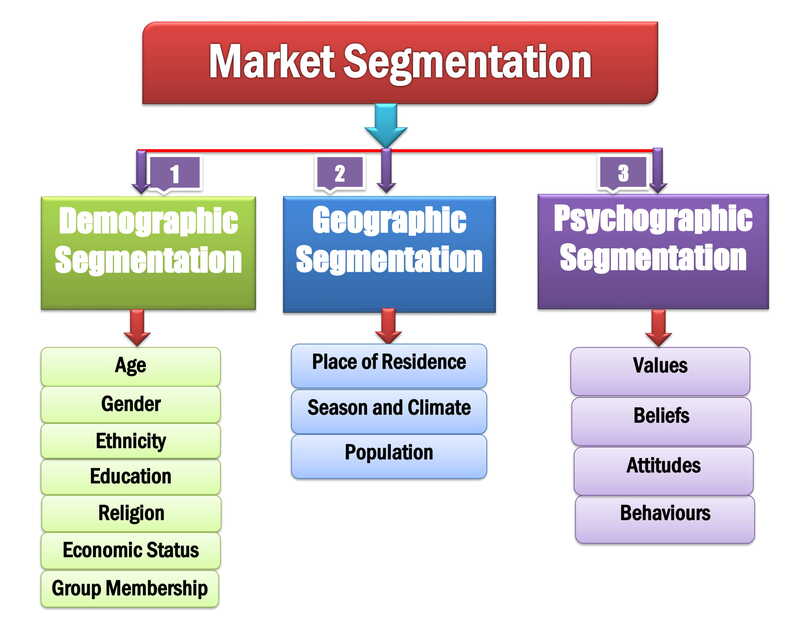
demographic geographic psychographic market segmentation variable
Demographic Geographic Psychographic Market Segmentation Factors

Types of Market Segmentation

The 3 Types of Market Segmentation are

  1. Demographic Segmentation
  2. Geographic Segmentation
  3. Psychographic Segmentation

1. Demographic Segmentation

Demographic segmentation refers to the process of grouping individuals into similar subgroups based on demographic characteristics such as age, gender, ethnicity, education, religion, socioeconomic status, and group membership.

For example, a political organization divides people by age. They are looking for voters whose age is more than 18 years. It is an example of demographic segmentation. Demographic questionnaires are crucial to conducting surveys and market research.

Demographic Factors

Demographic factors are characteristics of audiences, such as age, gender, ethnicity, education, and religion.

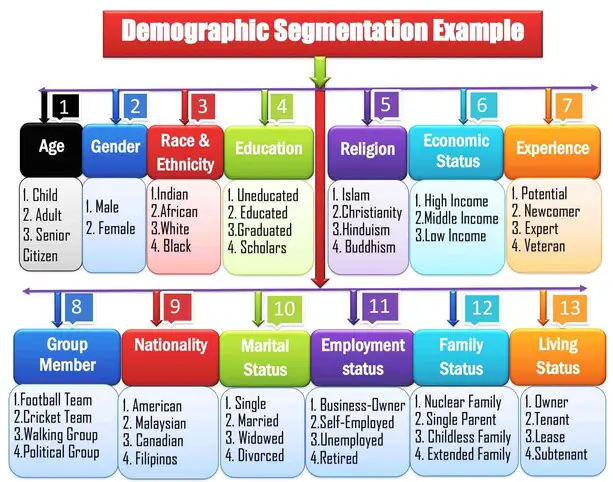
The demographic segmentation factors are Age, Gender, Ethnicity, Education, Religion, Economic status, Experience, Group Member, Nationality, Marital Status, Employment Status, Family Status, and Living Status.

Examples of Demographics in Marketing

demographic market segmentation factors

2. Geographic Segmentation

Geographic segmentation refers to grouping individuals into similar subgroups based on geographic factors such as residence, climate, and population. It highlights the audience’s location and environment.

Geographic Factors

The Geographic Factors are Place of residence, Season climate, and Population.

1. Place of Residence

Place of residence refers to rural or urban areas where the audience lives, whether permanently or temporarily. People in urban and rural areas differ in their lifestyles, including dress, appearance, and attitudes. Therefore, market segmentation is essential before starting an advertising or social campaign.

 2. Season and Climate

Season refers to a specific period of the year characterized by a particular climate. For example, the United States has four seasons: Autumn, Spring, Summer, and Winter.

For example, Ice cream companies earn more money in the summer season than in winter. In contrast, the blanket-selling company focuses its marketing on the winter season. The company needs to focus on geographic segmentation for the advertising campaigns.

3. Population

Population means the inhabitants of a particular area; for example, the capital city, metropolitan city, or small town. However, they share similar characteristics but also differ.

3. Psychographic Segmentation

Psychographic segmentation separates people into similar subgroups based on psychographic factors such as values, beliefs, attitudes, and behaviors. These factors indicate individuals’ internal psychological characteristics.

Psychographic Factors

The four psychographic factors of market segmentation are values, beliefs, attitudes, and behaviors; these four factors help explain how audiences feel and behave.

For example, a political leader’s values, beliefs, attitudes, and behaviors are clearly distinct from those of a physician.

 1. Values

Firstly, values are judgments about what is right or wrong, desirable or undesirable. For example, most people share equality, freedom, honesty, fairness, justice, good health, and family. Another example, we respect human life naturally (Value).

2. Beliefs

Secondly, a belief is something you accept as true, and it is stated as a declarative sentence. For instance, students believe that using the internet improves the quality of their research. Furthermore, you may feel that giving blood is important because an adequate blood supply is necessary to save a life (Belief).

3. Attitudes

Thirdly, an attitude is a statement expressing an individual’s approval or disapproval, such as liking or disliking. Attitudes typically derive from our values and beliefs. Many values and beliefs interact to complicate our decision-making.  For example, you may feel that giving blood is very important (Attitude).

4. Behaviors

Finally, Behavior is an individual’s observable action. It is the way we act or behave toward others. It is the combination of other psychological factors, such as values, beliefs, and attitudes.

For example, you may feel that giving blood is important (Attitude) because an adequate blood supply is necessary to save a life (Belief) and because you respect human life (Value). Your behavior is a logical and observable extension of your outlook as you participate in the blood drive and donate blood.

Example of Psychographic segmentation

For example, you may feel that giving blood is important (Attitude) because an adequate blood supply is necessary to save a life (Belief) and because you respect human life (Value). Your Behavior, as you participate in the blood drive and donate blood, is a logical and observable extension of your

Advantages and Disadvantages of Psychographic Segmentation

Advantages of Psychographic Segmentation

  1. Deeper Understanding of Customers: Psychographic segmentation offers a more comprehensive understanding of customers beyond basic demographic characteristics such as age and income. It helps marketers understand the drivers of consumer behavior, preferences, and purchasing decisions.
  2. Targeted Marketing Communications: By segmenting the market based on psychographic variables, marketers can tailor their messaging and communication strategies to resonate with specific consumer segments. This personalized approach enhances the relevance of marketing efforts, resulting in higher engagement and response rates.
  3. Enhanced Product Development: Psychographic segmentation enables companies to develop products and services that align with the needs, preferences, and lifestyles of different consumer segments. By catering to the unique desires and aspirations of target customers, companies can create offerings that stand out in the market and generate greater customer satisfaction.
  4. Improved Customer Retention: Understanding customers’ psychographic profiles enables companies to build stronger relationships and loyalty. By delivering personalized experiences and addressing customers’ values and interests, companies can foster deeper connections and increase customer retention.
  5. Effective Market Positioning: Psychographic segmentation helps companies identify niche markets or segments with distinct needs and preferences. By positioning their products or services to address the specific desires of these segments, companies can differentiate themselves from competitors and gain a competitive advantage in the market.
  6. Increased Marketing ROI: Targeting specific psychographic segments allows companies to allocate their marketing resources more efficiently. By focusing efforts on segments most likely to respond positively to their offerings, companies can optimize their marketing ROI and achieve better results with less expenditure.
  7. Adaptation to Changing Trends: Psychographic segmentation enables companies to stay attuned to evolving consumer trends, lifestyles, and preferences. By continuously monitoring and analyzing psychographic data, companies can

Disadvantages of Psychographic Segmentation

  1. Subjectivity and Interpretation Bias: Psychographic segmentation relies on subjective interpretations of consumer attitudes, values, and behaviors, which can introduce bias into the segmentation process. Different analysts may interpret the same data differently, leading to inconsistent segmentation outcomes.
  2. Limited Generalizability: Psychographic segments may not generalize well across markets or demographic groups. Consumer preferences and behaviors can vary widely across cultural, regional, and temporal contexts, making it challenging to apply psychographic insights universally.
  3. Complexity in Data Collection: Gathering psychographic data can be more complex and time-consuming compared to demographic or geographic data. It often requires extensive market research, surveys, and analyses to accurately uncover consumers’ attitudes, values, and lifestyles.
  4. Overlap Among Segments: Psychographic segments often overlap, making it difficult to create distinct, actionable segments for targeted marketing. Consumers may exhibit characteristics of multiple psychographic segments simultaneously, blurring the boundaries between segments.
  5. Privacy Concerns: Collecting and analyzing personal information related to consumers’ attitudes, values, and lifestyles raises privacy concerns. Consumers may be wary of sharing sensitive information, especially in light of data privacy regulations and concerns about data security breaches.

Two Market Segmentation Theories

  1. Maslow’s Hierarchy of Psychological Needs theory
  2. VALS Segmentation Model in Consumer Behavior

1. Maslow’s Hierarchy of Needs Theory

Maslow (1943) initially stated that individuals must satisfy lower-level deficit needs before meeting higher-level growth needs. It is a well-known content theory of motivation. However, he later clarified that satisfaction of a need is not an “all-or-none” phenomenon, admitting that his earlier statements may have given, for example, “the false impression that a need must be satisfied 100 percent before the next need emerges. According to Maslow’s theory, human needs can be divided into five categories. These are physical, safety, belongings, love, esteem, and self-actualization needs.

Elements of Maslow’s Psychological Needs Theory

1. Physical needs: Physical needs are basic human requirements for livelihood, for example, water, food, rest, warmth, and so on.

2. Safety needs Requirements for security and protection purposes, such as personal security, health security, employment, property, etc.

3. Belongings and love needs: Relationship with people around us for giving and receiving affection, for example, intimacy, friendship, family, and friends.

4. Esteem needs: Refers to self-confidence, self-esteem, and self-respect of humans; for example, everyone has a certain talent, so we need to pat them on the back from time to time for exploring their intellectuality.

5. Self-actualization needs: Refers to self-fulfillment, desiring to become the most that one can be; for example, we need our goals to feel that we have fulfilled our destiny or reached our potential.

2. VALS Segmentation Model in Consumer Behavior

The VALS (Values, Attitudes, and Lifestyles) segmentation model is a widely used framework in consumer behavior research and marketing. Developed by social scientists Arnold Mitchell and S. Robert Horton, the VALS framework categorizes consumers into distinct psychographic segments based on their primary motivations, attitudes, and behavioral patterns. Here’s an overview of the VALS segmentation model:

  1. Values: The VALS model identifies two primary dimensions of human values: resources and self-orientation. Resources refer to the extent to which individuals prioritize achieving goals related to self-enhancement or self-transcendence. Self-orientation refers to individuals’ motivations to seek stimulation and variety versus stability and order in their lives.
  2. Attitudes: VALS classifies individuals based on their attitudes toward innovation and change, as well as their level of openness to new experiences and ideas. This dimension reflects individuals’ willingness to adopt new products, technologies, or lifestyles.
  3. Lifestyles: The VALS model distinguishes between primary and secondary motivations that drive consumer behavior. Primary motivations reflect individuals’ core values and priorities, while secondary motivations are situational or contextual factors that influence behavior in specific circumstances.

Based on these dimensions, the VALS segmentation model identifies eight distinct consumer segments:

Elements of the VALS Segmentation Model
  1. Innovators: These consumers are characterized by their high levels of resources, self-confidence, and openness to new ideas and experiences. They are often early adopters of innovative products and technologies.
  2. Thinkers: Thinkers value knowledge, education, and intellectual pursuits. Therefore, they tend to be rational and deliberate in their decision-making process, preferring products and brands that align with their values and beliefs.
  3. Achievers: Achievers are motivated by success, status, and achievement. They strive for material wealth and social recognition, preferring established brands and products that symbolize success and prestige.
  4. Experiencers: Experiencers seek excitement, adventure, and variety in their lives. They are spontaneous, impulsive, and open to new experiences, often seeking out novel and unconventional products and activities.
  5. Believers: Believers are traditional, conservative, and value-oriented consumers. Hence, they prioritize security, stability, and family values, preferring established brands and products with a track record of reliability.
  6. Strivers: Strivers are ambitious, aspiring individuals who seek to improve their social and economic status. Additionally, they are motivated by success and recognition, often emulating the lifestyles and behaviors of higher-status groups.
  7. Makers: Makers are practical, hands-on individuals who value self-sufficiency, craftsmanship, and utility. They also prefer functional, no-frills products that offer value and durability.
  8. Survivors: Survivors are cautious, risk-averse consumers who prioritize security, safety, and basic needs. They are typically on fixed incomes or facing financial constraints, preferring low-cost, practical solutions to their needs.

Conclusion

Target market segmentation has become a viral strategy for social, political, and business purposes. People now live in a global village as global citizens due to the widespread accessibility of social media. Therefore, politicians and businesspeople pay greater attention to market segmentation in political campaigns and to social media marketing, such as Facebook, Instagram, Twitter, and YouTube.