M M Kobiruzzaman is a researcher, academic content writer, traveler, and the founding editor of Newsmoor.com. Specializing in communication, management, technology adoption models, and frameworks analysis, and journalism, his work bridges the gap between theory explanation and cultural communication. With a strong background in communication and management, he is dedicated to providing authoritative guides that elevate business and media literacy and academic writing standards.
Importance of Customer Relationship Management CRM & Software
Customer Relationship Management
CRM refers to the practices, strategies, and technologies used by organizations to manage and communicate with their existing and potential customers. CRM stands for customer relationship management. Customer relationship management focuses on improving customer service, building rapport, and increasing sales growth. CRM collects and analyzes customer data in many ways. Customer data can be collected through multiple channels, including social media platforms, the company’s website, live chat, direct marketing, and telephone. Many renowned companies worldwide use CRM software to manage customer relationships and streamline operations.
Examples of five companies that execute customer relationship management (CRM) in business: Apple, Coca-Cola, Amazon, Activision, and Tesco.
Importance of Customer Relationship Management
The five key customer relationship management (CRM) objectives are customer satisfaction, improved effectiveness, marketing campaign execution, customer acquisition, and growth. An effective customer relationship improves the company’s sales growth.
1. Customer gratification
No business can exist without customers; therefore, customer satisfaction is an important factor in increasing sales growth. The company strives to satisfy its customers so they return to purchase more products or services. Focusing on customer satisfaction is part of corporate branding, so every industry uses a CRM strategy to benefit both the company and the customer. For example, a contact management tool helps the company to implement the CRM strategy properly. Contact management software enables the company to track conversations between customers and employees. Therefore, customers feel they are a significant part of the industry, as the company records their conversations. Finally, customers will be impressed by the company’s communication service and be more willing to purchase additional products and services.
2. Improve Effectiveness
The CRM tool helps the company manage communication efficiently. It provides the industry with a great opportunity to respond quickly when customers have questions. It yields effective communication between the company and clients and produces customer satisfaction. CRM can track marketing campaigns to inform future industry decisions.
3. Marketing Campaign
CRM software plays an important role in the purpose of the marketing campaign. It makes it easy to run sales campaigns targeting specific audiences. This software enables targeting potential customers using a dedicated tool. The target audience segmentation process can be driven by CRM software to deliver an effective campaign. However, demographic, geographic, and psychographic segmentation are the most significant market segmentation techniques for dividing people into homogeneous subgroups.
4. Attract Potential Customers
The CRM software allows the company to track detailed information about existing customers. This software can also identify the company’s loyal customers, enabling industries to reward them more easily. It will continue to satisfy current customers and persuade new customers to purchase products or services. CRM software can identify industry gaps that need to be addressed to improve customer satisfaction. It can explore why customers are not interested in the products or services, so the company can address the gap and persuade them to buy.
5. Increase the Sales Growth
Based on the discussion, it is clear that CRM software helps the company sell more products and services by better satisfying customers. The company will benefit automatically as sales growth increases.
Types of CRM Software
CRM software has become one of the most popular tools in the global business market, helping organizations acquire more clients than competitors. The company is increasing its use of CRM software to adapt to the digital era. He also said that the industry uses various CRM tools based on business policy.
Five Types of CRM software are Operational CRM, Analytical CRM, Collaborative CRM, Campaign management CRM, and Strategic CRM.
1. Operational CRM
This type of software helps the industry’s sales and marketing department provide better service to existing and potential customers. This tool can also be used for marketing, service, and sales automation.
For example, Mailchimp or Outreach.
2. Analytical CRM
Analytical CRM helps the company gather customer data, including points of contact, interests, channels, and preferences. This software aims to understand customers by applying operational CRM attributes to the sales funnel. Thus, the industry can make the best business decisions by collecting customer data through CRM tools.
For example, Zoho Analytics or Wave: Salesforce Analytics Cloud
3. Collaborative CRM
This software enables departments across an industry to share customer information. Collective CRM focuses on customer service, while operational CRM focuses on marketing and product sales.
For example, Pipedrive or Copper
4. Campaign management CRM
This tool supports both analytical and operational use in the industry. A campaign management CRM collects customer information and applies it to marketing and sales campaigns. The primary objective of this tool is to help run campaigns effectively through email integration software.
For example, Active Campaign (email marketing campaigns)
5. Strategic CRM
It focuses on customers to develop the relationship between the industry and the client. This tool is handy for building rapport rather than short-term relationships, such as instant sales or short campaigns.
The Importance of Customer
Customer engagement – customers’ investment in or commitment to a brand and product offerings
Characteristics
Customer retention and loyalty.
Customers’ willingness to do business with the organization.
Customers’ willingness to actively advocate for and recommend the brand and product offerings.
The Importance of Suppliers
The quality of the supply chain affects the quality that customers receive
Superior quality, consistent service, and competitive pricing are just the price of entry to get into the game.
Suppliers must continually improve and align their operations with customer needs.
Principles for Customer-Supplier Relationships
Firstly, recognition of the strategic importance of customers and suppliers.
Secondly, the development of win-win relationships between customers and suppliers.
Finally, establishing relationships based on trust.
SRM- Supplier Relationship Management
Supplier relationship management (SRM) helps organizations maintain stronger relationships with suppliers. SRM helps to reduce the risk of miscommunication and misunderstanding between the industry and the supplier. To provide good service to suppliers, SRM works to enhance communication. To achieve a competitive advantage, most reputable companies use SRM tools to build and maintain strong, loyal relationships with suppliers.
The example of the five companies that use SRM in business: Amazon, France’s Renault, Japan’s Nissan, PepsiCo, Alcoa, and so on.
M M Kobiruzzaman is a researcher, academic content writer, traveler, and the founding editor of Newsmoor.com. Specializing in communication, management, technology adoption models, and frameworks analysis, and journalism, his work bridges the gap between theory explanation and cultural communication. With a strong background in communication and management, he is dedicated to providing authoritative guides that elevate business and media literacy and academic writing standards.
The article explains the 5-Dimension Service Quality (SERVQUAL) Model. It also shows the SERVQUAL Model of Service Quality Questionnaire Instruments for customer satisfaction.
Five Dimensions of Service Quality
In 1985, three American marketing scholars —A. Parasuraman, Valarie A., Zeithaml, Valarie A., and Berry, Leonard L. established 10 service quality dimensions based on customer evaluations. Customers evaluate the services they receive from organizations and make a decision. Initially, the authors proposed 10 dimensions to assess service quality. Later, the authors condensed ten dimensions into five and introduced a refined SERVQUAL Model in 1988 (Parasuraman, Zeithaml, & Berry, 1985).
The ten dimensions include Reliability, Tangibles, Responsiveness, Competence, Access, Courtesy, Communication, Credibility, Security, and Understanding.
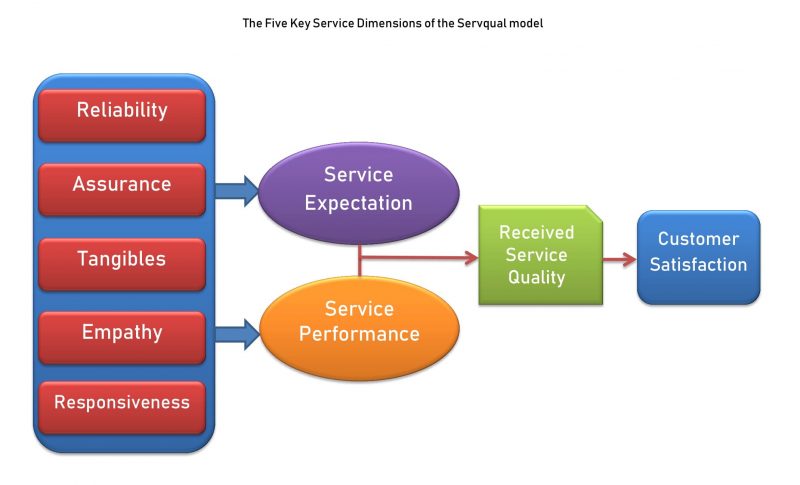
The SERVQUAL model comprises five key dimensions of service quality: Reliability, Assurance, Tangibles, Empathy, and Responsiveness. The Servqual model, also known as the Service Quality Model, comprises five dimensions of service quality. SERVQUAL is the short form of service quality. The SERVQUAL Model is a multidimensional research framework designed to measure the gap between customers’ expectations and perceptions of service quality across five dimensions.
Therefore, the five-dimensional service quality model was introduced in 1988 by A. Parasuraman, Valarie A. Zeithaml, and Leonard L. Berry (Parasuraman, Zeithaml, & Berry, 1988). Researchers and practitioners employ the latest version of the SERVQUAL model.
SERVQUAL Model
The SERVQUAL model comprises five dimensions of service quality that measure customer expectations. The SERVQUAL model classifies the elements of service quality into five dimensions. Although the model developers initially proposed 10 service quality dimensions, many experts later narrowed this to 5: Reliability, Assurance, Tangibles, Empathy, and Responsiveness (Parasuraman, Zeithaml, & Berry, 1985). In 1988, Parasuraman, Zeithaml, and Berry extended the previous model and articulated the five dimensions of service quality, forming the acronym RATER from the first letters of each dimension (Parasuraman, Zeithaml, & Berry, 1988). However, after measuring the gaps, this model recommends the most common causes of service quality problems.
In 2026, the SERVQUAL model is widely accepted for measuring and ensuring customer satisfaction. Many organizations use this model to assess their efforts and outcomes with respect to competitiveness.
Servqual Model 10 Dimensions
However, initially, the authors of the SERVQUAL model presented ten dimensions of service quality as follows: Reliability, Responsiveness, Competence, Access, Courtesy, Communication, Credibility, Security, Knowing the Customer, and Tangibles (Parasuraman, Zeithaml, & Berry, 1985).
Figure 1: 5 Dimensions of Service Quality- SERVQUAL Model
Dimensions of Service Quality
The 5 Dimensions of Service Quality are
Reliability
Assurance
Tangibles
Empathy
Responsiveness.
1. Reliability in the Servqual Model
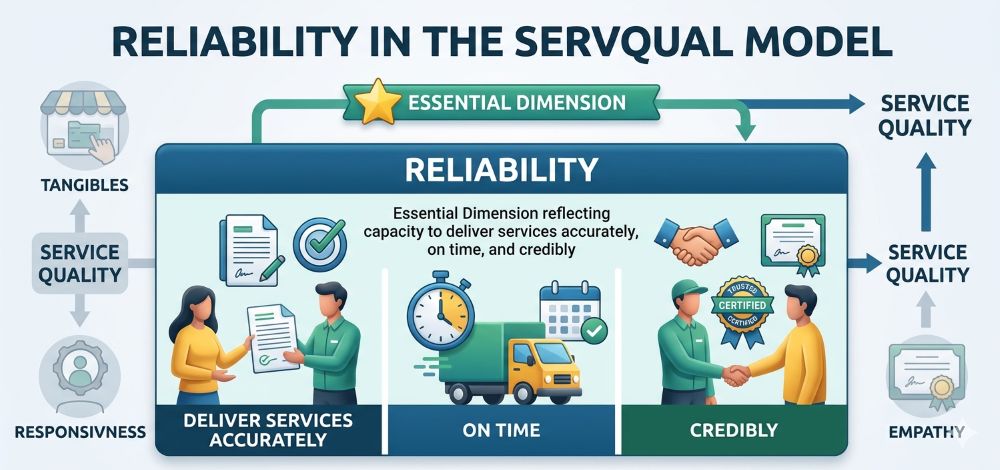
Reliability is an essential dimension of the Servqual model, reflecting the capacity to deliver services accurately, on time, and credibly. It means a service provider’s ability to deliver services consistently and accurately, meeting customers’ expectations every time. Consistency is critical for providing assistance or products to customers on time and without errors. You must honor your commitment to provide your service on time and accurately, as you promised.
For example, Hotel Global Assistant prides itself on reliable and consistent service to its guests. One aspect of reliability is the hotel’s commitment to ensuring that rooms are ready for check-in at the designated time, without any delays or errors.
Guests arriving at Hotel Global Assistant expect to check into their rooms promptly, in accordance with their reservation. The hotel’s front desk staff ensures that rooms are prepared well in advance, following a standardized process for cleaning, maintenance, and inspection.
Upon arrival, guests are warmly greeted by the front desk staff, who efficiently handle check-in. The staff verifies guests’ reservations, assigns rooms based on their preferences, and promptly provides them with keys.
Throughout their stay, guests receive consistent, reliable service from the hotel staff. Housekeeping maintains the cleanliness and orderliness of the rooms, ensuring that amenities are replenished and any issues are promptly addressed. The hotel’s facilities, such as restaurants, fitness centers, and business centers, operate smoothly and reliably, meeting guests’ needs and expectations.
2. Assurance in the Servqual Model
Assurance means building trust and credibility with customers. It depends on the employee’s technical knowledge, practical communication skills, courtesy, credibility, competency, and professionalism. Therefore, these skills will help the organization gain customer trust and credibility.
The assurance dimension combines four factors: Competence, Courtesy, Credibility, and Security. Firstly, competence means having the requisite skills and knowledge. Secondly, courtesy refers to the politeness, respect, consideration, and friendliness of contact staff. Thirdly, credibility is the staff’s trustworthiness, believability, and honesty. Finally, security means freedom from danger, risk, or doubt.
Example of Assurance Dimension in SERVQUAL Model
The employee demonstrates competence, courtesy, credibility, and professionalism when serving customers.
Assurance Example in Retail Banking Services
In retail banking, the Assurance dimension of the SERVQUAL model plays a crucial role in building customer trust and confidence. Let’s consider a scenario where a customer visits a bank branch to inquire about opening a new savings account:
Competence
The customer approaches a bank representative and expresses interest in opening a savings account. The representative demonstrates competence by thoroughly explaining the available account types, their features, and the associated benefits. They are knowledgeable about the bank’s products and services and provide accurate information to help customers make informed decisions.
Courtesy
The bank representative maintains a courteous and respectful demeanor throughout the interaction. They greet the customer warmly, listen attentively to their needs and preferences, and address any questions or concerns with patience and empathy. The customer feels valued and respected, contributing to a positive service experience.
Credibility
The bank has established a reputation for reliability and integrity in the community. The representative reinforces this credibility by providing transparent information about account fees, interest rates, and terms and conditions. They assure the customer that the bank is committed to upholding ethical standards and safeguarding their financial interests, thereby earning their trust and confidence.
Security
As the customer considers opening a new account, they express concerns about the security of their funds and personal information. The bank representative assures the customer that the bank employs robust security measures to protect against fraud, identity theft, and unauthorized access to accounts. They explain the various security features, such as encryption protocols, multi-factor authentication, and fraud-monitoring systems, to reassure the customer about the bank’s commitment to safeguarding their assets and privacy.
In this example, the Assurance dimension of the SERVQUAL model is exemplified through the bank’s focus on competence, courtesy, credibility, and security in delivering retail banking services
3. Tangibles in the Servqual Model
Tangibles comprise physical facilities, employees’ appearance, equipment, machinery, communication materials, and information systems. It focuses on facilitating materials and physical facilities.
This dimension assesses the extent to which these tangible elements convey professionalism, competence, and attention to detail, influencing customers’ perceptions of service quality. For example, the organization maintains a clean environment, and staff follow the appropriate dress code.
The example of Tangibles in the SERVQUAL model
1. Physical Facilities: Physical facilities refer to the organization’s environment where the service is delivered. It includes the company’s infrastructure, such as buildings, furniture, decorations, location, and amenities. For example, a meeting room, a reception area, an office location, and a well-decorated space enhance the tangible aspects of the service.
2. Equipment and Tools: Tangibles also encompass the use of equipment and tools by the organization to deliver the service. It includes computers, PoS (Point of Sale) machines, ICT, and other resources necessary for ensuring better service. For instance, in a Bank, Electronic Payment Systems, cash Deposit Machines (CDMs), Fraud Detection, High-Speed Wi-Fi, and an ATM adjacent to the bank are tangible factors that impact customer perceptions.
3. Personnel Appearance: The personal appearance of tangibles in the SERVQUAL model indicates employees’ education, attire, hygiene, status, moral character, social position, and trustworthiness. It promotes corporate branding by enhancing tangible assets. For instance, a well-dressed waiter, the cleanliness of the attire, and the receptionist’s behavior influence customers’ perceptions of service quality.
4. Communication Materials: Communication materials are a crucial element of tangibles in the SERVQUAL model. It includes communication channels such as social media platforms, banners, brochures, websites, and other promotional materials. For example, a travel agency’s website should be user-friendly, accessible, and concise, with information on ticket and hotel costs, as well as travel guidelines.
Accessibility and Convenience: Tangibles also include factors such as ease of access and convenience for clients. The factors are parking facilities, separate male and female washrooms, accessible features, and free Wi-Fi for guests. For example, a bank that offers ample parking, separate toilets for women, and wheelchair ramps enhances the tangible aspects of the customer experience.
4. Empathy in the Servqual Model
Empathy is the service provider’s ability to understand and address customers’ needs and concerns in a caring, personalized manner. It means focusing on customers attentively to ensure caring, distinguished service. It is also an effective way to satisfy customers psychologically and increase confidence, trust, and loyalty. The company may lose customers due to a lack of empathy among employees; therefore, it needs to ensure that employees demonstrate compassion.
Additionally, empathy is a combination of the following factors:
Access (physical and social) (e.g., approachability and ease of contact).
Communication – (For instance, keeping customers informed in a language they understand and listening to them).
Understanding the customer (e.g., by identifying their specific needs).
Example of Empathy in SERVQUAL Model
For example, a customer contacts a telecommunications company’s customer service department to report an issue with their internet connection. The customer reports that they are working from home and urgently require a reliable internet connection to complete an important project. The customer service representative, demonstrating empathy, responds with understanding and concern for the customer’s situation.
Instead of simply acknowledging the issue and providing generic troubleshooting steps, the representative actively listens to the customer’s concerns and expresses empathy for the inconvenience caused by the internet outage. They reassure the customer that they understand the importance of reliable internet access, particularly for remote work, and that resolving the issue is a top priority.
The representative goes a step further by offering personalized assistance tailored to the customer’s needs. They provide detailed guidance on troubleshooting steps specific to the customer’s internet setup and offer to escalate the issue to technical support for further investigation. Additionally, they proactively follow up with the customer to ensure the problem is fully resolved and offer compensation for any inconvenience caused.
Through their empathetic response, the customer service representative demonstrates a genuine understanding of the customer’s situation, instilling trust and confidence in the company’s commitment to customer satisfaction.
5. Responsiveness in the Servqual Model
Responsiveness refers to the eagerness to assist customers courteously and to provide prompt service to meet their needs. This dimension focuses on two essential factors: willingness and promptness. You must ensure that the customer receives their service promptly and perceives that you are highly interested in helping them. Responsiveness will be defined by the time customers wait for an answer or solution. In short, responsiveness solves the customer’s problem as soon as possible by providing the expected information or replacing the product. To ensure responsive service quality, the employee does not leave any customer waiting and replaces the product promptly before the promised period ends.
Example of the Responsiveness Dimension
For example, a customer visits a busy restaurant during peak hours and places an order. Despite the high volume of orders, the restaurant staff remained responsive, promptly acknowledging the customer’s order and providing an estimated wait time.
As the customer waits for their meal, they notice that their drink is running low. Before they even have a chance to flag down a server, a member of the restaurant staff proactively approaches their table to refill their drink and inquire if there’s anything else they need.
Later, when the customer’s meal arrives after the expected time, the restaurant manager personally visits their table to apologize for the delay and assure them that their order is being expedited. The manager offers a complimentary appetizer as a gesture of goodwill for the inconvenience caused by the delay.
In this example, the restaurant staff demonstrates responsiveness by promptly addressing the customers’ needs and concerns throughout their dining experience.
SERVQUAL Survey Questionnaire
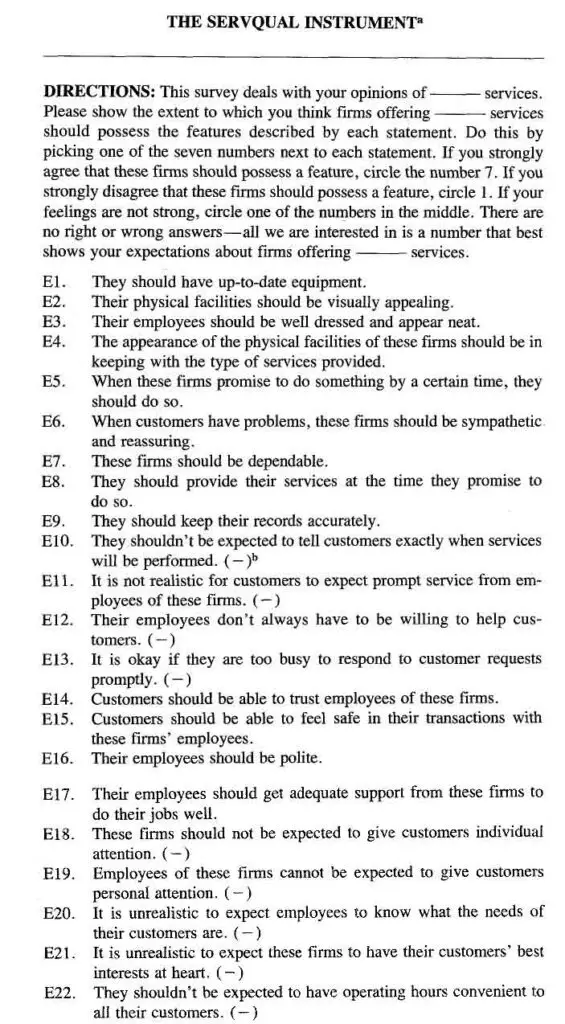
The Servqual survey refers to the instruments of the Servqual model. The instrument consists of 22 perception items. The researchers utilize these instruments to evaluate consumers’ thoughts and expectations regarding the quality of service. Therefore, it is also known as a SERVQUAL questionnaire for customer satisfaction. The authors of the SERVQUAL model developed 22 perception items and 22 expectation items to form five dimensions of service quality. The Servqual model questionnaire assesses the company’s gap score, which ideally yields a positive result.
SERVQUAL Model Original Questionnaire Instruments
The original questionnaire instruments were adapted from the paper “A Conceptual Model of Service Quality and Its Implications for Future Research,” published in the Journal of Marketing in 1985.
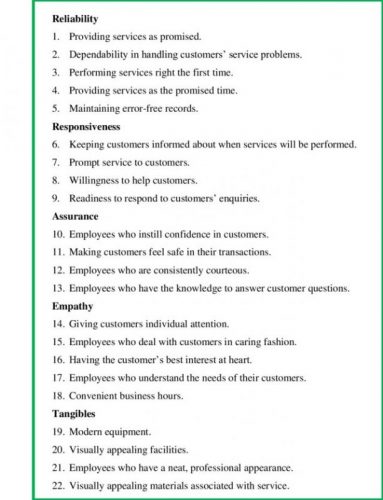
Servqual Questionnaire Example With 22 Items
Reliability
Providing services as promised.
Dependability in handling customers’ service problems.
Performing services right the first time.
Providing services as promised on time.
Maintaining error-free records.
Responsiveness
Keeping customers informed about when services will be performed.
Prompt service to customers.
Willingness to help customers.
Readiness to respond to customers’ inquiries
Assurance
Employees who instill confidence in customers.
Making customers feel safe in their transactions.
Consistently courteous employees.
Employees who know how to answer customer questions.
Empathy
Giving customers individual attention.
Employees who deal with customers in a caring fashion.
Having the customer’s best interest at heart.
Employees who understand the needs of their customers.
Convenient business hours.
Tangibles
Modern equipment.
Visually appealing facilities.
Employees who have a neat, professional appearance.
Visually appealing materials associated with service.
SERVQUAL Model Questionnaire Image
Figure 2: SERVQUAL Model Questionnaire- 22 Scales Items
SERVQUAL Questionnaire Example For Customer Satisfaction
Reliability Dimension
1. Gloant-Automobile fixes faults in cars as promised.
2. They are reliable in handling faults in cars.
3. They repair cars right the first time.
4. Their employees fix car faults on time.
5. The charges for services are reasonable.
Assurance Dimension
6. The apprentices of Gloant-Automobile create confidence in customers.
7. They display professionalism in handling faults in cars.
8. Their employees are always polite.
9. They have the knowledge to answer customers’ questions.
Tangibles Dimension
10. Gloant-Automobile makes use of modern equipment in repairing cars
11. They have enough parking space for their customers.
12. They provide an environment free from danger.
13. Their employees appear professional in their workplace.
Empathy Dimension
14. The apprentices of Gloant-Automobile give customers individual attention.
15. They deal with customers in a caring manner.
16. Their employees quickly apologize when they make mistakes.
17. Their employees try to understand customers’ needs.
18. Gloant-Automobile operating hours are convenient for customers.
Responsiveness Dimension
19. This company always informs customers when services will be performed.
20. They always serve customers promptly.
21. Gloant-Automobile is always willing to rectify car faults.
22. They are always ready to respond to customers.
References (APA-7th Edition): Scholarly Sources
Parasuraman, A., Zeithaml, V. A., & Berry, L. L. (1985). A conceptual model of service quality and its implications for future research. Journal of Marketing, 49(4), 41–50
Parasuraman, A., Zeithaml, V. A., & Berry, L. L. (1988). SERVQUAL: A multiple-item scale for measuring consumer perceptions of service quality. Journal of Retailing, 64(1), 12–40.
FAQ (Frequently Asked Questions): Dimensions of Service Quality in the Servqual Model
Who introduced the Servqual model?
Parasuraman, Zeithaml, and Berry introduced the SERVQUAL model in 1985 with 10 dimensions of service quality.
What are the five dimensions of service quality in the Servqual model?
The 5 key dimensions of Service Quality are Reliability, Assurance, Tangibles, Empathy, and Responsiveness
What are the 10 dimensions of service quality in the Servqual model?
The ten dimensions of service quality are Reliability, Responsiveness, Competence, Access, Courtesy, Communication, Credibility, Security, Knowing the Customer, and Tangibles.
What is the best model for improving customer service quality?
The SERVQUAL model has become widely accepted and popular worldwide for its ability to improve customer service quality. It is a multidimensional research system that represents a customer satisfaction framework to better serve customers. Many organizations, such as Global Assistant Education Consultant, use this model to achieve goals.
M M Kobiruzzaman is a researcher, academic content writer, traveler, and the founding editor of Newsmoor.com. Specializing in communication, management, technology adoption models, and frameworks analysis, and journalism, his work bridges the gap between theory explanation and cultural communication. With a strong background in communication and management, he is dedicated to providing authoritative guides that elevate business and media literacy and academic writing standards.