Travelogue Feature Article Examples & Sample For Students- Tour To Japan. Short and Long Travelogue Feature Article Writing Examples For Students.
Travelogue Article
A travelogue article is a feature story that explains a traveler’s tour itinerary. It is also known as a travel feature story in journalism. Journalists write travelogue articles to inform others about tourist spots. A travel feature article is always designed to ensure a hassle-free journey to a particular location, like a travel itinerary.
The most common feature articles are profiles, how-to articles, reviews, and travelogue articles. Travelogue article is a crucial feature in journalism for recreation and entertainment. The writer follows the inverted pyramid of writing style to attract readers. Readers always read the headlines and story leads to decide whether to read the whole article or leave it. Therefore, the headlines and feature leads include how, where, and what to explore.
People travel for various reasons: recreation, business, job purposes, multicultural immigration, curiosity, and adventure.
Elements of a Travelogue Article
The Ten Elements to write a travelogue article are:
1. Visit and explore the place
2. Write a descriptive story
3. Explain how to travel to the destination
4. Discuss the hotel, motel, and accommodation
5. Review the cultural and traditional background
6. Explain the historical and tourist attractions
7. Discuss the food and the restaurant
8. Notify the weather and atmosphere
9. Report the shopping mall
10. Mention the Dos and Don’ts fact.
Travelogue Feature Article Example for Students
The two examples of travelogue feature articles have been illustrated for students. The first example represents a long history, and the second example illustrates a five-day short travelogue article. These travelogue examples are suitable for those students who want to write a travelogue article.
The title of the long travelogue article is “Tour To Tokyo, Japan: The Place of Peace.” A journalism student at the University of Putra Malaysia wrote this article. Students may follow the structure of this article to learn how to write a long travelogue.
The author presents an ideal example of a travel feature article for students that includes most components of a travelogue article.
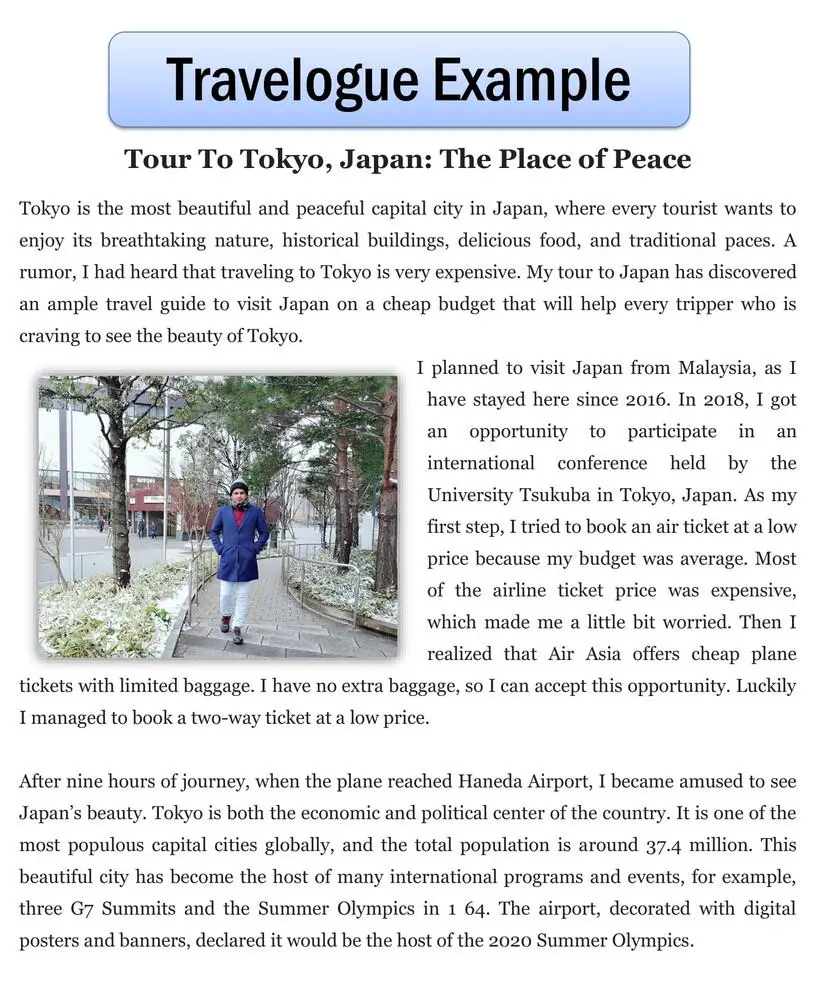
A Long Travelogue Feature Article Example -1
Tour To Tokyo, Japan: The Place of Peace
Tokyo is Japan’s most beautiful and peaceful capital city, where every tourist wants to enjoy its breathtaking nature, historical buildings, delicious food, and traditional places. A rumor I had heard was that traveling to Tokyo is very expensive. My tour of Japan provides a comprehensive budget travel guide to help every traveler enjoy Tokyo’s beauty.
I planned to visit Japan from Malaysia, as I have stayed here since 2016. In 2018, I participated in an international conference at the University of Tsukuba in Tokyo, Japan. As my first step, I tried to book a low-cost air ticket because my budget was average. Most airline ticket prices were expensive, which worried me a little bit. Then I realized that AirAsia offers cheap plane tickets with a limited baggage allowance. I have no extra baggage, so I can accept this opportunity. Luckily, I managed to book a two-way ticket at a low price.
After a nine-hour journey, when the plane reached Haneda Airport, I was amazed by Japan’s beauty.
Tokyo is both the economic and political center of the country. It is one of the most populous capital cities globally, with around 37.4 million. This beautiful city has hosted many international programs and events, including three G7 Summits and the Summer Olympics. The airport, decorated with digital posters and banners, announced it would host the 2020 Summer Olympics.
Japanese people are very kind, humble, helpful, and polite. I noticed it during the conversation and asked them for help.
Per my pre-plan, I decided to stay with my friend instead of at a hotel. He lives in the Akabane area, which is around 30 kilometers from the Haneda International Airport. So, I was looking for a station to get the train to Akabane. I asked a Japanese police officer to help me find the train station.
I was amused by his hospitality; he had taken me to the exact location where I could catch the train. He also paid money for my ticket because he did not have Japanese currency. The tickets cost ¥1400, and the journey takes 5 minutes. Finally, he bowed to exchange greetings before saying goodbye to me. It is a tradition in Japan to bow while exchanging greetings.
I caught the last train from Haneda Airport Terminal 3 Train Station, and after 55 minutes, I arrived at Akabane station at 11:45 AM. My friend was waiting for me outside the station, wearing an anti-cold jacket, which amused me. I felt freezing whenever I came out of the station because this area was not air-conditioned. Instantly, I removed my jacket from my baggage and put it on to protect myself from the bitterly cold weather. I have always been afraid of the cold, but I enjoy the cold weather in Japan.
It was a ten-minute walk from my friend’s house, so we started out and finally reached our destination at 12:30 PM. It was the second time I was astonished that my friend had not locked his house. Out of curiosity, I asked him why he didn’t lock his house when he went outside. He replied that there are few house robbery incidents in Japan, even though you leave your houses unlocked.

The following day, I woke up early to prepare and participate in a conference held by the University of Tsukuba. This is the first time I have fallen in love with Japan’s beauty and experienced its fantastic weather. It was freezing, windy, and snowing. This was my first experience of seeing snowfall. I dreamed of experiencing this kind of atmosphere that I had only seen in the cinema.
My habit is capturing photos; therefore, I grabbed some pictures inside and outside the station. Now I know how to purchase a ticket using the ticket machine that the Japanese police officer taught me last night. I bought my ticket to get to the University of Tsukuba.
I attended the APEC-Tsukuba International Conference XIII, and they offered a buffet lunch for all participants. There was no doubt that this conference paved the way for my future connection with academic life. The university appointed a few guides to ease our movements in new places. The guide took us to a restaurant to have lunch. It was my first opportunity to test Japanese food. I thought I would not feel comfortable eating Japanese food when I saw it on the table. My concept turned upside down when I tried them. These foods were very delicious, and everyone enjoyed them.
Most of the food items were preferable to me, except raw eggs. Japanese restaurants provide raw eggs, and many Japanese and foreigners eat them. I stopped eating in the meantime and had lunch to think about whether the food was halal. I asked the guide for confirmation, and he replied that these foods were perfectly halal. He also said that not all restaurants in Japan are halal, so Muslims should be more aware of the food in Japanese restaurants.
The obesity rate in Japan is higher than in other countries; therefore, they set different prices for the same food for lunch and dinner. Usually, they set dinner prices higher to discourage people from eating heavy meals at night.

Figure 2: Traditional Japanese Restaurant
The gift-giving etiquette is another ritualistic and meaningful custom in Japan. They offer gifts on many occasions; for example, they provide traditional gifts to all conference participants. Nobody can deny the cordial hospitality offered by the University of Tsukuba. Along with me, all the participants from diverse countries became glad and praised them. They are treating us very politely. I became confused several times when I thought about how they attacked Pearl Harbor in 1941 in the United States. It seems Tokyo is the world’s most secure and peaceful capital for hassle-free living.
I decided to rest for the third day because I was exhausted. We spent the whole day together inside the house, gossiping, cooking, and eating. In addition, we planned to roam around Tokyo the next day. I have to return to Malaysia in two days, so I need to plan to see all the best places in Tokyo within two days. We divided Tokyo City into two zones to visit them in two days.
On the fourth day, my friend and I followed the train to visit SKYTREE, the tallest tower in Japan, located in Sumida, Tokyo. It costs only JP¥450 and takes about 30 minutes from Akabane Station to Oshiage Station (SKYTREE), but it requires two platform changes. Since 2011, it has been the tallest structure in Japan, standing at 634.0 meters and making it the second-tallest tower and structure globally, after the Canton Tower and the Burj Khalifa. The primary objective of this tower is broadcasting; for example, it transmits TV and radio signals for the national broadcaster NHK and a few TV channels.
Every day, they allow only 10,000 tourists to visit the sky tree. The ticket option is divided into three types: combo ticket, Tembo gallery, and Tembo deck. The ticket is around JP¥1000 for all three tiers. Tourists can visit only one or two decks, or all three. My excitement was palpable when I was lifted to the top floor of the Sky Tree. We had seen all three tiers—the tower’s appearance changes with changes in the light’s color.
My tour to Japan was successful when I saw Tokyo from the Tembo Deck and the tower’s top floor. Viewing the entire city from the top floor at night was excellent. After all, I did not forget to buy some souvenirs from the observation decks of Tokyo Skytree; they made my journey more compelling.

Figure 3: The Main Entrance of the Tokyo Skytree
Good time flies by so fast. It was challenging to realize that I had spent five days here. My return flight was at night, so I could use the whole day for sightseeing. On my fifth and final day in Japan, I visited many historical and traditional places, such as the Imperial Palace, the Sensō-Ji Temple, the National Museum of Nature and Science, and Ueno Park and Zoo. In addition, I tried Japanese street food; although it’s a little expensive, some items are cheap.
You can buy souvenirs, gifts, and food cheaply in many places. I purchased pens, gift items, and great souvenirs on Nakamachi Street in Asakusa. It’s a great street to visit and walk along your path to see the traditional temple, and along the way, you can buy snacks and conventional gifts. Japanese people are well-organized and always respect senior people across all sectors. Traditionally, seniority was the primary qualification for holding a higher rank.
In short, Tokyo is not an ordinary place that I forget quickly. According to Japanese “architect Tadao Ando “Look at London or Paris: they are filthy. You don’t get that in Tokyo. The proud residents look after their city.” Traveling to Tokyo was a tour and an experience I earned adequately. I can forget my tour, but I cannot forget my experiences. So, if you love traveling, you will love Tokyo!
Travelogue Article Samples of the Newspaper
Malaysian English Newspaper Travel Article Link
The Daily Star Newspaper Travel Article Link Here
This is a travelogue article writing example for Students. This travelogue sample will help students to complete travel article writing assignments and expand their knowledge. We appreciate your comments and suggestions.

M M Kobiruzzaman is a researcher, academic content writer, traveler, and the founding editor of Newsmoor.com. Specializing in communication, management, technology adoption models, and frameworks analysis, and journalism, his work bridges the gap between theory explanation and cultural communication. With a strong background in communication and management, he is dedicated to providing authoritative guides that elevate business and media literacy and academic writing standards.