This article explains the 12 Types of Non-verbal Communication: Physical Appearance, Paralinguistics, Body Movement, Gestures, Posture, Facial Expression, Eye Contact, Proxemics, Haptics, Chronemics, Artifacts, and Environment.
What is Nonverbal Communication?
Nonverbal communication is the transmission of messages through nonverbal elements, such as physical appearance, eye contact, facial expressions, body movements, gestures, and posture (Burgoon, Guerrero & Floyd, 2016). Therefore, it is also known as a non-verbal cue. The four types of communication contexts are verbal, nonverbal, visual, and written.
Nonverbal communication conveys messages without spoken words. On the other hand, verbal communication involves conveying a message through spoken words. The combination of both verbal and nonverbal cues generates effective interaction between the sender and receiver. Effective communication relies on using both verbal and nonverbal communication cues.
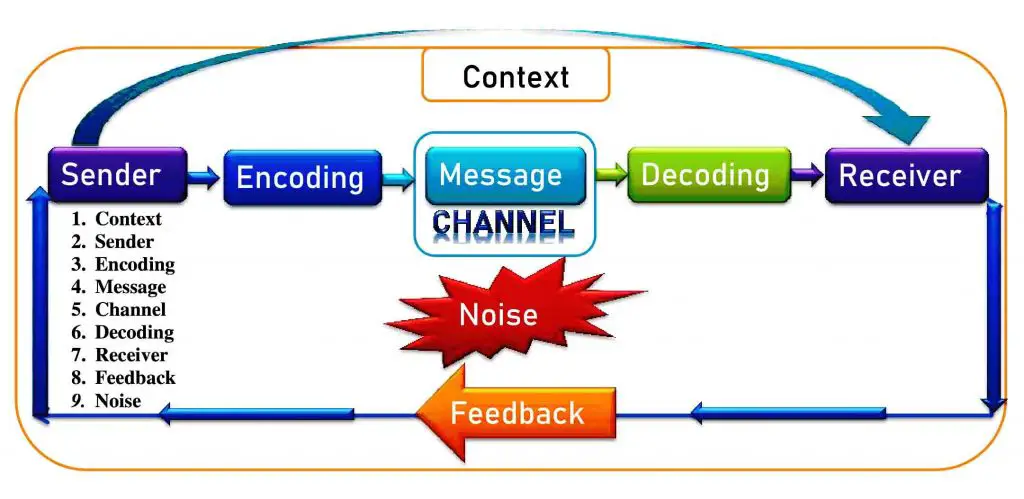
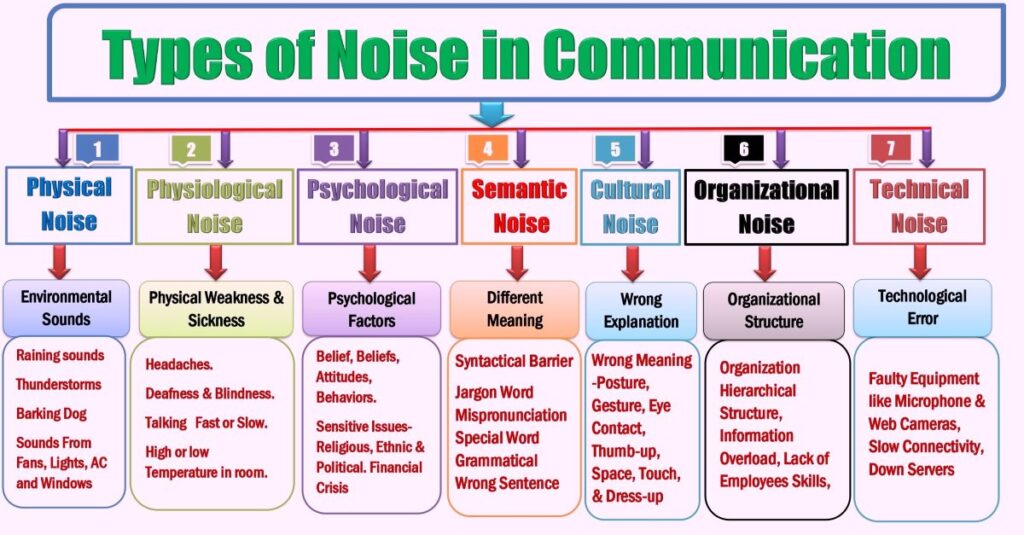
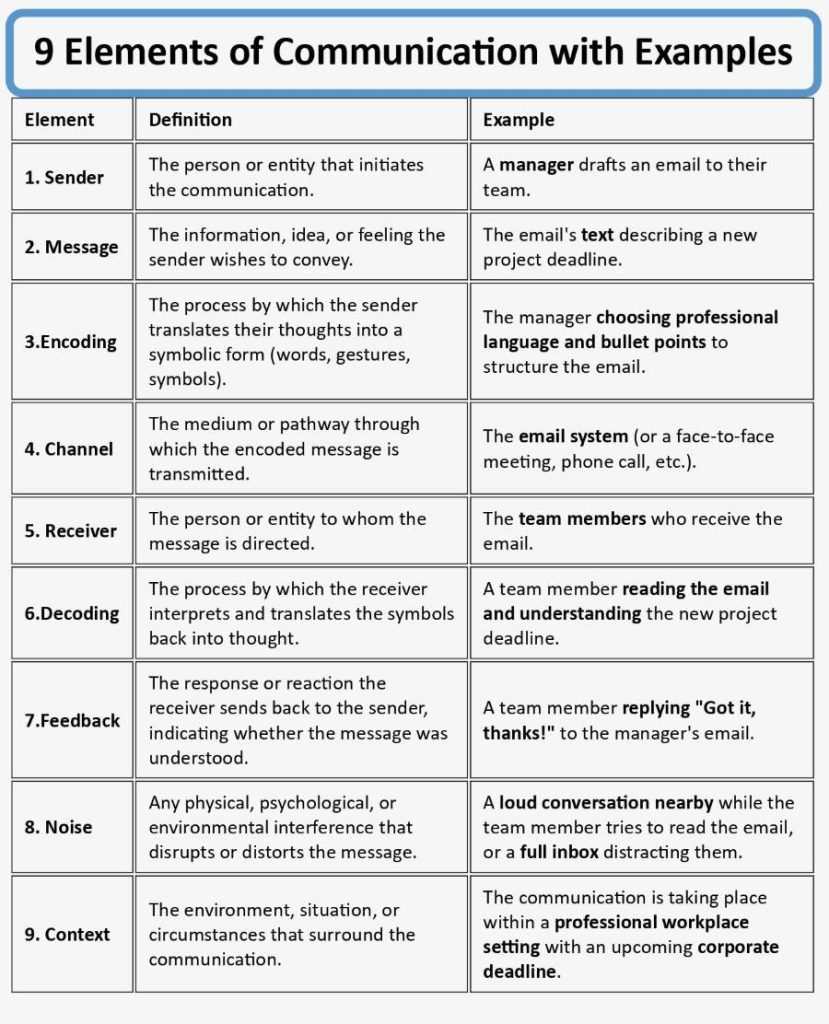
Using verbal and nonverbal cues during interaction can make communication more effective and efficient. There are several types of noise in communication: physical, physiological, psychological, and environmental. The combination of verbal and nonverbal communication reduces communication noise and makes the interaction more effective. The researchers have mentioned nonverbal communication cues as components of the communication process.
Example of Nonverbal Communication
For example, Rose types on a laptop while interacting with her senior Boss. Simultaneously, the Boss asks her when she wants to submit the company’s new business report. Rose raises two fingers, focusing his eyes on the laptop. The Boss leaves the place, saying, All right. Rose intends to complete the business report at 2 PM, and the Boss completely understands the message. Raising two fingers is a nonverbal communication example that conveys the message in this context.
Similarly, the Boss shows a thumbs-up gesture when Rose says she has emailed the report before 2 PM. Here, a thumbs-up conveys the Boss’s good job message to Rose. There are thousands of examples of nonverbal communication: eye contact, gestures, posture, silence, an angry face, an anxious mood, smiles, talking fast, and many more.
Types of Nonverbal Communication
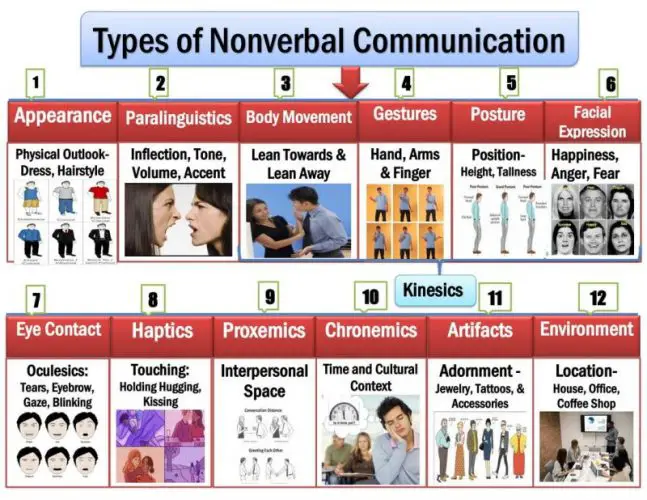
The 12 Types of Nonverbal Communication are:
1. Physical Appearance
2. Paralinguistics (Vocalics)
3. Body Movement
4. Gestures
5. Posture
6. Facial Expression
7. Eye Contact
8. Proxemics (Space)
9. Haptics (Touch)
10. Chronemics (Time)
11. Artifacts
12. Environment (Context)
Many scholars term the types as components and examples of nonverbal communication (Burgoon, Guerrero & Floyd, 2016; Andersen, 2008).
1. Physical Appearance (Personal Appearance)
Physical appearance is a significant form of nonverbal communication that conveys a strong message about who you are and where you study or work. A proverb says, “The first impression is the best impression.” People judge others’ education, attire, hygiene, professionalism, success, moral character, social position, and trustworthiness based on physical appearance.
According to a statistical report, people take less than 10 seconds in the first meeting to form an impression of others. Clothing is a significant element in conveying messages to other group members. Casual attire is more acceptable in informal meetings because it reflects trustworthiness. On the other hand, a professional appearance is well-accepted in business meetings and formal group presentations. However, research shows that good-looking people make more money and get promoted more often than those with average looks.
Physical Appearance Examples
For example, two people are walking on the road wearing different dresses. The first person wears formal attire, and the second person wears a jersey and shorts. Most people can guess a person’s profession from their dress. Usually, employees follow official dress codes, including shoes and hairstyles.
On the other hand, football players wear jerseys, shorts, boots, and socks. The dress conveys a message about their profession without spoken words. So, physical appearance is a significant form of nonverbal communication that conveys a strong message about the communicator.
2. Paralinguistics (Voice)
Paralinguistics refers to the ways we use our voices when speaking, and it is the meta-communicative elements of nonverbal communication that modify the meaning of a message. It is also known as vocalics, paralanguage, or voice in nonverbal communication.
In addition to physical appearance, paralinguistics is another crucial form of nonverbal communication that significantly shapes the meaning of a speaker’s speech. Examples of paralinguistics are inflection, tone, pitch, filler words, indicators, volume, rate, and articulation. People have more than 630 muscles, but use around 72 of them together to deliver a speech. The tongue is the most significant and robust muscle among them. People use this tongue to generate these paralinguistic elements during nonverbal communication.
Paralinguistics Nonverbal Communication Examples

3. Body Movement (Kinesics)
Body movement refers to nonverbal communication through the head, hands, and hand movements, including body angles. The angles between the bodies of two people reveal their relationship. People tend to lean toward the speaker when they are interested in the topic under discussion. On the other hand, people tend to orient away from the speaker when they dislike the discussion topic. The same thing happens when the audience likes or dislikes the speaker personally. People use their bodies mostly in interaction; therefore, it is a crucial type of nonverbal communication.
Body Movement Nonverbal Communication Examples
For example, males tend to lean towards females in confined conditions, and females face away.
Body movement is also part of body language, or Kinesic, nonverbal communication. Kinesics is the study of nonverbal communication, including body movement, facial expressions, gestures, and posture. According to a statistical report, people use 7% words, 38% voice, and 55% body language in communication (Ekman & Friesen, 1969).
Kinesics in Nonverbal Communication
Kinesics is the symbolic meaning of body movements. Ekman and Friesen (1969) developed five types of components of Kinesics, also known as body movements.
1. Emblems
Emblems are body movements that can carry information without using verbal communication. For example, a thumbs-up means OK, waving a hand means goodbye, and the Logo represents something.
2. Illustrator
Illustrators are body movements that transmit a complete message with or without verbal communication. Communicators link illustrators with oral action to make the interaction more effective. For example, a person is showing directions to the Bank and explaining them verbally.
3. Affect Display
Affect displays are body movements that relate to your emotions. For example, a slumping body, a relaxed body, and a confident body.
4. Regulators
Regulators are body movements that emphasize further action. It also determines turn-taking in conversations—for example, controlling communication, such as a nod of the head.
5. Adaptors
Adaptors are body movements to adapt to a situation and the current environment. For example, it reveals nervousness, fixing clothes, nose scratches, stress, and anxiety.
4. Gestures (Sign Language)
Gestures are a form of nonverbal communication that includes waving hands, nodding, and pointing. The gesture makes communication livelier and more effective. The speakers may be perceived as boring, stiff, and unanimated if they do not use gestures while speaking. Head nods and raking fingers through hair are gestures.
Gestures Nonverbal Communication Examples
For example, the Deaf community worldwide develops and uses various sign languages.
5. Posture (Body Position)
Posture is a crucial form of nonverbal communication related to body position. It represents numerous messages through the way people walk, talk, stand, and sit. Posture denotes the body position in nonverbal communication.
Posture Nonverbal Communication Examples
For example, standing erect but not rigid and leaning slightly forward communicates to your audience that you are approachable, receptive, and friendly. Additionally, speaking with your back turned or looking at the floor or ceiling should be avoided; it communicates disinterest to your audience.
6. Facial Expression (Face)
Facial expression in nonverbal communication is the way of conveying a message through the mouth, eyebrows, and facial muscles. Facial expressions demonstrate approval or disapproval of the topic being discussed. It is one of the most common forms of nonverbal communication that influences interaction. It plays a crucial role in regulating interactions and conveying messages. The audience’s facial expressions indicate whether the speech is exciting. The five universal facial expressions are Happiness, Sadness, Anger, Fear, and Surprise.
People have over 30 facial muscles to help them smile or frown; for example, 17 to smile and 43 to frown.
Facial Expression Nonverbal Communication Examples
For example, people open their mouths and extend their eyebrows when surprised.
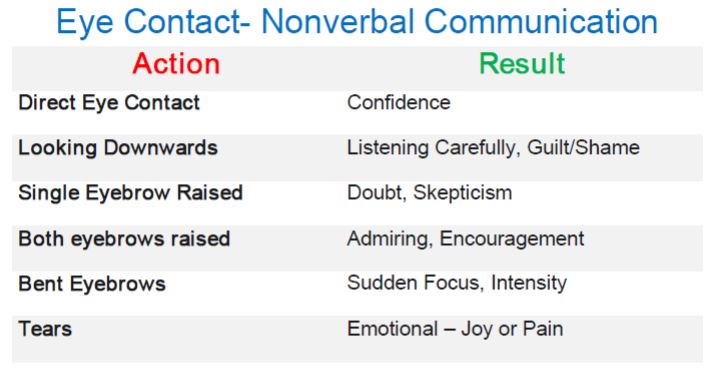
7. Eye Contact (Eyes)
Eye Contact is a significant type of nonverbal communication that regulates and controls communication. It is also known as oculesics, meaning the study of eye behavior. Eye muscles are the busiest muscles in the body. Scientists estimate that the eyes move more than 100,000 times a day (Perea-García, Kano, Sibierska, Fiala, Skrok, Danel, Ratajczak, Zywiczynski & Wacewicz, 2026).
Eye Contact Nonverbal Communication Examples
8. Haptics (Touch)
Haptic communication occurs when people interact through touch. It plays a significant role in the communication process. It refers to the touch that conveys the crucial message. Therefore, haptics is another type of nonverbal communication that conveys information through touch.
Haptics Nonverbal Communication Examples
The most noteworthy examples of haptics are holding hands, hugging, tickling, and kissing.
9. Proxemics (Touch)
Proxemics refers to the interpersonal space during communication that affects the interaction. It is a familiar form of nonverbal communication that conveys seating arrangements. Proxemics is a very significant factor in the workplace. It also plays an influential role in describing your position and attitude.
For example, members of the dominant group position themselves more centrally within the group’s space. However, task- and socially oriented leaders maintain a space ratio, or territoriality, during the exhibit group meeting.
Proxemics Nonverbal Communication Examples
Interpersonal Spaces
In 1969, Hall introduced the Four Types of Interpersonal Spaces: Intimate, Personal, Social, and Public Distance(Hall, 1976).
1. Intimate distance ( 0-18 inches (45.72 cm): For example, close friends, some family members, and lovers maintain close distance; therefore, it is also a private zone.
2. Personal distance (18 in. – 4 ft (1.22 m), an arm’s length away): For example, friends and acquaintances maintain this distance when interacting with each other.
3. Social distance ( 4 – 8 ft (2.44 m): For example, strangers maintain social distance as they do not have intimate relationships.
4. Public distance ( >8 ft (2.44 m): A speaker presents to a larger audience.
10. Chronemics (Elapse)
Chronemics refers to the role of time during nonverbal interaction. It is not spoken speech; instead, it represents the communication gap. Therefore, it is another example of nonverbal communication that indicates how much time to talk and how long to elapse when interacting with others. For example, how many members speak, and how long they wait before responding to other group members.
In 1976, Edward T. Hall introduced the concepts of monochronic and polychronic time to distinguish one culture from another (Hall, 1976). Monochronic describes the representative as punctual and active. On the other hand, polychronic people are considered lazy (Hall, 1976).
Chronemics Nonverbal Communication Examples
For example, in most countries, bosses come to the meeting after the employees. The employees think that they must be present at the meeting before the Boss arrives. The employees are active and join the discussion early. In contrast, the person will be considered lazy if they arrive late to the meeting. Bosses can defer or cancel the appointment.
The lower-status person is willing to wait for the higher-status person. The higher-status person talks more than the lower-status person and dominates communication. Lower-status people are reluctant to interrupt communication.
11. Artifacts (Speaker Belongings)
Nonverbal artifacts in communication include physical objects a person uses, such as clothing and shoe brands, mobile phones, laptops, car brands, tattoos, piercings, and jewelry. It is also known as the communicator’s belongings. However, artifacts assist the audience strongly in forming a perception of the speakers. The audience can identify the speaker’s personality through artifacts.
Artifacts of nonverbal communication examples
For example, a person driving a BMW suggests that the person is wealthy. Similarly, if a person wears high-end clothing and diamond jewelry, these artifacts also indicate that the person is wealthy. Likewise, sportspeople and singers are more likely to have tattoos than ordinary people. Tattoos signal the social groups they are part of. People with expensive jewelry represent their personality and socio-economic conditions.
In 2024, people think rich people use the latest smartphones, such as the iPhone 15, iPhone 15 Pro, Samsung Galaxy S24 Ultra, and Google Pixel 8 Pro. In a business context, smartphones are influential artifacts that help shape perceptions of the people who own them.
12. Environment (Communication Context)
The environment of nonverbal communication refers to the surrounding context. Context in communication refers to the climate of the discussion.
It mentions the discussion’s physical environment. Aneurin Bevan, a British political leader, recognized that the color of the conference room affected the political campaigns. He noticed that party conferences are more successful when held in a brightly colored room rather than a depressing one. The environment conveys a message that motivates others.
Environment Nonverbal Communication Examples
Customers develop negative perceptions of the company and its products. For example, potential clients would not be interested in buying the products if the management set a meeting in a dirty room. In contrast, customers are more interested in purchasing the products when the meeting is held in the office. The environment conveys both positive and negative messages based on the situation.
FAQ (Frequently Asked Questions): Nonverbal Communication
Q1: What are the types of nonverbal communication?
A: The twelve types of nonverbal communication are Physical Appearance, Paralinguistics, Body Movement, Gestures, Posture, Facial Expression, Eye Contact, Proxemics, Haptics, Chronemics, Artifacts, and Environment (Burgoon, Guerrero & Floyd, 2016).
References (APA-7th) & Scholarly Sources
- Andersen, P. A. (2008). Nonverbal Communication: Forms and Functions (2nd ed.). Waveland Press
- Burgoon, J. K., Guerrero, L. K., & Floyd, K. (2016). Nonverbal Communication. Routledge. https://doi.org/10.4324/9781315663425
- Ekman, P., & Friesen, W. V. (1969). The repertoire of nonverbal behavior: Categories, origins, usage, and coding. Semiotica, 1(1), 49–98.
- Hall, E. T. (1976). Beyond culture. Anchor Books.
- Perea-García, J. O., Kano, F., Sibierska, M., Fiala, V., Skrok, M. K., Danel, P. D., Ratajczak, E. K., Zywiczynski, P., & Wacewicz, S. (2026). Gaze in context: Non-human eyes can be more salient under ecologically-relevant conditions. Evolutionary Human Sciences. Advance online publication. https://doi.org/10.1017/ehs.2026.x

M M Kobiruzzaman is a researcher, academic content writer, traveler, and the founding editor of Newsmoor.com. Specializing in communication, management, technology adoption models, and frameworks analysis, and journalism, his work bridges the gap between theory explanation and cultural communication. With a strong background in communication and management, he is dedicated to providing authoritative guides that elevate business and media literacy and academic writing standards.