Principles of Total Quality Management & Eight Principles of TQM

Principles of Total Quality Management & Eight Principles of TQM.

Quality Definition in Business

Quality in business means satisfying the customers by providing excellent products and services. Researchers defined quality in many ways, but the essence of the definition is almost similar. Edward described that “quality is the ability to exceed the customer’s satisfaction by providing service and product.” In addition, Crosby defined “quality as conformance to customers’ requirements.” Moreover, Juran defined quality as being ‘fitness for use. So, quality is the standard or degree of the products or services that can differentiate them from others by measurement.

Total Quality Management (TQM)

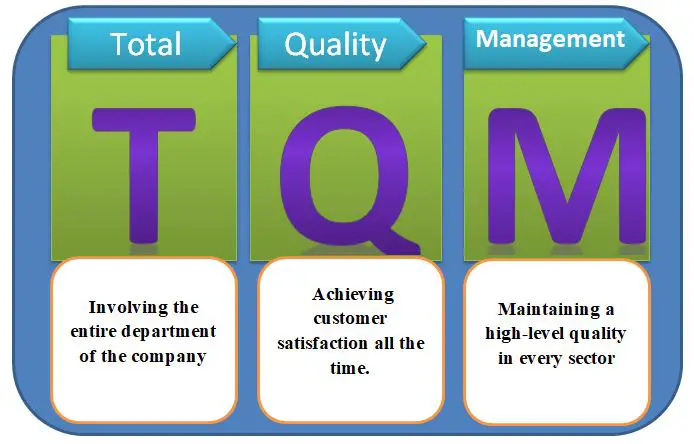
Total Quality Management (TQM) refers to the management process that includes the commitment and dedication of every employee in the organization to maintain a high level of quality in every sector for customer gratification. The employees have to be informed about the strategy before implementing it. In the mid-1980s, total quality management (TQM) was introduced based on the Company-Wide Quality Control (CWQC) and benchmarking process.

Later, many scholars, such as Juran, Deming, and Ishikawa, contributed to the practices and improved the content of Total Quality Management. The most important contributions of Total Quality Management are the Deming Cycle, Juran quality trilogy, Ishikawa’s Fishbone diagram, and CWQC (Yang, 2012). For example, Netflix practices Total Quality Management, and Netflix organization changes confirm that the authority focuses on maintaining the TQM tools.

What are the Principles of Total Quality Management?

Principles of Total Quality Management

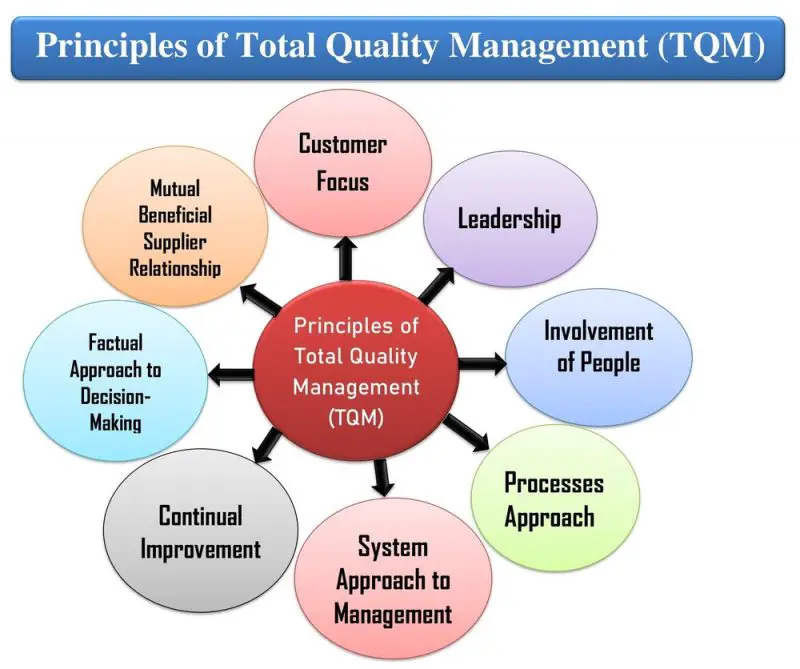
The 8 Principles of TQM are:
  1. Customer Focus
  2. Leadership
  3. Involvement of People
  4. Processes Approach
  5. System Approach
  6. Continual Improvement
  7. Factual Approach to Decision-Making
  8. Mutual Beneficial Supplier Relationship.
Principles of Total Quality Management (TQM)- 8 Principles of TQM

In the mid-1990s, the eight basic principles or elements of total quality management (TQM) were proposed by some well-known philosophers (Evans, 2013). These eight principles of TQM work together to develop processes and yield customer satisfaction. The 8 Pillars of TQM are key components to achieve competitiveness. Many organizations adopt these TQM pillars to gain top positions in the market.

1. Customer Focus

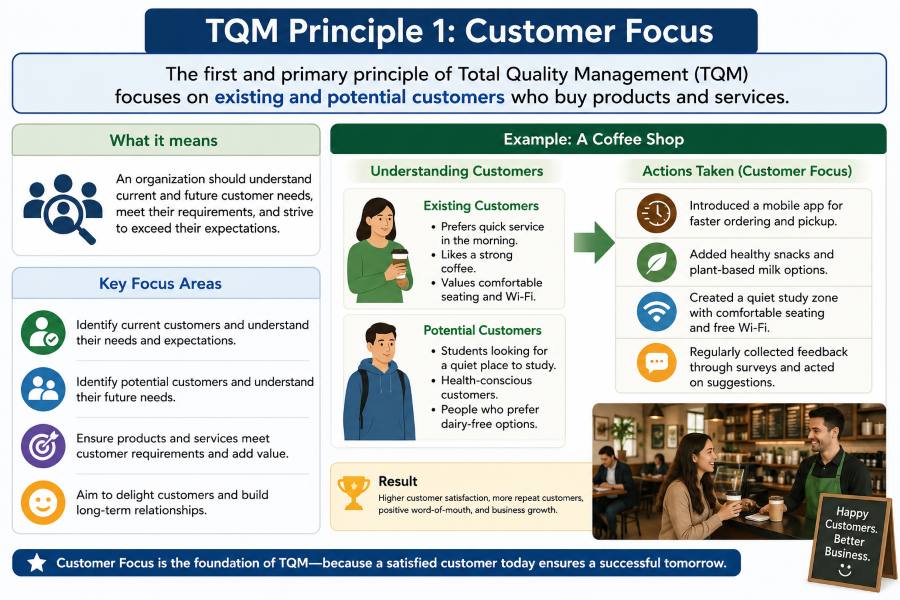
The first and primary principle of total quality management (TQM) focuses on existing and potential customers who buy products and services. Customers are the people who justify the quality of the products and services. So, the company needs to ensure that customers feel they have spent their money on a quality product that will last long enough to meet their needs. You can exceed customer satisfaction only when you know their needs. So, successful companies align their objectives with the client’s needs. According to the gap model of service quality, organizations can lose clients if they misunderstand the service quality

Customer Focus in TQM

2. Leadership

Leadership is the process by which leaders influence others to work effectively toward organizational goals. They enhance relationship engagement in the organization.  Leadership is essential in maintaining unity among employees to achieve interdependent goals (Evans, 2013). Although there are mainly three types of leadership in the industry, the democratic leadership style is the best for performing well. Leaders can create an environment in which employees work effectively within the organization, where all employees work to achieve the organization’s goal. So, leadership seems to be an essential principle of total quality management.

The primary advantages of Leadership are:

The primary motive of the leaders is to motivate the employees to achieve targets and improve job performance.
Leaders inspire, motivate, and create a strategic plan congruent with the business goal.
They develop a precise vision for the organization’s future.

3. Involvement of People or Employees

People’s involvement refers to engaging all employees, from top to bottom, in taking responsibility for products and services and fostering continuous improvement.

People at every level give their all to the organization’s profits. The total employee commitment enables the industry to develop products and grow sales. So, all employees in the organization must be well-trained, committed, and dedicated to achieving an interdependent goal on time.

Additionally, the industry needs to create a responsive environment in which every employee is motivated to complete tasks correctly. The employees’ activeness, motivation, and retention can yield customer satisfaction. Involving people can foster effective teamwork. According to Evans (2013), three types of cooperation are vertical, horizontal, and inter-organizational.

The primary benefits of People Involvement are:

It influences employees who are dedicated to the workplace.

Involving people is an intrinsic motivator that inspires employees to contribute to the organization’s growth. Process theories of motivation explain how people’s involvement and affiliation motivate employees to continue working in the workplace.

It enhances employees’ creativity and innovation in the organization.

4. Processes Approach

The company needs to improve the process consistently to yield sound output. A good result from the process approach can lead to customer satisfaction. The process approach enhances continuous improvement, which is innately connected to the Deming PDCA cycle. Continuous progress can ensure product and service quality. It is an essential principle of Total Quality Management (TQM). Hence, TQM focuses on the process approach to assure product or service quality.

5. System Approach to Management

The System Approach to Management is a vital element of Total Quality Management (TQM) because it provides a holistic view of how to execute the strategy successfully. It includes an open system, subsystems, holism, inputs, outputs, and feedback. The leader focuses on the company’s common goals rather than individual goals. They consider the overall effectiveness and achievement of the organization to be aligned with the company’s vision and mission.

The industry develops an implementation plan and collects data while implementing those processes. The International Organization for Standardization (ISO) describes this principle: “Identifying, understanding, and managing interrelated processes as a system contributes to the organization’s effectiveness and efficiency in achieving its objectives.”

6. Continual Improvement

Continual improvement of the process is an essential step for every industry to satisfy its customers. Therefore, TQM helps the company monitor continuous system improvement to enhance service quality and product quality in the industry. Above all, continual improvement helps the company achieve competitive advantage and is the most critical principle among the eight principles of TQM. It is a cyclical process that continuously identifies and resolves problems to achieve operational success.

Continual Improvement Model

The most common models of continual improvement are: the Deming PDCA Cycle, the Six Sigma, and Kaizen.

Deming PDCA Cycle

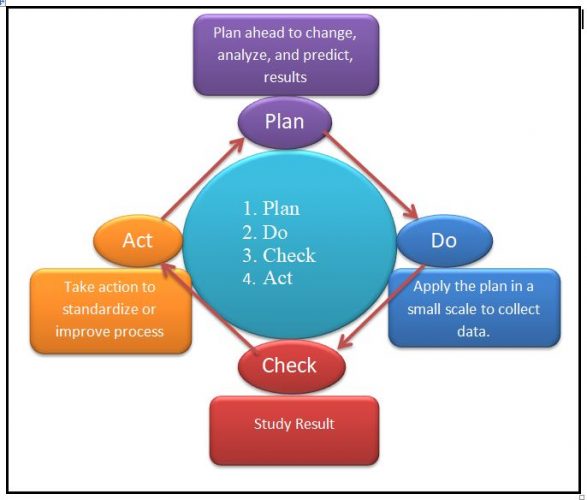
The Deming PDCA model includes four key elements — Plan, Do, Check, and Act — to ensure continuous improvement in an organization. The PDCA cycle highlights research, learning, team empowerment, data collection, data analysis, evidence-based decision-making, implementation, rapid progress, and continuous improvement of products and services within the organization.

Six Sigma

Six Sigma is a methodology used by companies such as General Electric and Motorola to reduce defects and process variation. By applying statistical tools and rigorous analysis, organizations identify the root causes of problems and implement solutions to achieve near-perfect quality levels. Six Sigma emphasizes data-driven decision-making and continuous improvement to drive business success.

Kaizen

Kaizen, meaning “continuous improvement” in Japanese, is a fundamental aspect of TQM. Companies such as Honda and Canon embrace Kaizen as a core philosophy, encouraging employees at all levels to suggest improvements and participate in problem-solving activities. Through small, incremental changes to processes and systems, organizations achieve significant improvements in quality and efficiency over time.

7. Factual Approach to Decision-Making

A factual approach to decision-making is an objective one, rather than relying on assumptions. In this step, leaders focus on data collection and analysis, and making decisions.

It eases making decisions based on the information collected from data. Making a decision based on facts is an effective way to achieve customer satisfaction. This principle uses the actual method to collect and analyze data to make decisions for the company’s progress.

The key benefits of a factual approach are achieving outcomes, improving performance and efficiency, and enhancing confidence.

8. Mutual Beneficial Supplier Relationship

A mutually beneficial supplier relationship is the final principle of total quality management for building rapport with suppliers. It is also called reciprocity or mutual benefits for both the company and stakeholders. Usually, a business is run by multiple departments, and each department is assigned specific tasks, although their functions are interconnected.

At this stage, the organization and supplier share a common goal and depend on each other. The trust and value creation improve between the company and the supplier.

Mutually beneficial supplier relationships improve the quality of the products and services, and  create long-term agreements

Conclusion

The Eight Core Principles of TQM are Customer Focus, Leadership, Involvement of People, Process Approach, System Approach to Management, Continual Improvement, Factual Approach to Decision-Making, and Mutually Beneficial Supplier Relationship. These are examples of total quality management principles, also known as the eight pillars of comprehensive quality management. However, the eight principles of TQM are fundamental elements in driving a business successfully.

Everyone in the company has to be conscious of the plan, method, and strategy for achieving a goal. The risk of failure can increase if the principles of total quality management are not maintained. So, the authority should ensure that every employee is aware of them. It will motivate employees by letting them know they contribute to the industry. Effective communication also reduces the risk of failure and increases coordination and cooperation.

The total quality management process helps all sections work together to achieve an interdependent objective. The company uses visual aids and flowcharts to understand how employees perform perfectly. Executing total quality management (TQM) is not easy; TQM represents a significant cultural shift, so the company needs to implement it slowly and accurately (Evans, 2013).

 Examples of Total Quality Management (TQM) in Practice:
Toyota Production System (TPS)

Toyota’s renowned production system is a prime example of TQM in action. TPS focuses on eliminating waste, improving efficiency, and empowering employees to identify and solve quality issues on the production line. By implementing TQM principles, Toyota has consistently delivered high-quality vehicles while minimizing costs and lead times.

ISO 9000 Quality Management System

Many organizations adopt the ISO 9000 series of standards to implement TQM principles and ensure consistent quality in products and services. By establishing formal quality management systems focused on customer satisfaction, process improvement, and regulatory compliance, companies demonstrate their commitment to delivering high-quality products and services.

These examples demonstrate how TQM principles can be applied across various industries to drive continuous improvement, enhance customer satisfaction, and achieve sustainable business success, all while ensuring the content’s originality and authenticity.
Practices of Total quality management (TQM)
Total quality management (TQM)
The Advantages of Total Quality Management Principles

Although Japan identified the advantages of total quality management (TQM) in the mid-1950s, the benefits of TQM have been recognized worldwide. The most important benefits of the TQM are:

The TQM principles improve the quality of products and services to satisfy customers; they naturally motivate employees and boost their productivity.

Additionally, the principles of TQM reduce production costs and faults and make processes more efficient and reliable.

Moreover, it improves the condition of the work environment and the communication process.

Finally, the core principles of TQM increase profit margins.

Total Quality Management Tools

The researchers introduced many TQM tools that help the industry operate smoothly and profitably. These tools can help the industry in many ways. For example, the fundamental strategies are: identifying quality issues, analyzing data, collecting information, identifying the leading causes of the problems, and assessing the results.

Quality Strategy to Profitability in the Organization

Since the 1980s, researchers have proposed diverse quality management systems to maintain product and service quality within organizations, such as total quality management (TQM), Six Sigma, reengineering, and the skeletal system. The company has implemented the most effective quality improvement strategies worldwide to achieve good results by solving problems and addressing faults.

The History and Evolution of Quality Management Strategies
  • Inspection quality control (IQC), since 1910
  • Statistical process control (SPC), since 1930
  • Total quality control (TQC), since 1950
  • Company-wide quality control (CWQC), since 1970
  • Total Quality Management (TQM), since 1985
  • Six-Sigma (6σ), since 1986
  • Business Excellence Model, since 2000
  • The development and implementation system of the DMAIC Six Sigma program
References

Evans, J. R. (2013). Quality & performance excellence. Cengage Learning.
Yang, C. C. (2012). The integration of TQM and Six Sigma. Total Quality Management and Six Sigma, 219.

Citation for this Article (APA 7th Edition)
Kobiruzzaman, M. M. (2026). Principles of Total Quality Management & 8 Principles of TQM. Newsmoor- Best Online Learning Platform. https://newsmoor.com/total-quality-management-tqm-eight-principles-and-practices-of-tqm/

Deming PDCA Cycle Four Stages, Advantages and Disadvantages

This article explains the Deming PDCA Cycle- Four Stages, Advantages, and Disadvantages. It also describes PDSA Cycle Revolution with Pros and Cons.

Deming PDCA Cycle

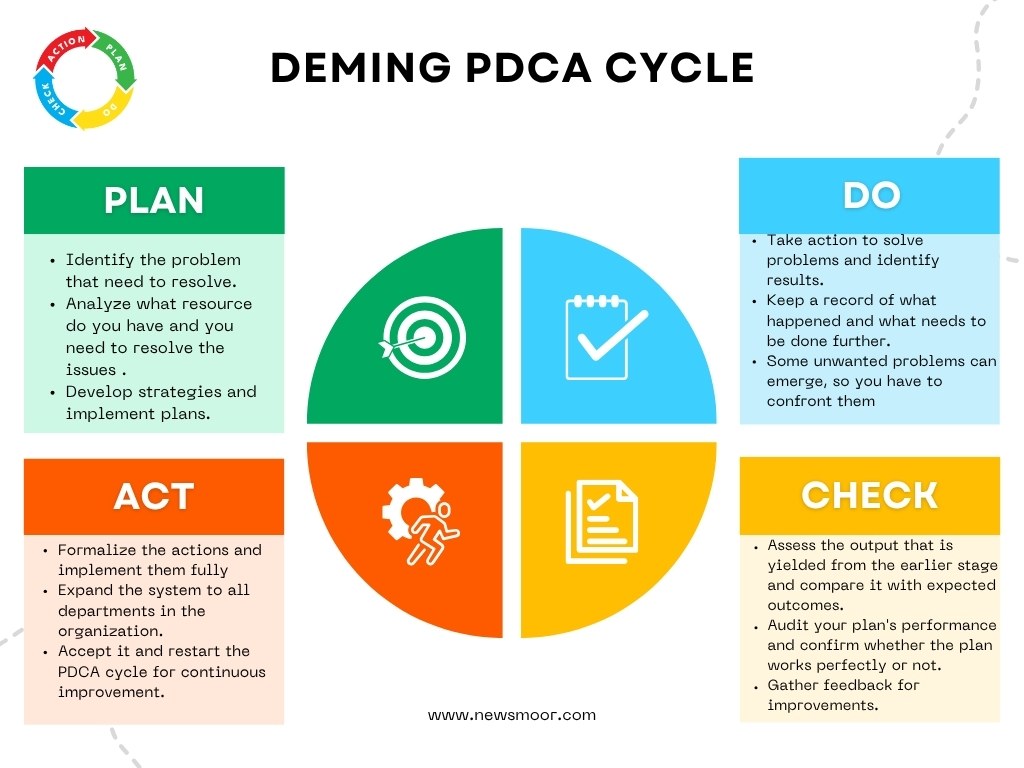
Deming PDCA cycle refers to a repeated four-step management model that ensures the continuous improvement of products and services in the industry. In the 1950s, a famous management scholar, Dr. William Edwards Deming, introduced the PDCA method; therefore, it is also known as the Deming Cycle or Deming Wheel. It is a famous method for solving problems to yield the highest quality results. The full meaning of PDCA is the Plan–Do–Check–Act, a four-step action method.

Apart from PDCA, it has multiple names, such as the PDSA abbreviation of the Plan–Do–Check–Adjust, the Deming cycle or circle, or wheel, the Shewhart cycle, and the control cycle or circle. The Plan-Do-Study-Act (PDSA) cycle is a quality improvement framework commonly used in various industries, including healthcare, manufacturing, and education.

The Four Stages of the Deming Cycle

The Four Stages of the Deming Cycle are Plan, Do, Study or Check, and Act. These are the four core elements or principles of the Deming cycle model. Deming’s principles for pdca cycle include Plan, Do, Study, or Check, and Act. 

Deming PDCA Cycle Four Stages

1. Plan

PLAN is the initial step of the four-step method that identifies the problem and opportunities to suggest recommendations. In addition, it analyzes and describes the overall current situation of the project. The authority recruits a team to understand the full process of the project in this stage; they  identify the problems that need to be changed and find solutions to fix the problems.

In this stage, you have to find out the answers to some basic questions regarding the project. The questions are as follows;

Firstly, you have to identify the main problem that needs to be solved in your organization. The customers demand to resolve this problem be resolved.
Secondly, what kind of resources do you have now that you use regularly?
In addition, what resources do you need to resolve the problem?
Moreover, what is the solution that you have taken with resources?
Finally, how long will it take to analyze the problems and implement the planning?

2. Do

The DO phase is the second stage of the Deming cycle, where the testing of the solution starts to be executed to identify the results. After completing the planning step, you have to take action to solve the problems. You will apply all the plans that you have taken in the first stage. Some unwanted problems can emerge in this stage, so you have to be aware to confront them. To increase your confidence level, you can apply your actions to a small arena in the project. It is a subtle way to control the situation properly as well as avoid an unpredictable big mistake. All team members stay alert at this stage to play their roles and responsibilities.

In this stage, you, with your team members, will take some initiatives mentioned below:

  • Keep a record of what happened and what needs to be done further.
  • When do you apply the planning?
  • Collect data from the planning stage.
  • Try to use a check sheet, swim lane map, and flowchart to capture data.
3. Study or Check

Study or check is probably the most important step of the Deming cycle. You must pay attention to the CHECK stage if you want to scrutinize the output that is yielded from the earlier stage. It will help you to avoid repeating mistakes and clarify the success of your planning and application of steps. This stage will allow you to audit your plan’s performance; you will be confirmed whether the plan works perfectly or not.  Additionally, your team will identify the problematic portions of the project to eliminate them in the future. You would be able to discover the root cause of the problem if something went wrong. In short, this stage will assess the system’s effectiveness and help you decide whether the theory is helpful or not.

Example: Appraisals or  Gap analysis.

In this stage, you have to capable to answer some questions mentioned below.

  • Is the system effective or not to resolving the issues?
  • Do you want to continue this system or need to change it?
  • Have you outlined a list including the unexpected results, failures, successes, and outcomes?
4. Act

ACT is the final stage of the system that finalizes the perfect solution to implement. In this stage, your organization should follow the adapt, adopt, and abandon factors.

Adapt refers to changing and modifying the PDSA circle for the next test.

Adopt indicates considering expanding the system to all departments in the organization.

Abandon means modifying your full approach and repeating the PDCA circle.  In sum, it is the step of standardization that is considered standardized when goals are exceeded.

In this stage, you need to answer the questions below.

  • Do you want to formalize the actions and implement them fully?
  • Do you want to expand the system to all departments in the organization?
  • Do you want to accept it and restart the PDCA cycle for continuous improvement?

Deming PDCA Cycle Pros and Cons

Firstly, PDSA is a simple and effective process for addressing new and recurring problems in the industry. In addition, it is a repeated approach that will allow you to measure results without wasting time. Moreover, it is a risk-free approach to apply a small scale to the project; therefore, there is no need to change the full process if it doesn’t work.

In contrast, the full PDSA process is slow when applied in industry to yield the final result. It is not a straightforward execution process that can be applied to urgent problem-solving issues. Additionally, you need to use some resources, including effective team members, to ensure that each circle step is directed perfectly.

Advantages of the PDSA Cycle

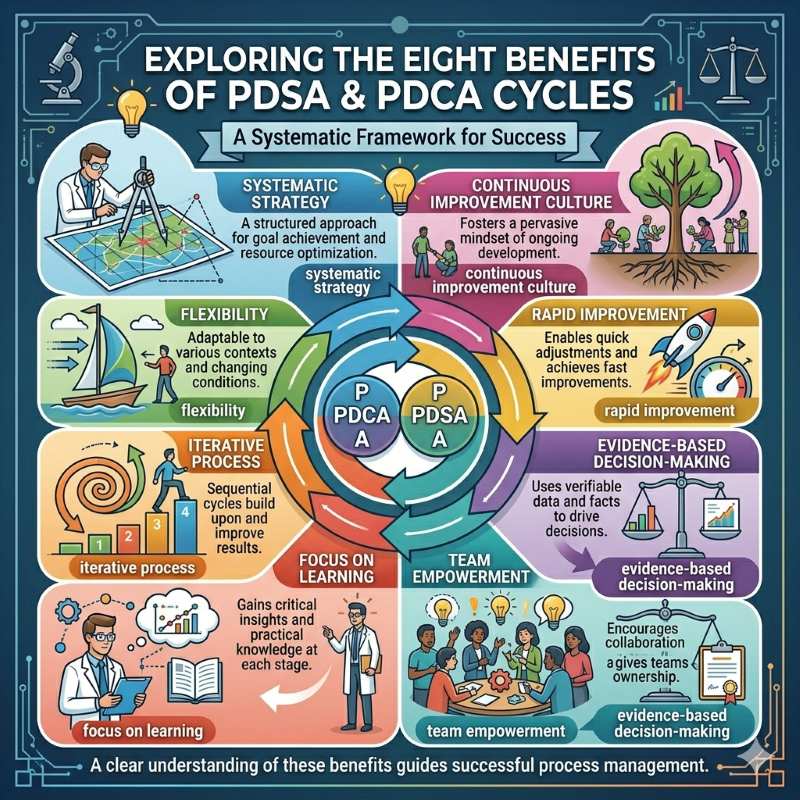
The eight benefits of the PDSA or PDCA cycle are systematic strategy, flexibility, an iterative process, a focus on learning, team empowerment, evidence-based decision-making, rapid improvement, and a continuous improvement culture.

Advantages of the PDSA Cycle

Systematic Strategy

The PDSA framework offers a structured strategy for resolving problems and ensuring continuous improvement. It shows the step-by-step (Plan, Do, Study or Check, Act), process to assess the improvement. We can address the complex issues and refine them in every section methodically. It allows us to follow systematically, one by one.

Flexibility

The PDSA cycle is flexible and adaptable to a wide range of settings and industries. It can be applied to small-scale projects or larger initiatives, making it suitable for organizations of all sizes and types.

Iterative Process

The iterative nature of the PDSA cycle allows organizations to make incremental improvements over time. By continually cycling through the steps of the PDSA cycle, organizations can refine their processes, systems, and practices to achieve greater efficiency and effectiveness.

Focus on Learning

The PDSA cycle emphasizes learning and experimentation as essential components of improvement. By studying the results of each cycle, organizations gain valuable insights into what works and what doesn’t, enabling them to make informed decisions and adjustments.

Empowerment of Teams

The PDSA cycle encourages collaboration and engagement among teams involved in improvement efforts. By involving frontline staff in the planning, execution, and evaluation of improvement initiatives, organizations empower employees to take ownership of the process and contribute their expertise and insights.

Data-Driven Decision-Making

The PDSA cycle relies on data and evidence to drive decision-making. By collecting and analyzing data throughout the improvement process, organizations can identify trends, root causes, and opportunities for improvement, enabling them to make informed decisions and prioritize actions effectively.

Rapid Implementation

The PDSA cycle enables organizations to implement changes quickly and test their impact in a controlled manner. By breaking down improvement initiatives into small, manageable steps, organizations can avoid delays and minimize the risks associated with large-scale changes.

Continuous Improvement Culture

The PDSA cycle fosters a culture of continuous improvement within organizations. By encouraging ongoing reflection, learning, and adaptation, organizations can create an environment where innovation and excellence are valued and rewarded.

Disadvantages of the PDSA Cycle

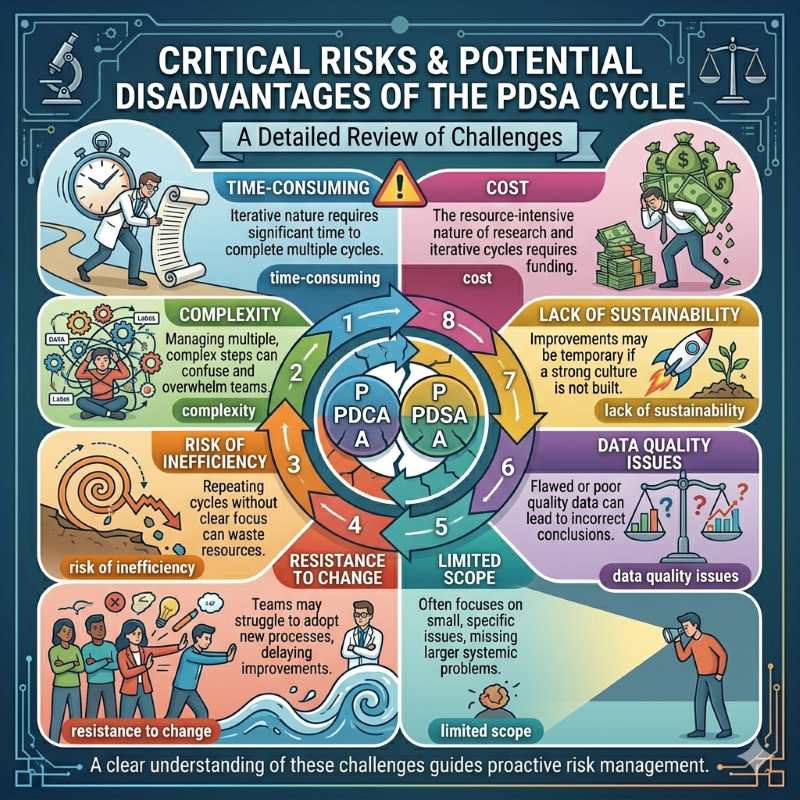
While the PDSA cycle offers numerous benefits for continuous improvement, it also has eight potential weaknesses, including time-consuming, complexity, risk of inefficiency, resistance to change, limited scope, data quality issues, lack of sustainability, and cost.

Weakness of the PDSA Cycle

Time-consuming

Implementing the PDSA cycle requires time and effort to plan, execute, and evaluate improvement initiatives. For organizations with limited resources or competing priorities, the PDSA cycle may add to the workload and strain resources.

Complexity

The PDSA cycle involves multiple steps, including planning, implementation, data collection, and analysis. This complexity can be daunting for individuals or teams unfamiliar with quality improvement methodologies, leading to confusion or errors in implementation.

Risk of Inefficiency

In some cases, organizations may engage in the PDSA cycle without clear goals or objectives, leading to inefficient use of resources. Without proper planning or alignment with strategic priorities, improvement efforts may yield minimal results or fail to address critical issues.

Resistance to Change

Implementing the PDSA cycle often requires changes to existing processes, workflows, or behaviors. Resistance to change from stakeholders, including employees, management, or customers, can impede the effectiveness of improvement initiatives and hinder progress.

Limited Scope

The PDSA cycle is best suited for small-scale, incremental improvements rather than large-scale organizational change. For complex or systemic issues requiring comprehensive restructuring or transformation, alternative methodologies may be more appropriate.

Data Quality Issues

Effective implementation of the PDSA cycle relies on accurate and reliable data for decision-making. However, organizations may encounter challenges with data collection, measurement, or analysis, leading to flawed conclusions or ineffective interventions.

Lack of Sustainability

Improvement initiatives resulting from the PDSA cycle may struggle to sustain long-term gains without ongoing support, monitoring, and reinforcement. Without a culture of continuous improvement or organizational commitment, improvements may regress over time.

Cost

While the PDSA cycle can lead to cost savings through efficiency gains or error reduction, there are also associated costs with implementing quality improvement initiatives. These costs may include training, technology investments, or hiring additional staff to support improvement efforts.

Overall, while the PDSA cycle offers a systematic approach to continuous improvement, organizations must carefully consider its limitations and potential drawbacks to maximize its effectiveness and achieve sustainable results.

The Evolution of the Deming Cycle or PDSA

The Deming cycle has evolved over time to become an effective process. I will discuss how the Deming cycle came to be and how it has evolved over time.

Dr. W. Edwards Deming

Deming was an American management consultant who graduated as an electrical engineer and later concentrated in mathematical physics. He has become a famous person in the Japanese industry for his work and initiatives after WWII. In addition, Dr. W. Edwards Deming got recognition as one of the most influential figures in the Japanese manufacturing industry, who was not Japanese but American. He championed the work of Walter Shewhart, including total quality management, statistical process control, and renamed the Shewhart Cycle. After all, he made a significant contribution to the rise of post-war economic growth in Japan.

The Shewhart Cycle

Deming had been inspired by an American engineer, Walter Andrew Shewhart, who was also a physicist and statistician. In 1939, Shewhart published a book on the Viewpoint of Quality Control. It was the first book that articulated a three-stage systematic process of specification, production, and inspection. These three stages were developed to test the hypothesis of experiments. Finally, he mentioned that these stages should not proceed in a straight line but rather in a cycle. Thus, the Shewhart Cycle took the form of a circle.

The Deming Wheel

In 1950, Deming analyzed Shewhart’s Cycle to modify it. He introduced a new version of Shewhart’s Cycle: a four-step process of design, production, sales, and research. This cycle has been known as the Deming Circle or Deming Wheel.

PDCA

Some Japanese executives probably modified the Deming cycle, or Deming wheel, to Plan-Do-Check-Act (PDCA), although the exact reason for changing the name is unclear. This four-step cycle was introduced to identify the problems in the industry and solve them by applying the four steps together. The primary objective of this cycle is to standardize the assessment of whether the results are satisfactory.

Deming Cycle- Four Stages of Deming Cycle & PDSA Cycle Pros and Cons
Deming PDCA Cycle or PDSA Cycle
PDSA
Deming was not satisfied with the name of PDCA; therefore, he amended it in 1986. He emphasized the core meaning of checking and noted that it does not incorporate the cycle. Hence, the PDSA emerged from Deming’s recommendation.

When to Apply PDSA

The PDSA or PDCA framework can be used to develop any process or product by breaking it down into smaller steps. This cycle can be used in all kinds of organizations across many areas, such as change management, new service or product deployment, product lifecycle, and so on. This framework is beneficial for assisting in the improvement of the Six Sigma and total quality management processes. It is the best option for identifying problems and practical solutions.

Deming Cycle or PDSA Quality Improvement

The Deming cycle is an essential part of the quality improvement process in large-scale industry. Apart from that, organizations apply other quality improvement programs that are much more complex QI processes.

Continuous Quality Improvement

It is also known as the CQI process that organizations apply to reduce waste, increase efficiency, and increase internal and external satisfaction. It is a management philosophy that assesses how the industry operates and develops its processes. These more complex quality improvement programs include the following:

Lean

The lean process is a manufacturing approach that improves efficiency and reduces waste. This program focuses more on improving products and services based on customer demand.

Six Sigma

The Six Sigma process is a set of tools and techniques that improve process quality by eliminating defects and minimizing variability in manufacturing.

Total Quality Management

It is a process of a management system based on practicing a principle that instills a good business culture, where every employee maintains a high standard of work. It influences the organization to maintain a high quality of service in every aspect of the company.

Quality Improvement Collaboratives

It is a process that usually applies to healthcare centers, where many organizations work together to develop services for patients.

Conclusion

The Deming cycle is a four-step (PLAN, DO, STUDY, ACT) process that ensures continuous improvement of products and services in industry. Today, many organizations worldwide use this method to improve their products and services by solving problems.