Demographic Questionnaire For Research PDF. Demographic Questionnaire Examples. Example of Demographic Profile Questionnaire For Students
Demographic Questionnaire
The demographic questionnaire is a collection of demographic questions assigned to separate the respondents into similar subgroups based on socioeconomic data such as age, gender, education, religion, income, and family status. It allows surveyors and researchers to obtain background information from the respondents. A cluster of demographic questions forms a demographic questionnaire. So, the demographic questionnaire includes questions about the respondent’s age, gender, nationality, education, race, religion, experience, economic condition, health condition, technology usage, and family status. It is an effective tool for market surveyors to conduct audience segmentation. Therefore, it is familiar as a demographic example for market segmentation. It is also essential for researchers to collect qualitative and quantitative research information. Researchers utilize these questionnaires to gain data from respondents and informants.
The demographic questionnaire for research means a bundle of questions set by the researchers to obtain socio-demographic information from the respondents and informants. Informants denote participants in the qualitative analysis. In contrast, respondents indicate the participants in the quantitative survey research. Researchers utilize these questionnaires to gain participants’ background information in qualitative and quantitative studies.
The questionnaire is crucial for demographic, geographic, and psychographic market research. This article presents the demographic questions that assist in collecting data.
The students and researchers add a questionnaire introduction before the demographic information to explain the study. The questionnaire introduction sample is as follows:
Dear Respondents,
My name is Kobi, and I am currently studying for a Doctor of Philosophy in the School of Business and Economics at the University of Putra Malaysia. I am conducting the research entitled “Title of the Research.” This questionnaire includes 20 questions that might not take more than 10 minutes. However, all the information you provide in this questionnaire is intended to complete the study only. So, your info on this questionnaire will be preserved strictly confidential and used only for survey purposes. Thank you.
Demographic Questionnaire Example For Research
The 33 Demographic Questions For Survey
The following example of the demographic questionnaire for research includes 28 questions about the respondents.
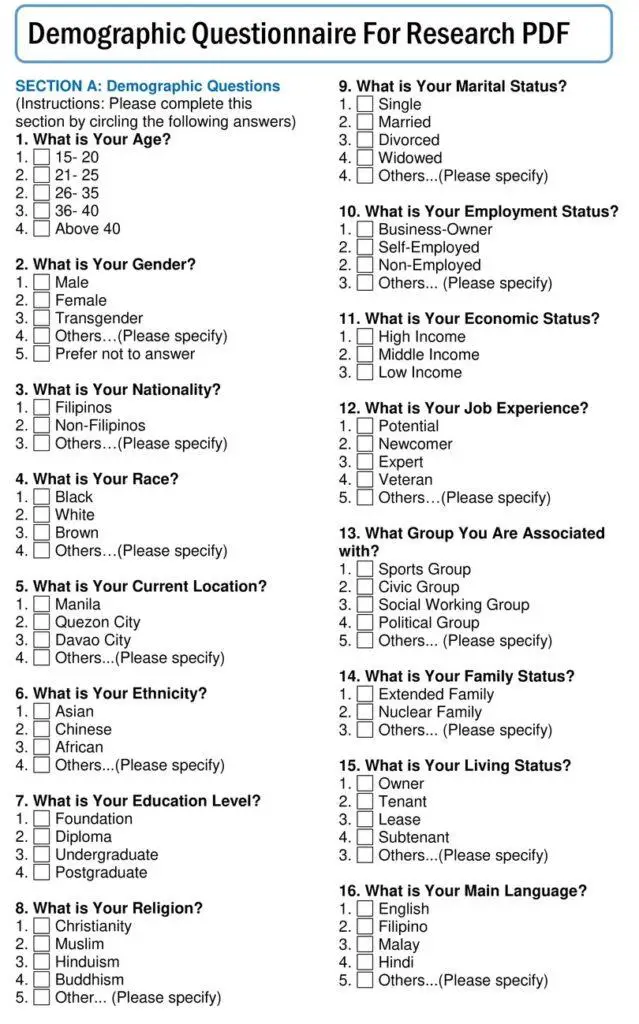
SECTION A: Demographic Questions
(Instructions: Please complete this section by circling the following answers) 1. What is Your Age?
1. 15-20
2. 25-30
3. 30-35
4. Above 35
2. What is Your Gender?
1. Male
2. Female
3. Transgender
4. Others…(Please specify)
5. Prefer not to answer
3. What is Your Nationality?
1. Filipinos
2. Non-Filipinos
3. Others…(Please specify)
4. What is Your Race?
1. Black
2. White
3. Brown
4. Others
5. What is Your Current Location?
1. Manila
2. Quezon City
3. Davao City
4. Others…(Please specify)
6. What is Your Ethnicity?
1. Asian
2. Chinese
3. African
4. Others…(Please specify)
7. What is Your Education Level?
1. Foundation
2. Diploma
3. Undergraduate
4. Postgraduate
8. What is Your Religion?
1. Christianity
2. Muslim
3. Hinduism
4. Buddhism
5. Other… (Please specify)
9. What is Your Marital Status?
1. Single
2. Married
3. Divorced
4. Widowed
4. Others…(Please specify)
10. What is Your Employment Status?
1. Business-Owner
2. Self-Employed
2. Non-Employed
3. Others… (Please specify)
11. What is Your Economic Status?
1. High Income
2. Middle Income
3. Low Income
12. What is Your Job Experience?
1. New
2. Expert
4. Veteran
5. Others…(Please specify)
13. What Group Are You Associated With?
1. Sports Group
2. Civic Group
3. Social Working Group
4. Political Group
5. Others… (Please specify)
14. What is Your Family Status?
1. Extended Family
2. Nuclear Family
3. Others… (Please specify)
15. What is Your Living Status?
1. Owner
2. Tenant
3. Lease
4. Subtenant
3. Others…(Please specify)
16. What is Your Main Language?
1. English
2. Filipino
3. Malay
4. Hindi
5. Others…(Please specify)
17. What Is Sexual Orientation?
1. Heterosexual
2. Homosexual
3. Bisexual
4 Pansexual
5. Asexual
6. Lesbian
7. Gay
18. Where Do You Stay in Malaysia?
1. Kuala Lumpur
2. Petaling Jaya
3. Cyberjaya
4. Klang
5. Kajang
6. Puchong
7. Seri Kembangan
8. Others(Please Specify)
19. What is Your Political Affiliation?
1. Democratic
2. Republican
3. Independent
4. Others (Please Specify)
20. Are You Involved With Local or National Politics?
1. Yes
2. No
3. Prefer Not To Say
21. How Many Years Do You Work In This Organization?
Less than one year
02-05 Years
More than 05 Years
22. Number of People Living in Your Household.
One
Two
Three
Four
Five or More23. Do you have children?
Yes
No
If yes, please specify the number of children and their ages:
Number of children: ________
Ages: _______________________
24. Frequency of Family Gatherings:
Daily
Weekly
Monthly
Rarely
Never
25. Level of Family Support Available:
Very supportive
Somewhat supportive
Neutral
Somewhat unsupportive
Not supportive at all
Health and Lifestyle
26. What is your height?
1. 150-160 centimeters
2. 161-170 centimeters
3. 171-180 centimeters
4. More than 181 centimeters
27. What is your height?
1. 50-60 kg
2. 61-70 kg
3. 71-80 kg
4. More than 81 kg
28. What is Your Physical Activity Level?
1. Sedentary
2. Light
3. Moderate
4. Vigorous
5. Prefer not to say
29. What is your Dietary Preferences?
1. Vegetarian
2. Vegan
3. Omnivore
4. Prefer not to say
30. What Types of Accessibility Do You Need?
None
Mobility impairment
Visual impairment
Hearing impairment
Other (please specify: ______________)
Technology Use
31. How Frequently do you use the Internet?
1. Daily
2. Weekly
3. Monthly
4. Rarely
5. Never
32. What Types of Devices do you Own?
1. Smartphone
2. Tablet
3. Laptop
4. Desktop Computer
5. Smartwatch
6. Other (Please specify)
33. What Operating System Do You Prefer To Use?
iOS
Android
Windows
MacOS
Linux
Other (please specify: ______________)
34. What is Your Internet Connection Type?
Broadband
Mobile data
Wi-Fi
Dial-up
Other (please specify: ______________)
35. What Is Your Primary Purpose of Technology Use?
Communication
Entertainment
Education
Work
Social networking
Other (please specify: ______________)
36. Are You Interested in Adopting New Technologies?
Very interested
Somewhat interested
Neutral
Not very interested
Not interested at all
Demographic Questionnaire For Research PDF
The author presents examples of demographic questionnaires in pdf format for students. So, this content assists students in obtaining knowledge on how to make demographic questions for research. So these are examples of demographic questionnaires for college students. Additionally, this example helps researchers to develop survey questionnaires for further research. Hence, they are also known as demographic questionnaires for surveys. The author has attached a PDF demographic questionnaire so students and researchers can download it.
This is a sample of the demographics questionnaire for students.
Feature Articles Examples for Students PDF. Feature Writing Example For Students. How to Write a Feature Article in Journalism.
Feature Article
A feature article is a human-interest story in mass media, including newspapers, magazines, blogs, and websites. It is a journalistic report, but not opinion or editorial writing. The fundamental objective of the feature articles is to educate and entertain readers, focusing on specific people, locations, events, and expertise. For example, a travel feature article focuses on a particular area and explains why tourists should visit it. The profile feature article also represents a person’s lifestyle, hobbies, profession, recognition, and goals. There are many types of feature articles. The seven most common feature articles in journalism are profile, travel, round-up, how-to, personal experience, review, and obituary.
The feature article is soft news, so writers take enough time to study the topic before publishing it. Journalists research, gather information, and convey a descriptive and meaningful message through feature articles about original ideas. However, journalists intend to publish hard news quickly in print media. Hard news cannot adequately explain the event’s background due to insufficient preparation and limited time.
How Long Should a Feature Article Be?
A feature article should be 500 to 2500 words in length for newspapers.
A feature article should be 500 to 5000 words in length for a Magazine.
Feature Articles Examples for Students
Today, the author explains how to write a feature article for students in journalism. This article also mentions seven steps to writing feature stories. The writers must prepare before writing the feature article and follow the steps thoroughly to yield a thoughtful article.
The Steps To Write a Feature Article
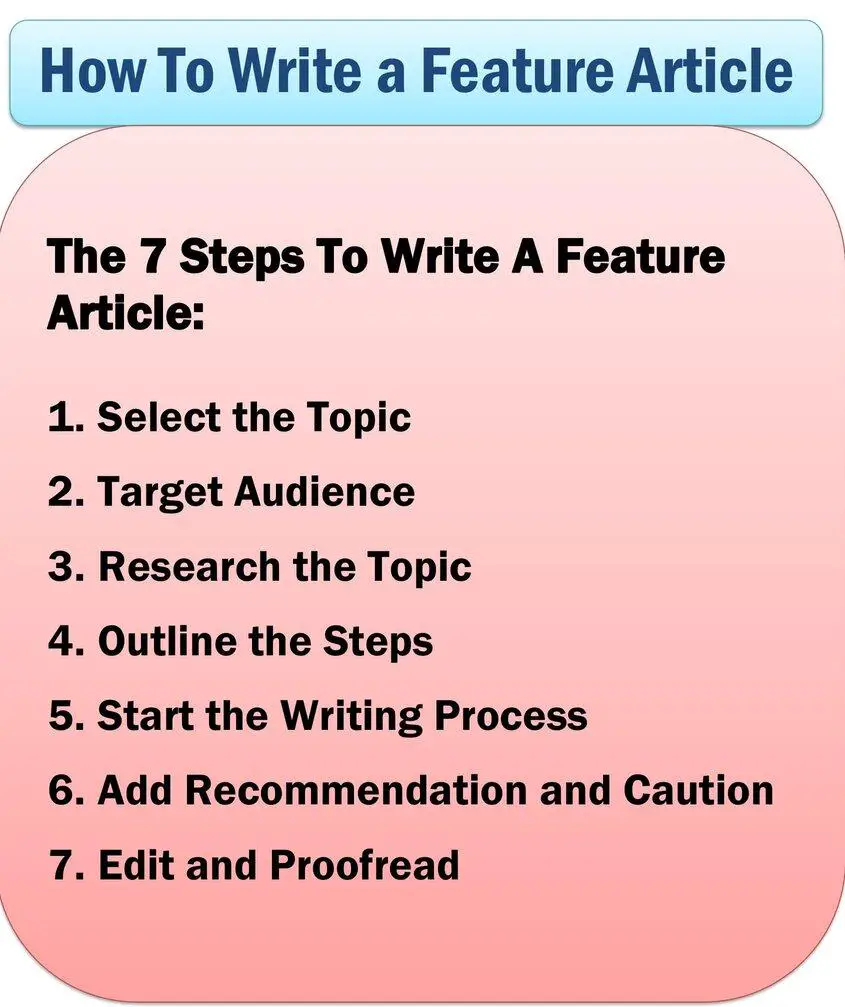
The seven steps to writing a feature article are as follows:
Select the Topic
Target Audience
Research the Topic
Outline the Steps
Start the Writing Process
Propose Recommendation and Caution
Edit and Proofread
1. Select the Topic
Firstly, the writers have to select a subject topic in which they can generate a meaningful feature article. It is significant to set a title as part of the pre-writing process. So, the author suggests the writers choose a topic they are interested in studying. Additionally, the writers must have a good idea and experience with the issues. For example, if the writers like to travel to tourist areas and know how to describe a tourist place. It will undoubtedly help them set the topic of the feature article based on travel experiences. Therefore, selecting a topic is a crucial and initial step in writing a feature article in journalism.
2. Target Audience
The target audience is the second stage of making a feature article. It is another essential fact; it is useless if nobody reads the story. For example, the youths show more interest in topics related to social media. In contrast, they might show less interest in the feature article on cooking recipes. However, the restaurant owners and cooks show more interest in cooking instructions. So, the writer must set the topic based on the target audience who will read the articles. The researchers suggest following geographic, demographic, and psychographic factors when targeting the audience.
3. Research the Topic
Research on the topic means studying the issue in depth to collect more information. So, writers should take enough time to research the case before writing the feature article. It isn’t easy to write a thoughtful story without providing precious information. The research helps journalists find sources. Authentic sources help verify information, such as statistical reports, quotes by a well-known person, and references from TV, newspapers, radio, and journals. Hence, research on the topic is significant in making the article more valuable and believable.
4. Outline the Steps
The outline of the steps means sketching all stages that the writer plans to complete thoroughly. The writers should draft a rough outline for writing a complete feature story, including all the steps of feature writing. This outline certainly helps determine how many steps writers need to complete and which have already been done. It also discovers the strengths and weaknesses of the writers. So they can take the additional initiative to overcome weaknesses. The best way to outline the stages is to use transitional verbs or highlight points with numbered lists. After all, it has appeared as an essential step in feature writing.
5. Start the Writing Process
The writers begin writing the feature article at this stage. Therefore, it is the most significant part of feature writing. The five elements of a feature article are headline, lead, body, image, and conclusion.
In the first paragraph, they should introduce the feature to help readers understand the essence of the topic. In addition, journalists explain the advantages of reading this article, so they use catchy sentences to attract readers. For example, journalists must describe the kinds of adverse consequences the audience could face if they hack to write a feature article about how to stop hacking Facebook IDs. So it triggers them to read the full article.
Moreover, the researcher suggests writing one paragraph for each section and avoiding mixing parts. The writer should remember that readers are not aware of the writing process. So, it will be difficult for them if they do not write one paragraph in each section. For example, journalists should mention “how to open a Facebook ID” before instructing them to protect Facebook from hacking.
Furthermore, the writers should use chronological order to clarify each step for readers. For example, they should mention steps 1, 2, and 3 of the article to improve understanding. They also need to use action verbs to describe steps, such as apply, write, cut, mix, use, change, etc.
Finally, the writers should ensure that the article is simple and friendly. So, they need to stop using irrelevant information and make their arguments more assertive.
6. Add Recommendations and Caution
If necessary, the journalists should propose suggestions and offer cautions. The readers might consider the writer less informative if they do not provide recommendations. It is a fundamental duty to add a warning if there are any possible dangers in the process of the article. For example, the writers suggest wearing winter dresses to stay warm while writing a travelogue feature article about cold places, including Antarctica, Russia, Iceland, Canada, and the United States.
7. Edit and Proofread
The final step of feature writing is editing and proofreading. It means revising the article repeatedly before publishing it for readers. The writers should read the article loudly in front of friends and employees to verify it. They need to brainstorm to dig out more questions and find the answer. Students can edit the article only because proofreading is expensive. However, the editors must proofread the article before publishing it in print media such as newspapers and magazines.
The researchers suggested some common questions writers can ask. The questions are as follows: do they understand the process, are there any steps missing, and is there anything else to add?
Feature Articles Examples for Students
The author includes two examples of feature articles for students. These examples incorporate the seven steps to writing a feature article. Therefore, this feature article example must assist students, writers, journalists, and employees in teaching how to write a feature story.
Short feature article example for students -1
Title: “Discover the Diversity of the USA: A Journey Across America’s Landscapes”
From the majestic peaks of the Rocky Mountains to the bustling streets of New York City, the United States of America offers travelers a diverse array of experiences. Whether you’re drawn to natural wonders, iconic landmarks, or vibrant cities, a journey through the USA promises adventure at every turn.
Begin your American adventure in the breathtaking landscapes of the West Coast. Explore the rugged beauty of California’s coastline along the Pacific Coast Highway, where you can surf the waves of Malibu, hike among the towering redwoods of Muir Woods, and witness the stunning vistas of Big Sur.
Head inland to the awe-inspiring landscapes of the Rocky Mountains, where you can embark on outdoor adventures year-round. In Colorado, ski the slopes of Aspen or hike the trails of Rocky Mountain National Park, while in Utah, marvel at the otherworldly rock formations of Arches and Zion National Parks.
For a taste of American history and culture, journey to the East Coast and immerse yourself in the vibrant cities that define the region. Explore the historic streets of Boston, where the Freedom Trail leads you past revolutionary landmarks such as the Paul Revere House and Faneuil Hall. In Washington, D.C., stroll along the National Mall and marvel at the iconic monuments and memorials that honor the nation’s past.
No visit to the USA would be complete without experiencing the excitement of New York City. From Times Square and Central Park to the Statue of Liberty and Broadway, the Big Apple offers endless opportunities for exploration and discovery.
As you travel across the USA, take time to savor the local cuisine that reflects the country’s diverse cultural heritage. Indulge in barbecue in Texas, seafood in New England, and soul food in the South, sampling regional specialties that tantalize the taste buds.
With its vast landscapes, vibrant cities, and rich cultural tapestry, the USA beckons travelers from around the world to embark on a journey of discovery. Whether you’re exploring the natural wonders of the West Coast or immersing yourself in the history of the East Coast, a trip to the USA promises an unforgettable adventure filled with experiences that will stay with you long after you return home.
Book Review Feature Article Example for Students-2
Book Review Feature on Atomic Habits
Title:Atomic Habits: An Easy & Proven Way to Build Good Habits and Break Bad Ones Author: James Clear Genre: Self-help, Psychology, Personal Development Publication Year: 2018 Publisher: Avery (an imprint of Penguin Random House
James Clear’s Atomic Habits became a big deal in the personal growth book world. It came out in 2018, then blew up worldwide because it offered an easy yet powerful way to build habits and shift behavior. He’s a writer and speaker who focuses on daily routines and getting things done, blending studies with real-life examples, so the advice feels both doable and inspiring. His main idea? Small actions repeated regularly—what he calls atomic habits—add up to massive changes later.
Summary
James Clear kicks things off with something close to home – back in high school, during a baseball game, a bat hit him right in the face. That brutal moment changed everything. Afterward, healing took forever, pushing him to start over completely. Bit by bit, he noticed that real change didn’t come from big pushes; instead, it grew out of tiny actions repeated. Eventually, that idea turned into what we now know as Atomic Habits.
The story focuses on something James Clear calls The Four Laws of Behavior Change—an easy framework for building better routines while ditching harmful ones.
Making things obvious helps—clear signals guide actions better. Bad timing screws up good intentions, mostly ’cause reminders blend into the background. Spot-on placement works way better —like tossing a book onto your pillow so it sticks in your mind. There’s this trick called habit stacking, too, linking fresh routines to old ones; say, right after brushing, you sit quietly for sixty seconds.
Making it fun helps – doing things that feel good boosts your drive to stick with them. James Clear suggests pairing a new routine with things you love, which he calls “temptation stacking.” He talks about how being around others matters too; hanging out with folks who act like the person you want to become makes shifting habits simpler and way more tempting.
Keep it simple—when things are easy, people stick with them. A straightforward approach helps folks ease into change by taking tiny steps. Instead of promising to jog five kilometers, slip on your workout shoes; that’s what his two-minute trick is about. When you start small, moving forward feels natural—doing little by little sparks the urge to keep going.
Get a kick out of it – Habits stick better when they give you a quick win. Since your brain loves instant feels-good moments, James Clear suggests ticking off tiny wins—say, putting an “X” on a calendar or giving yourself credit for minor ones. That kind of feedback loop makes wise choices fun and easier to keep up.
Besides those rules, James Clear raises a deeper concept: habits tied to self-image. Rather than zeroing in on targets such as “I need to drop pounds,” he pushes thinking about character—”I’m someone who takes care of their health.” That small change nudges folks to behave more like the person they aim to be, not just chase outcomes.
To back up his ideas, James Clear shares relatable stories from everyday life. Take the case of Britain’s cycling squad – a group that went from struggling to dominating globally thanks to guidance from Dave Brailsford. Instead of big leaps, they focused on tiny upgrades across the board: better meals, tweaked gear, even how seats were shaped. Over time, those minor tweaks added up, leading to huge wins in just a handful of seasons. That example shows how little steps, done regularly, can snowball into something massive.
Critical Analysis
What makes Atomic Habits different is how clear and helpful it feels. Instead of jargon, James Clear turns deep findings from mind studies into words anyone can understand. Rather than jumping around, the layout moves forward in a way that makes sense—each part building on what came before. Because it’s written like a conversation, with stories from actual people, even newcomers to the topic won’t feel lost.
A big plus of the book? It pushes systems instead of goals. James Clear says goals point the way—yet it’s systems that move you forward. Success isn’t tied to huge aims, he explains – it’s built through more brilliant routines day after day. That view shakes up old-school advice, where setting targets always takes center stage. His take shows that lasting gains come from tweaking how things are done, not from fixating on results.
The way the author breaks down how tiny habits build up is eye-opening. Since small choices pile up, they work kind of like savings earning interest —only your progress grows slowly but steadily. Doing a bit better each day adds up to something huge after weeks or months. That idea helps you stick with it, even when results don’t show right away.
Still, the book has a few minor flaws. Several people might find the material redundant, since James Clear revisits key ideas across several sections. But that redundancy helps lock things in—kind of like how habits form. One downside, though: Atomic Habits zeroes in on actions and routines instead of tackling inner emotional hurdles that can get in the way of progress. When someone’s facing tough inner struggles, routines by themselves may fall short. Still, if you’re looking to learn how behaviors work, this method pulls it off pretty well.
Positive Aspects
The real power of Atomic Habits comes from how easy it is to use. Every idea shows clear steps people can start using right away. Inside, you’ll find helpful tips like:
Habit stacking (linking new habits to existing ones)
The two-minute trick – begin tiny so you can gain speed
Change your space so helpful actions feel simpler while unhelpful ones take more effort
Keep an eye on your steps (try a daily log to stay pumped, plus keep going)
These approaches help people see behavior shifts as doable—especially if they’ve had trouble sticking to habits before.
A different strong point? It’s how James Clear keeps things motivating but still down-to-earth. Instead of leaning on vague hype like lots of self-help writers, he stays hands-on and tangible. When setbacks happen, he doesn’t ignore them – he says they’re normal, telling people to restart instead of chasing flawlessness. That idea—“Success isn’t about lofty targets; it’s where your habits land you”—has been shared everywhere since it nails what lasting progress really means.
On top of that, Atomic Habits attracts people from all walks of life. While students learn how to study smarter, workers find ways to get more done, and anyone wanting stronger relationships or better health discovers methods that stick. Because it fits so many situations, this book stands out as one of the go-to reads lately.
Recommendation
Atomic Habits is worth checking out if you’re looking to improve your daily routine for good. Instead of just hype, it gives you a step-by-step way to stick with change. Pupils might find it helpful to enhance their focus when hitting the books. Workers could use its ideas to get more done without burning out. People aiming to feel stronger, connect more deeply, or grow as humans will likely spot practical takeaways, too.
The charm of this story is how basic it stays: tiny habits done regularly create real results. It guides people to own their space, daily patterns, and even the way they think. Above all, it points out that growth isn’t tied to flawless effort—what counts is sticking with it.
In the end, James Clear shares a lasting idea: each choice counts toward who you want to turn into. Because when these choices pile up, they build your character and steer where you’re headed. Atomic Habits isn’t merely a how-to book – it’s a practical plan for growing a stronger life, bit by tiny bit.
Several examples of feature articles in journalism include human-interest stories, profile features, news story features, informative features, cultural features, environmental features, investigative features, historical features, travel features, and lifestyle features.
1. Human Interest Feature
Example Title:“A student from a poor background who became a university scholar” Focus: Tells the emotional story of a young man from a poor background and a small village who overcame poverty and challenges to study abroad. Finally, he became a scholar and became the pride of his town. Purpose: To encourage and engage readers emotionally through personal storytelling.
2. Profile Feature
Example Title:“Elon Musk: The Man Who Dares to Dream Beyond Earth” Focus: Provides an in-depth look at a famous personality’s background, motivations, and achievements. Purpose: To reveal the character and personality of a person of interest.
3. News Story Feature
Example Title:“How Remote Work Shifting City Dwellers to Urban” Focus: Explores how remote jobs assist city people to move to the village and allow them to live with their families. It focuses on the positive aspect. Purpose: To explain the positive aspect of the current issue with the current context, background, and expert opinions.
4. Informative Feature
Example Title:“The Science of Sleep: How To Sleep Early and Lead a Healthy Life” Focus: Explains scientific research in sleep using simple terms, with quotes from scientists. Purpose: To educate readers on how to use the information to lead a healthy life.
5. Cultural Feature
Example Title:“How Globalization is Changing Local Food Culture” Focus: Explores the evolution of Tukey’s local food culture and its growing global influence. Purpose: To highlight cultural and traditional issues.
6. Environmental Feature
Example Title:“Scientists Identify the Major Human Causes of Climate Change” Focus: Discusses crucial human activities that cause climate change on the Planet. It also represents their impact on the ecosystem. Purpose: To raise awareness of environmental issues and community involvement.
7. Investigative Feature
Example Title:“The Hidden Cost of Indonesia’s Nickel Boom” Focus: Presents findings from a months-long investigation into environmental pollution and its effects on health and livelihoods. Purpose: To uncover truth, promote accountability, and inform the public.
8. Historical Feature
Example Title:“The Asian financial crisis 20 years on: Lessons learnt and remaining challenges?” Focus: Revisits a significant historical event, its consequences, and lessons learned. Purpose: To provide reflection, analysis, and relevance to current events.
9. Travel Feature
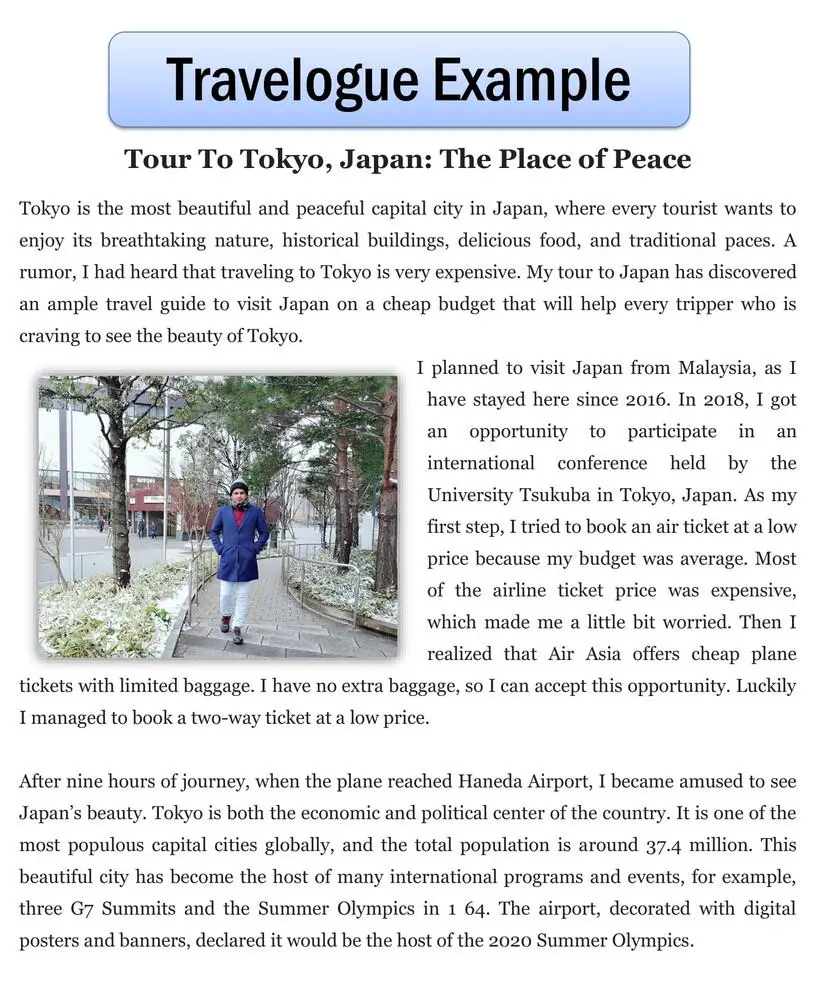
Example Title:“Tour To Japan: Embracing Tradition and Innovation in Tokyo” Focus: Describes the sights, culture, and experiences of traveling in a specific destination. Purpose: To entertain and inspire readers to explore.
10. Lifestyle Feature
Example Title:“U.N. Fashion and Lifestyle Network Talks Global Circularity” Focus: Examines the growing trend of minimalism in fashion, design, and living habits. Purpose: To explore social trends and offer lifestyle insights.
11. How To Feature
Example Title:“How to complete Facebook monetization to earn from video content” Focus: Explain practical advice, guides, or step-by-step instructions on a particular topic. It is also known as an instructional feature in journalism.
Purpose: To explore issues that other wants to know. Explore how to learn something you do not know. It is also an informative feature that highlights creative ideas to help others know one another.
12. Obituary Feature
Example Title: The Remarkable Journey of Illona Sandre Young: Gone but Never Forgotten Focus: It employs a more narrative style, often reading like a short biography or a story, rather than a factual announcement. It also captures the deceased’s unique spirit, personality, and life journey. Purpose: To explore their personal, academic, and professional history and contribution towards society.
Focus: Explain who is part of this trend and why they join this trend.
Purpose: Explain the reason behind the trend. Why do people follow the trends, and what are the positive and negative aspects? It also identifies who is getting affected.
Conclusion
The seven steps to write a feature article are: select the topic, target audience, research the topic, outline the steps, start the writing process, propose recommendations and cautions, and edit and proofread. People read feature articles to gain more knowledge about specific events. Sometimes, audiences read feature writing to get instructions for completing their tasks. So, the writer should be more responsible when writing a feature article to educate the audience. Hopefully, the seven steps to writing a feature article will help students complete feature writing assignments. It also guides new writers and journalists in writing complete feature articles.