Active vs Passive Audience: Differences With Examples

Understanding the distinction between passive and active audiences is central to media and communication studies. While early media theories viewed audiences as easily influenced by media messages, contemporary perspectives recognize that individuals actively interpret, evaluate, and respond to information. Examining how different audiences process and engage with media helps explain the psychological and social dynamics shaping today’s information environment.

Active and Passive Audience

What is Active Audience?

An active audience receives media information and makes sense of the messages based on their social and personal contexts. They listen to media messages rather than hear them. However, active audiences receive media information, and the act of receiving it is natural (Lazarsfeld, Berelson & Gaudet, 1948). So, active audiences pay close attention to the information they receive and interpret it to give feedback. The most common listening styles are people-oriented, content-oriented, action-oriented, and Time-oriented listening.

Examples of Active Audiences

For example, people are the active audience that comments on social media content to express their opinions.

Another example, based on the story shared in the active and passive audience example below, is that Ela is an active audience member who scrutinizes messages before accepting them and always tries to provide feedback.

Characteristics of Active Audiences

Active audiences actively listen carefully to provide feedback, making them complicated and critical thinkers. Additionally, they have good schemata. Feedback is an essential component of interactive communication.

What is a passive audience?

Passive audiences watch and observe media information without making sense of it (Bineham, 1988). Hence, they are recognized as inactive receivers. Passive audiences have low motivation to process information, low ability to process information, and focus on simple cues (e.g., appearances instead of content)

Examples of Passive Audiences

For example, passive audiences dislike commenting on social media content. Audiences like to watch Television and read newspapers without providing opinions. They prefer a linear communication process where feedback is not essential.

Another example, based on the story shared in the active and passive audience example below, is that Bela is a passive audience member who accepts the message without challenging it.

Characteristics of Passive Audiences

The Passive audience merely hears something rather than listens. Passive audiences merely observe the message; therefore, they are cognitive misers, lazy in their thinking.

Examples of Active and Passive Audiences

For example, Ela and Bela are siblings watching the news on television. The news reporter is providing tips on how to stay healthy. Ela actively listens to the news reporter’s tips to follow them. Then she asks her sister Bela to confirm whether these tips work. In contrast, Bela readily accepts those tips. Here, Ela is an active audience member who is a critical thinker. Therefore, she carefully focuses on the news presenter’s dress, speaking style, and messages’ meaning.

On the other hand, Bela watches the news without focusing on the message. Here, Bela is a passive audience member who is a cognitive miser. Therefore, she does not focus on interpreting the message; she only focuses on the news reporter’s appearance. As a result, she believes the news reporter’s tips quickly and becomes manipulated.
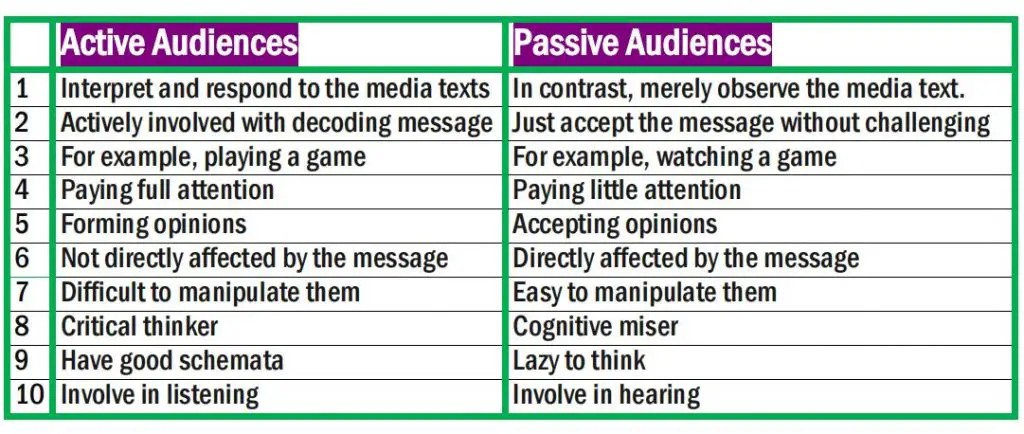
active and passive audience
Difference Between Active and Passive Audience

Comparison: Active vs. Passive Audiences

Criteria Active Audiences Passive Audiences
Media Engagement Actively interpret, question, and respond to media texts. Merely observe and consume media texts without interaction.
Message Processing Decode, analyze, and critically evaluate the message. Accept the message at face value without evaluation.
Feedback & Opinion Form independent opinions and actively provide feedback. Adopt predetermined opinions provided by the media.
Attention Level Maintain close cognitive attention and focus on the content. Display low attentional focus, superficial processing.
Direct Influence Resistant to direct, unmediated media influence. Vulnerable to immediate, direct media effects.
Manipulability Highly difficult to manipulate due to critical evaluation. Easily manipulated or conditioned by media messaging.
Cognitive Style Act as critical thinkers who actively process information. Act as cognitive misers, minimizing mental effort.
Mental Framework Utilize well-developed schemata to contextualize information. Avoid deep cognitive reflection or analytical thinking.
Listening Dynamic Practice active, discriminative, and comprehensive listening. Engage in passive, uncritical hearing rather than listening.
Example (Case Study) Ela: Scrutinizes news reports, checking facts against her own knowledge before accepting them. Bela: Absorbs news reports completely, accepting the reporter’s narrative without scrutiny.

Active and Passive Audience Theories

Active Audience Theories

The theory of the active audience holds that media audiences do not passively accept information but interpret messages in light of their personal and social contexts.

The Models of Active Audience posits that audiences are not passive recipients of media messages but rather actively engage with and interpret media content based on their own experiences, values, and beliefs. This theory challenges the notion of passive audience effects proposed by earlier media theories, such as the Hypodermic Needle Theory, and emphasizes the agency and autonomy of audience members in their interactions with media texts. According to Active Audience Theory, individuals actively select, interpret, and make meaning from media content, drawing upon their personal backgrounds, social contexts, and cultural frameworks. This theory acknowledges the diversity of audience responses to media messages and highlights the importance of audience participation and engagement in shaping the reception and interpretation of media content.

List of Active Audience Theories:
  1. Uses and Gratifications Theory
  2. Reception Theory
  3. Cultural Studies
  4. Active Audiences Theory
  5. Two-Step Flow Theory
  6. Agenda-Setting Theory
  7. Participatory Culture Theory
  8. Media Literacy Theory
  9. Social Learning Theory
  10. Social Cognitive Theory

Passive Audience Theories

Passive audience theories, also known as media effects theories, propose that audiences are passive recipients of media messages and highly susceptible to mass media influence. These theories suggest that media content directly and powerfully shapes audience attitudes, beliefs, and behaviors, with little active engagement or resistance from the audience.

List of Passive Audience Theories:
  1. Hypodermic Needle Theory (Magic Bullet Theory)
  2. Mass Society Theory
  3. Passive Audience Theory
  4. Limited Effects Theory
  5. Reinforcement Theory
  6. Encoding-Decoding Model
  7. Spiral of Silence Theory
  8. Dependency Theory
  9. Selective Exposure Theory
  10. Cumulative Effects Theory

FAQ (Frequently Asked Questions): Active and Passive Audience

Q1: Which theory explains active and passive audiences in media communication?

A: The Hypodermic needle theory explains the active and passive audiences. According to this theory, audiences are highly susceptible to media influence, and media messages are believed to have an immediate, direct effect on audience perceptions.

References APA 7th Edition: Scholarly Sources

Lazarsfeld, P. F., Berelson, B., & Gaudet, H. (1948). The people’s choice: How the voter makes up his mind in a presidential campaign (2nd ed.). Columbia University Press.

Bineham, J. L. (1988). A historical account of the hypodermic model in mass communication. Communication Monographs, 55(3), 230–246. https://doi.org/10.1080/03637758809376169

How To Write a TV Program Proposal Sample

TV Program Proposal Sample, How To Write a TV Program Proposal. TV Program Proposal: How To Write a Proposal For Television Program. The Full instruction for Writing a TV Proposal For Al-Hijrah Malaysian Television.

TV Program Proposal

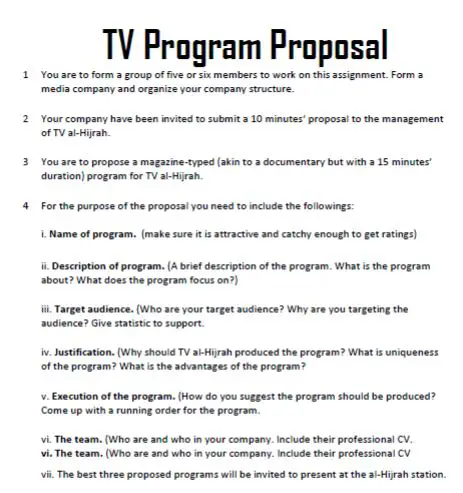
The TV program proposal means a written complete description of a TV show that describes the entire program procedure. The proposal must include the program name, estimated budget, description, execution procedure, target audience segmentation, uniqueness, and program justification. A  TV program proposal outlines the Television show thoroughly so that media authority identifies the output and future of the program. The TV program proposal is like a business proposal that describes the show before broadcasting on the channel.

tv program proposal sample, how to write a tv program proposal. tv program proposal: how to write a proposal for television program.

Elements of a TV Program Proposal

The 9 Elements of a TV Program Proposal are:

  1. Name of Program
  2. Description of Program
  3. Target audience
  4. The budget of the program
  5. Justification
  6. Execution of the Program
  7. The team
  8. The uniqueness of the program
  9. The strengths of the program

Instruction on Writing a TV Program Proposal

Instruction to write a proposal for the Al-Hijrah TV program
1. You are to form a group of five or six members to work on this assignment. Form a media company and organize your company structure.
2. Your company has been invited to submit a 10 minutes proposal to the management of TV Al-Hijrah.
3. You propose a magazine-typed (akin to a documentary but with a 15 minutes duration) program for TV al-Hijrah.
4. For the proposal, you need to include the followings:

i. Name of program.  (make sure it is attractive and catchy enough to get ratings).

ii. Description of the program. (A brief description of the program. What is the program about? What does the program focus on?)

iii. Target audience. (Who is your target audience? Why are you targeting the audience? Give statistics to support this.

iv. Justification. (Why should TV al-Hijrah produce the program? What is the uniqueness of the program? What are the advantages of the program?

v. Execution of the program. (How do you suggest the program should be produced? Come up with a running order for the program.

vi. The team. (Who are and who in your company. Include their professional CV.

vii. The best three proposed programs will be invited to present at the Al-Hijrah station.

The Sample of TV Program Proposal 

Name of Program: Discover Student Talent (DST)-2023

Description of TV Program Proposal

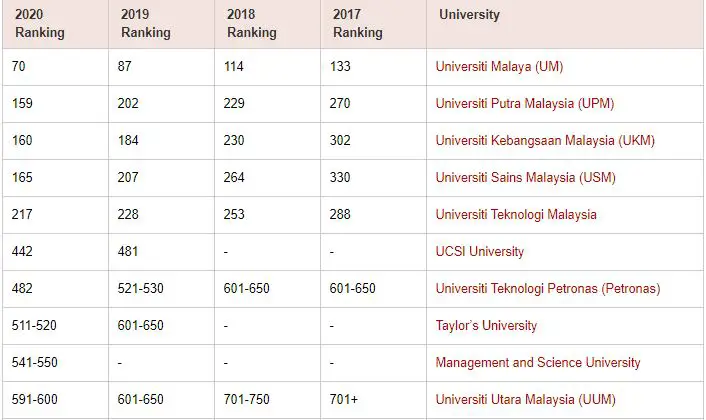
Discover student talent is an attractive, inclusive TV program targeted toward students studying in the top-ranked public and private universities in Malaysia. This TV program will welcome students to explore their talents and help them to become famous by adequately utilizing their cognitive knowledge. The door to participation in this program is open for all students studying in Malaysian top 10 ranked universities. These top 10 universities will be considered as per the ranking of QS (Quacquarelli Symonds). According to the QS ranking, the top 10 universities in Malaysia are:

tv program proposal the top 10 universities in malaysia

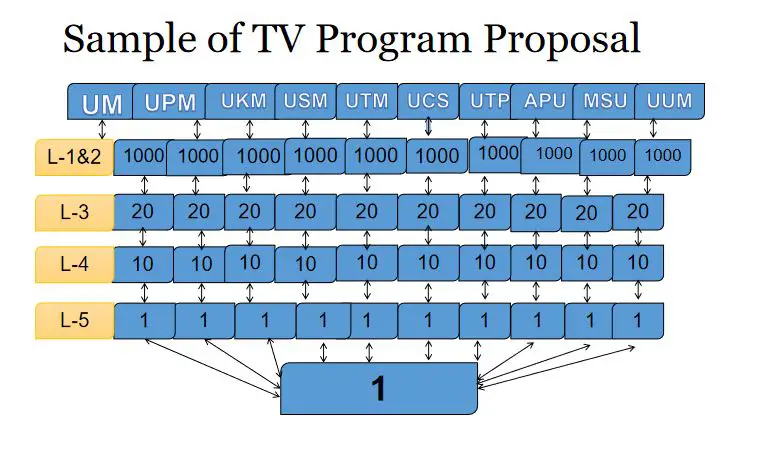
So, the student of these top 10 universities can participate in the Discover student talent program by enrolling via a specific mobile application or website. When they apply for contesting the Discover student talent program, contestants will have to participate in levels 1 and level 2 to secure a position among the top 20 students. The top 20 students from every university will go to the TV station in level 3 for contesting and securing positions in the top 10. In level 4, the top ten contestants will compete for being the most talented student in the university. The top 10 contestants from the top ten universities in Malaysia compete to be the most talented student in Malaysia. It is considered that the winner will get a certificate and 10,000 ringgit as prize money, following 5,000 ringgit for the runner-up and 2000 ringgit for the second runner-up.

Execution of the TV Program Proposal

Every student needs to create an account by providing a specific university name and student id number. When their account is activated, they can participate in question-answering sessions two times a month. But, they must provide a student ID number to verify that they are studying at that university.

After getting an activated account, they face 50 easy general knowledge questionnaire in the internet system at level 1, and they have to answer those questions to get higher marks. They can participate in this session through mobile, laptop, or tab. Thus, students will get their first-level marks in the system and have to be prepared for the second level. The second level also has the same 50 questions but could be more challenging than the first level. In level 2, the contestants will sit for an exam in university in the OMR answer sheet. The university authority will all-out effort into the television company to organize the level 1 and 2 activities. All questions of the first and second levels will be in English and Malay. Students can choose their preferred language in the system.

The TV company will pick up the top 20 contestants from every university for level 3. In level 3, the top 20 contestants will come to the TV station stage to compete to secure a position among the top 10 students in the university. After that, the top 10 students of the university will compete to be the most talented student in the university.

Grand final

Level 5 is considered the final level of the program for discovering the most talented student in Malaysia. Therefore, in this stage, each university’s top 10 talented students will compete to be the most talented student in Malaysia.

tv program proposal sample: how to write a tv program proposal. tv program proposal: how to write a proposal for television program. the full instruction of writing tv proposal for al-hijrah malaysian television.

Questions Patterns Set For the TV Program

  1. General Knowledge
  2. Books and Authors
  3. Famous Personalities
  4. Geography
  5. History
  6. Science and Inventions
  7. Movies
  8. Politics
  9. Religious
  10. Sports
Full Process at a glance
  1. Create an account and log in.
  2. Choose university name, and provide student ID number for account activation.
  3. Level-1 (50 Questions).
  4. Level-2 (50 Questions).
  5. Level-3: Location at Alhijrah, and a total of 20 top-scored students from every university will compete to secure a position within the top 10. (Transportation, Beverage, and 100 Ringgit for the participant).
  6. Level-4: Location at Alhijrah and the top 10 students from every university will compete to become the most talented student of the university. (Transportation, Beverages, and 200 Ringgit for the participant).
  7. Level-5: Location at Alhijrah, and the top 10 students from 10 universities will compete to become the most talented student in Malaysia. .(Transportation, Beverage, and 500 Ringgit for the participant).
  8. Total Price –20,000 Ringgit, Winner will get 10000 Rm, Runner up 5000 Rm, and the second Runner up 2000 Rm).
Additional events for audiences

The TV channel authority will organize two additional events for audiences. First of all, the audiences who will participate in the program physically can get prizes by answering questions on the stage. These audiences are those who sit in front of the main competition stage to watch live programs. In addition, the audiences who watch this program through TV channels can win prizes by answering questions through mobile. Audiences differ from active and passive media audiences.

Target Audiences of the TV Program

Demographic, geographic, and psychographic segmentation is the most powerful audience segmentation technique. For this program, demographic segmentation is the most relevant strategy to the target audience, and audiences can be youth, adults, and senior people. Their ages may be between 15 and 65 years old. The prime target audiences of this Discover talent student program are students. Students are the main components of running this program because they will participate. Also, it will be an interactive program, viewers in front of the TV can also answer questions, and when the audience can answer the questions successfully, they will feel delighted. The contestants and audiences face various topics, such as general knowledge, common sense, literature, history, astronomy, geography, sports, and entertainment. So, audiences can also increase their knowledge through our questions answering session; simultaneously, they can win prizes.

Youth

The motive for choosing youth as the target audience is because they have already received a part of the education and have a specific knowledge background. And our program can be a competition; youth could set up a team to answer questions together to determine how many questions can be answered. In this way, they expand their knowledge and enhance friends’ relationships.

Adult

Furthermore, there are two aspects which are unemployed people and workers. Unemployed people have a lot of time can watch TV or videos, and they can learn something from our program. Our problems are so wide that they can learn something from them and benefit them in the future. Besides that, the workers didn’t have more free time to watch our program to relax. When they are tired, they can watch our program. If they can answer the questions correctly, they feel happy.

Senior people

Maybe not many o people watch our show, but we hope to have more older people to watch. Because they can learn and educate their grandchildren.

Justifications

The reason why TV al-Hijrah should produce this program has been discussed here. There are two major reasons for producing this program. Firstly, there’s something unique about producing a program based on students and centering universities in Malaysia. So, It’s a whole new format. Secondly, because the nature of the show is not just entertainment, some common sense questions make the show educational. On the other hand, the program has a wide range of audiences because of its educational significance.

The uniqueness of the program

Firstly, The nature of this show is unique in Malaysia because Malaysian TV programs are mostly about travel, food reality shows, and music-related selection programs. People’s conformity, snooping, and curiosity all affect people’s attention to TV programs. Therefore, the new format surely attracts some viewers. On the other hand, previous reality shows were mostly celebrities, but participants in this program were students from the top 10 universities in Malaysia. This kind of guest on the TV program makes the show more attractive. Finally, we intend to give some students who have talent but have not yet been able to shine.

Advantages of the programs

Firstly, compared with the variety of entertainment programs, this program has educational meaning. This program can also attract primary and middle school, and college students interested in exercising their knowledge through competition. Secondly, the program can also raise social awareness among the general people to focus on learning, and participants obtain confidence. Finally, this program can increase the popularity of the TV channel by increasing ratings.

In conclusion, the TV program proposal is crucial to explain the show’s benefits. It convinces the authority to telecast the show.

TV Program Proposal Sample PDF- Download Link