12 Types of Nonverbal Communication Definition and Examples

This article explains the 12 Types of Non-verbal Communication: Physical Appearance, Paralinguistics, Body Movement, Gestures, Posture, Facial Expression, Eye Contact, Proxemics, Haptics, Chronemics, Artifacts, and Environment.

Nonverbal Communication Definition

Nonverbal communication is the transmission of messages through nonverbal elements, such as physical appearance, eye contact, facial expressions, body movements, gestures, and posture. Therefore, it is also known as a non-verbal cue. The four types of communication contexts are verbal, nonverbal, visual, and written.

Nonverbal communication conveys messages without spoken words. On the other hand, verbal communication means conveying a message through written and spoken words. The combination of both verbal and nonverbal cues generates effective interaction between the sender and receiver. Effective communication relies on using both verbal and nonverbal communication cues. 

Using verbal and nonverbal cues during interaction can make communication more effective and efficient. There are several types of noise in communication: physical, physiological, psychological, and environmental. The combination of verbal and nonverbal communication reduces communication noise and makes the interaction more effective. The researchers have mentioned nonverbal communication cues as components of the communication process.

Example of Nonverbal Communication

For example, Rose types on a laptop while interacting with her senior Boss. Simultaneously, the Boss asks her when she wants to submit the company’s new business report. Rose raises two fingers, focusing his eyes on the laptop. The Boss leaves the place, saying, All right. Rose intends to complete the business report at 2 PM, and the Boss completely understands the message. Raising two fingers is a nonverbal communication example that conveys the message in this context.

Similarly, the Boss shows a thumbs-up gesture when Rose says she has emailed the report before 2 PM. Here, a thumbs-up conveys the Boss’s good job message to Rose. There are thousands of examples of nonverbal communication: eye contact, gestures, posture, silence, an angry face, an anxious mood, smiles, talking fast, and many more.

Types of Nonverbal Communication

The 12 Types of Nonverbal Communication are:

1. Physical Appearance
2. Paralinguistics (Vocalics)
3. Body Movement
4. Gestures
5. Posture
6. Facial Expression
7. Eye Contact
8. Proxemics (Space)
9. Haptics (Touch)
10. Chronemics (Time)
11. Artifacts
12. Environment (Context)

Many scholars term the types as components and examples of nonverbal communication.

Nonverbal Communication Types
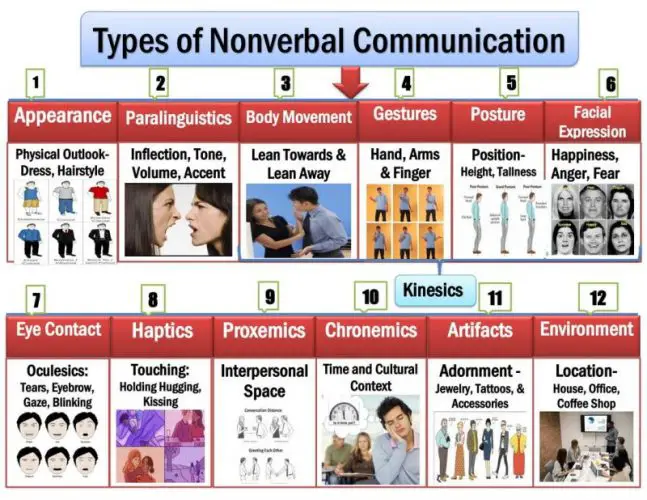
Types of Nonverbal Communication
Different Types of Nonverbal Communication

1. Physical Appearance Nonverbal Communication

Physical appearance is one of the significant types of nonverbal communication that conveys a strong message about who you are and where you study or work. A proverb says, “The first impression is the best impression.” People assume others’ education, attire, hygiene, professionalism, success, moral character, social position, and trustworthiness by physical appearance.

According to a statistical report, people take less than 10 seconds in the first meeting to form an impression of others. Clothes are significant elements in conveying messages to other group members. Casual attire is more acceptable in informal meetings because it reflects trustworthiness. On the other hand, a professional appearance is well-accepted in business meetings and formal group presentations. However, research shows that good-looking people make more money and get promoted more often than those with average looks.

Physical Appearance Examples

For example, two people are walking on the road wearing different dresses. The first person wears formal attire, and the second person wears a jersey and shorts. Most people can guess a person’s profession from their dress. Usually, employees follow official dress codes, including shoes and hairstyles.

On the other hand, football players wear jerseys, shorts, boots, and socks. The dress conveys a message about their profession without spoken words. So, physical appearance is a significant form of nonverbal communication that conveys a strong message about the communicator.

2. Paralinguistics Nonverbal Communication

Paralinguistics refers to the meta-communication elements of nonverbal communication that modify the message’s meaning. It is also known as vocalics, paralanguage, or voice in nonverbal communication. Paralinguistics refers to the ways we use our voices when speaking to someone.

In addition to physical appearance, paralinguistics is another crucial type of nonverbal communication that significantly changes the meaning of the speaker’s speech. Examples of paralinguistics are inflection, tone, pitch, filler words, indicators, volume, rate, and articulation. People have more than 630 muscles, but use around 72 of them together to deliver a speech. The tongue is the most significant and robust muscle among them. People use this tongue to generate these paralinguistic elements during nonverbal communication.

Paralinguistics Nonverbal Communication Examples
Paralinguistics Nonverbal Communication Example
Paralinguistics Nonverbal Communication

3. Body Movement Nonverbal Communication

Body movement refers to communication through the head, hands, and hand movements —nonverbal communication —using body angles. The body angles between two people reveal their relationship. People tend to lean toward the speaker when they are interested in the discussion topic. On the other hand, people tend to orient away from the speaker when they do not like the discussion topic. The same thing happens when the audience likes or dislikes the speaker personally.  People use their bodies mostly in interaction; therefore, it is a crucial type of nonverbal communication.

Body Movement Nonverbal Communication Examples

For example, males tend to lean towards females in confined conditions, and females face away.

Body movement is also part of body language, or Kinesic, nonverbal communication. Kinesics is the study of nonverbal communication, including body movement, facial expressions, gestures, and posture. According to the statistics report, people use 7% of words, 38% of voice, and 55% of body language in communication.

Elements of Kinesics in Nonverbal Communication

Kinesics is the symbolic meaning of body movements. Ekman and Friesen (1969) developed five types of components of Kinesics, also known as body movements.

Five Types of Kinesics in Communication

The five types of Kinesics Communication are Emblems, Illustrators, Affect Displays, Regulators, and Adaptors.

1. Emblems

Emblems are body movements that can carry information without using verbal communication. For example, a thumbs-up means OK, waving a hand means goodbye, and the Logo represents something.

2. Illustrator

Illustrators are body movements that transmit a complete message with or without verbal communication. Communicators link illustrators with oral action to make the interaction more effective. For example, a person is showing directions to the Bank and explaining them verbally.

3. Affect Display

Affect displays are body movements that relate to your emotions. For example, a slumping body, a relaxed body, and a confident body.

4. Regulators

Regulators are body movements that emphasize further action. It also determines turn-taking in conversations—for example, controlling communication, such as a nod of the head.

5. Adaptors

Adaptors are body movements to adapt to a situation and the current environment. For example, it reveals nervousness, fixing clothes, nose scratches, stress, and anxiety.

4. Gestures Nonverbal Communication

Gestures are a form of nonverbal communication that includes waving hands, nodding, and pointing. The gesture makes communication more lively and effective. The speakers may be perceived as boring, stiff, and unanimated if they do not use gestures while speaking. Head nods and raking fingers through hair are gestures.

Gestures Nonverbal Communication Examples

For example, the Deaf community worldwide develops and uses various sign languages.

5. Posture Nonverbal Communication

Posture is one of the crucial types of nonverbal communication that is related to body position. It represents numerous messages through the way people walk, talk, stand, and sit. Posture denotes the body position in nonverbal communication.

Posture Nonverbal Communication Examples

For example, standing erect but not rigid and leaning slightly forward communicates to your audience that you are approachable, receptive, and friendly. Additionally, speaking with your back turned or looking at the floor or ceiling should be avoided; it communicates disinterest to your audience.

6. Facial Expression Nonverbal Communication

Facial expression is one of the most common forms of nonverbal communication that influences interaction. It plays a crucial role in regulating the interaction and conveying the message. Facial expression includes the mouth, eyebrows, and facial muscles. Facial expressions demonstrate approval or disapproval of the topic being discussed. The audience’s facial expressions indicate whether the speech is exciting. The five universal facial expressions are Happiness, Sadness, Anger, Fear, and Surprise.

People have over 30 facial muscles to help them smile or frown; for example, 17 to smile and 43 to frown.

Facial Expression Nonverbal Communication Examples

For example, people open their mouths and extend their eyebrows when surprised.

7. Eye Contact Nonverbal Communication

Eye Contact is a significant type of nonverbal communication that regulates and controls communication. It is also known as oculesics, meaning the study of eye behavior. Eye muscles are the busiest muscles in the body. Scientists estimate that the eyes move more than 100,000 times a day.

Eye Contact Nonverbal Communication Examples
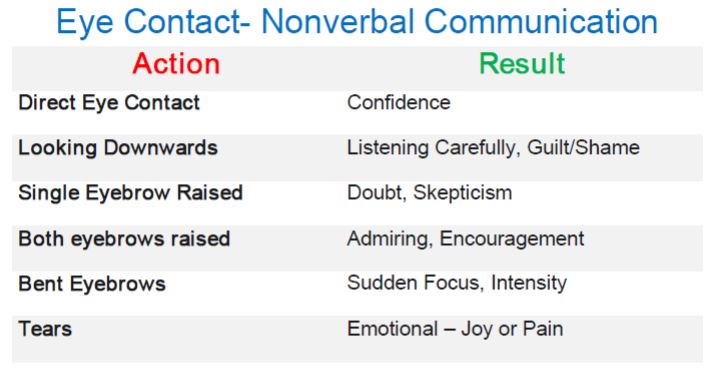
Eye Contact Nonverbal Communication

8. Haptics in Nonverbal Communication

Haptic communication occurs when people interact with the sense of touch. It plays a significant role in the communication process. It refers to the touch that conveys the crucial message. Therefore, haptics is another type of nonverbal communication that conveys information through touch.

Haptics Nonverbal Communication Examples

The most noteworthy examples of haptics are holding hands, hugging, tickling, and kissing.

9.  Proxemics in Nonverbal Communication

Proxemics refers to the interpersonal space during communication that affects the interaction. It is a familiar type of nonverbal communication that represents the seating arrangements. Proxemics are very significant factors in the workplace. It also plays an influential role in describing your position and attitude.

For example, dominant group members position themselves more centrally in the group’s space. However, task- and socially-oriented leaders maintain space ratio or territoriality during the exhibit group meeting.

Proxemics Nonverbal Communication Examples

Interpersonal Spaces

In 1969, Hall introduced the Four Types of Interpersonal Spaces: Intimate, Personal, Social, and Public Distance.

1. Intimate distance ( 0-18 inches (45.72 cm): For example, close friends, some family members, and lovers maintain close distance; therefore, it is also a private zone.

2. Personal distance (18 in. – 4 ft (1.22 m), an arm’s length away): For example, friends and acquaintances maintain this distance when interacting with each other.

3. Social distance ( 4 – 8 ft (2.44 m): For example, strangers maintain social distance as they do not have intimate relationships.

4. Public distance ( >8 ft (2.44 m): A speaker presents to a larger audience.

10. Chronemics in Nonverbal Communication

Chronemics refers to the role of time during nonverbal interaction. It is not spoken speech; instead, it represents the communication gap. Therefore, it is another example of nonverbal communication that indicates how much time to talk and how long to elapse when interacting with others. For example, how many members speak, and how long they wait before responding to other group members.

In 1976, Edward T. Hall introduced the concepts of monochronic and polychronic time to distinguish one culture from another. Monochronic shows the representative who is punctual and active. On the other hand, polychronic represents lazy people.

Chronemics Nonverbal Communication Examples

For example, in most countries, bosses come to the meeting after the employees. The employees think that they must be present at the meeting before the Boss arrives. The employees are active and join the discussion early. In contrast, the person will be considered lazy if they arrive late to the meeting. Bosses can defer or cancel the appointment.

The lower-status person is willing to wait for the higher-status person. The higher-status person talks more than the lower-status person and dominates communication. Lower-status people are reluctant to interrupt communication.

11. Artifacts Nonverbal Communication

Nonverbal artifacts in communication include physical objects a person uses, such as clothing and shoe brands, mobile phones, laptops, car brands, tattoos, piercings, and jewelry. It is also known as the communicator’s belongings. However, artifacts assist the audience strongly in forming a perception of the speakers. The audience can identify the speaker’s personality through artifacts.

Artifacts of nonverbal communication examples

For example, a person drives a BMW, suggesting that the person is wealthy. Similarly, if a person wears a good brand of clothing and diamond jewelry, these artifacts also indicate that the person is rich. Likewise, sportspeople and singers are more likely to have tattoos than ordinary people. Tattoos denounce the social groups they are in. People with expensive jewelry represent their personality and socio-economic conditions.

In 2024, people think rich people use the latest smartphones, such as the iPhone 15, iPhone 15 Pro, Samsung Galaxy S24 Ultra, and Google Pixel 8 Pro. In a business context, smartphones are influential artifacts that help shape perceptions of the people who own them.

12. Environment Nonverbal Communication

The environment of nonverbal communication refers to the surrounding context of communication. Context in communication refers to the climate of the discussion.

It mentions the physical environment of the discussion. Aneurin Bevan, a British political leader, recognized that the color of the conference room affected the political campaigns. He noticed that party conferences are more successful when they are held in a bright-colored room rather than a depressing one. The environment conveys a message that motivates others.

Environment Nonverbal Communication Examples

Customers develop negative perceptions of the company and its products. For example, potential clients would not be interested in buying the products if the management set a meeting in a dirty room. In contrast, customers are more interested in purchasing the products when the meeting is held in the office. The environment conveys both positive and negative messages based on the situation.

Conclusion

The twelve types of nonverbal communication are Physical Appearance, Paralinguistics, Body Movement, Gestures, Posture, Facial Expression, Eye Contact, Proxemics, Haptics, Chronemics, Artifacts, and Environment. However, there are many more types of nonverbal communication in the world, such as Silence and olfaction.

Citation For This Article(APA-7th)
Kobiruzzaman, M. M. (2025). Nonverbal Communication: 12 Types of Nonverbal Communication Examples. Newsmoor- Best Online Learning Platform. https://newsmoor.com/nonverbal-communication-types-12-types-of-nonverbal-communication-example/

Communication Noise: Types, Real-World Examples, and Solutions

What is Communication Noise?

Communication noise means any barrier to the effective communication process. Noise hinders effective communication between senders and receivers. These noises distract the sender and receiver of the communication process from listening to the message effectively. Noise bars the effectiveness of the communication process; therefore, it is also known as a barrier to effective communication. It is one of the unwanted communication elements, followed by Context, Sender, Encoder,  Message, Channel, Decoder, Receiver, and Feedback.

Communication noises are present in all communication contexts, such as face-to-face, group, organizational, and technical communication. The researchers have identified noise as an element of every type of communication model, including linear, interactive, and transactional models.

In 1949, communication scholars Shannon and Weaver introduced noise in the linear communication model (Shannon & Weaver, 1949). Later, many researchers incorporated noise into other theories. A comprehensive communication model surely includes noise and feedback to explain the communication process.

Effect of Communication Noise?

The communication process gets more effective, productive, and interactive if there is no noise. Many scholars are researching ways to overcome noise in communication. Researchers have found that in the U.S.A., business organizations are losing $1.2 trillion annually due to ineffective communication and noise (Rothwell, 2025).

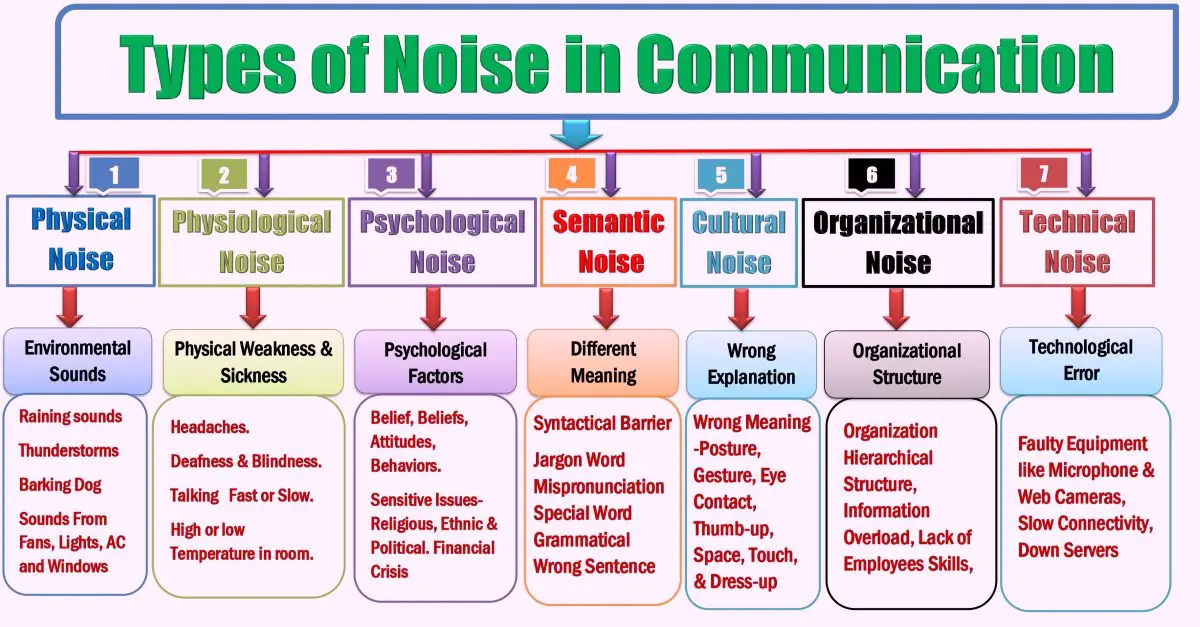
Different Types of Noise in Communication

Types of Communication Noise
Seven Types of Noise in Communication

Real-Life Example of Communication Noise

A classic real-life example of communication noise is hearing a loud car horn during an urgent phone call. This scenario perfectly demonstrates how multiple communication barriers can interact simultaneously to disrupt a message.

Imagine Elly is severely ill at home. She calls her husband, Jack, to ask him to bring home specific medicine. As she speaks, a passing driver blares their car horn outside Jack’s window.

Because of the sudden blast, Jack cannot clearly hear or decode the name of the medicine. To ensure the message isn’t lost, Jack must initiate a feedback loop by asking Elly to repeat the request.

In this single phone call, three distinct communication barriers are at play:

Table: Real-Life Example of Communication Noise

Situation Type of Noise Explanation Effect on Communication
Loud vehicle horn during a phone call Physical Noise External environmental sound interrupts hearing The receiver cannot clearly hear the message
Elly is sick while calling her husband Physiological Noise Sender’s physical condition affects communication clarity The message may be unclear or weakly delivered
Jack is asking to repeat the message Feedback disruption The receiver did not understand due to the noise Communication becomes slower and less efficient

Types of Noise in Communication

The key types of noise in communication are physical or environmental, physiological, psychological, semantic, cultural, organizational, and technical noise. The author studies several articles published in reputed journals, including Sage Journals and the International Journal of Communication. These articles demonstrate different types of noise; for example, Brogan explains semantic noise in communication in his paper published in the Journal of Technical Writing and Communication (Brogan, 1974). In this article, the author compiles all types of noise mentioned in academic journals and illustrates them with real-life examples. 

Seven Types of Communication Noise

  • Physical Noise
  • Physiological Noise
  • Psychological Noise
  • Syntactical Noise
  • Cultural Noise
  • Organizational Noise
  • Technical Noise

The seven types of noise in communication are physical or environmental, factual, physiological, psychological, semantic, cultural, organizational, and technical noise.

However, additional noise in the communication process includes group communication noise, syntactic, emotional, medium, encoding, and decoding noise, etc. 

Table: 7 Types of Noise in Communication at a Glance

No Type of Noise Description Real-Life Example
1 Physical Noise External environmental distractions that hinder message reception Loud traffic, horn sounds, and construction noise during a phone call
2 Physiological Noise Physical or biological issues affecting communication Hearing impairment, headache, and illness while listening to a lecture
3 Psychological Noise Internal mental and emotional interference Stress, anger, prejudice, or daydreaming during communication
4 Semantic Noise Misunderstanding of words, language, or meaning Technical jargon or ambiguous words causing confusion
5 Cultural Noise Differences in culture, values, and beliefs Misinterpretation of gestures or expressions in cross-cultural communication
6 Organizational Noise Barriers created by organizational structure or hierarchy Delayed messages due to the chain of command or poor workflow
7 Technical/Channel Noise Problems in communication tools or media Poor internet connection during a video call or distorted audio

1. Physical Noise

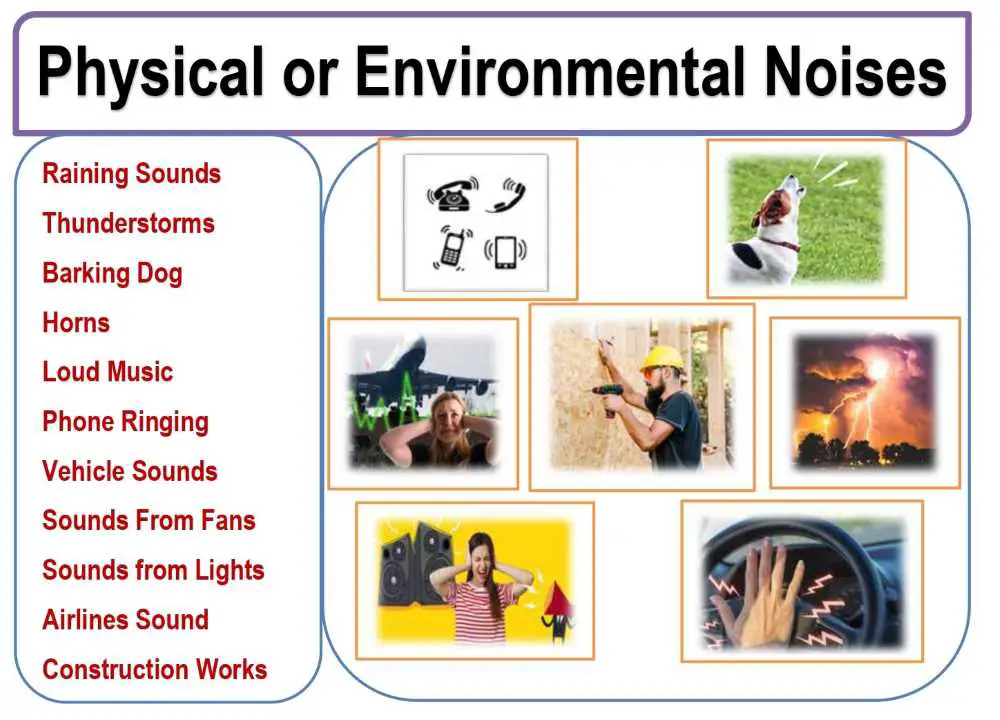
Physical noise is external, unnecessary sound that hinders effective communication. It is also a communication disturbance created by the environment. Therefore, physical noise is also known as environmental or factual noise in communication. Factual noise comes from ambient background noise in the environment.

Example of Physical Noise

For example, rain, thunderstorms, ringing phones, horns, airline sounds, whispering, sounds from outside the building, and sounds from fans, lights, and windows are the best examples of physical or environmental noise. Besides loud music, barking dogs, and nearby noisy conflicts, vehicle sounds are among the sources of physical noise. These are also examples of factual noise in communication.

Environmental Noises
Environmental Noises in Communication
Factual Noise Example

“Imagine the top management professionals organizing a meeting to amend company rules and regulations, the HR manager tried to propose a list of new rules related to working time. However, the meeting room was filled with factual noise as employees whispered and raised issues related to pension and lunch break rules.  Despite the HR managers’ attempts to steer the working-time issue, the factual noise persisted and interfered with the decision-making process.

2. Physiological Noise

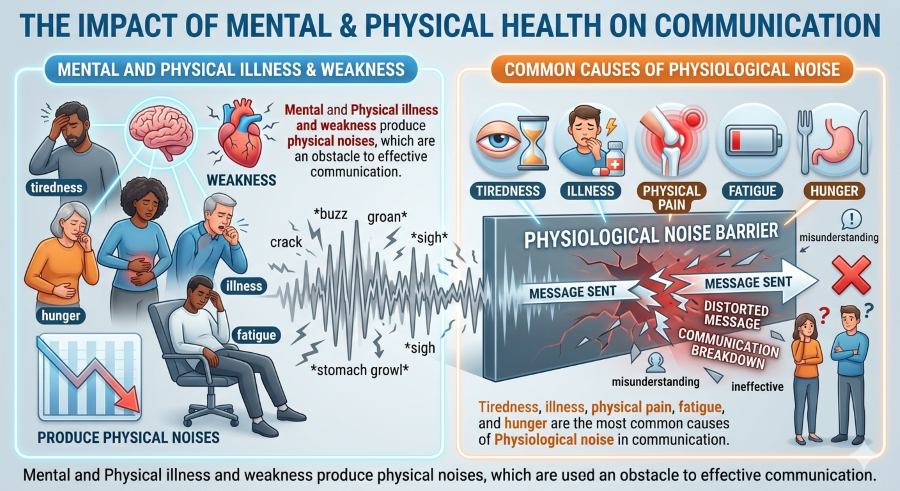
Physiological noise is a barrier created by the communicator’s physical and physiological condition. Mental and Physical illness and weakness produce physical noises, which are an obstacle to effective communication. Tiredness, illness, physical pain, fatigue, and hunger are the most common causes of Physiological noise in communication. These physiological factors prevent people from speaking and listening properly. 

Physiological communication barriers

Example of Physiological Noise

For example, Ela is having headaches; therefore, she can not concentrate in class. Here, a headache is a physical illness that hinders the listening process of communication.  Also, deafness and blindness are physical impairments that hinder hearing and vision. Talking too fast or too slow, and the room’s high or low temperature, also generate physiological noise. 

3. Psychological Noise

Psychological noise is a communication barrier created by the communicator’s psychological factors, for example, emotions, thoughts, values, beliefs, attitudes, and behaviors. This noise is generated from an internal condition that prevents people from sending and receiving messages effectively.

This type of noise interrupts our minds from concentrating on listening. People don’t like to listen to or talk about topics that make them feel down or aren’t enjoyable. Apart from that, ethnocentrism, prejudices, stereotypes, and discrimination are also examples of psychological noise. These factors bar effective communication in a group or team. The four noises in group communication are ethnocentrism, prejudices, stereotypes, and discrimination. Psychological noise in communication interferes with respect for and acceptance of other opinions. 

Example of Psychological Noise

For example, Elly is a Muslim girl who does not like to listen to any criticism of Islam. Therefore, she became distracted when her lecturer discussed anti-Islam issues. Any sensitive issues like religious, ethnic, and political are examples of psychological noise. Apart from that, a financial crisis, the loss of a loved one, and an exhausting schedule may cause psychological noise. 

4. Semantic Noise

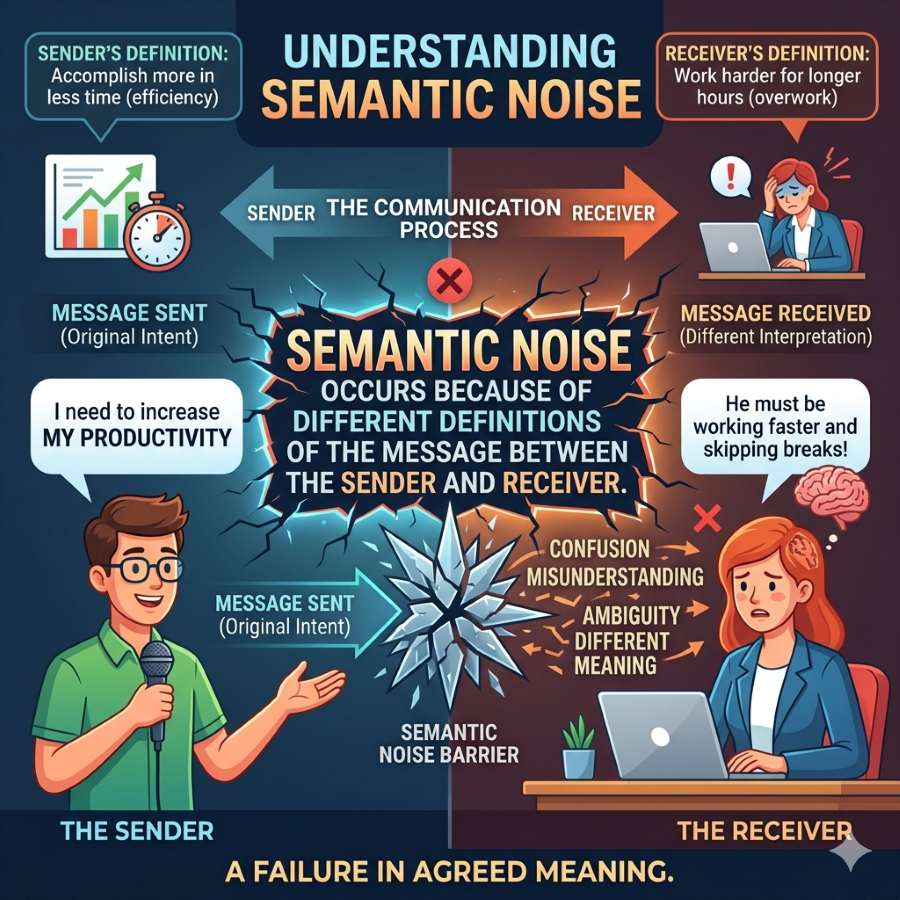
Semantic noise is a communication barrier created by confusion over the meaning of words. It comes from complex, technical, autochthonous, or grammatical errors in communication. Semantic noise occurs when the message is defined differently by the sender and receiver. It also refers to a grammatically incorrect sentence that makes the receiver unable to understand the meaning. Scholars term it a syntactical barrier or noise.

Syntactical noise is a grammatically wrong sentence in which the receiver cannot derive the proper meaning. Using complex language during computer programming is an example of syntactical noise. It also contrasts with syntactic sugar.

Semantic noise in communication

Example of Semantic Noise

Ela is an international student who studies at the University of Putra Malaysia. She is listening to lectures from her Malaysian lecturer. In the meantime, her lecturer says, ” I believe SEMUA understand this topic.” SEMUA is a Malaysian word meaning “everyone”. Ela does not understand the meaning of “SEMUA” because she is not a Malaysian student. It is an example of semantic noise.

Similarly, a lecturer says that the natural causes of climate change and global warming are distinct. However, a few students are confused about the lecturer’s statement. The confusion has come from semantic noise. These students believe that climate change and global warming are the same phenomenon. Finally, the lecturer describes global warming as the rise in Earth’s temperature. On the other hand, climate change points to both increases and decreases in global temperature. It is also an example of semantic noise.

Additionally, jargon, mispronunciations, unique words, and grammatically incorrect sentences are Semantic Noise.

Examples of Semantic Noise

1. Jargon or Technical Language: Semantic noises can be portrayed when a speaker uses a technical term, specialized language, idiom, or abbreviation. Receivers might not understand if they are not familiar. For example, a lecturer assigns their students to write an SOP as a final assignment and submit it before the final exam. SOP might be short for standard operating procedure or a statement of purpose. It makes students confused.

2. Ambiguity: Ambiguous language conveys confused messages that generate misunderstanding. For example, if an applicant says, “I will email a resume with a cover letter soon”. In this scenario, Soon might not specify the exact timeframe when the applicant will email the resume.

3. Slang or Colloquialisms: The use of slang or colloquial language might convey confused information. These terms bar the communication process depending on the receiver’s age and context. For example, the word “cool” might convey confused messages to the older generation. 

4. Misinterpretation of Nonverbal Cues: Nonverbal communication cues, including body language, gestures, and artifacts, may lead to misinterpretation of the message. For example, a smile might signal friendliness and ignorance depending on context.

5. Cultural Noise

Cultural noise is a communication barrier arising from cultural differences, leading to different explanations of another person’s behavior. This noise can be caused by the wrong meaning of messages; therefore, it is known as semantic noise. In particular, cultural noise arises from the nonverbal communication of people from different cultural backgrounds. The basic kinds of nonverbal communication cues are posture, gesture, eye contact, space, touch, and dress. The meaning of nonverbal cues varies across cultures and societies. The conflicting message in communication is one form of cultural noise. 

Cultural noise can manifest in various forms, including language barriers, nonverbal communication, cultural stereotypes, cultural norms and values, and cultural differences.

Cultural Noise in Communication

Cultural Differences: The same language and words depict different meanings in different cultures. For example, the phrase “Thumbs up” indicates a positive indication in the USA and European countries. Contrastingly, the phrase “Thumbs up” indicates a negative meaning in Middle Eastern countries, including Iran and Afghanistan.

Example of Cultural Noise

Jon is a Russian citizen who is studying at the University of Putra Malaysia. He offers his Malaysian female friend a handshake, but she declines. It makes Jon feel very embarrassed. Later, he understood that women in Malaysia do not like to shake hands with men, which is a cultural norm.

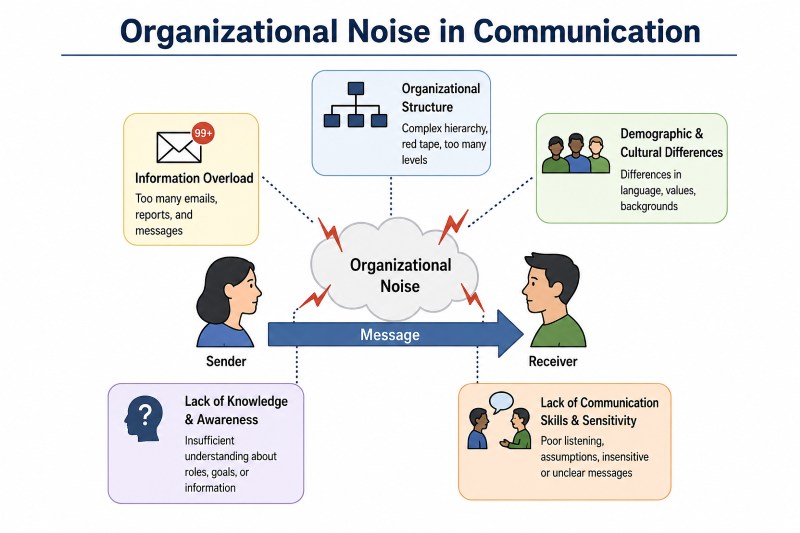
6. Organizational Noise

Organizational noise occurs when the communication flow is impeded by organizational structure, information overload, and demographic and cultural differences among employees. It also happens due to a lack of sensitivity, knowledge, and communication skills among new and existing employees. The new employees have poor communication skills, insufficient subject knowledge, emotional interference, etc.  According to Geert Hofstede’s cultural dimensions, monochronic members in an organization prefer to complete tasks on time; in contrast, polychronic members are continually late in completing office tasks.

Organizational Noise in Communication

Example of Organizational Noise

For example, new employees do not know to whom they should submit the monthly report. In this scenario, noise occurs within a complex organizational hierarchy. A flat, decentralized organizational structure provides employees with great freedom to make decisions. Netflix’s flat organizational structure reduces communication noise.

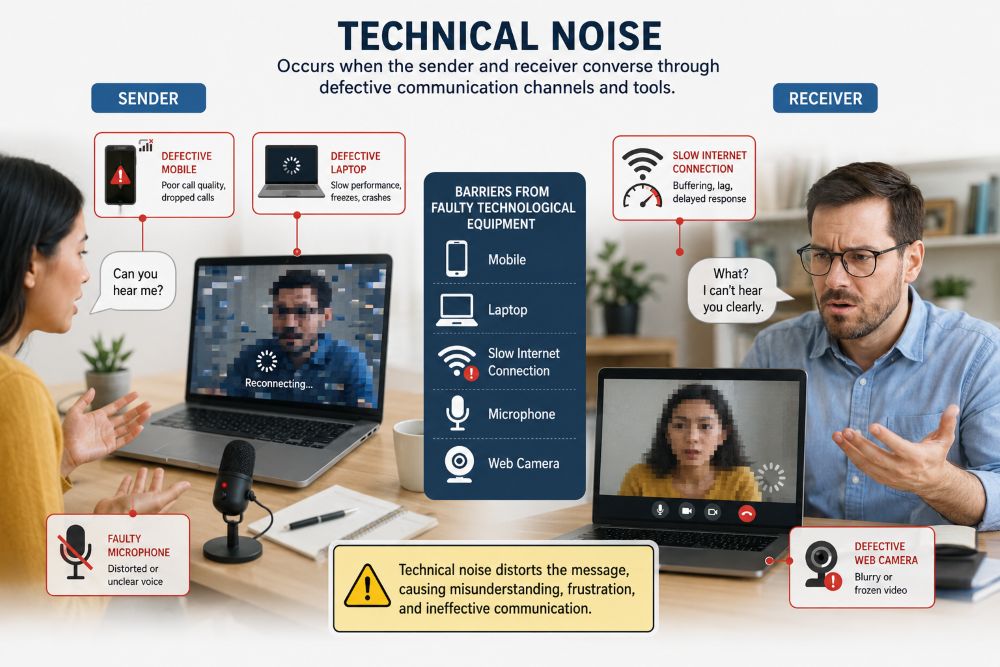
7. Technical Noise

Technical noise occurs when the sender and receiver converse through defective communication channels and tools. The barriers come from faulty equipment, such as a mobile, a laptop, a slow internet connection, a microphone, and a web camera. It is related to information and communication technology and electrical devices, including email delivery problems, television signal interference, and webpage loading errors.

Therefore, it is known as electrical noise in technology-based communication. Electrical Noise differs in shot and thermal barriers.  Shot noise originates from the audio output of receivers. Thermal noise is generated from the random movement of electrons in the electronic device.

Technical Noise or Barriers

Example of Technical Noise

For example, a lecturer conducts online classes through Google Meet. A student cannot hear the lesson due to a slow internet connection. Another student is unable to hear the class because of a headphone issue.

Apart from these five basic types of noise, additional sources in the communication process include technical noise (such as shot and thermal noise), organizational noise, and noise in group conversations.

Communication Noise: Pros and Cons

Advantages of Communication Noise 

Despite its negative aspects, communication noise can sometimes offer advantages in certain contexts, including enhancing creativity, enriching communication studies, increasing awareness, and facilitating innovation.   The following communication noise strengths are adopted from ChatGPT.

Enhanced Creativity

Communication noise influences people to be creative in resolving problems. Human beings find alternative ways when they encounter barriers. Hence, communication noise makes people creative, innovative, and critical thinkers.

Enrichment of Communication Studies

Researchers conduct more research on noise in communication, thereby enhancing learning opportunities. Many scholars have studied ways to reduce communication barriers. These studies enrich the literature of the communication context.

Increasing Awareness

Scientists have identified noise-related problems, including anger, sickness, and stress. Many researchers have reported that environmental noise, such as sounds above 70 dB, can damage the eardrum. It highlights social awareness.

Facilitation of Innovation

Finally, communication noise prompts individuals to innovate solutions to overcome it as a barrier to effective communication. It fosters a culture of innovation in society and organizations.

Disadvantages of Communication Noise

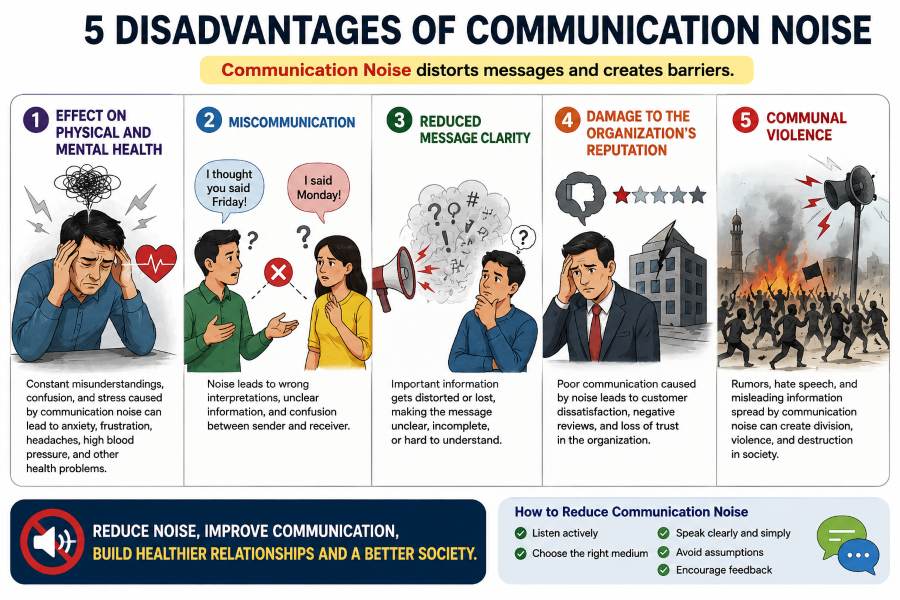
The five disadvantages of communication noise are the effect on physical and mental health, miscommunication, reduced message clarity, damage to the organization’s reputation, and communal violence.

 five disadvantages of communication noise

1. Noise Effects on Physical and Mental Health

Firstly, noise makes people exhausted, anxious, irritated, dissatisfied, tense, angry, and sick. Babies and ill people cannot sleep due to environmental noise. People can become deaf if they are exposed to loud noise for a long time. Noise above 70 dB damages the eardrum. In 2022, researchers at HARVARD Medical School identified that people encounter autonomic stress reactions when they wake up from a loud sound (Environmental Noise), and it might cause cardiac arrest.

2. Miscommunication

Noise bars hinder effective communication and lead to misunderstandings. Sometimes, psychological and semantic noise spreads misleading information. Organizational noise damages the company’s reputation.

3. Reduced Message Clarity

Noise reduces the clarity of the message by introducing distortion. It affects the receiver’s ability to interpret meaning accurately. In some scenarios, communication noise can lead to the loss of important messages.

4. Damage the Organization’s Reputation

Noise hampers organizations financially by reducing employees’ productivity.  The workers cannot concentrate appropriately due to noise. The organizational noise arises from a faulty communication channel. Communication noise can tarnish an individual’s or an organization’s reputation.

5. Create Communal Violence

Semantic noise spreads misleading information among people. Sometimes it sparks communal violence when the message comes from political or social leaders. Political group members indulge in spreading fake information and creating communal riots.

Noise in Group Communication

Barriers to Group Communication are disturbances that hinder interactive communication among group members. The barrier in group communication usually hinders understanding other members of the group or team. The four types of barriers in group communication are Ethnocentrism, Stereotyping, Prejudice, and Discrimination. The group discussion involves many stages, tensions, and conflicts. According to Tuckman’s Theory, the five stages of group discussion are Forming, Storming, Norming, Performing, and Adjourning. Members must overcome all these stages to achieve the independent and interdependent goal.

FAQ (Frequently Asked Questions): Communication Noise)

Q: What are the 7 types of noise in communication barriers?

A: The 7 types of communication noise are Physical, Physiological, Psychological, Semantic, Cultural, Organizational, and Technical.

Q: The negative impact of communication noise? 

A: Noises adversely impact personal, social, political, and organizational contexts.

Q: How to make communication more effective?

A: We have to minimize noise to make communication more effective, productive, and efficient.

Q: Do communication noises exist in all types of communication processes?

A: Communication noise is prevalent across all communication contexts, including face-to-face, group, mediated, and corporate contexts. Noise is an unwanted element of the communication process.

Q: What is the difference between noise and barriers in communication?

A: Noise and Barriers in conversation denote the same meaning, although people use them in different interaction contexts. For example, people use the word “noise” when encountering obstacles in face-to-face or group communication. On the other hand, people use the word “barrier” when facing obstacles in corporate or mediated communication. Noise refers to the hindrance during the interaction between the sender and the receiver. However, many people, including scholars, described them as noise barriers. People also refer to them as distractions, distortions, disturbances, etc.

References (APA 7th Edition)

Brogan, J. A. (1974). Semantic Noise. Journal of Technical Writing and Communication, 4(4), 315-322. https://doi.org/10.2190/9174-347D-EKM5-5RCV

Rothwell, J. D. (2025). Communication Myths: What We Know that Isn’t So and what We Need to Know.

Shannon, C. E., & Weaver, W. (1949). The Mathematical Theory of Communication. Urbana, IL: University of Illinois Press.