This article provides a clear explanation of the Shannon and Weaver Model of Communication, one of the most renowned and widely cited theories in the field of communication. It outlines and explains the six key components of the model—including sender, encoder, channel, noise, decoder, and receiver. Additionally, it explains how the message is transmitted from the sender to the receiver through the six elements. To enhance understanding, this academic article also presents a practical, real-life example of how we use this theory in our daily communication. The purpose of this guide is to provide students, researchers, and content producers with a clear, well-organized understanding of the model’s concept and use.
What is Shannon and Weaver’s Model of Communication?
Shannon and Weaver’s communication model is linear and was published in their 1949 book The Mathematical Theory of Communication. American mathematician Claude Elwood Shannon and scientist Warren Weaver published this model in the University of Illinois Press in Urbana, IL. Now, it has become one of the best communication models in communication studies. Therefore, it is called Shannon and Weaver’s communication model.
Initially, Claude Elwood Shannon introduced this model in 1948 in the article ” The Mathematical Theory of Communication” in The Bell System Technical Journal (Shannon, 1948).
Later, they proposed this mathematical model to describe the signal-transmitting system and enhance telephone communication by minimizing noise. It is now applied across every field of information and communication. However, the Shannon-Weaver model excluded feedback; hence, it is a linear communication model. Therefore, it was an incomplete model because it did not include Feedback.
In 1950, Norbert Wiener incorporated feedback into the model to counter criticism of the one-way communication approach. Shannon and Weaver’s communication model is called the “Mother of all Communication Models” for its extreme popularity. It is also called the mathematical theory of communication, Shannon theory, and information theory in the engineering disciplines.
Table: The History of the Shannon-Weaver Model of Communication
| Category | Details |
|---|---|
| Created By | Claude Elwood Shannon and Warren Weaver |
| Established Year | In 1949, Shannon first published the concept in 1948 as “A Mathematical Theory of Communication”. In 1949, it became a collaborative model when Warren Weaver joined and expanded its application to human communication in a published book. |
| Elements | Information Source, Transmitter, Channel, Receiver, Destination, and Noise Source. |
| Alternative Names | Mathematical Theory of Communication, Information Theory, Shannon’s Theory |
| Award | Mother of all Communication Models |
| Types | Linear Communication Model |
The Key Elements of the Shannon-Weaver Model of Communication
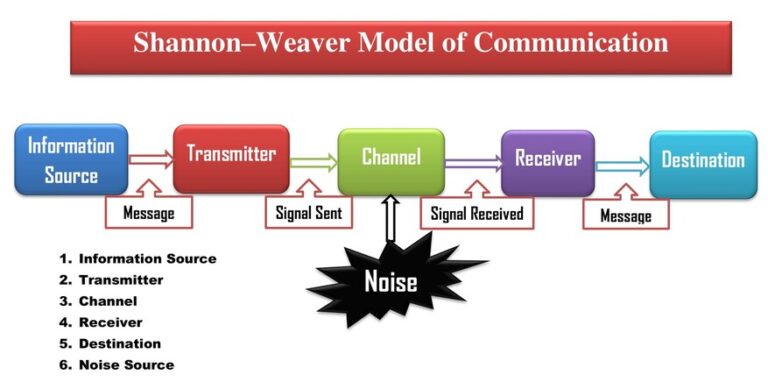
The Six Elements of Shannon and Weaver’s Model of Communication are:
- Information Source.
- Transmitter.
- Channel.
- Receiver.
- Destination.
- Noise Source.
Shannon-Weaver Model Elements Details at a Glance
| Element | Description | Real-Life Example |
|---|---|---|
| 1. Information Source (Sender) | The individual or system that creates and sends the message to the destination. | A person (e.g head of marketing) deciding to send an email, make a phone call, or type a message. |
| 2. Transmitter (Encoder) | The device or process that converts the message into signals or digital format suitable for transmission. | A message-transmitting platform like Gmail or a social media site that transforms text or voice messages into digital data. |
| 3. Channel | The medium or pathway through which the encoded message travels from sender to receiver. | The internet connection or social network that conveys the message. |
| 4. Noise Source | Any internal or external disturbance that disrupts or distorts the message during transmission. | Poor internet connection, technical errors, or environmental or psychological conditions. |
| 5. Receiver (Decoder) | The system or device that receives and converts the transmitted signals back into an understandable form. | A smartphone or social media site like WhatsApp that decodes incoming data into a thoughtful message |
| 6. Destination | The final intended recipient who receives and understands the original message. | The sales team listened to the head of marketing’s speech. |
1. Information Source
An information source is the sender in the communication process who conveys the message to the receiver. It also indicates the person who generates the information and begins the communication process.
- Example: Mr. Azlan, the head of marketing, delivers a motivational speech to the sales team via a Zoom meeting to boost monthly sales. In this context, Mr. Azlan is the source of information who initiates the conversation.
2. Transmitter (Encode)
The transmitter is the message converter that converts the message into a signal for transmission through the communication channel (Shannon & Weaver, 1949). It is also called the encoding process. The messages are spoken words, written messages, pictures, music, and nonverbal cues.
- Example: The head of marketing’s speech is delivered via Zoom. The software converts and transmits the message using a streamlined combination of VoIP (Voice over IP) technologies, audio compression, and a cloud routing system.
3. Channel
A channel is the medium that conveys the message from senders to receivers (Shannon & Weaver, 1949). Communicators use distinct channels, such as human senses, radio, television, newspapers, electronic tools, social media, and so on.
- Example: Zoom meeting software is the channel through which the head of marketing transmits the message to the sales team.
4. Receiver (Decode)
Receivers are the individuals who convert the signal into a meaningful message. They are responsible for decoding the message. So, the receiver is the decoder of the communication process.
- Example: The sales team members also use a computer or smartphone to manage Zoom meetings. In this context, their devices are the receivers of the message. The receivers who receive the message and decode it into meaningful thoughts.
5. Destination
Destination refers to both the sender and the receiver in the communication process, who encode and decode the message.
Example: The head of marketing wanted to send all the messages to the targeted sales team members. In this context, the sales team members are both the recipients and the destination of the message.
According to Shannon and Weaver’s Model, “when I talk to you, my brain is the information source, yours the destination; my vocal system is the transmitter, and your ear and the associated eighth nerve is the receiver.”
6. Noise
Noise is the unwanted sound barrier of the communication process that disrupts effective communication (Shannon & Weaver, 1949). Communicators found noise in every communication process, including verbal, nonverbal, written, visual, face-to-face, mediated, and group communication. The most common types of noise in communication are physical, physiological, psychological, semantic, electrical, syntactic, cultural, and so on.
- Example: The seven types of communication noises are Physical, Physiological, Psychological, Semantic, Cultural, Organizational, and Technical. Airplane sound is considered a physical noise in communication that distracts the students from hearing the speech. The technical noise comes from faulty equipment, such as a poor internet connection, a faulty microphone, or a web camera.
Feedback in the Shannon-Weaver Model (The 7th Element)
In 1950, Norbert Wiener added the “Feedback” to Shannon’s model. He presented the feedback system in the book (The Human Use of Human Beings), initially published in 1950. Norbert Wiener is also the founder of cybernetics, which explains feedback systems.
The Shannon and Weaver communication model includes six elements: Information Source, Transmitter, Channel, Receiver, Destination, and Noise Source. In 1949, Shannon and Weaver did not mention “Feedback”; hence, it is a linear communication model, like the models of Aristotle and Lasswell. Many researchers and practitioners criticize this model for not adding “Feedback.”
Therefore, Norbert Wiener later included “Feedback” to describe the transactional communication process. Many communication models have been postulated based on this model, for example, Eugene White’s model and Osgood-Schramm’s transactional model.
4 Real-Life Examples of the Shannon-Weaver Model
The four example situations of the Shannon-Weaver model provide an in-depth understanding of how this technical system applies to daily life:
- Ordering Food Through Food Panda
- Simple Job Application Email
- Listening to the News on the Radio
- Watching the United States Presidential Debates- 2024
Scenario 1: Ordering Food via an App (e.g., Foodpanda)
- Information Source: In this scenario, the customer is the information sender who orders a meal through the Foodpanda Mobile App.
- Transmitter (Encoder): The customer encodes messages and transmits them through a signal via a mobile application using TCP/IP sockets.
- Channel: The mobile application is the channel through which messages are transmitted from senders to receivers.
- Noise: A momentary drop in Wi-Fi or cellular signal slowing the transaction.
- Receiver (Decoder): The restaurant’s tablet or kitchen display device decrypts the notification.
- Destination: The restaurant chef and delivery driver who read and fulfill the order.
Scenario 2: Sending a Job Application Email
- Sender or Source of Information: The applicants write a simple job application email with a CV attachment.
- Transmitter: The Gmail email software converts ideas into text messages for transmission.
- Channel: The internet-based email conveys the message to HR professionals
- Noise: Like spam filters or internet issues, might interfere.
- Receiver: The computer and email of the HR manager.
- Destination: The manager who receives the email and takes further action sometimes forwards the email cover letter with the attached resume or forwards it to the concerned professional.
Real-Life Scenario 3: Listening to a Radio News Broadcast
- Information Source: The news presenter broadcasts today’s weather forecast. In this context, the news presenter is the information source or sender of the message.
- Transmitter (Encoder): The radio station equipment transforming voice patterns into electromagnetic waves.
- Channel: Radio frequencies traveling through space.
- Noise: Radio Frequency Interference (RFI) from localized electrical equipment causing static.
- Receiver (Decoder): The physical radio device inside a listener’s home, decoding the wave back into sound.
- Destination: The listener of the radio news; for example, Jon hears and interprets the weather alert.
Scenario 4: Watching a Televised Presidential Debate
- Information Source: Political candidates participating in a live debate.
- Transmitter (Encoder): CNN televised the first general election debate for the United States Presidential Debates 2024. Television studio cameras and sound boards translate the debate into high-definition digital broadcast streams.
- Channel: Cable television networks or satellite feeds (such as CNN).
- Noise: Buffering issues on a smart TV or localized power flickers. Receiver
- Decoder: The television set in the viewer’s living room is decoding the feed.
- Destination: Around 51.27 million people watched this presidential debate, and most think that Trump performed better than Joe Biden.
Shannon and Weaver Communication Model Advantages and Disadvantages
| Strengths of the Shannon and Weaver Model of Communication | Limitations of the Shannon and Weaver Model of Communication |
| 1. Explain IT-Based Communication: Firstly, Shannon and Weaver’s theory enhances telephone communication by representing six essential elements. It articulates the signal-transmitting system through the medium. The model provides a clear and straightforward framework for understanding the technology-based communication process. This simple model can be used in multiple contexts. | 1. Linear and One-Way: Firstly, it is a linear communication model because it does not demonstrate feedback. The model describes that communication is a one-way process. However, most communication processes are two-way and directional. Therefore, this model is inappropriate for analyzing transactional communication processes, such as face-to-face discussions. |
| 2. Representing Key Components (Noise): For the first time, this theory explains the communication noises that hinder effective message transmission. Noise is a significant communication component. This model includes key components of the communication process, including noise. Many communication theories avoid noise as the unwanted key component in communication. Controversially, it is the first linear model that explains noise as a fundamental element. |
2. No Feedback:The Shannon-Weaver model does not include feedback in communication. Avoiding feedback is the major weakness of this model because every transactional communication holds feedback. |
| 3. Diverse Applicability: Shannon and Weaver’s model can be used to explain diverse communication contexts, including interpersonal, social, mass, digital, and organizational communication. | 3. Focus on Technological Context: Shannon and Weaver’s model of communication highlights the technological communication context, overlooking social, psychological, and cultural contexts. Shannon Weaver’s model was designed to explain mediated communication. |
| 4. Technological Relevance: This model was established in 1948; however, it is still relevant to analyze digital communication. Finally, Shannon-Weaver’s framework is the first communication model that explains the message-sending process through an instrument. It has contributed to the development of telecommunications systems, digital coding techniques, and data transmission technologies. |
4. Ignores Psychological and Cultural Factors: This model does not consider how psychological factors like culture, beliefs, values, and attitudes affect the communication process. |
Summary
In short, the Six Elements of the Shannon and Weaver Model are Information Source, Transmitter, Channel, Receiver, Destination, and Noise Source. Eventually, Norbert Wiener included the seventh element (Feedback) to make it a transactional communication model. Shannon and Weaver’s Model was introduced in 1949 and is undoubtedly a linear communication model, like Aristotle’s, Lasswell’s, and David Berlo’s SMCR Model.
FAQ (Frequently Asked Questions) Shannon’s Model
Q: What are the components of the Shannon and Weaver Communication Model?
A: The Six Elements of the Shannon and Weaver Model are Information Source, Transmitter, Channel, Receiver, Destination, and Noise Source.
Q: Is there any Feedback in the Shannon-Weaver Model?
A: In 1950, Norbert Wiener added the “Feedback” to Shannon’s model (Wiener, 1950). He presented the feedback system in the book (The Human Use of Human Beings), initially published in 1950. Norbert Wiener is also the founder of cybernetics, which explains feedback systems. Shannon and Weaver have not published the modified model, including feedback. Hence, the original model of Shannon and Weaver is linear, as they did not mention feedback.
Q: Is the Shannon and Weaver Model a Linear or Transactional Model of Communication?
A: Shannon and Weaver introduced the linear communication model with six elements: information source, transmitter, channel, receiver, destination, and noise source. The authors did not add feedback to this model in 1949; therefore, it is a linear communication model. However, later, the feedback was included by Norbert Wiener in 1950 (Wiener, 1950).
Q: What is the Established Year of the Shannon-Weaver Model?
A: The Shannon and Weaver model was introduced in 1949. However, there is controversy regarding the establishment year of the Shannon and Weaver model. Claude Shannon published the article(A Mathematical Theory of Communication) in the Bell System Technical Journal in 1948, known as the Shannon theory. Warren Weaver republished the previous article in 1949, adding more information and discussing the model’s implications for effective communication. They also renamed The Mathematical Theory of Communication while republishing it in a book. Therefore, it is known as the Shannon-Weaver model of communication.
Warren Weaver did not contribute to the article (A Mathematical Theory of Communication) published in 1948 by Claude Elwood Shannon. So, Weaver’s name cannot be included in the model published in 1948. He co-authored the same article in 1949 and, upon reprinting it in the book, renamed it “The Mathematical Theory of Communication“. The Mathematical Theory of Communication is called Claude Shannon and Warren Weaver’s model of communication. So, it is rational to say that the Shannon and Weaver model was introduced in 1949, not 1948.
What is the APA citation for Shannon Weaver’s communication model in 1949?
Shannon, C. E., & Weaver, W. (1949). The mathematical theory of communication. Urbana, IL: University of Illinois Press
References (APA 7th Edition): Scholarly Citation
Shannon, C. E. (1948). A mathematical theory of communication. The Bell System Technical Journal, 27(3), 379–423. https://doi.org/10.1002/j.1538-7305.1948.tb01338.x
Shannon, C. E., & Weaver, W. (1949). The mathematical theory of communication. Urbana, IL: University of Illinois Press.
Wiener, N. (1950). The human use of human beings: Cybernetics and society. Houghton Mifflin.

M M Kobiruzzaman is a researcher, academic content writer, traveler, and the founding editor of Newsmoor.com. Specializing in communication, management, technology adoption models, and frameworks analysis, and journalism, his work bridges the gap between theory explanation and cultural communication. With a strong background in communication and management, he is dedicated to providing authoritative guides that elevate business and media literacy and academic writing standards.