Minutes of Meeting Example, Sample, Elements, Types & Advantages or Importance of Meeting Minutes.
Minutes of Meeting
Meeting Minutes are a written record of the activities of a company, organization, or group. It is also known as the meeting notes. Meeting minutes record what happened during a meeting. Additionally, it records the decisions taken during the discussion. Furthermore, the employee can revisit the important issue discussed in the conference. Finally, the purpose of minutes is to take detailed notes during the meeting on attendance, discussion, who is responsible for which task, how to solve problems, vision, mission, and more. Therefore, taking minutes of meetings with specific notes is an essential part of every formal meeting discussion.
Minutes of Meeting Types
The two types of meeting minutes are physical and online. Physical meeting minutes include the meeting location and venue. On the other hand, virtual meeting minutes are recorded on platforms such as Google Meet, Zoom, Microsoft Teams, and others. The physical meeting minutes are also known as minutes.
Minutes of Meeting Example
Meeting Minutes Template and Sample
On the other hand, Online meeting minutes include the online meeting platforms used for the meeting. Many organizations, educational institutes, and social worker groups are conducting online meetings due to the COVID-19 Pandemic. The example of physical and virtual meeting minutes has been discussed here for better understanding.
Elements of Meeting Minutes
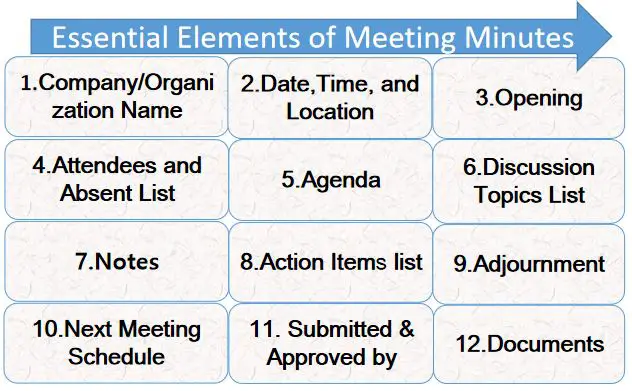
The 12 elements of meeting minutes are:
1. Company or organization name
2. Date, Time & Location
3. Opening
4. List of attendees and Absent
5. Agenda
6. Discussion
7. Note
8. Action Items
9. Adjournment
10. Submitted by
11, approved by
12. Documents.
The Minutes of the Meeting need specific components to make them more meaningful. It is also known as the feature of meeting minutes. The
1. Company or Organization Name
The company name is the essential element of meeting minutes. Every minute of the meeting needs to have an exact organization name at the top of the letter, and add a logo if you have one.
2. Date, Time & Location
The precise date, time, and location are the prime components of minutes to express the profound meaning of discussion meetings.
3. Opening
For example, the regular weekly meeting of the Demigods Bullies group was called to order on 24 June 2024, 4:00 PM in room 202 in the Faculty of Modern Language and Communication.
4. List of attendees
The list of attendees includes all the participants of the meeting. For example, the members who participated in the meeting.
List of Absences
It notifies those who did not join the meeting. For example, the members who did not join the meeting discussion. It also updates and reminds members who are absent from the meeting.
5. Agenda
The agenda includes the discussion issues in the meeting. It seems like the main plan is a list of activities—a list of topics to be discussed at the meeting.
6. Discussion
This is similar to the agenda, but it provides a brief discussion of the main point. The members discuss issues briefly. Every member tries to provide their opinions.
7. Note
It is a way to record key points from the discussion. Take a record of who will do which task later. The note here implies a list of people assigned specific tasks.
8. Action Items
Based on the discussions, I sorted a few issues that must be completed within a time period. For example, how many decisions have been taken during the meeting? In this stage, you have to follow the 5W and 1H rules to accomplish.
9. Adjournment
It is written evidence of when and how the meeting was dismissed.
10. Submitted by
It represents who writes the meeting minutes and submits them to the authority.
11. Approved by
It describes the top management individual who accepts and approves the meeting.
12. Documents
Documents refer to the items that we attach to the meeting minutes; for example, photos, Word files, and PDF files.
In conclusion, you can add some extra elements if necessary, but they should be more specific and meaningful. Above all, these components of meeting minutes will make your minutes of meeting minutes more significant.
Minutes of Meeting Elements
The 12 Elements of Minutes of Meeting
Minutes of Meeting Example
University students designed the following meeting minutes. The author wrote these meeting minutes based on group meetings to complete an assignment. It was not a business meeting. However, it represents how to write business minutes.
Demigod Anti-Bullying Students Group
Minutes of Meeting
24 June 2024/ 4:00 PM
Opening
The regular weekly meeting of Demigods Bullies was called to order on 24 June 2024 at 4:00 PM in room 202, Faculty of Modern Language and Communication, Universiti Putra Malaysia.
Attendees List
Kobiruzzaman, Joshua, and Samuel.
Absent List
MaXiaojie, Rania.
Agenda
Capturing photos and making a video
Active on Social media
Planning for a drama and talk show program.
Discussion
First, we must create photos and videos to illustrate the negative impact of bullying and cyberbullying. These photos and videos will represent our activity with diverse creativity.
In addition, all group members must emphasize social media activities such as uploading photos and videos regarding bullying and cyberbullying.
Finally, we must prepare adequately to perform effectively in the final program at Dewan Za’ba. Every group member will rehearse according to the script.
Notes
Kobiruzzaman will be responsible for booking the Dewan Za’ba hall room for our final program by next week.
Additionally, Joshua will print out all posters with proposals.
Samuel and Jiven will go to the departmental office to get the necessary signatures to approve these posters for hanging on the boards.
Action Items
A group session on dividing group members’ duties for the social campaign, focusing on the negative impact of bullying and cyberbullying, will be held on 29 November 2019.
Additionally, we have finalized the dress code, food, and beverages for the program.
The member has approved the program budget; therefore, everyone must deposit payment before the due date.
Adjournment
The meeting was adjourned at 6 PM by the anonymous decision of group members. Hence, the group leader loudly declared the adjournment.
Next Meeting
According to today’s meeting decision, our next meeting will be held on Tuesday, 5th November 2019, at 3 pm in the same venue.
Submitted by
The person who creates the meeting minutes. For example, M M Kobiruzzaman
Approved by
For example, the group leader’s name.
Importance of Meeting Minutes
Firstly, the meeting minutes record the exact date, time, location, and meeting activities. It is a form of formal evidence that documents your whereabouts. Also, it keeps clear records of attendees who attended and those who didn’t.
Further, it elaborates on the agenda and discussion topics, who will take responsibility, and how to solve the problem or achieve goals. Usually, group discussion doesn’t have a long attention span. So, minutes help to divert from sidetracking and facilitate staying on track.
Furthermore, minutes represent the list of action items and adjourning time precisely. Typically, the action list indicates members’ awareness of their respective duties and their proper, on-time performance.
Finally, the minutes of the meeting state the upcoming schedule, including specific times and dates, and list the names of those who submitted and approved them. It is an alarming directive for group members to prepare for a new meeting.
This article explains the 3 basic types of market segmentation: Demographic Segmentation, geographic segmentation, and psychographic. It also demonstrates Target Market Segmentation Theories- Maslow’s Hierarchy and VALS Segmentation Model in Consumer Behavior.
Demographic Geographic Psychographic
Demographic, Geographic, and Psychographic segmentation refers to the market segmentation technique based on the different factors related to the audience. These are the most effective strategies for dividing people into identical subgroups. The purpose of demographic, geographic, and psychographic segmentation is to segment audiences into subgroups to inform political campaigns, commercial marketing, and advertising.
Market Segmentation
Market segmentation separates people into similar subgroups based on geographic, demographic, and psychographic factors. It is an essential process for social, political, and commercial campaigns and advertising. It is an effective way to send messages to a targeted group rather than to everyone. A long time ago, audience segmentation was primarily applied for social and political campaigns. Currently, it is widely used in market segmentation. Therefore, audience segmentation is known as market segmentation.
Market Segmentation Examples
For example, a political leader is campaigning, urging voters to support his party. Thus, the leader targets voters solely to conduct the campaign. In many countries worldwide, the minimum voting age is 18 years. For example, in the USA, citizens aged 18 or older. The political leader persuades the citizens of the constituency to adopt an age minimum of 18 years. Here, a citizen of the constituency refers to the inhabitant of a particular area, which is also an example of a geographic factor of market segmentation. Similarly, age is a demographic characteristic of market segmentation.
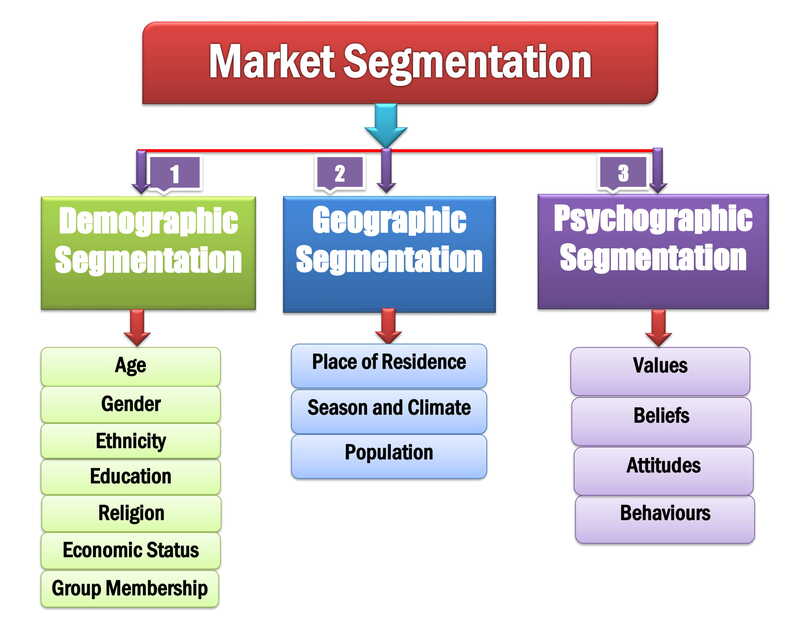
Demographic segmentation refers to the process of grouping individuals into similar subgroups based on demographic characteristics such as age, gender, ethnicity, education, religion, socioeconomic status, and group membership.
For example, a political organization divides people by age. They are looking for voters whose age is more than 18 years. It is an example of demographic segmentation. Demographic questionnaires are crucial to conducting surveys and market research.
Demographic Factors
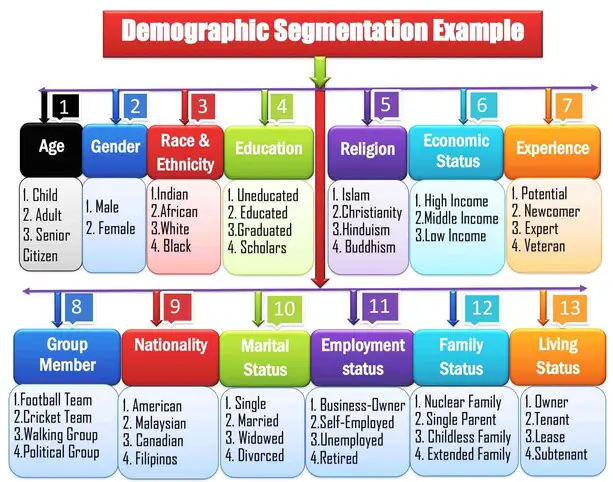
Demographic factors are characteristics of audiences, such as age, gender, ethnicity, education, and religion.
The demographic segmentation factors are Age, Gender, Ethnicity, Education, Religion, Economic status, Experience, Group Member, Nationality, Marital Status, Employment Status, Family Status, and Living Status.
Geographic segmentation refers to grouping individuals into similar subgroups based on geographic factors such as residence, climate, and population. It highlights the audience’s location and environment.
Geographic Factors
The Geographic Factors are Place of residence, Season climate, and Population.
1. Place of Residence
Place of residence refers to rural or urban areas where the audience lives, whether permanently or temporarily. People in urban and rural areas differ in their lifestyles, including dress, appearance, and attitudes. Therefore, market segmentation is essential before starting an advertising or social campaign.
2. Season and Climate
Season refers to a specific period of the year characterized by a particular climate. For example, the United States has four seasons: Autumn, Spring, Summer, and Winter.
For example, Ice cream companies earn more money in the summer season than in winter. In contrast, the blanket-selling company focuses its marketing on the winter season. The company needs to focus on geographic segmentation for the advertising campaigns.
3. Population
Population means the inhabitants of a particular area; for example, the capital city, metropolitan city, or small town. However, they share similar characteristics but also differ.
3. Psychographic Segmentation
Psychographic segmentation separates people into similar subgroups based on psychographic factors such as values, beliefs, attitudes, and behaviors. These factors indicate individuals’ internal psychological characteristics.
Psychographic Factors
The four psychographic factors of market segmentation are values, beliefs, attitudes, and behaviors; these four factors help explain how audiences feel and behave.
For example, a political leader’s values, beliefs, attitudes, and behaviors are clearly distinct from those of a physician.
1. Values
Firstly, values are judgments about what is right or wrong, desirable or undesirable. For example, most people share equality, freedom, honesty, fairness, justice, good health, and family. Another example, we respect human life naturally (Value).
2. Beliefs
Secondly, a belief is something you accept as true, and it is stated as a declarative sentence. For instance, students believe that using the internet improves the quality of their research. Furthermore, you may feel that giving blood is important because an adequate blood supply is necessary to save a life (Belief).
3. Attitudes
Thirdly, an attitude is a statement expressing an individual’s approval or disapproval, such as liking or disliking. Attitudes typically derive from our values and beliefs. Many values and beliefs interact to complicate our decision-making. For example, you may feel that giving blood is very important (Attitude).
4. Behaviors
Finally, Behavior is an individual’s observable action. It is the way we act or behave toward others. It is the combination of other psychological factors, such as values, beliefs, and attitudes.
For example, you may feel that giving blood is important (Attitude) because an adequate blood supply is necessary to save a life (Belief) and because you respect human life (Value). Your behavior is a logical and observable extension of your outlook as you participate in the blood drive and donate blood.
Example of Psychographic segmentation
For example, you may feel that giving blood is important (Attitude) because an adequate blood supply is necessary to save a life (Belief) and because you respect human life (Value). Your Behavior, as you participate in the blood drive and donate blood, is a logical and observable extension of your
Advantages and Disadvantages of Psychographic Segmentation
Advantages of Psychographic Segmentation
Deeper Understanding of Customers: Psychographic segmentation offers a more comprehensive understanding of customers beyond basic demographic characteristics such as age and income. It helps marketers understand the drivers of consumer behavior, preferences, and purchasing decisions.
Targeted Marketing Communications: By segmenting the market based on psychographic variables, marketers can tailor their messaging and communication strategies to resonate with specific consumer segments. This personalized approach enhances the relevance of marketing efforts, resulting in higher engagement and response rates.
Enhanced Product Development: Psychographic segmentation enables companies to develop products and services that align with the needs, preferences, and lifestyles of different consumer segments. By catering to the unique desires and aspirations of target customers, companies can create offerings that stand out in the market and generate greater customer satisfaction.
Improved Customer Retention: Understanding customers’ psychographic profiles enables companies to build stronger relationships and loyalty. By delivering personalized experiences and addressing customers’ values and interests, companies can foster deeper connections and increase customer retention.
Effective Market Positioning: Psychographic segmentation helps companies identify niche markets or segments with distinct needs and preferences. By positioning their products or services to address the specific desires of these segments, companies can differentiate themselves from competitors and gain a competitive advantage in the market.
Increased Marketing ROI: Targeting specific psychographic segments allows companies to allocate their marketing resources more efficiently. By focusing efforts on segments most likely to respond positively to their offerings, companies can optimize their marketing ROI and achieve better results with less expenditure.
Adaptation to Changing Trends: Psychographic segmentation enables companies to stay attuned to evolving consumer trends, lifestyles, and preferences. By continuously monitoring and analyzing psychographic data, companies can
Disadvantages of Psychographic Segmentation
Subjectivity and Interpretation Bias: Psychographic segmentation relies on subjective interpretations of consumer attitudes, values, and behaviors, which can introduce bias into the segmentation process. Different analysts may interpret the same data differently, leading to inconsistent segmentation outcomes.
Limited Generalizability: Psychographic segments may not generalize well across markets or demographic groups. Consumer preferences and behaviors can vary widely across cultural, regional, and temporal contexts, making it challenging to apply psychographic insights universally.
Complexity in Data Collection: Gathering psychographic data can be more complex and time-consuming compared to demographic or geographic data. It often requires extensive market research, surveys, and analyses to accurately uncover consumers’ attitudes, values, and lifestyles.
Overlap Among Segments: Psychographic segments often overlap, making it difficult to create distinct, actionable segments for targeted marketing. Consumers may exhibit characteristics of multiple psychographic segments simultaneously, blurring the boundaries between segments.
Privacy Concerns: Collecting and analyzing personal information related to consumers’ attitudes, values, and lifestyles raises privacy concerns. Consumers may be wary of sharing sensitive information, especially in light of data privacy regulations and concerns about data security breaches.
Two Market Segmentation Theories
Maslow’s Hierarchy of Psychological Needs theory
VALS Segmentation Model in Consumer Behavior
1. Maslow’s Hierarchy of Needs Theory
Maslow (1943) initially stated that individuals must satisfy lower-level deficit needs before meeting higher-level growth needs. It is a well-known content theory of motivation. However, he later clarified that satisfaction of a need is not an “all-or-none” phenomenon, admitting that his earlier statements may have given, for example, “the false impression that a need must be satisfied 100 percent before the next need emerges. According to Maslow’s theory, human needs can be divided into five categories. These are physical, safety, belongings, love, esteem, and self-actualization needs.
Elements of Maslow’s Psychological Needs Theory
1. Physical needs: Physical needs are basic human requirements for livelihood, for example, water, food, rest, warmth, and so on.
2. Safety needs Requirements for security and protection purposes, such as personal security, health security, employment, property, etc.
3. Belongings and love needs: Relationship with people around us for giving and receiving affection, for example, intimacy, friendship, family, and friends.
4. Esteem needs: Refers to self-confidence, self-esteem, and self-respect of humans; for example, everyone has a certain talent, so we need to pat them on the back from time to time for exploring their intellectuality.
5. Self-actualization needs: Refers to self-fulfillment, desiring to become the most that one can be; for example, we need our goals to feel that we have fulfilled our destiny or reached our potential.
The VALS (Values, Attitudes, and Lifestyles) segmentation model is a widely used framework in consumer behavior research and marketing. Developed by social scientists Arnold Mitchell and S. Robert Horton, the VALS framework categorizes consumers into distinct psychographic segments based on their primary motivations, attitudes, and behavioral patterns. Here’s an overview of the VALS segmentation model:
Values: The VALS model identifies two primary dimensions of human values: resources and self-orientation. Resources refer to the extent to which individuals prioritize achieving goals related to self-enhancement or self-transcendence. Self-orientation refers to individuals’ motivations to seek stimulation and variety versus stability and order in their lives.
Attitudes: VALS classifies individuals based on their attitudes toward innovation and change, as well as their level of openness to new experiences and ideas. This dimension reflects individuals’ willingness to adopt new products, technologies, or lifestyles.
Lifestyles: The VALS model distinguishes between primary and secondary motivations that drive consumer behavior. Primary motivations reflect individuals’ core values and priorities, while secondary motivations are situational or contextual factors that influence behavior in specific circumstances.
Based on these dimensions, the VALS segmentation model identifies eight distinct consumer segments:
Elements of the VALS Segmentation Model
Innovators: These consumers are characterized by their high levels of resources, self-confidence, and openness to new ideas and experiences. They are often early adopters of innovative products and technologies.
Thinkers: Thinkers value knowledge, education, and intellectual pursuits. Therefore, they tend to be rational and deliberate in their decision-making process, preferring products and brands that align with their values and beliefs.
Achievers: Achievers are motivated by success, status, and achievement. They strive for material wealth and social recognition, preferring established brands and products that symbolize success and prestige.
Experiencers: Experiencers seek excitement, adventure, and variety in their lives. They are spontaneous, impulsive, and open to new experiences, often seeking out novel and unconventional products and activities.
Believers: Believers are traditional, conservative, and value-oriented consumers. Hence, they prioritize security, stability, and family values, preferring established brands and products with a track record of reliability.
Strivers: Strivers are ambitious, aspiring individuals who seek to improve their social and economic status. Additionally, they are motivated by success and recognition, often emulating the lifestyles and behaviors of higher-status groups.
Makers: Makers are practical, hands-on individuals who value self-sufficiency, craftsmanship, and utility. They also prefer functional, no-frills products that offer value and durability.
Survivors: Survivors are cautious, risk-averse consumers who prioritize security, safety, and basic needs. They are typically on fixed incomes or facing financial constraints, preferring low-cost, practical solutions to their needs.
Conclusion
Target market segmentation has become a viral strategy for social, political, and business purposes. People now live in a global village as global citizens due to the widespread accessibility of social media. Therefore, politicians and businesspeople pay greater attention to market segmentation in political campaigns and to social media marketing, such as Facebook, Instagram, Twitter, and YouTube.